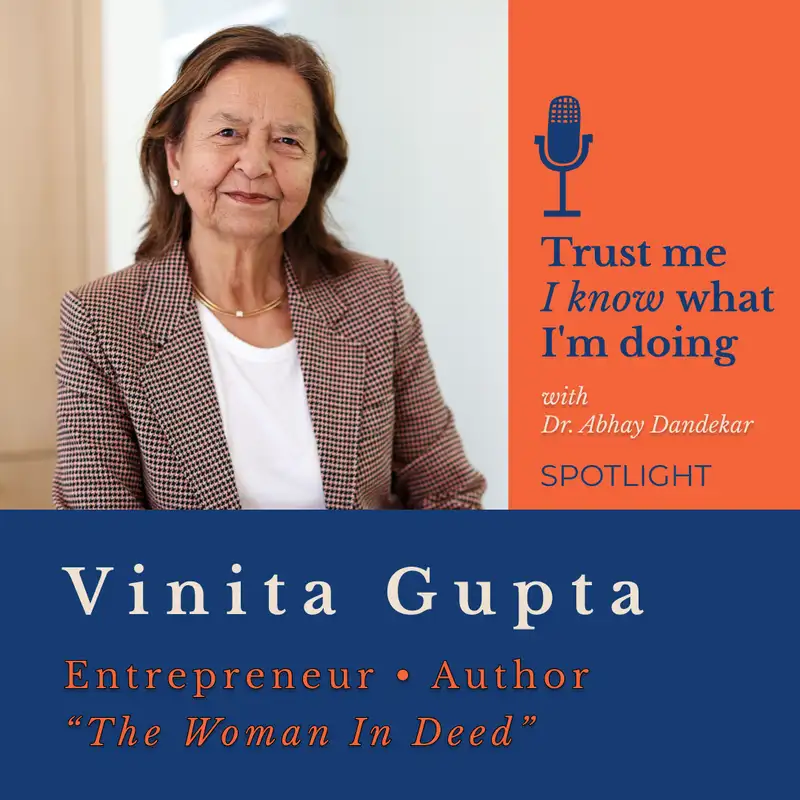
SPOTLIGHT on Vinita Gupta and "The Woman In Deed"
Download MP3Abhay (00:00.61)
Hey friends, this is Abhay Dandekar. Before we get started, don't forget to subscribe to Trust Me I Know What I'm Doing on YouTube, Amazon, Spotify, Apple, or wherever you listen or watch. That way you never miss our show celebrating the vibrant Indian and South Asian global experience. Thanks!
I am Vinita Gupta, an entrepreneur, a passionate bridge player, and now I am the author of my new memoir, The Woman in Deed. This is Trust Me, I Know What I Am Doing.
My name is Abhay Dandekar and I share conversations with talented and interesting individuals linked to the global Indian and South Asian community. It's informal and informative, adding insights to our evolving cultural expressions, where each person can proudly say, trust me, I know what I'm doing.
Well, periodically on Trust Me, I Know What I'm Doing, we share a spotlight conversation and feature brief chats with an individual from the community about a very special topic or a unique endeavor. Now, we live in an era where lessons and memory of the past seems to get crystallized and presented with increasing speed and accuracy. But perhaps now more than ever, it's equally important
to actually pause and reflect and synthesize and process our experiences as rich human lessons to share and express to the world. Vinita Gupta is a pioneering entrepreneur and technology leader who made history as the first woman of Indian origin to take a company public in the US. With over 40 years in Silicon Valley, she's a celebrated leader in engineering and innovation.
Abhay (01:51.062)
and a staunch advocate for women in tech. To add to that, Vinita is an internationally recognized bridge champion, an artist, and a writer. And she recently wrote about her multifaceted journey in her memoir, The Woman Indeed, Road to IPO, Bridge Tables, and Beyond, which is available everywhere. And I'm so pleased and honored to welcome her to Trust Me, I Know What I'm Doing. Vinita, it's so nice to share some time with you today.
Well, I look forward to this interaction and hope the audience will enjoy it.
Me too. I wanted to ask you, know, people write books and memoirs for many, different reasons, but why did you feel that writing and chronicling a little bit about your experiences was particularly so important now?
Okay, let me show the picture of the book. I want to reflect on the title of the book, because it has significance to answer the question. Sure. This is the copy of the book, which I published on September 20th, 2025. So it is recent publication. The fact that it says the woman indeed in the title is, I have been action oriented.
This is my story of what I have done. And I learned by doing things and making mistakes and accomplishing a lot of milestones in the external people's eyes, I would say. The reason for writing a book was not for any other purpose. It had to do with timing and it has to do with skills. This is my first.
Speaker 2 (03:40.77)
book. So I have, I'm not a born writer. In fact, I wasn't born anything, you know, you just learn through your experiences. And that is the main point I want to make. The woman in deed is by doing things. Skills wise, I've been writing blogs on first Huffington Post and or caught Huff Post and now on my own blog site.
every month. So it has been almost nine years since I've been writing and I don't miss a single month. And I say that because that's the way I built my writing muscles. Talking about skills, you just can't start writing a huge book without knowing how to write, even though I had a help in writing.
So.
Speaker 2 (04:37.698)
but still it's my journey and nobody else can describe it in an authentic way. So every word of this is edited, written, whatever by me. And then I was on a journey of doing things and they were very difficult things. Both my entrepreneurial journey, entrepreneurial journey first and then playing bridge, which is very gutsy sport.
It is a mental sport. So in doing that, it left in just learning how to do those things. It left no time in my schedule to think about writing. So these two things came together, not because I have stopped playing bridge. Bridge was a journey that I undertook after my chapter on running the company was over. the timing worked out. had stories to tell.
And how to tell those stories is the art of writing book. And I hope my readers would enjoy that. And so far, feedback has been positive.
You know, when you talk about the skills you developed, the tasks you've accomplished, the, you know, muscle memory you've built up of writing and even of, you know, repeating those skilled achievements over the years. Did you feel like the book was the natural next way to share that expression? Was this just the right timing to now share why and how?
you were able to develop those sets of muscle memories.
Speaker 2 (06:21.25)
was culmination. It wasn't a grand plan. I didn't do anything with a map or a grand plan. But I was intentional about everything that I wanted to do. It felt right time to do it when I thought about doing it. So it's not something that I was dreaming of doing for many years.
Did you find any, we always, especially when we're reflecting on achievements or reflecting on successes and even challenges that we've encountered along the way to get to those successful high points, did you unearth any blind spots? Were there any surprises that you discovered along, especially in writing the book that you hadn't necessarily unearthed before?
Absolutely good question. I like the question. From the point of view of I lost my partner and husband four years back and he was an entrepreneur. So this in this house, there were two aspirational people who had brought their individual aspirations and we had built a family together. Kids were young.
So when I started writing the book, because he's no more, I felt a little emotional, sentimental. That was a surprise to me. But what I felt was, you know, we were both argumentative Indians. We argued about everything in our lives and seldom agreed, but we listened to each other. That was our...
In summary, that was our relationship. And I think that made us one plus one equal more than two. So I think it helped us, but we were argumentative people. So I said, okay, I'm writing about him, but he's not there to defend it. And that didn't right thing to do. That was the biggest surprise.
Abhay (08:29.408)
Interesting. Do you think I mean, I never met him, but I'm sure that your family and friends who knew him, what do you think his reaction may be to the book?
Well, I think he would say, you just think what you think you don't check with other people. That would have been his reaction. Neither good nor bad.
I mean, it's interesting to see and of course celebrating his journey with you, hopefully it would have been spirited argumentative, but also in a very kind and listening way in reaction to reading the book.
I think it has a lot of embedded lessons for any long-term partnership or marriage. Because our journeys start differently when we get married and then things happen in life. We evolve, the other person evolves.
You know, you're someone who's had some pioneering experiences. You're the first woman of Indian origin to take a company public in the US. I'm just curious in reflecting in writing the book and of course, sharing some of those lessons. I'm curious if you remember what you were going through the day before the IPO.
Speaker 2 (09:42.794)
It probably was not a day before, but a month before the IPO. And we had what is called an all hands meeting in a conference room in my company. And they were investment bankers. We had two investment bankers who took us public. We had their lawyers, my lawyers, because it's a very legally oriented, regulated process, how you go public.
So we were all sitting there and suddenly I realized that I was really worth a lot, at least on paper. Something beyond my wildest dream. And that was a feeling of, I must be important. You know, and day before the IPO, just didn't, it was a moment. And yes, I knew it was an achievement.
But it wasn't something which stuck in my mind because in those days, this was 1994, in those days, was no ringing of the bell. CEOs didn't go on the stock exchange and there were no feeds from there to the employees. So we came to work, elated, all of us, but it was the problems cloud you as soon as you walk in the work environment and the life takes over and...
it becomes normalized.
Yeah, yeah. I mean, I imagine that, you know, again, the fanfare is just different. And of course, the excitement and the energy and also the nervousness and anxieties that go along with that probably were transcending. But it is, I'm sure, nice to see or nice to feel what your at least worth is, especially among lawyers that are out there as well. When you think about that time in 1994,
Speaker 2 (11:35.427)
Yeah.
Abhay (11:41.298)
And then fast forward through all the ebbs and flows of the tech and entrepreneurial space over the years. What's maybe the secret to perhaps aging gracefully, especially as a leader and especially as a woman leader in Silicon Valley?
Let me give a little flavor for those people who may not realize how IPO changes your life as a leader of the company. You're first being measured every day by the stock price, which never used to happen before. you are being and employees walk in with their heads hanging low the day the stock goes down and elated the day stock goes up.
So as a CEO founder, I was getting evaluated and I could feel it, but I didn't dwell on it that, but the biggest thing is you are expected to meet your revenue and profitability projections every three months. And in a growing company that is almost next to impossible to do consistently. So one day you are going to not meet the expectation.
And the stock takes a plunge. That is the normal reaction of public markets. When the stock takes a plunge, the employees are unhappy and they start leaving the company because they think that is handwriting is on the wall. They don't know. They have been measuring themselves with the stock price. So they say, okay, let's go to a greener pasture. The effect of that is.
in an engineering driven company that you cannot deliver the new product on time. And then you make your customers. So you get into a vicious cycle going downward. And I cannot think of any CEO who has not experienced that sooner or later. It is all through these ups and downs of life that I matured and learned to listen to my instincts.
Abhay (13:48.024)
short.
Speaker 2 (13:59.062)
so that I had the confidence for doing that, but also ride the wave and get up when I fell. And that was the biggest learning. you can, yes, you can just crawl into a hole when things don't go well for you or it emboldens you. Put it very mildly. Makes you, it made me fearless.
It is a mixture of confidence happenings and figuring out this is not the way I want to live. One bad brick falls on your head and you're gone forever. So this is how I matured and I kept looking at the next step. What can I do which will excite me, energize me? So that is how my life has gone.
I've asked this to other leaders where you certainly are learning and growing with those ups and downs and those ebbs and flows. And particularly both, you sometimes feel very lonely in those positions, but of course you have a team and you have people that you're working with and also you're responsible for. When you think about how you have gracefully matured and how you've grown in those roles,
You know, how do you balance the drive and the ambition of capitalizing on success and looking to the future with also the importance of engaging in the present and feeling content in a way so that you harmonize both of those? Did you ever struggle with that part particularly?
The part which I resonated so well with me is focusing on the present. I think that is the key to moving forward. It's a key to not look back. And I have been playing for last 10 years, competitive bridge. And that is the lesson. In seven minutes, the hand is over. And basketball, just to give an analogy,
Speaker 2 (16:09.046)
You shoot a ball, either goes, it either goes in the hoop or doesn't go in the hoop. If you miss a ball and you keep thinking about, missed it because this happened. You know, that's not going to help the next shoot that you make. You have to be in the moment. It's called mindfulness in sports and it cannot be more true in the game of bridge. Play it. And in a tournament, I ended up playing 500 hands.
seven minutes each hand. So you have lots more on your mind to think about the techniques you have learned, how you can trip the opponents, how you can be your best, how can you nurture your partnership with your partner because it's a partnership game. It's like doubles tennis that you are playing. You know where who is positioned, what they are thinking and have complete
trust in each other. So there are so many things that I have learned through the game of bridge and it hasn't stopped learning. And I love competition. That's what energizes me. That's, and I knew that. And that's why I got hooked into playing bridge because okay, you want to thrash your opponents who are sitting a foot away from you. So that has been my life for last 10 years. It is more fierce. seems like
when I'm in bridge tournament that I'm in compact.
which is hopefully, you know, it's definitely the fierce and the combative nature is there. I wanted to ask you one thing, like you said, because I'm trying to connect the dots between the brick falling on your head as a CEO and as a leader in tech and also the fierce combativeness of playing bridge. Certainly success is one that we can navigate through and living in the moment, being mindful and present. And of course, the strategizing of bridge is there.
Abhay (18:07.074)
I'm so curious, what has Bridge and not only just navigating through the strategy of Bridge and the complexity of Bridge, but what has Bridge perhaps taught you about losing?
It is, don't fight yesterday's wars. It is over. What is over is over. Look, get ready for the next hand and play the hand that you are dealt. Don't wish you had this or that or this. So I just think there is so much, if you want to learn, all of us, people teach you techniques and bridge. don't. Sure.
teach you life lessons, but over 10 years, given my background, given how I think, I think about strategies and learning lessons which are going to stay with me. Techniques, yes, you can forget the techniques, so what? If you made a mistake, so what? know, human minds are not perfect by any stretch of imagination.
Absolutely. No, and I love how you talk about that in focusing on, you know, rapidly moving on playing the next hand. Speaking of the next hand, you've been a mentor to many other leaders and particularly women in the tech and entrepreneurial ecosystems. I'm a big believer in this concept of reverse mentorship and the learnings that we often get from those that we're seeing.
step into the new roles of leadership and, and next on the ladder, so to speak. What, what are, what do you enjoy, about the mentorship experience, but particularly from the lens of learning from those who are newly entering these spaces, those you're mentoring, especially in the, in light of what you just mentioned, constantly growing and, learning from, you know, that next hand.
Speaker 2 (20:09.708)
Yeah, it's a very individual, the mentorship issue. I say that because I haven't spent huge amount of time mentoring anybody, but I do advise people if they call. And from my own experience, nobody needs to be dependent on somebody else. If you can be there for them when they
really are down there for them not to pick them up, but shared with them how to look at the situation. That is the most effective way of mentorship. But what do I get out of talking with people? I think we are social animals. can read, home is filled with books, which I read quite a bit. I usually end up reading New Yorker, at least for
few hours every week, but it comes with the speed of light at you. So there is a lot of reading, but talking to people gives you new thoughts, new ideas, new ways to think. So I think talking to people of all ages, young and old, your cohorts, next generation, or people who are going through some struggles is personal growth.
Yeah, I love, I love that because you know, we always talk about this concept, uh, particularly on this podcast, which is that conversation is the antidote to apathy. And, hopefully that's a spirit that, that we can all kind of tap into. I want to leave you with this one thing that I've always been fascinated by, especially with things, but people as well are those things that are both endearing and enduring. so I want to.
think a little bit about this in light of your book particularly, but what do you want readers of your book, entrepreneurs, leaders, particularly women, but for that matter, anyone, those folks in any of these arena, what do you want them to best understand about the endearing capacity of being vulnerable? And then of course, the enduring prospect of legacy.
Abhay (22:33.378)
And I'm just curious to hear what your thoughts are on both of those, being vulnerable and creating legacy.
So let me answer it a little bit slightly differently. I think being vulnerable, being authentic and walking the talk makes your journey more enduring because you are yourself. You have ability to think. If you're trying to work on yourself, how you are projecting yourself, I think that is
much harder. So I have found that it's not just good for me, it builds my confidence because now I'm depending upon how I approach the problem and how the receiver receives the information I'm delivering or the conversation that I'm delivering as a result. And you can tell whether they like it or they think that you are from outer space.
So that builds especially for women. think they don't experiment enough, go out enough to make a little out of the ordinary statements that they believe in, not something for sake of saying. If they believe in it and somebody says, what are you thinking about? Okay, fall in line, but you have to do it by doing. My whole life has been about
just doing and seeing what works, what doesn't work, how to test the boundaries of the society, of the rules that society lays on you. You know, there is no right or wrong definition, but you have to be edgy. You can't just walk in the middle of the line, middle of the road and hope to accomplish something extraordinary. So...
Speaker 2 (24:32.182)
I think that has worked out well for me. Doesn't mean that I haven't fallen down because of that, but you know, that's life. And I have, I get energized even by making mistakes, not big mistakes, but small mistakes. Okay, I learned something. How would you learn otherwise?
Do you do you often think about that idea of, you know, vulnerability as a great accelerator to that enduring legacy, but particularly from the lens of being edgy and taking risk in that way?
I have been often told that I make myself vulnerable and I have not quite internalized that word, what makes me vulnerable or act in a way that's vulnerable because I have nothing to hide. In the beginning, before we started this conversation, you asked me, there anything off limit? And I said, not a thing in the world.
You ask me any question, I'm going to give you a very straight answer. But that's easy for me over the years. You know, in the beginning, we all think, oh, I should not say this, or I should not have said this. OK, get those thoughts out of your mind. First of all, is don't fight yesterday's wars. It's over. You have said it. OK.
And if you learn something, it, in your personality and try not to do it again. But I don't, I don't know what it is to live without being vulnerable is probably the better answer to your question.
Abhay (26:18.348)
No, I really appreciate that. One final thought, because that particular ability to, like you said, you don't know what it's like to not be vulnerable in a way. Now in thinking about 2025 and beyond, for those leaders, and particularly women for that matter, who are entering this space, what do you feel most optimistic about? What makes you optimistic for women?
in the tech and entrepreneurial space, especially as new leaders.
get very energized by the fact how well women have done in the last 20, 30 years after me. That is, they're thought leaders. They're not just doers. They're not just CEOs of a company. So I think the potential is almost unlimited for them because they don't think that world owes anything to them.
So they work harder, they apply themselves harder and by large they have done very well. You know, there just, there is still a little stigma whether a woman should be the one taking the burden of the home or not, puts unreasonable burden on a woman at times. But I also say that expect more from your spouse and they will rise to the occasion. You know, don't think,
He probably never did anything in his own house or now I have to do this. That is a defeatist mindset.
Abhay (27:55.16)
Yeah, well, inspiring people to go against the grain and not think like a defeatist, really live with great purpose, sharing your own vulnerability, and on top of that, doing so many great things. Vinita, thank you so much for joining us. I hope people can pick up the memoir and really learn and grow with it. And I appreciate you so much for joining me today.
Thank you very much. I really enjoyed talking to you.
Thanks so much, Vinita. Please check out her book, The Woman Indeed, Road to IPO, Bridge Tables and Beyond, available everywhere. And you can learn more about Vanita's work at GuptaVenita.com. Big shout out to Indiaspora for sparking this one. To anyone who is sick of the six seven trend, (please). And to the American South Asian Network at AmericanSouthAsianNetwork.com. It's Thanksgiving week in the US, so if you can, find someone in need and consciously practice an act of kindness.
Until next time, I'm Abhay Dandekar.