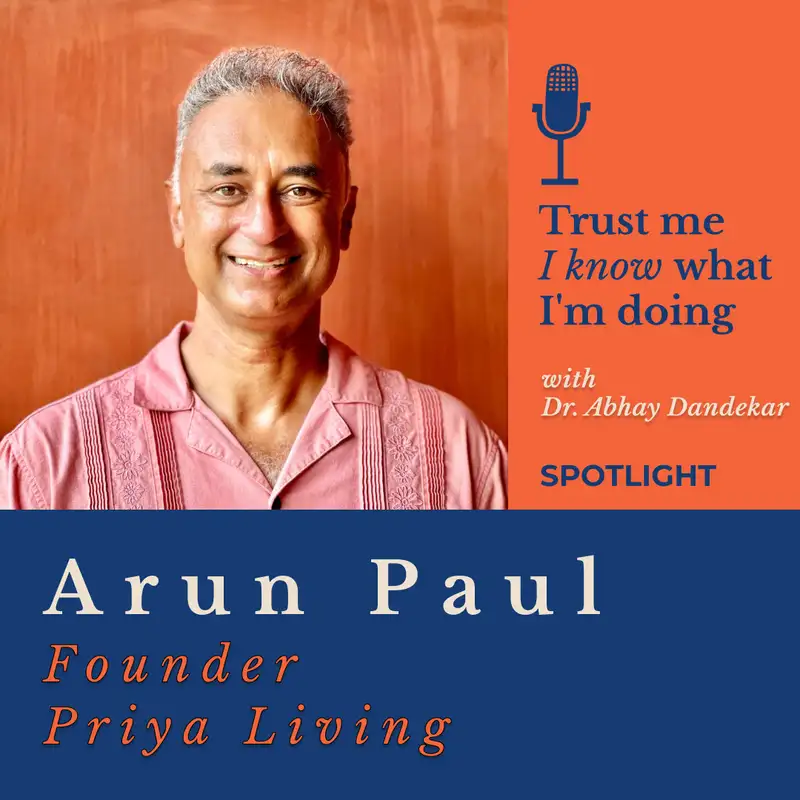
Arun Paul on Redefining Senior Living for the Diaspora
Download MP3Arun. Paul (00:00)
I come out of hospitality. I knew from the beginning, like the way we want to approach this was to create a place that didn't feel
At all, like
senior living, and we wanted to do it in a very different way with its own kind of personality. And
Abhay (00:14)
what do you think the
Indian diaspora particularly has to unlearn about itself when it comes to senior care, when it comes to intergenerational communities,
Arun. Paul (00:27)
one of the things this work has taught me is this third stage of life I do believe is when we're at our highest levels, peak powers, right? I mean,
you know, the great thing about that way of thinking is you you always believe that the best is ahead,
Hi, this is Arun Paul. I'm the founder and CEO of Priya Living. And this is Trust Me, I Know What I'm Doing.
Abhay (01:20)
thanks everyone for listening and watching, sharing with your family and friends, and don't forget to subscribe. TRUST ME I KNOW WHAT I'm DOING is brought to you by Travelopod.
For destinations like Africa, Japan, Antarctica, India, and the Northern Lights regions, start your journey with Travelopod. Visit vacation.travelopod.com.
Abhay (01:39)
welcome everybody to this episode of Trust Me, I Know What I'm Doing. You know, over the past 15 or 20 years or so, as we've been living at this intersection where the internet, the smartphone, and now AI, these are all eras that have been blossoming. And the connections between Desi and the diaspora have been growing increasingly deeper and closer, but also a lot more complex and potentially isolating.
I find myself asking some very important questions about gracefully aging without losing the foundations of human relationships around me. now many young people have never experienced a day without a WhatsApp chat or FaceTime with friends and family. And they do a pretty great job of integrating the digitalness pretty seamlessly into their worlds. And equally, many seniors who are living longer than ever.
Both love that instant access of technology and can appreciate the nostalgia and the intimacy of a more organic and readily accessible community and those bonds that are formed within those communities. Now, for those of us who are in that sandwich generation, finding ourselves at many crosswalks between home in India and being abroad, aging parents and our own children, and bridging cultural and communication gaps without really any blueprints or a playbook.
The challenges are certainly very real and evolving. And that's why I'm so grateful to share a conversation with my friend Arun Paul. Arun's a hospitality executive and is also the founder and CEO of Priya Living, an innovative company that's reimagining senior and intergenerational living to meet the very human needs of our communities. And for the past 13 years, he's had a front row seat to building around elder care, combating loneliness.
harmonizing cultural priorities and really connecting the dots from the diaspora to India. Arun, it's so great to chat with you and catch up. Thanks so much for joining me on Trust Me, I know what I'm doing.
Arun. Paul (03:43)
thanks for having me.
Abhay (03:45)
I don't completely know how I feel about having a Stanford guy on, but we'll get beyond that, I'm sure. But you know, the genesis of a lot of those intersections that I just talked about, and you know, many of the things that I think a lot of people in the diaspora and even at home being Desi are struggling with. starts with.
Trying to solve a problem. And I know for you, you were trying to look for housing to help with your own aging parents. I'm just curious, how did you even get to that step? Because for so many families that have lived in multi-generational households, just even the process of asking that question is pretty foreign. So, was there kind of a couple of pre-searching steps that needed to happen or
Maybe if you can just reflect on what it took to even get to that point of looking for housing solutions for your parents.
Arun. Paul (04:41)
Well, you know, for me it was I was an only child and you know, I think for me what that meant is if I didn't have that conversation, if I didn't do anything, nobody else would, right? I didn't I didn't have a sibling to talk with about this or or share my emotions or anything like that. So
I was going home to visit my parents, in that same house I grew up in in Southern California. I would go as often as I could and I as the years were going by I could see them aging. And so I started the conversation with them and you know, for me that conversation was I was living in San Francisco at the time. that conversation was, you know, Ma, Baba, I'd feel a lot more comfortable.
if you guys were closer.
Abhay (05:31)
Was there any ever talk about
them moving in with you at all or you relocating and moving in with them?
Arun. Paul (05:37)
No, it wasn't because well, part of it is, you know, I was living in the city of San Francisco and you know, we didn't we didn't we didn't have a big place. I mean, we didn't it wasn't you know, it wasn't one of these suburban homes with all these bedrooms and all that. I mean, we had a you know, pretty pretty small condo in San Francisco, right? So it just from a physical space standpoint.
It wasn't practical. And but you know what I
What I wanted to do like very early on is I did want them close by. I thought, you the solution would be I was gonna look for a duplex, buy a duplex in my neighborhood, as close as possible, to where we lived. And I was gonna have my parents move in with their best friends, right? So that was my
Abhay (06:27)
Mm.
Arun. Paul (06:28)
solution, if you will.
Abhay (06:31)
When when you think back to those first steps and that became the sort of viable option to have them close by And for a lot of families, you know, the the other alternative, of course, is for everyone to move in together and become this kind of multi-generational unit, which is so commonly the case.
at least or has been traditionally commonly the case in many, many households in India. there's obviously a seva, right, that's involved in kind of doing this and caring for your parents and and carrying that responsibility that you were just sharing in trying to make something you know happen for your parents and and build a solution here. But you know, it was making sure that they had a say in this, making sure that they
Or felt they they felt empowered by the process and kind of enabling them to thrive in a community. there's a little bit of a burden to make that shift of just even kind of giving up their autonomy and now you kind of engineering something for them. Or or for that matter, did they feel liberated by that in a sense? Did you feel liberated by that?
Arun. Paul (07:42)
Well I I certainly felt liberated. I I
For me the status quo just it was eating me up, because
I was scared, I was scared something might happen to my parents. I wasn't close by.
I don't I think I don't know if all kids feel this. I certainly did. One day, you know, you get a call and something's happened, right? And so that was a real fear I had and you know, I I did feel like them being closer that it did liberate me from from that.
Abhay (08:18)
Was it tough to get them to agree to this entire scheme?
Arun. Paul (08:22)
It was a process. It was a process. I mean, I think they could understand it was coming from a place of caring and love and but yeah, it it it didn't happen overnight. I mean, you know, I started this conversation with them and then, you know, they would come visit, the Bay Area and when they would come we would just
We would even look at senior living communities, right? they were they were open to exploring all of it. But I think both they and I realized like that's not gonna work for them with not with what was out there. so we we were just you know we were just looking at everything and it it took a few years, right? It wasn't
it wasn't something that happened overnight.
Abhay (09:07)
Right. There wasn't the magical aha moment that that just made it happen very smoothly, I'm sure. For a lot of people, that's a big process. I know that for a lot of seniors, a lot of families, they struggle with this idea where there are seniors who are living in, as you kind of mentioned, these large suburban areas that are pretty expansive, that don't have a whole lot of built-in.
naturally accessible community. There's not a terrific set of public transportation options. There isn't a walking culture. There aren't sort of local friendships that are now built in. And to top it off, their adult adult children are often working and their grandchildren are often at school. So they're sort of shackled in these, areas for for their days. When people
Are emigrating from India or from South Asia to, places that are quite common like this in in America. it can feel like it's a shock. So is this sort of the trap of trying to transpose an Indian style community into what is a very American reality?
Arun. Paul (10:16)
Yeah,
there's no question like the way the US
US lifestyles, American lifestyles are,
Much more private, much more individualistic, right? I mean American society is very individualistic. and that reflects in the way we have built communities, right? I mean, the suburban home, the desire for space, for separation, you from neighbors. And that has real consequences in terms of like human connection. I mean
You're just physically further apart, right, than the alternative. So yeah, I I felt that, I've I felt that for a long time. I mean, I cause obviously I'd go back to India, see what life was like, understand what my parents were used to, just people always being around, people walking in the front door unannounced, you know, like that serendipity.
is to me so important, right? I mean, I felt with my parents that that was as important as like water or air, right? I mean, it's
Abhay (11:18)
Mm.
Arun. Paul (11:19)
it's really like an essential fuel, so I could see that, you know, when we go back to India and I could see them in their element, it was just a whole different energy and
there is a huge difference, you know, and there's no question about it, you know. And I think I felt with my parents it was like fish out of water, right? I mean,
Abhay (11:39)
Mm.
Arun. Paul (11:40)
it's you know, it's it's it's it's a real issue, real problem.
Abhay (11:43)
because you spend
now a lot of time in India, do it's not lost on me that some of the same trappings that I just mentioned are becoming more and more prevalent, even in in some of India's neighborhoods where, you know, that serendipity and that sort of those social connections are are becoming more fragmented and a little bit more difficult to find as well. I mean,
I I'd imagine that there are misconceptions and this ideal nostalgia of what that was like for many people who have immigrated, but the current reality sometimes is it's kind of getting more and more like that in India in some places too.
Arun. Paul (12:24)
Yeah, for sure, for sure. times have changed. I mean people are very focused on careers, just like in the US.
labor mobility is a big thing, right? I mean, younger people are moving across India, across the world for professional advancement, right? I mean, they want to realize their dreams professionally.
And I think technology, right? you know, technology is a global thing. It's not just about the US.
I I would call myself a techno optimist and someone who believes that technology is a force for good, but when it comes to human connection it has actually made us feel more alone, right? I mean we
when we're talking about loneliness, people are are are saying they feel more lonely than ever, right? And and it's young people and old people,
the eighteen to twenty five
age group is from what I understand is actually reporting the highest rates of loneliness. And I do think technology has a lot to do with that because we've you know the in person physical interactions, so many of them have moved online.
Abhay (13:34)
I wonder with that, right? That, you know, again, you we talk about the kind of individualistic attitudes of many American communities and how that potentially, especially with both economic advancement, technological inva advancement, people much more reliant on single driver cars and you
Get to these kind of bedroom communities in India just as much as are very, very prevalent in the United States with that background and like thinking a lot about your own parents' process and how you went through that, how they went through that. when you were now engaging in this whole idea of Priya Living what do you think kind of was the problem statement?
That you were trying to solve? Or was there kind of a simple mission that you were embarking on, or even a north star of some of these ideas? When now you found building communities through Priya Living has there been some kind of guiding principle or playbook or north star or mission statement here that that's really been at the kind of core?
of what you've been working on.
Arun. Paul (14:52)
Well,
look, at the beginning, I mean, this was really about trying to solve like a a very personal problem. Like I was I was thinking about myself and my parents and
Priya Living was accidental. I mean, I didn't at the very beginning think of this as something bigger.
I was headed down the path I described, earlier, which is I was gonna buy a duplex in my neighborhood. and and my mom starts talking to her friends and her best friend who was also gonna move into this duplex, it was gonna be two couples. her best friend starts talking to her friends. And then all of a sudden I start getting phone calls from aunties,
They would call and it was like a game of telephone, so somehow the story had changed. And the story that had gone out was there was this guy in San Francisco who was thinking about opening a community for Desis
right? And so they would call, I would get calls from aunties and they were so excited about this. They were like, my name is Champa Auntie. We've never met, but I'm your mom's cousin's best friend from college.
I heard you're doing something there, like a community, like how big is it? When's it opening? How many, you know, units do you have?
God bless you, Beta. Right? Like mean that
Abhay (16:12)
Yeah, yeah.
Arun. Paul (16:14)
for me was like when it all
changed right and I was like know getting those calls from aunties who I didn't know I mean literally from different cities right this is Atlanta Chicago Philadelphia
Abhay (16:30)
Sure.
Arun. Paul (16:31)
I would get calls and so I mean for me that was where I like really
thought of this as something I should
Abhay (16:43)
Yeah.
Arun. Paul (16:41)
I should do, you know.
you know, for us a North Star to the North Star question, you know, it's it's you know, it's about human connection,
I think I felt with my parents that that was something that was missing, in their lives. Like the
Abhay (16:54)
Mm.
Arun. Paul (16:54)
the level of human connection that they needed, right?
And sure, my mom was on the phone all day, but you know, thing is like whether it's a phone, whether it's you know, WhatsApp, whether it's FaceTime, whether it's whatever it is, it's not it's not in person. And so for us it's that's a North Star is human connection, like real human connection, 3D
i in the flesh, that kind of thing, right?
Abhay (17:21)
Yeah. Very human, very real, very physical. and I think that, you know, from from its what it sounds like, getting messages and texts and calls from aunties and uncles, across America sounds like there was an actual real like hunger and thirst and yearning for something like that from people who were peers of your parents.
Abhay (18:19)
Hi friends, this episode of Trust Me, I know what I'm doing is brought to you by Lotus Lane Coffee, a South Asian woman owned coffee brand that's roasted in Columbus, Ohio.
Every small batch bag begins on farms across India and ends in your cup with depth, intention, and story.
Lotus Lane Coffee, rooted in India, roasted in Columbus. Discover the beans, the mission, and the journey at lotuslanecoffee.com.
Abhay (18:45)
When you
Got that aha moment, and it seemed a little bit more tangible about building something. Was there a physical or cultural or sort of sociologic design principle that kind needed to be the bedrock for this? I mean, when we think about kind of buildings and communities in India.
there is a kind of organic nature to how communal it feels. But did you have to keep that kind of spatial or physical sensibility? I mean, did that immediately come to mind or is that something that had to sort of like take shape and evolve as you, as you kind of built this out?
Arun. Paul (19:29)
Yeah,
no, it it it did come immediately to mind that you know this was all about public spaces, right? It was all about common areas, right? It was was less about private home and the residence and more about the space that everyone shared collectively, right? And so in our first community in Santa Clara.
it's arranged around a central courtyard,
you know, all the apartments, you know, are around a central courtyard. So you can like look out your window, you could like see everyone, see see who's hanging out in the courtyard. People can call across, you know, you can just open your window and like call across to someone. that was something, you know
we wanted to do with that and and everyone since it's it's it's really about creating space for people to
hang out, connect, all of that stuff, right?
Abhay (20:26)
You you spent a lot of time as a hospitality executive and really sort of developed some great muscle memory in thinking about that. How how'd you connect the dots maybe from that experience in you know hospitality and hotels and kind of that living to more of a residential communal space, connection space? was there sort of was that an easy leap to make?
Was there obviously some lessons from that space to now trying to build something like this?
Arun. Paul (20:59)
Well, I was I was in the resort industry. that was my prior experience. and yeah, there's a lot of things I could apply to this. but you know what's interesting, you know, in in in I mean in resorts it's about privacy, right? I mean it's it's people
want to be left alone, right? You don't you're
not
it's it's not about connecting with your neighbor. but you know, you also have amazing common spaces, right? And so it did help me quite a bit. I mean, it was a lot of what we did with Priya was,
it it was based on things I had learned, but we just applied it differently. and I knew we we wanted to do something that was that was different than what I had done before.
Abhay (21:51)
Yeah. y you've built Priya in Northern California, in Guru Gram, in Hyderabad, and I know, more to come in Gujarat as well. When people learn about it or when they actually visit and they think about this concept, and there's more aunties and uncles and families who are interested in this. What are most people surprised by when they learn about Priya?
and the work you're doing, but particularly that makes it more unique than what the kind of traditional institution of senior living is like in the United States or or what people imagine senior living to be like in India.
Arun. Paul (22:31)
Mm-hmm.
Well, I think it's exactly that that I think what's surprising for folks is it doesn't feel like senior living at all. Like you, you, you walk in and you know, I think people are somewhat some level confused. They're like, I thought this was an old age home, right? But I come out of hospitality. I knew from the beginning, like the way we want to approach this was to create a place that didn't feel
At all, like
senior living, and we wanted to do it in a very different way with its own kind of personality. And mean there were a lot of reasons for that.
I mean one of the most important reasons was we wanted this appeal to y to young people, right? I mean we wanted
Abhay (23:13)
Mm.
Arun. Paul (23:13)
a place that spoke to young and old because we knew that, we wanted the kids to
be excited about this, right? and I think at the time we were doing this, you know, I would say either it hadn't been done or it was, very early. And there were a lot of questions about, you know, how ready are Indians for a concept like this. and so the approach was, let's let's create a place where the kids
are excited, they're happy, they're proud, they wanna come visit, the grandkids wanna come visit. So the whole place had to feel like something that appealed to multiple generations, you know, I think it presents itself much more like a boutique, you know, hotel or even a boutique resort than, senior living, old age home.
And we don't call ourselves a senior living company, you know, I mean that's very intentional.
Abhay (24:08)
Yeah.
Arun. Paul (24:09)
You know, we we call it hospitality for the third stage of life, and so our identity is a hospitality company, but with a very clear, focus and mission.
Abhay (24:20)
How do you think, as families think about this, right? And when they are either giving you feedback or you're learning from the seniors and the families who are visiting, but the particularly the seniors who are living there,
Does the iterative kind of improvement and growth as you learn in stages, right? you've been doing this for 13, 14 years now. So how how is that feedback loop helped to strengthen the relationships and even the experience for that matter?
Arun. Paul (24:51)
Well, yeah, it's all the time. we're we're always, you know, learning, getting better. I mean, one of the biggest things, you know, the fact that came to India was driven by feedback, feedback from the people we serve, when we started that wasn't something we were thinking about. We weren't
Thinking
about India, but people we started to get the question from residents, you know, are you planning anything in India? And we said, no. but why do you ask? And what we heard from people was this desire from the diaspora to stay connected to India, to deepen that connection. I mean, I think.
There are people, you know, who are thinking about moving back, but I think much a much bigger segment is people who want the best of both worlds, right? I mean, and we were hearing a lot of that, like, you know, I want to spend six months in the US, six months in India, or eight months in the US, four months in India, whatever, whatever that combination is.
Abhay (25:52)
Sort of the snowbird mentality.
Arun. Paul (25:54)
right, right. And so that that for us was based that was feedback, right? that wasn't it was one hundred percent feedback. It wasn't something we had, you know, it wasn't part of our master strategy. We had no no plans for it. So so that's probably the biggest example of getting feedback and
Abhay (26:14)
Changing direction.
Arun. Paul (26:14)
You know right, right.
Abhay (26:17)
Yeah. you said you're not a senior living company, you're not an elder care company. And certainly, you know, the not just the optics, but the tangibility of being a hospitality company for that third phase of life and gearing it towards families and visitors and making sure that there is a a boutiqueiness to it, if you will.
How do you think the work that you've done has changed the qualities of time and relationship building for Indian families who are experiencing this now? Because, for families visiting, whether they are, you know, coming across the oceans to visit or whether they're visiting in the same city, there is a quality of sort of dipping in and you know making a visit. And for seniors,
who are living there? it can oftentimes feel like it's a small fraction of the rest of their day or the rest of their week or the rest of their month. So how has this kind of environment that you've created, this community that you've created, perhaps changed that concept of cultivating relationships, strengthening relationships, what the quality and impact of time is?
for busy families who are, struggling with how they can actually spend their time thoughtfully and wisely.
Arun. Paul (27:42)
So, you know, what's interesting is, you know, when my parents moved in, so they they were one of, you know, our first residents.
for my whole life when I called my parents, they would pick up the phone, right? that's all I could remember. And they're always there or, very reliably there. And all of a sudden they moved in and I would call and I'll get no response, right? I leave a voicemail, you know, and then
Maybe they call me back the next day, sometimes maybe not even then, right? And I remember
Abhay (28:15)
Maybe not, right.
Arun. Paul (28:17)
yeah, I I remember all of a sudden it totally changed, the dynamic and in a in in a really unexpected, but then ultimately like super positive way. Because, you know, of course now as a kid, I was like, wait a second, my first reaction was, wait a second, like I
Abhay (28:34)
What's going on?
Arun. Paul (28:35)
yeah, yeah, like what about me? Right. But
Abhay (28:37)
Right.
Arun. Paul (28:38)
but then it just hit me I was so happy to see that, they they they had a life. They were so excited. When we did finally get on the phone, they would tell me fill me in on all this stuff that had happened. And and in that sense, yeah, it like totally for me it like strengthened my relationship with them. And it wasn't about the time,
How many calls a week I would get with them, or how many visits a week I would do, or how many hours I was there. it wasn't about anything like that, right? It was just they had a life that was very fulfilling for them, that they were having fun, you
They were growing, right? They they they were
Abhay (29:16)
Mm.
Arun. Paul (29:16)
growing. And and I I as a son, I I start to realize it, I'm like, wow, this is this is cool. And okay, so maybe they won't pick up my call. But you know, I I felt really good about it. And one of the things I'll I'll never forget, you know, one of the
One of the daughters, you of one of our residents one once said to me, It's like, thank you for for giving giving my mom a second childhood, right?
Abhay (29:42)
Mm.
Arun. Paul (29:43)
And and I think that's that's how I felt it as a son, too, right? And and so I think it changes so much, you know. I mean
and in in unexpected ways, right? I mean I I never expected any of that.
Abhay (29:56)
and there are so many different ways to do this, right? there are the importance of connection, the importance of community, whether it's through Priya Living or or something else, know finding the joy in having that kind of rediscovery or a second childhood, or particularly having strong.
Community and social relationships that are available for families, but particularly for seniors, how do you prevent these ecosystems, particularly centered around seniors, from being these areas of confinement, from being these zones where they're they're void of like real palpable human connection and relationship development?
Or or even that the feeling of being unempowered and that you're you're dependent. and sometimes even that these, you know, places feel like they're sort of living aquariums where, you know, just it doesn't feel like it's it's real or that you can be a part of it, but that you're observing and it's it's got its own interesting psychology and sociology, but it doesn't feel like you necessarily want to be a part of it.
Arun. Paul (31:12)
Well,
I think one of the things that's really important, and and
One of the things that, we've done is these communities are multi-generational, right? So it's not just old people in the aquarium, right? I mean, we have young people too that have been drawn in that really like
this version of community living. I mean, for us the older adult, the auntie and uncle, I mean, they're always the hero of our story. But, mean soon after we opened we had young Indians coming and they would ask us, like, can can we live here? You know, and and we said, sure, why not? And
I think what we found it it can be a really beautiful thing. you know, the young people that that come, they self-select in, they're actually they're the ones saying, like, I I value this, I value being around elders. I don't wanna just be around a bunch of young people, right? I wanna be in the deep ed deep end of the pool, right? Not the shallow end.
Abhay (32:08)
Right. And I heard I heard
that that that you know there are particularly for those 20 or 30 somethings who have just emigrated to the United States, like there in fact was a real thirst and hunger to be a part of a community that had a lot of seniors. And whether that is kind of a a balm for the homesickness piece or it's just actually a really important
Arun. Paul (32:32)
Yeah.
Abhay (32:33)
component of of being able to not only just integrate, but
find that concept of home.
Arun. Paul (32:40)
Yeah, I think I think homesickness definitely you know was part of it and you know you had young people far away from their parents. and finding these communities where, you know, they would be adopted, in some sense by a bunch of aunties and uncles. And you know, we've had babies born at our communities and it's like a beautiful thing
Abhay (33:00)
Mm.
Arun. Paul (33:00)
because the babies are born and then, you know, they grow up.
around all these aunties and uncles. so I think that's an im you know to be back to your question about how do you keep it from just feeling like an aquarium, right? I mean, that's that's that's how we've done it is to create a place that, young people want to be too. And it's not just about age, you know, and and that it feels
much more integrated and so that's been our approach.
Abhay (33:30)
I wanted to ask you for you personally. I mean, what do you think this work has taught you about the notion of loneliness in 2026? Especially hearing some of these really just I mean, spotlight and highlight stories of people who have been thriving, and yet there's a
a huge epidemic of loneliness in 2026. So, we have the the contrast of what your experience is. And I'm imagining that there are some who may be in one of the real living communities who still are lonely. What do you think is you know kind of the I wouldn't say the solution, but what are what are some of the learnings that that you've discovered particularly about loneliness and doing this work?
Arun. Paul (34:17)
Well,
I think it's a great challenge and and you know, a lot of the things since we've started that we've learned is is is the science behind loneliness and its impact on our health, I think over the last decade there's been so much research on this that
what the feeling of being disconnected does to us, on a physiological level, right? And so that's been a huge learning is that it's actually a much bigger issue. And it's a it's actually a public health issue, right? I mean this is like a public health emergency. and when you look at longevity,
social connection is arguably like the number one driver of longevity. So I think what's changed is we've just begun to realize that this is actually a much, much bigger issue than we thought, I mean for most of my life I thought if you're lonely you're lonely I mean okay that's sad. But you know now
It's it's something that's it's a serious issue, right? It's a very serious issue. So,
Abhay (35:24)
Yeah. Maybe there's an urgency, there's a priority to it that
particularly resonates a lot, especially in the with what you do.
Arun. Paul (35:32)
Yeah, yeah. But you know, look, I I think there's so many levels to it. I mean, creating opportunities for us to really connect, you know, with humans, other humans, and not just be in the same room, not just be physically close, right? Because we all know what's happening there too is
this is about being present. It's about, being mindful. It's about not being distracted. Right. And this is people are like, we all know this, you know, I've I've got two girls at home. And it is a big challenge, right? And and technology, the distraction. so but I think this is something that's that's
y you know, when I look at our residents and the people we serve, you know, they have so much to teach us about this, right? I mean, they're the ones that can
Abhay (36:19)
Mm.
Arun. Paul (36:19)
be present and like one hundred percent present,
I saw some research the other day that just blew my mind. You know, we're speaking
thirty percent fewer words per day than we
Abhay (36:32)
Yeah.
Arun. Paul (36:33)
did twenty years ago, right? Like
Abhay (36:35)
Yeah,
Arun. Paul (36:36)
because our verbal communication has just been displaced by we used to like call someone to get a plane ticket, right? And
we would never do that anymore, right? And but all these
Abhay (36:47)
Yeah.
Arun. Paul (36:47)
little interactions, right? I mean, it makes us human,
Abhay (36:51)
that is mind blowing, right? it's staggering to think about how few interactions. not only is it the loneliness piece that we need to prioritize and and have some urgency around, but it's, you know, the actual like doing things that are incredibly human and they are the sort of foundation of how we communicate with each other and just even verbalizing and speaking and
ensuring that there are conversations that are going on. that's equally a big, you know, sort of vehicle for ensuring that we we stay less lonely.
Abhay (37:26)
Hi, I'm Abhay Dandekar and if you have an animal in your life that you love, then I want to introduce you to the Timber Dog Ruff Rest, the only dog bed you'll ever need. compact and light with over 14 travel features, comes in three sizes and has everything from storage for essentials to a built-in sleeping bag. The New York Times Wirecutter calls it a versatile portable dog bed with lots of extras for traveling or camping. Go to timberdog.com to explore Ruffrest
the only dog bed you'll ever need.
Abhay (37:56)
your work is one that kind of transcends the you know homeland and the diaspora pretty, pretty well. And I wanted to, I mean it's impossible to generalize, but I wanted to ask you, what do you think the
Indian diaspora particularly has to unlearn about itself when it comes to senior care, when it comes to intergenerational communities,
and of course to preserve some of that.
Arun. Paul (38:27)
Well,
I think for a long time there was one way of doing it, right?
generations, there was an approach and you know things have changed, right? I mean, the world changes and you know we we need to change too, right? And and for the South Asian context, right? I mean that that was the joint family
I yeah, yeah, of course, of course.
Abhay (38:49)
And by the way, that that still works for many, right?
Arun. Paul (38:53)
But what I would present though is
I think I think what I've what I've come to realize is
Growth comes from our peers, right? I mean, we send our kids to school because we know that they're being around other kids is good for their development, and that's where they're gonna learn and grow and thrive, right? Sure, we could homeschool them, and some people do, but the reason we you know.
The vast majority of people don't do that is because we know that there's huge benefits for kids to be at school around other kids.
This goes through our lifetimes, right? I mean, when we're adults, you know, we we go to the workplace, we go to the office, whatever, whatever form it takes, you know, the value of that is not just money, it's it's it's growth. It's it's and that's that's happening because we're solving problems with our colleagues and the teamwork, camaraderie, all that stuff, right?
Abhay (39:52)
Mm.
Arun. Paul (39:52)
And so that's why, you know, when you hit this third stage.
we don't have institutions that enable us to do that in the same way. And and I think that's what I would present is, this is about growth and having opportunities for growth throughout life, right? Because otherwise,
think I think when you lose that sense that you're growing is when
Abhay (40:13)
Hey, you really hit the wall then.
Arun. Paul (40:14)
yeah, yeah. So
So that's that's where I think,
Abhay (40:18)
Yeah.
Arun. Paul (40:19)
there's opportunity to rethink, the way that we've
we've done it.
Abhay (40:24)
when you compare your particular stage of thinking today to when you were first starting out, and acknowledging that there is this kind of tension between privacy and community and the way that people design their lives in a way, right? I mean, you mentioned the kind of physical design of
One of the pre-a living centers being built around a courtyard. And so it, you know, the sense of community is always right in front of you. And how do you think this concept of home has evolved for you in thinking about like what home means, especially, you know, with the importance of some privacy and autonomy and independence, coupled with the incredible value.
from a health standpoint, from a mental hygiene standpoint of community and ensuring that there is openness for conversation and physical connection and friendships and relationships to kind of blossom? I mean, how how is your concept in thinking about this both as an entrepreneur, but also, you know, as as a son? how is that concept of home maybe changed, especially thinking about
kind of privacy and and community at the same time.
Arun. Paul (41:48)
I
think home home can be so many things and
I think, for people that come to our communities, I mean,
they are putting a value on, you know, the human connection and that's that's really the
the emphasis, but but you know, of course people all over the world live live in very different ways so and and their home takes very different formats.
I think for me, you is was interesting is after starting Priya Living I started to realize how my life was not like that. Right. like in a in a way I was thinking, wow, you know, I mean I'm actually not connected in this way in my own life, right? Like, I mean
Abhay (42:25)
Mm. Yeah.
Arun. Paul (42:26)
And this was even though I was living in an urban area in San Francisco, lots of people around, but I didn't have that connection, the that that level of connection that I saw, you know, our residents having and and so
Abhay (42:42)
Kind eye opening.
Arun. Paul (42:43)
Yeah, yeah, for sure, for sure. I
Abhay (42:45)
It's clearly not a stagnant thing. It's clearly something that's dynamic and evolving. But sounds like because it takes so many shapes and forms that for you it's it's one that's you know opened your eyes to, maybe what the possibility and potential is, especially from learning from the people you serve and and the residents as well. let me get you out of here on this one and and that is.
and thinking first off, the word Priya itself, right? one of the meanings is love. And when you think of it that way, where you are building this really intangible feeling among residents to have that sense of home and community and and connection and conversation and and it can happen through so many different methods, but
In thinking of this work that you're leading, both in the US and in India, what cultivates trust among the people you meet who are exploring these options and considering situations And, when you think about the trust that's required to
engage in a situation like this or the trust that you have to cultivate in others around you as a leader in this sort of space, what are sort of the factors that that cultivate that trust? And for that matter, how does that make you feel as far as being optimistic about the future?
Arun. Paul (44:16)
Well,
I think
trust
It's a big deal, obviously, when it comes to like what we do and this is a decision that can take a long time, right? I mean and over that whole time you have to like build build the trust. you know, in many cases it takes years, right, for people to
become comfortable with this. I mean it took me years with my parents, right? It's not a and that is all about trust, right? And so,
I think hopefully by now, you know, it's it's it's that people, can see what we've done and and spoke and you know, know people that have either been residents or families over the years.
but you know as far as hope for the future, yeah, I mean
one of the things this work has taught me is that this third stage of life I do believe is when we're at our highest levels, right? I mean peak powers, right? I mean,
And so, you know, the great thing about that way of thinking is you you always believe that the best is ahead, right?
And and I do one hundred percent. I mean I've I've I've come to realize like, society may not think so, but I I I don't think there's any question that,
The older we get, the more powerful we become. and so That's that's hope hope for all of us, right?
Abhay (45:45)
Well, helping people to develop their superpowers in that third stage. And on top of that, cultivating lots of trust and more than anything else being very hopeful and optimistic, so that we can solve some of these very, very challenging issues all over for many generations. I know people are appreciating all of it. Arun, thank you so much for
sharing a conversation. This was really a treat and wish you nothing but the best.
Arun. Paul (46:11)
thank you for inviting me and having me on the show. I really appreciate it.
Abhay (46:17)
Hey thanks Arun and please check out more at PriyaLiving.com Please don't forget to subscribe and thank you so much for listening and watching and sharing this with your family and friends. And remember, conversation is truly the antidote for apathy. Till next time, I'm Abhay Dandekar