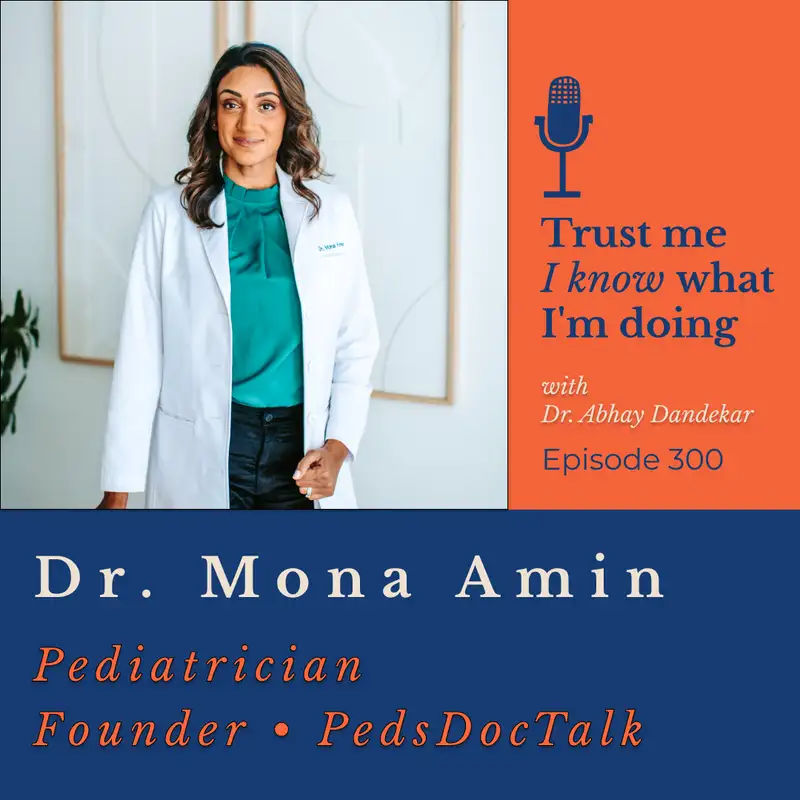
Dr. Mona Amin on Connection and Control : A Pediatrician's Guide to Parenting
Download MP3Mona Amin (00:00)
every one of us needs that connection. And I think when we start parenting,
We tend to get into that, well, my kid needs to listen to me and I need to be in control. And we forget that in order for your child to listen to you, they need to feel that you're listening to them. And that part is connection, right?
Abhay (00:17)
is there a formula to finding ways to build that narrative, that story, so that you can effectively
combat that misinformation,
Mona Amin (00:27)
We have this toxic positivity that I can't share anything negative, bad. And then we have this woe is me, my life is horrible, nothing goes right. And it's the middle, right? We have to meet in the middle, and that is what I am. I I call myself an uplifting realist, meaning I know that this isn't easy. I know that being a pediatrician, having a business, being a mom is not easy, but what I do see are those glimmers.
Hi, I'm Dr. Mona Amin, board certified pediatrician, founder of PEDS Doc Talk and the award winning the PEDS Doc Talk podcast. And you're listening to TRUST ME I KNOW WHAT I'm DOING.
Abhay (01:28)
thanks everyone for listening and watching, sharing with your family and friends, and don't forget to subscribe. TRUST ME I KNOW WHAT I'm DOING is brought to you by Travelopod.
For destinations like Africa, Japan, Antarctica, India, and the Northern Lights regions, start your journey with Travelopod. Visit vacation.travelopod.com.
Abhay (01:48)
welcome everyone to this episode of TRUST ME I KNOW WHAT I'm DOING. I have to really sort of say that it's no secret that parenting is an equally joyful and challenging lane to live in. Maybe the greatest reward for me of parenting has been.
Embracing the vulnerability and humility of nurturing another growing human into an entrusted and self-determined adult. Now, for me as a pediatrician, the physical and mental gymnastics of balancing and integrating the knowledge of disease and prevention, and of course the day-to-day practicalities of parenting is an added layer that can be equally daunting yet very liberating too. And taking ownership and control and finding connection.
are all at the heart of it. And it's why I'm so delighted to be joined by
a fellow pediatrician and a fellow parent in Dr. Mona Amin, a board certified pediatrician and a lactation consultant who's been serving children and helping families navigate it all.
Her Peds Doc Talk platform through podcasts and educational videos and blog posts.
Have been informing and supporting countless families by bringing clarity and comfort among so much noise that's out there. Mona, it's so nice to have you on. TRUST ME I KNOW WHAT I'm DOING. Glitches and all at least. but it's terrific to have you here.
Mona Amin (03:05)
I'm so happy to be here and I know we've tried to schedule this. I always, you know, as a fellow podcaster, I know, you know, the schedule woes and all of that. I am so excited to chat with you. and I love the title of your show here, right? TRUST ME I KNOW WHAT I'm DOING. What a great, great segue to parenting because sometimes we just don't know what we're doing.
Abhay (03:23)
Yeah,
building trust and and finding that confidence, right? I've seen
Mona Amin (03:26)
Yeah.
Abhay (03:26)
you speak and write about like how perfect parenting is about control, but real parenting is about connection. I I thought maybe to just start out with you would reflect on that a little bit because the idea of what control brings to being a parent, and then also how do you build connection, both with your children, with other parents,
from the pediatrician lens, is there a dance that you are constantly you know, orchestrating between that sort of control and connection, or is the secret to just sort of harmonize the two together?
Mona Amin (04:00)
I think it's so important to remember why we may get into that point of control, right? many of us, just by temperament, by our own upbringings, may have this different level of need of control. I can tell you that I, for lack of a better term, was and am a recovering control freak. Like I like to be in control. I like to know what to expect. And a reminder: not all control is related to anxiety, but control and anxiety can live hand in hand. And I see it so much in my mothers that I talk to in my office.
They have anxiety and they're looking for control wherever they can because it gives them a sense of safety when that anxiety is feeling overconsuming. And I think as parents, we want the best for our children, right? We want to optimize their life, however that may look. And a lot of that optimization comes from social norms, comes from gender norms, comes from how we were raised, comes from societal expectations, when that doesn't necessarily mean it's the right thing.
For the child in front of you. And so when I talk about connection and control, we're human species. And the fact that we're human means that we rely on connection. Connection is the foundation of everything we do. Even someone who may say that are an introvert, right? That may not want to go out and and socialize, that introvert also needs human connection, whether it's through text, whether it's through a phone call, every one of us needs that connection. And I think when we start parenting,
We tend to get into that, well, my kid needs to listen to me and I need to be in control. They need to do what I say. Maybe that's how we were raised. And we forget that in order for your child to listen to you, they need to feel that you're listening to them. And that part is connection, right?
Like I think about when I'm trying to get my kid to do something, and it actually happened the other day. My son, I could sense that he was getting dysregulated. He was getting very overwhelmed and I had to set a limit.
And I was about to set a limit, but I knew that if he's already in this escalating mode, if I told him what to do, it would be met with, I'm not doing that, mom. So I added silliness. I added a little humor. I said, I tickled him a little bit. And I just said, Ryan's not going to want to eat his dinner and wash his hands. And I added that connection piece back in because we all feel regulated with connection. And so when you asked me about this control and connection, I will always lead.
on connection as the most valuable thing, because through that will become the ability to be a more agreeable limit setter. You know, when you have that connection piece, you're more likely to be able to leave your child. And I think of that with my peers, maybe with your partner and I see with my husband. If my husband comes into a room and a media is like, why didn't you do that last night? Why why
Abhay (06:44)
Mm.
Mona Amin (06:44)
are you doing this? versus, hey, good morning. I love you. how was your sleep? And then leading
Abhay (06:50)
Yeah.
Mona Amin (06:50)
with the ask.
Think about how
Abhay (06:52)
Yeah.
Mona Amin (06:52)
that makes us feel, and the same thing applies to our little kiddos.
Abhay (06:56)
I wonder, you know, with all of that kind of leading with connection, sort of, embracing that connection and of course all the other abilities for us to control then flow so much from that. You are speaking about this, of course, with the baseline background of the neuroscience and the
Mona Amin (07:14)
Mm.
Abhay (07:14)
pediatric lens on all of this. And it means that we often have to speak textbook and parent.
languages at the same time. And, for you, the when you mentioned this idea of bridging you know, the control and the connection and tickling or or having that sort of body language or that verbal you know, ability to make those connections, at least be in the beginning, especially with a young toddler or with any child or or teen for that matter. do you find yourself constantly having to code switch?
And in your head at least, between pediatrician and parent? Or is that harmony really the sweet spot that that we're
looking for?
Mona Amin (07:53)
Harmony is the sweet spot, and I find that that takes a lot of practice and it takes a lot of undoing of past
Abhay (07:59)
Mm.
Mona Amin (07:59)
belief systems and behaviors. And when you think about control, control in our brain is saying, What do I need my kid to do right now to agree with me or to behave? Right? We're again we're going back to those expectations we have of our child. What do I need to do to make my kid comply? Connection says, What does my kid need from me right now? And so when you look at both of those things, and I'm
I'm toggling with that any given moment. And it's not always a, it's not like a textbook, you, you check a box and you're like, okay, I'm doing this. It's so fluid in our brain.
Abhay (08:31)
It's very instinctive.
Mona Amin (08:32)
yeah, the more you do it, it becomes instinctive. And that's exactly what parenting is. And to that point, I always advise my parents, like, I love giving education. I think it's one of the most beautiful things about my platform. But in my education, I always remind parents that you're not gonna have an answer for every single situation you find in your parenting journey.
So it becomes that sort of what is my goal here? My goal is to stay connected with my kid, remember and remind them that I am their safe space, but also guide them on an important limit. So it doesn't mean that you back down because they're upset at you. And that's what a lot of parents can tend to do, right? the moment their kid gets upset with the limit, they can become permissive and say, okay, well, you know what? Fine, have one more TV show, fine,
have
Abhay (09:13)
Yeah.
Mona Amin (09:13)
more candy, or you know, go. It is about saying,
I love you so much. I care about you so much. That's the connection. I think I want the best for you. And part of that means I can't let you go sleep over at your friend's house today. But here are some other solutions we can do. And that's where the connection and collaborative approach comes in as the child gets older, right? It's it's I value you, your opinion, I am the limit setter, I am the controller, if you will, but I care about your beliefs and what your wants are. And let's see if we can come up with a solution that meets what I need for you and your well-being.
And also listens to what your needs are as a child.
Abhay (09:49)
Yeah. I I'm curious as as I listen to this, I'm thinking of, our training as pediatricians, as physicians, where we've gone through a a lot of rigorous mistake making and we've
Mona Amin (10:00)
Yeah.
Abhay (10:01)
learned. how is being a pediatrician sort of helped you to grapple with mistake making as a parent?
Mona Amin (10:09)
I am so grateful for this experience. And people often ask, did pe being a pediatrician make me a better mom, or did being a mom make me a better pediatrician? and I think being a mom has really opened my empathy bucket even more. My
Abhay (10:23)
Mm.
Mona Amin (10:24)
listening, my listening ability, my perspective ability. I think I always had that to some degree, but then I started to experience it so more because I knew the uniqueness of a child so much more. I saw it in front of my face with my two kids.
and that mistake making was part of it. And I think about actually a situation that happened right before a very traumatic delivery that I experienced. About three weeks before that traumatic delivery, and I've I've shared this story before, I had a parent come in that me and my colleagues all thought was were being dramatic. We thought that they were just coming in and we sort of gaslit this family, right? We were like, like they keep coming in. This the kid looks great, like I don't know what they're here for.
And we all started to do the same thing. And a few days later, that kid got really sick. And that is a mistake I made, right? A mistake in judgment call, a mistake in thinking that this child was, the family was being dramatic and gaslighting that family. And interestingly enough, when I delivered my son, I was gaslit. And I connected the two. You know, I didn't say that, this happened. I was gaslit, or I gaslit a family, and thus that's why I was gaslit myself, but I used it
Abhay (11:34)
Sure, sure.
Mona Amin (11:35)
as a
How could that family how must they have felt when someone who they're supposed to trust says that nothing's wrong when they're obviously coming in and screaming to you or craving for some sort of response to be happening here? And that is the mistakes that I keep learning from. And I did that before being a mom, but now so it really has opened my eyes to be like a more compassionate listener, a more compassionate understander of like, if a family is approaching me and genuinely concerned.
And I think that family is completely okay. I want to make sure that because of that mistake I made, right? What can I do to reassure that family? Does it mean more time with them? Does it mean re referring them? Labs. I will go that extra mile now because I don't want to make that same mistake. And so we all have to learn from our mistakes. And I think physicians sometimes forget to do that, right? They have an ego. I see it in my colleagues sometimes. They even if they make a mistake, they don't own up to it.
My own OB that made a mistake with me still to this day never owned up to the fact that they made a mistake and that I almost died in that situation. I think from the consumer side, the patient side, they want clinicians that just can admit that they're wrong, right? that you made a mistake, own up to the mistake, but it's the dismissal, it's the ego, all of that that not only doesn't help as a physician, but think about how that doesn't help as a parent, too, right? We make mistakes.
You're gonna yell, you're gonna say things you didn't mean, you're gonna wanna make a change in your decision. And that humility that comes with knowing that we're fallible is so powerful.
Abhay (13:09)
I love that. the idea of being vulnerable, the idea of humility, how do we translate that in the office, right? With conversation. And we, of course, build that currency of both confidence in ourselves, but also the idea that we're constantly learning. And on top of that, right, we're we're always trying to find ways to bridge our message with parents, with kids, with families,
Mona Amin (13:34)
Yeah.
Abhay (13:35)
and at the same time just iteratively grow from it.
For you, when you think about that, those conversations in the office really, really can be very powerful where you actually make that connection with the family, with a child, with a mom, with a parent. and and yet a lot of times these days, of course, we are living with trying to build that digital village. And so many parents are actually finding that comfort, that trust, that connection, as you mentioned, online. So i is it a different empathy?
To try and portray online as opposed to in the office, that you've had to cultivate and really share with families and with parents that kind of tool that you mentioned of making those connections through empathy, through understanding, through this sort of fallibility or vulnerability that we just talked about.
Mona Amin (14:24)
I think that empathy is so much easier to do face to face, right? you when you're in the room with someone and right now, me and you are talking virtually, and I imagine if you were sitting next to me, the empathy, the the energy, the body language is going to cultivate this even our conversation is amazing, but this even more like palpable energy. And I yeah.
Abhay (14:41)
Yeah, it's it's accelerating. It it's
sort of there's an additive like, you know, quantum that you get
there in person.
Mona Amin (14:46)
Yeah.
And I'm I'm have I have always been a personality that radiates energy and takes on energy of the people around me too. Like I I love being in the room with people, you know, and I I feel sincerity there. And so what I found is that when I was in person, now I'm completely telehealth. When I'm in person, a lot of that was easier to do for me, right? Because I'm able to have the eye contact, the the body language, maybe the pause before I put a hand on their shoulder, the seeing them sink into my hand and cry.
Maybe. In an online setting, we obviously lose that body language, the pausing, the eye contact, the sincerity. And what I found the difference that has really helped me online is storytelling through connection. I do a lot of storytelling on my podcast, in my, videos. I will always always talk about, here's what I'm feeling. And just by sharing my feeling brings that person into my world of like, okay, she gets it. Like she understands that this isn't just her talking down from
From as a pediatrician, that it is this level of connection before I can get them to understand the awareness and the tools that they need. And so that's what I've really found. And as a telehealth doctor, I do a combo of virtual visits, but also we do text-based visits. And what I do is I always send a photo of myself before I start talking to them. And I say, hi, like I do this, and I'm like, Hi, Dr. Mona here. We don't have to do that. But what I found is like, because when you're texting back and forth with a clinician,
You can lose tone, you can lose
Abhay (16:15)
Yeah.
Mona Amin (16:15)
that empathy, it can just sound like cold. And I, I try to bring that in. And I, if I'm finding that they're feeling disconnected, I will say, hey, would you like me to give you a call? if you're willing to, I can give you a phone call because we're allowed to do that, just so you can hear my voice. And I've done that because there's so much to the art of communication that is in person and by the by our voice that we're losing with tech.
Right. and although I love my platform, I think it can be this combo of saying, Okay, how can I create this empathy, this connection? And it's through storytelling, it's through just being my authentic self. And that's not hard to do because I'm generally a very empathetic person. I cry during kids' movies all the time. So I I feel big feelings. And so it comes very naturally to me. So it's been an easy process, I would feel.
Abhay (17:04)
Yeah, I I agree. it it's hard. We can't generate that Toy Story moment or Pixar moment every single time we're in there. And yet,
Mona Amin (17:08)
Yeah.
Abhay (17:11)
it's true, right? people understanding our visible emotions that we wear in our sleeves or the way that we actually utilize kind of a body language. how do we actually interact with children as opposed to just simply the proxy interactions with parents?
Abhay (17:59)
Hi friends, this episode of Trust Me, I know what I'm doing is brought to you by Lotus Lane Coffee, a South Asian woman owned coffee brand that's roasted in Columbus, Ohio.
Every small batch bag begins on farms across India and ends in your cup with depth, intention, and story.
Lotus Lane Coffee, rooted in India, roasted in Columbus. Discover the beans, the mission, and the journey at lotuslanecoffee.com.
Abhay (18:25)
you and I both are from Southern California, and of course.
Mona Amin (18:28)
Yeah.
Abhay (18:29)
right. And and you know, the the auntie and uncle culture of
Indian Americans is quite strong everywhere, but certainly in in Southern California. I I'm curious for for you, in our kind of general Indian American or South Asian American communities, there is this unspoken culture of parenting that oftentimes is not necessarily questioned. And in in many ways, we're we gain a lot of value from it because there's a lot of village.
making
at the same time. in in your experiences as a mom, as a pediatrician, as a professional who really helps build trust, both, you know, from those phone conversations and also online through the platform, but what have you potentially had to unlearn about yourself as an Indian American or a South Asian American in order to sort of find success in this platform?
Mona Amin (19:22)
I think this is a topic for a whole podcast because I have
Abhay (19:27)
Yeah.
Mona Amin (19:28)
deep dived with my husband on this in many occasions. My husband's also Indian American. He's Gujarati, like myself, the Western part of India. we were children of immigrants, as many of us are. I always like to start with that children of immigrant comments because I will never fault my parents for wanting the best of us, because that's what was security for them. But with that security came a lot of anxiety.
Meaning performance-related anxiety. I think many of us can agree to this. I know a lot of my peers, I've spoken to them. Our success, our value was very placed on outcome, right? The grades that we got, the performance, what people said about us. It was very external validation heavy and not a lot of internal validation. And as you get older, you know, you realize that you can lose your identity that way because you're constantly looking at, well, what what does my mom think? What does
My teacher think? What does my husband think? What does what do the the the people around my community think when you lose sight of yourself and what you want? And part of this journey by creating online and doing all of that was undoing a lot of that need for external validation. Very ironic because having a social platform is very externally validating. But
Abhay (20:38)
I was gonna say, quite based on that.
Mona Amin (20:40)
right, but what I you know, an example of what really had to force me to look at internal validation was when things weren't going well on my platform.
And I think, you know, I like to share this story because people can look at successful creators and I'm putting it in quotes, right? The people who get awards and have millions of followers and say, Wow, look at her. It's been so easy. But I like to remind people that there were many times where my no one was watching my videos. I would only get a few, few hundred views compared to the millions I'm getting now. And it was those moments that I had to learn to buckle down and say, Why are you doing this, Mona?
Are you doing it for the fact that you're getting alike or are you doing it because you truly believe that your words matter? And that is where it became very obvious that I care so deeply about children. I cared so deeply about how parents approach their children and feel comfortable parenting their children. So I think that was the big number one of learning internal validation more so than external. And then we have the perfectionism, right? I think many of us grew up with this perfectionism mindset, and that had a lot to do again with like,
you're so you look so pretty, all the things that you how you look, how you act, you're so be well behaved, anything that you did that was deemed perfection in the eye of a grown-up, right? You you could lose your authentic self. And I tell my husband that if I could go back, I love being a pediatrician, but I probably would have gone into theater. theater was something that I really enjoyed. But in an Indian immigrant household, they didn't look at that as a successful.
Career stabilizing field, right? they didn't feel like that was gonna lead to success because it's not a guaranteed field like being a doctor, a lawyer, business person, whatever it may be. And now it's funny that as a content creator, I am acting a little bit. I do skits, I do all of that. And it's just a nice way of saying, okay, I was able to do the, you know, the path that made sense for security, but now I'm getting to reclaim how I want to do that. And so that perfectionism, the control.
and then also just more self-love. You know, I lived with a lot of shame on mistakes. my parents would say, whenever I made a mistake, it would be a lot of big production of how could you do this? Why did you do this? And undoing that shame narrative that, like, I am a very awesome person. I can wear what I want, I can act like I want. I'm not disrespectful when I'm a little goofy and silly. And the most beautiful part of healing as a mother is now allowing my children to do the same.
they're they're six and three at the time of this recording. And I get to see them be their most silly, authentic selves without me trying to shut it down, right? Like there's a
Abhay (23:19)
Yeah. Yeah.
Mona Amin (23:20)
time and a place, yes. in school, they have to listen. at events, you know, there's certain criteria, but when we're at home, when they're in a restaurant and there's no one around, let them dance, let them be themselves, let your kids and yourself be a little weird. Like I our our parents never let us be weird, right? They never let us have
Abhay (23:37)
Yeah, yeah.
Mona Amin (23:38)
feelings.
And I think the last one is about the feelings. I grew up where feelings were shamed. I had
Abhay (23:43)
Mm.
Mona Amin (23:44)
really big feelings, and I'm talking, I cried during movies, I would get really happy, but also get really angry. And I was met with a lot of authoritarian parenting, which meant physical punishment if I didn't listen, a very top-down approach. And I learned to stifle those parts of my feelings that actually can be very beneficial. thinking about how anger.
Anger is actually a very healthy feeling. It's it can shows us what matters to us. And I grew up in a house where if I was angry, I got hit, I got shut down, and then it made that I never knew how to handle that anger. And it would come out as stomping my feet. It came out as throwing an iron at my husband. And I these are all stories I share because I had to undo all of that to be a better version of myself for not only me, my partner, but for the kids as well.
Abhay (24:33)
I I know that there are so many things that we are, all the things you just mentioned, you know, can resonate with so many different, children of immigrants. And of course we have new generations of immigrants and children in the Indian diaspora in the South Asian American community. And, whether it's from tone, the skin tone that we have, whether it's
Mona Amin (24:55)
Yeah.
Abhay (24:56)
from our food culture of like
what to eat. And, I see parents of Indian immigrant parents of toddlers running around their kids, you know, with the spoon chasing them. I mean, there there's so many different layers
Mona Amin (25:05)
Yes, yes. Yeah.
Abhay (25:08)
to this, right? And it all goes back to kind of the things we maybe have been already programmed with, you know, back from the motherland and and how that translates to American culture or diaspora culture. I guess the question is, is with all the things that we are trying to unwind about that, are there some
advantages or anchors that you find comfort in as both a pediatrician and a parent when it comes to the the baseline operational value of being an Indian American or being a South Asian American that have really bolstered your practice as a pediatrician or for that matter given you great comfort.
Mona Amin (25:45)
Always go back to the work ethic. I think Indian Americans, and I think most of us listening can agree, we have a very strong work ethic. And what I mean is that we focus on what we need to, we get the job done, we really know when to buckle down on something that's important. And I see it in my son. And what's so beautiful is like I don't want to create anxiety around my with my son about schoolwork that he has to perform, but I actually see him enjoy the process.
And my mom and dad did bring that into me, and I'm very grateful, meaning my love for reading. They didn't say you have to read five books and then you get an award, right? It's like, hey, let's go to the library. And Mona, you love reading. That is what I think worked really well, right? That that drive, that, hey, we want to focus on this. On the flip side, it's when we start equating the external validation to your worth. That is the problem, right? So for my son, when he gets he's doing really well in school right now, and he is one of the top kids in the class. And
I think that's wonderful. Any Indian parent will be like, look at my boy, you know? And I I talked to my husband about this and I said, I want him to know that that's amazing. Like that's amazing that his teacher keeps giving him compliments, but let's also remind him what he's doing to get there, which is the process. You are working so hard, Ryan. I have noticed that every day you come home and you do your homework, and whenever you don't understand something, you ask for help. That is why you're learning. That is why you're getting good grades.
And
that is why your teacher is saying that you're doing a good job. And I always will say the the community and the fallback is something that I really love about being an Indian American. The cultural aspect, right? I know that if S H I T hit the fan tomorrow.
if I lost all my money, I'm just giving an example. My mom and dad will be like, Mona, move home. bring the whole family and move home. And I say
Abhay (27:31)
Yeah. Yep.
Mona Amin (27:32)
that because that's not always a cultural thing, right? Like some parents you leave and you're like, well, you gotta figure it out. I have figured out my life, but I also know that I have parents that have my back that will say, you know what, you're struggling, come home. Like, come home. We will take care of you. We will do these things and like you don't have to worry about anything. My mom will cook. And that is so
Heartwarming. And I I I like that combo, right? We are meant to parent in a communal aspect. And Western culture has lost a lot of that, right? We rely on daycares and nannies, and I do too. But I I love the love for community. I love the value of community. and on just one caveat, it doesn't mean that you don't set boundaries with people who are verbally abusive or you know that don't treat you well, but if they're treating you well.
gravitate towards it, ask them for that help. And it is so beautiful to have that cultural aspect of just child rearing. And I will never take that for granted.
Abhay (28:30)
It's a it's a a great design boon, right? To have communal living and this idea that there's a village out there who will always have your back, whether it's your parents, your aunts, your uncles, your siblings. and it's a joy and a luxury that we can all always have. And at the same time, it often can be the the curse with which we measure
Mona Amin (28:48)
Yeah.
Abhay (28:49)
ourselves and are constantly, living as a part of. I know I have a line when I have kids in the office where I'm showing particularly
immigrant parents or or for that matter any Indian American or South Asian American parent where we're looking at the growth curve and I remind them that you that percentile is not a grade. we
Mona Amin (29:04)
Right.
Abhay (29:04)
don't have to, you know, constantly be be measuring our kids in those ways. And and when I go through that, I do find myself trying to myth bust a little bit, right? Like, you know, look, let let's just break that down. Let's find a way to unwind this right now. You might ask me another four or five times, but I need to do my job by
busting that myth that that's out there about something, right? And and in for you, I mean, because you have such a front row seat to all of this when it comes to myth busting or Just unwinding misinformation that's out there. is there a formula that you have to finding ways to build that that narrative, that story, so that you can effectively
combat that misinformation,
whether it's online, whether it's on the phone, whether it's even in person, but i is there a method that you've really found to be successful and one that you can reproduce when it comes to not only just building trust, but you know, breaking some of that misinformation?
Mona Amin (30:05)
Absolutely. I'm a I'm a big rule rule of three fan, meaning I like to remind people of three things because I think our brains are able to at least remember three things. Before I get into those three things, I think Indian Americans should be on their own little growth curve because we are petite, man. we're not gonna be bodybuilders. My daughter
Abhay (30:21)
It's true, yeah.
Mona Amin (30:22)
is the is the first percentile, but this girl is eating, like amazing. And like even when I go to another doctor
They're always like, it's okay. I'm like, no, I I'm not worried. Please don't even make it an issue. Like, she's thriving. I she's first
Abhay (30:33)
Right. Right. Yeah.
Mona Amin (30:35)
percentile. I do not care. I was also the first percentile. So
Abhay (30:39)
There you go.
Mona Amin (30:40)
when you talk about this, you know, trying to reach someone on misinformation or anything in general, the three things that I I think about are acknowledge, align, and guide. So you know, for all the listeners, just think about this for any any conflict resolution or any conversation you're having, having here.
So acknowledge align guide. Acknowledge means acknowledging that person. It doesn't have to mean a qu like a like, sweetie, this must be so hard, but just a quick validation of what you're hearing so that they hear that you're hearing what they're hearing. So I'm gonna use the example. Speaking of what I see a lot is a smaller weighted child whose parents are freaking out about the kid's weight and are pummeling them and forcing them and chasing them with food.
Like what you just said, I see happen. And a lot of that is a psychological, if they're too skinny, what are people gonna say? It's just gonna show that I'm not a good mom or good dad and they have to eat and they're gonna starve. So first I acknowledge the fact that, hey, I I get it. It's so frustrating when you know they run away and when they don't wanna eat. And I've been there and it's hard. And I I ask, where does that come from? That's part of the acknowledging, so I can get an idea. Once I get a idea of where it's coming from, or just give them a little lay of the land.
I align on our goals together and I say, I'm here with you right now, and I think we both can agree that we want the best for your son. And I want him to thrive. I want him to be the best he can be. And I will always give you guidance that gives you, you know, that ability to lead your child in the right way, you know, and so you align with them on what you're feeling. And then comes the meat and potatoes, which is the guiding. The guiding is your evidence-based.
doctor tools, whatever it may be. And I I usually bring in psychology. I'm a big psychology fan. It's my it was my undergrad. I did research on it. And I talked to them about what that does, the pressure, the back how it can backfire, some tools that they can do at the dinner table, recognizing that if they refuse, what you can do when they refuse.
What that means for you as a parent. You are offering the food. You are giving them the meals and the opportunity. You are providing a safe food with that meal, something they may like, but we cannot control how much goes in their body and what comes out of their body when it comes to body training. And I bring them those tools after acknowledging with them where they're at, aligning with them on a shared goal. And I do this for even vaccine education. I do this with any time I'm sensing.
a concern or someone who's feeling overwhelmed because you think about it from a psychological standpoint. When someone's overwhelmed, you can't speak logic into their brain because that logic system's not on board. So I got to connect with you in a I see you way, get that feeling, get that agreement that we're on the same page, and then is the tools and the action that we can provide.
Abhay (33:28)
Yeah, the the guiding part especially, right, is once you get to that that plateau of being able to say, look, yes, we have I've been able to acknowledge, I've been able to align.
I I love the the guiding part particularly because now you've sort of made it beyond that trust barrier, hopefully, right?
Mona Amin (33:45)
Mm-hmm. Yeah.
Abhay (33:47)
do you have some just top two or three guidance principles?
Or even just look, these are some quick education nuggets that are just your favorites, that that when you sort of have either that telehealth visit or even on the platform that you revert back to, right? These are the the three guiding pediatric or parenting nuggets that I want people to take away from.
Mona Amin (34:14)
Yeah, I think
I think one of the biggest things is we and it has to do with the control question you asked me earlier, is that our goal is not to control, it's to guide, right? We can guide, but we can't force our kids to do anything. What I mean by that, especially going back to eating and pooping, like our goal is to do guiding. The other guiding principle that I will like, the hill I'll die on.
is we tend to focus so much on what our kids are not doing versus
Abhay (34:42)
Mm.
Mona Amin (34:43)
talking about the things that they're doing. And this is called positive reinforcement. And I notice that a lot of my neurodivergent families suffer with this the most because it's so hard raising a kid who feels like they're not listening, right? Like, my God, you're not listening. Put away your shoes. Come on, get your backpack, do this, versus, hey, thank you so much for putting your shoes away.
Hey, I noticed that you did that, and I really want to thank you. I cannot stress how much we need to drive our energy into what behaviors we want versus what we don't want. And I and I'm gonna use this, it's like training a dog, right? Dogs and kids are a bit different, but think about if you're potty training a dog. If they poop in the room and you are like bad doggy, you're such a bad dog.
They're not going learn anything, but if you go outside and they poop and you give them a treat or you pat their head, they now learn, my owner, my leader, my alpha really wants me to poop outside. And
Abhay (35:36)
Hm. Yeah.
Mona Amin (35:39)
it's all about preferred behaviors. That is a huge thing for me. And I think I could put that on flyers and drop them from the ceiling. but
but it's just so important that we do that. And then the third thing is whenever we're feeling overwhelmed as a parent, whenever we're feeling like the guiding is off.
Going back to connection. Because what's happening again is dysregulation. And I wanna put co-regulation and connection in the same bucket. So co-regulation is: I'm calm, you're not calm, but you can borrow my calm because I'm feeling regulated. That is a huge part of psychology, right? Connection goes hand in hand with that. Our kids are not gonna wanna connect with someone who's always stressed.
Right? What's gonna happen is that they're going to push back more on limits. They're going to whine more. They're searching for you. They are going to do these things because they're trying to get back to the version of you that makes the most sense to them, that feels the safest. So I always say, whenever we're feeling overwhelmed, I want you to just sit back and think, what can I do right now to build the rebuild the connection in this relationship? And that goes back to silliness. That goes back to just saying, I think I need a moment right now. I'll be right back.
And then when we get back, let's just lay on the floor and do puzzles together. Because you're gonna find that your child will soften. And what parents don't realize, it's not just about the kid, it's about us. I don't like being a dysregulated, angry, cranky
Abhay (37:01)
Absolutely. Yeah.
Mona Amin (37:03)
mother. I I also need connection. And it's it's when I'm lacking connection and and isolate and I'm feeling isolated or I'm feeling overwhelmed. Those are the moments where I'm more likely to be dysregulated and snap at my kids. So I have to tell myself, Mona.
Right now you're feeling a little tooty. right now, you're not in a good space. Take a moment, if you have a partner tap out and say, Hey, I think I need to go upstairs and regulate myself. It's that introspection that we can do as a parent is a tool and a guide that I would say is so valuable because then you can be that regulated parent. You can be that co-regulator. Because I hate to say it, it's tough love, but our children lacks so lack those tools. So we have to be the one to bring that regulation. And it takes us saying,
What do I need at this moment? How can I tap out? If I can't tap out, what can I do with my body? Mmm, be silly. Make a face, just do a shimmy to get me to a point where I can handle what's being given to me in this moment.
Abhay (38:01)
And those tools, right, they are actually so important to fresh yourself
Mona Amin (38:08)
Yeah.
Abhay (38:08)
at those times where, when you're trying to sleep train. It could be when you're running around your your toddler and they're behaving like a teenager or a three major. it could be your middle schooler or your teenager who's going through
Mona Amin (38:20)
Yeah.
Abhay (38:20)
this and you're trying to find those those great connections as well.
Abhay (38:26)
Hi, I'm Abhay Dandekar and if you have an animal in your life that you love, then I want to introduce you to the Timber Dog Ruff Rest, the only dog bed you'll ever need. compact and light with over 14 travel features, comes in three sizes and has everything from storage for essentials to a built-in sleeping bag. The New York Times Wirecutter calls it a versatile portable dog bed with lots of extras for traveling or camping. Go to timberdog.com to explore Ruffrest
the only dog bed you'll ever need.
Abhay (38:55)
It is really, really hard to be a parent in 2026. And going forward, there are just it's just a swirl constantly out there. Whether you're trying to, learn these tactics and really harmonize all of them together with yourself. and for that matter, it's a really, really hard to be a pediatrician right now in the office or online. So, for you, what are maybe some of the things, some of the trends that that you're seeing right now.
That both give you pause that you want to address, but also are giving you optimism, both
as a pediatrician and a parent.
Mona Amin (39:29)
I think we have just seen a major change in the healthcare system, especially since the pandemic. I always say that our healthcare system in America has always been a little bit broken, a lot broken. But when the pandemic hit, we just saw all those cracks open up wide, right? We just saw that the the lack of value, corporate America, private interest, private equity, making it such that we do not have as much time with our families. and that's very, very obvious in pediatrics. And I'm seeing so many of my colleagues leave.
in-person pediatrics. I see so many complaints from parents saying they don't have enough time. and that is a really hard reality. the other thing that makes me pause is the double-edged sword of social media. I am on social media. I love what it's be what it's given me, but I also know that having so many, not only social media but AI, having so much information at our fingertips is also highly concerning. And it goes back to I think I alluded to this intuition. I
I think about evolution a lot and I think about back in the day when people had to raise kids without anything, right? There was no cell phones, there was just cavemen rolling their little w wheels everywhere and had to raise kids. You gotta look at intuition, right? Intuition is something that is innate in us. What harms intuition is a lot of commentary. The peanut gallery, everyone's saying you shouldn't do this, you should do this. It's social media that says you're a bad parent, you're a good parent. If you don't do it this way, you're harming your kid.
All of that loses your insight and your intuition as a parent, especially I think about it with my mothers in my office. So I often have you ask yourself, what is it that you want with your kid? Using the example of breast versus formula, right? Like I am pro either. I breastfed one baby, I formula fed another. I know that all babies turn out healthy if they're in a loving home with nutritious foods as they get older, okay? And so I ask them, I'm like, what is it that you want? And you don't realize that how many women never get asked after a baby comes, what do they want?
what is it that they want? And once I ask them that, that gives me hope that I can see that they are opening up. And that leads me to what's giving me a lot of hope with what I'm seeing on social media. It's a like I said, it's a double-edged sword, is when people l that have credentials, myself and my colleagues who are doing amazing work, what we're able to do is help them advocate in the same system that is not perfect. Right? I was dealing with iron deficiency without anemia and
I was doing the runaround, right? I wasn't really dismissed, but I was like not getting the answers I needed because of just my lack of insurance, seeing a doctor, and I had to get an infusion. And I use those stories as advocacy. Here is what you can ask your doctor if you are feeling and having these symptoms. And I think about how much power that is that a family now is able to go online from a credentials specialist and say, now I know what I can ask for. If my doctor, clinician,
Gives me a pushback here, I can now have this wordage and confidence of saying, I appreciate you, but I need something else. What labs, what x-rays, what imaging can be done because I am not feeling well? And I think that is a powerful thing that I love about the work that we do here. And it is that double-edged sword because it takes the consumer to be able to take information, separate some truth, take what they need, remove the rest.
And then say what can I do with this information to make my life better, advocate better, and make my parenting journey better. Because speaking of what I do on my platform with the education I give.
Abhay (42:59)
Sometimes I I really appreciate that where there is a level of democratization and to ensure that parents and children can have that kind of, you know, arsenal of of advocacy in their back pocket. And not even in their back pocket, I want it to be sort of outward and present. I do find as a practic practitioner also that there is an equal amount of just curiosity stuff.
Right. I I heard somewhere that if I did an MRI for this, that that would help me. Or I heard somewhere that doing XYZ testing you know, has it it then brings a different agenda into the office. Is is there a fine line between the kind of advocacy and sometimes the limits that are there that your your clinician, your provider, your doctor, your pediatrician may be offering as a like, you know, look, this this
we know the information's out there but it's not always the the best idea for your child.
Mona Amin (43:54)
And I think that is the combo of being on the other side as a clinician is I find that, when I when I left my old job, I found that a lot of the clinicians, the moment a family came in and said something they read online, it was immediate shutdown. And going back to that acknowledge align and guide, right? That's the same thing here. So if you shut them down immediately, I'm gonna give an example of I read that the MMR vaccine causes autism.
And if you're already frustrated dealing with that, you're gonna be like, my gosh, are you like, are you not gonna vaccinate today? Like in your head, you're already creating a perception of that family that won't go anywhere. And so what I advise us is that we are the knowledge of the situation, right? Do we know everything as a clinician? No, that's where the humility comes in, right? I have been
Abhay (44:39)
Absolutely.
Mona Amin (44:40)
introduced research studies from families, or maybe a new thing came out and I'm not always watching it on the news or it wasn't in an article.
And so part of this is having again, dropping the ego as a clinician, but not forgetting that you still have knowledge, right? Just because you don't agree with what they're saying doesn't mean that you can't agree with them coming to you and wanting to have a conversation. And I think that is part of this reality of being a clinician. It takes a lot more time. It's very hard. It's leading, you know, parent pediatricians are burnt out with the amount of vaccine education conversations that they're having. But it is about saying,
Hey, this is the information. Just because I agree with you on where you're what you're telling me in terms of being here doesn't mean I have to agree with you with your conclusion. And that is key here, right? Because you are not gonna back down. I'm not gonna let someone sway me to say, Well, Doctor, you don't think that vaccines are causing this? I'll be like, listen, I'm hearing what you're saying. I have worked in this and I wanna tell you some stories here and why I believe in this. And in the end of the day, I will always want you to get your vaccines on schedule.
And then you have to understand that that doesn't mean agreement. It doesn't mean that they're gonna be like, let's do all of them, but you are staying true to your integrity, your education, while also listening to them. And the reason I do that is that it keeps the door open for them, that this person wasn't dismissive. They stuck to facts, they stuck to their conviction, but they listen to me. And I have had those families come back and say, you know what, we thought about it and we'd love to do one at a time.
And I'm like, listen, I'd rather
have you do one at a time than not at all. But it's because of that opening acknowledgement that I think is so key that we can do without forgetting your morals, your ethics, and the immense amount of information we do know.
Abhay (46:26)
Yeah. Yeah. The the the patience that it takes and the listening skills that are required are really what are gonna eventually be those not just conversation starters and builders, but they're gonna bring people to the finish line. And it
Mona Amin (46:40)
Yeah.
Abhay (46:40)
it's it's finding that that patience, I think. And and I I like what you just said, which is that you don't always have to have the answer in the room. You can actually say, look, that's that's great. You wanna acknowledge, you want to say that like I need to learn about this as well. And
And having that humility, I think, is a a trust builder in the end. Mona, let me get you out of here on this one. And that is, you know, I find, at least throughout my career, that there have been moments where I have to remind myself of why I am still in love with what I do. And, you know, having those touch points of, you know, wooing yourself in a way, you know, keeping the romance alive as a pediatrician.
Mona Amin (47:18)
Yeah. Yeah, it's true.
Abhay (47:24)
But then also as a parent, right? So what are some of those touch points where you are reminding yourself of why you love parenting and why you love pediatrics? are there some moments from which you can find joy that that help you help remind you of that love for both?
Mona Amin (47:43)
This is so important because I think what happens is we often just go to either side, right? We have this toxic positivity that I can't share anything negative, bad. And then we have this like, I'm gonna say it, woe is me, my life is horrible, nothing goes right. And it's the middle, right? We have to meet in the middle, and that that is what I am. I I call myself an uplifting realist, meaning I know that this isn't easy. I know that being a pediatrician, having a business, being a mom is not easy, but what I do see are those glimmers.
I see those amazing, beautiful moments. And I am, I've always spoken with my community about gratitude. Gratitude from a psychological research perspective has also shown to be very beneficial to human beings to look at gratitude in situations. I have a gratitude jar. it I have little colored note notepads like post-it notes. And anytime something makes me happy, a rainbow, the fact that it stopped raining after six days and now it's sunny, the fact that
I love watching my kids laugh and play. It's all good things that go into that gratitude jar. It doesn't mean that I'm forgetting the hard stuff of the day, but my brain is choosing to remember. Look at all this amazing stuff in my life. Small. It doesn't, and I and I encourage you not to think about material things, right? Because that's not what brings us joy. Think about the laughter, the people, the the events, the things that just made you smile or made your heart feel warm. And so I do a lot of that gratitude exercise, I teach my kids that.
And what I found is that it really has given me this perspective. I have had really a hard time becoming a mother. I don't know if you know my story. I don't need to go into detail. I was in the ICU both times with my children, very sick. I lived this reality of I could have died, things were not going well. And I don't think anyone has to go through that event to be grateful, right? I think sometimes people wait for that sentinel event to finally kickstart into like,
shoot, life is so short. I gotta be grateful. Gratefulness and gratitude is something you can start today, and it's going to bring you so much more joy in your parenting experience. And I, you know, the example I give with my kids, yesterday they were driving me nuts. Me and my husband were like, What the F? Like, I did I want to get to bedtime. They're both crazy. It wasn't sugar because people think it's sugar. It's just that they were crazy. Like, my gosh. And af you know, I went we went through the things.
And then we just sat rather than rushing them in the bedtime routine because that's gonna cause more chaos. We just sat there and they did a little show for us, like a little, like funny little show. And me and my husband just like cuddled on the chair and just watched them do the show. And we just told ourselves, like, this isn't forever. And that's another thing I like to remind families that it's okay to say it's hard, but just like good things pass, bad things also pass. Like it's not forever that it's going to be hard. And having that perspective in life is going to take you so far.
I think it's what's also made me successful as a business owner because I know that not everything is going to be hunky dory. It's going to be a lot of lows, but you have to go through the lows to get to the highs. And that's just the reality of motherhood and parenthood and being a business owner or any clin any, you know, profession that you're in.
Abhay (50:51)
Well, I know helping so many to navigate through those peaks and valleys and finding not only the gratitude in everything around us, but building those quantums of joy and and really staying humble and sane throughout the whole thing. And, you
Mona Amin (51:05)
Yeah.
Abhay (51:05)
know, I we can't have those moments back as as parents and you know, really being able to cherish whether it's the the bedtime show or the little,
Mona Amin (51:12)
Yeah.
Abhay (51:13)
you know, moments that you have with your teenager or your even your grown adult. I know we're constantly
seeking the gratitude and and trying to be joyful as much as possible. Mona, what a treat. I I really appreciated everything that you had to say. And on top of that, look forward to to more. I hope you'll come back and join us again in the future.
Mona Amin (51:32)
This was such a pleasure. Love talking to you and connecting and sharing this wisdom with you too. And thank you. I can't wait to come back.
Abhay (51:39)
Hey, thanks so much, Mona. And please, everyone, check out more at Pedsdoctalk.com. Shoutouts this week to Voting in America, to Aparna for Being Born, and to Maitreyee Ghosh making small batch Ayurveda inspired Suanaya Ghee from Chicago. And I put some links in the show notes. Thanks again for listening, and please take a moment to subscribe to TRUST ME I KNOW WHAT I'm DOING wherever you might be watching or listening. and please pass this along to your friends and family.
Remember that conversation is truly the antidote for apathy. Till next time, I'm Abhay Dandekar