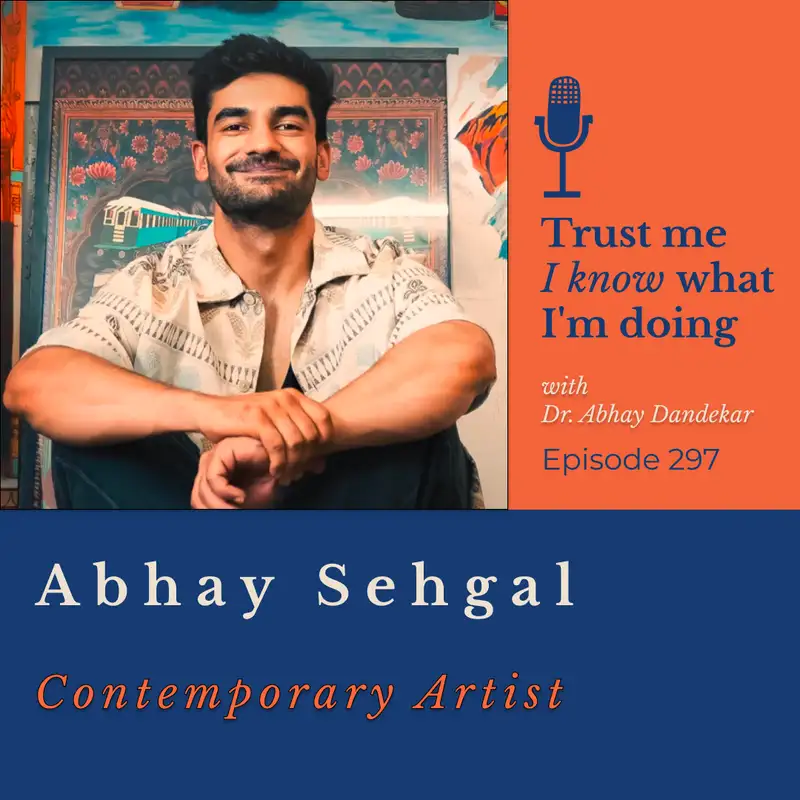
Abhay Sehgal on surreal contemporary art, nostalgia, and identity
Download MP3Abhay (00:00)
when you're creating, you can be fearless.
But, fear is what makes your pieces more interesting.
speaker-0 (00:08)
in the spirit of wanting to be happy, wanting to be content, is there a secret or a formula to keeping your work relevant?
Abhay (00:18)
it's hard for me to work in that stagnancy. I need some ups and downs, chaos to make me multiply my work,
speaker-1 (00:28)
Hi, my name is Abhay Sehgal and I'm a surreal contemporary artist. And this is, Trust Me, I know what I'm doing.
Abhay (01:05)
thanks everyone for listening and watching, sharing with your family and friends, and don't forget to subscribe. TRUST ME I KNOW WHAT I'm DOING is brought to you by Travelopod.
For destinations like Africa, Japan, Antarctica, India, and the Northern Lights regions, start your journey with Travelopod. Visit vacation.travelopod.com.
Abhay (01:24)
welcome everybody to this episode of Trust Me, I Know What I'm Doing. You know, I'm always drawn to the conversation around modern identity of global Indians. And there are seemingly no limits to what that concept of Indianness can be for any single human. And whether you're Desi or in the diaspora, the expression of this can manifest itself with such richness, such diversity, such creativity, and such power.
Moreover, I love the fact that for everyone, this is a dynamic and continuously evolving experience as we attempt to find both harmony and chaos from elements of history, culture, commerce, and community. And that's why I'm so pleased to share a chat with contemporary artist Abhay Sehgal Abai's work explores modern Indian identity, culture, memory, and human psychology through so many surreal visual narratives. What began for him as a personal creative practice is.
Has now evolved into a global art brand with collectors and collaborations spanning hospitality, luxury, and lifestyle spaces across India, the US, and beyond. He's an alumnus of the School of Art Institute of Chicago and the founder of the streetwear label Code Brown, and someone who's finding new ways to help Indian culture and curiosity resonate on a global level. Abay, it's so nice to share some time with you today on Trust Me, I Know What I'm Doing. Thanks so much for joining.
Abhay (02:45)
Thank you, it's my pleasure. Thank you for this opportunity,
Abhay (02:49)
first off, I have to tell you, you're this is the first time out of hundreds of guests that I've actually shared this with another abhay. So it's it's just great
Abhay (02:57)
Haha.
Abhay (02:58)
to have somebody else who's fearless
Abhay (03:01)
Let's go. I love
that. There are very few people who actually know the meaning of our names. And I feel like the best part about our name is
the meaning.
Abhay (03:11)
We gotta
celebrate that. The let's go is always the word. You know, you know, I I'm curious about one thing in that way that because we know what it means to be fearless, does art require an element of fearlessness? Do you have to have that fearlessness always in front of you when you're when you're actually creating?
Abhay (03:29)
Hmm,
I think that's a tough one. I think when you're creating, you can be fearless.
But, fear is what makes your pieces more interesting.
So, you gotta be fearless in making it, but the visual identity you create cannot be fearful. Is fearful, sorry. If that makes sense.
Abhay (03:52)
Hmm. Yeah,
yeah. It does. I mean, so the fear and the anxiety part of it kind of give it that that tension, but doesn't hopefully overwhelm it.
Abhay (04:03)
Yeah, I mean it's like making a horror movie but not watching a horror movie.
Abhay (04:08)
Do you does that play into how you experience your own art or how you actually appreciate other people's art? Do you seem to find the the fear or the fearlessness
you know, as as a viewer?
Abhay (04:22)
I think when I started studying art or looking at art, I was first drawn towards Renaissance. Renaissance. And it was all about war, violence, fear. I loved it. And when I started off art, obviously you're trying to make whatever there's out there, right? But I used to make very dark art before.
No one knows this. And then I don't know. When I thought of it as a career, I started making more cheerful art. I think when I was very mentally depressed, I started creating very cheerful works. But when I wasn't depressed or when I wasn't disturbed, I was just making more dark art. And I feel I want to touch that realm.
but at the right time. I don't know when will that right time be but I feel there is so much more to what I can do. It's just that I don't touch it right now because maybe it's not required. sometimes it's your bread and butter so sometimes you think that maybe it's not required in the market. Maybe if this will just go totally parallel to the stuff I am creating. It has a tinge of it but not
It's not shadowing it, you know?
Abhay (05:52)
I like that. Yeah. Not necessarily shadowing it. And I wonder if like, you know, the balance of how we exist is constantly this interplay between the things that make us optimistic and cheerful and and those things that are perhaps a little bit more on the darker or fear based or anx anxiety based side. When you think about this overall, and let's say you're at a party or a gathering where not too p many people may know you, I'm curious how you introduce yourself to strangers.
Abhay (06:21)
I'm
very bad talking in crowds. I'm like, I'm not a social butterfly and neither am I an introvert, but if I get comfortable, I'll be very talkative. I'm like that.
Abhay (06:31)
Hm.
Abhay (06:32)
I introduce myself. I don't like introducing myself as an artist. I like just introducing myself as Abhay because I feel like my personality versus my art is very different.
I think art is more
Abhay (06:50)
Mm.
Abhay (06:51)
like my journal, something personal and which is something like... That side of me no one knows and I'm just creating it. So when I talk to my friends, the people who especially know me very well, they are like, we don't believe it that you can think like this and all. And I'm just like, I don't know, it's just a different side of me.
But the other side of me which
Abhay (07:13)
Right.
Abhay (07:13)
is on a social basis, it's very different. It's like any other person. I won't come across to you as an artist if you
meet me randomly.
Abhay (07:23)
Right. I mean, do you do you let the expression speak for itself in a way, meaning that like when you're in a group of strangers or you're at a party or at your at a gathering, you want that to be secondary? Do you want that to be sort of like let someone discover that on their own instead of being kind of front and center?
Abhay (07:39)
Yeah, it should
be secondary, it shouldn't be my personality. I think it just takes away from a lot of it. I don't know, I think when you look at my art, I want you to look at it with an open perspective. But if you look at that art from my perspective, you'll just be surprised. There's nothing you would feel about it. So I don't want to inter-wine them.
Abhay (08:03)
Yeah.
No, absolutely. Does the success maybe change that? Like it's hard to keep that secondary, maybe it takes some some practice to keep it secondary?
Abhay (08:17)
I don't think I'm successful yet. But when I started off, I was too shy to say that I'm an artist because I wasn't doing... I mean, you're an artist but you're not living as a full-time artist. So I felt very shy to even say it. Then I got in the phase of being like, I'm an artist. I own a clothing line. And then now I'm in the phase that
just, I don't want you to know.
Abhay (08:49)
Right.
Let it let it come about in its own way.
Abhay (08:49)
Maybe know me, Yeah,
yeah, yeah, in its own way. Not like pushing yourself as like, I am an artist.
I am sure with you, when you say,
So do you feel that when people talk to you? I mean, I don't know what's your circle like or how many random people you meet,
Abhay (09:09)
Yeah.
Abhay (09:10)
but do you want to introduce yourself as a doctor?
Abhay (09:14)
Yeah. I I would say that
I meet random people every day. And yeah, professionally. But personally, outside of the professional world, I agree. Like I don't like introducing myself as a doctor. I I prefer the hi, I'm just Abhay And if it if it happens to come about that I'm a doctor, great. But I don't want that also to be front and center you know, for my identity. I'd rather that be something that we discover together, so to speak.
And that just feels more comfortable, you know?
Abhay (09:43)
yeah, and honestly, to the people you're meeting randomly at this, I mean, I am 28 and I don't feel I'll have a closer circle anymore, you know? I feel like I have had it. Like
Abhay (09:57)
Mm.
Abhay (09:58)
whatever circle I have, I'm the most happy with it. Maybe there might be a chance that I will probably find new friends and close friends, but that's...
Whoever wants to know randomly, can just know me through my art. I don't want to disclose who I am. I don't know.
Abhay (10:16)
Let me ask you this. I mean, when you think about the work that you do, which is this contemporary surreal surrealist play on so many different intersections of India and culture and psychology and technology, even, when did you kind of first fall in love with this idea of surrealism and psychology?
As at least a mode of expressing yourself.
Abhay (10:47)
I mean when I started off in college I think I was in that zone where I thought you know trying what Dali does is something I want to try so basically I was just trying to imitate him but after two years you realize that yeah they look cool but they are not your identity they are not who you are so maybe you need to make what you are in your own flavor and tongue
That's only when things will come out and I think that just came out. I mean, I decided to do art full time in COVID, but I think that personality in art came out when I moved back. I think when you move back, especially when you have lived in the States for four or five years, it kind of hits you. What things you have been missing out on. I think it's now overdone. I mean, now it's like being done in fashion. It's being done.
everywhere,
you know, this blend. I think it's overdone now. Now it'll be something
Abhay (11:49)
Yeah.
Abhay (11:49)
different to whoever is doing whatever.
Abhay (11:54)
Do you still do you still find a inherent love for that? I mean, compared to when you first started and even when you again fell in love with that idea of the blend, now of course
Abhay (12:04)
Yeah.
Abhay (12:05)
you mention it's overdone. do you have to remind yourself that you still love it?
Abhay (12:10)
I mean now I live there so I don't have to remind myself.
Abhay (12:13)
Yep.
Abhay (12:14)
I mean before if you live
in the states you are like loving it, you are all for your culture, now you have a love-hate relationship.
Abhay (12:23)
Right. and with that then, I mean, how much does nostalgia, even now that you're back in India and in Delhi, how much does that kind of nostalgia, even the nostalgia for being in Chicago, how much does that nostalgia play a role in anchoring some of the icon iconography or the mythology or the culture in your work? It does that factor in at all, like, you know, hey, these memories?
Abhay (12:50)
very big factor. I live by nostalgia. That's my very one of the few things I'm not the most proud of, but it is what keeps me at times. I'm a boarding school kid. For me, like looking back at my school, looking back at my, I don't know, whenever I move forward, I just keep making works about the past.
I make works about present too but they will have a touch of past because
Inheritance combined with presence keeps molding towards something new every day, every year. Especially in this
Abhay (13:25)
Hmm. Yeah.
Abhay (13:27)
age, I think I am nowhere at the surface of who I will be when I 60, 70. So I feel it is just something that keeps molding towards something new. And as long as you stick to your inheritance, it will be like a life.
You know, when you see the artworks later, when I'm not there. Maybe it will have that transition of something that doesn't need to be said. Like we spoke about meeting people, talking about you being an artist. I think that whole spectrum of your life's work is what would say a lot.
Abhay (14:04)
Yeah.
Abhay (14:05)
I can see myself make very dark
stuff when I'm like old. But I don't know, I'm just...
Abhay (14:11)
So hard to predict, right?
Abhay (14:13)
I just feel like when there's nothing to lose, the best art will come out.
Abhay (14:18)
Yeah, no, that's very true. I mean, you you mentioned this kind of like keeping true to your inheritance, to your lineage or even to your your own personal history. has your the arc of your story and the storytelling, especially based on that psychology? I mean, you're 28 now, you'll you know, age gracefully as an artist, but does that
storytelling, how how would you say that that has evolved for you, even in just the few years you've been doing this? know, do you think that that evolution and constantly reflecting on that evolution is that important to you as you age as an artist?
Abhay (15:00)
I mean, anyone's life, evolution will happen in its own way. For you, in your lifetime, your evolution might be very major, but to someone from the third perspective, it might be a minor evolution. So you can't really predict that evolution would happen. You can only just embrace things as it is and make things based on it.
and then maybe your work will do its charm in defining evolution.
Abhay (16:12)
Hi friends, this episode of Trust Me, I know what I'm doing is brought to you by Lotus Lane Coffee, a South Asian woman owned coffee brand that's roasted in Columbus, Ohio.
Every small batch bag begins on farms across India and ends in your cup with depth, intention, and story.
Lotus Lane Coffee, rooted in India, roasted in Columbus. Discover the beans, the mission, and the journey at lotuslanecoffee.com.
Abhay (16:37)
you know, on a day-to-day basis, do you have any kind of rituals that govern your work or maybe that are like, hey, this is kind of part of my process when it comes to creating.
Abhay (16:54)
rituals. I'm a very routine guy. F I
Abhay (16:58)
Mm-hmm.
Abhay (16:59)
I. but I feel the more I'm out of routine the quicker I can think of new ideas.
Abhay (17:07)
Interesting.
Abhay (17:09)
So when I'm in my routine, I enjoy like the fact that I'm healthy. The fact that I have my diet in and it's a routine where I'm not unhealthy. The moment I travel, it goes down hair hair wire. But when I come back from that routine,
When I come back from that like break or trip or work trip or whatever it is, it's just much better. I think quicker. I can execute an ample amount of things without
worrying much, but the moment I'm in a routine it's it's hard for me to work in that stagnancy. I need some ups and downs, chaos to make me multiply my work,
I guess.
Abhay (17:57)
Tell tell me what some of those kind of routines involve. Is there something about like how you approach work in the studio? how how what's the day to day, almost even mundane parts
of that routine?
Abhay (18:14)
I think mainly it's, you know, waking up, going to the studio, then going to the gym, then sitting at a cafe, working on some ideas and concepts, doing back to back meetings, then again studio. That's like my pretty much my routine. when I'm outside, I think there is something or the other that I capture that would trigger a thought.
You can obviously not predict where will that idea click, but the more your perspective is open, the the easier it is to think of fresh new things.
love conceptualizing when I'm travelling. I can come up with ideas way faster.
Does that make sense or like you burned?
Abhay (18:58)
it it it makes perfect sense,
speaker-0 (19:00)
I know I know rituals and anchors and routine are are all part of it. I'm just curious for you, like you've been doing this for a while now and of course you had the experience of being in the States and studying and then heading back to India to do this as well. But you know, why why do you think your art particularly resonates
with both new and old generations in kind of the diaspora. Like those who are in fact living that experience outside of India. why do you think your work matters?
speaker-1 (19:36)
No, I feel like whatever you make, obviously you're capturing a journey. And I kind of shared my perspective on how it is to come back and live both the sides of the world. And you know, there's a very huge amount of operation that kinda gets it. Because like I feel like people like me who have seen India and US
would get it the most, but there are also kids or it adults who have been born and brought up in for foreign countries and who feel very left out of their own culture. So it's a psychological thing, you know, to feel connected with by seeing both best of the both worlds.
speaker-0 (20:21)
Hmm. Do you think that especially for those who are struggling with that, right? They've newly immigrated to the States or their kids are now growing up. why why should art and that kind of balance of two worlds, three worlds, four worlds, why should that matter to people?
speaker-1 (20:44)
I mean you are taught to follow roots when you are born and brought up here. Every Indian parent wants their kid to resonate with what they have been born with and obviously he cannot or she cannot resonate with it because they have been not born in that thing. So they just they try and they fail.
And whenever they see something visual or listen to something, they feel more connected to it. That's their only medium to connect to it.
speaker-0 (21:21)
Yeah.
I mean have you gotten feedback perhaps from others who are, you know giving you their lived experience and saying that like, well, you know, art is an important vehicle for that evolution, for that identity to form, for that psychology.
speaker-1 (21:41)
I feel any medium that can get you through that portal is an important medium. It can be anything. It just has to do its job.
and and right now honestly is just one medium, you know, of nostalgia. Taking it back to a conversation about nostalgia.
Abhay (22:06)
you know, you're here in the States for a show and one that's gonna showcase some of your work.
I'm always asking this to different artists and and people who are are showcasing and expressing themselves, but do you feel that you have to prove anything to anyone? Or is is there that element of just kind of having to prove something to yourself, especially when you are showcasing your own work?
abhay (22:34)
I don't know I mean I don't think about all this stuff and I'm creating it
It does move people.
But I feel it's more like an open to perception thing. Like, you can't really calculate that. I just feel like even if it's made right now, it might hit it 10 years later. So you can't really.
I don't know. I mean I'm doing this show, why don't we... I'll think about this once the show happens and I'll tell you.
Abhay (23:06)
I mean, how do you how do you usually feel after these shows that you've done where you have an exhibit, you have a show, and you know, you people enjoy and and appreciate your work? They they talk to you about it, you talk to them about it. do you feel like it it is a achievement or maybe does does that matter to you when you are measuring your own value?
abhay (23:29)
I mean I'm very
glad that I got the chance to know showcase it. There's obviously thankfulness but when it's happening I don't think much about it. I don't get nervous about it. I don't get worried about it. I don't think what will sell what won't. It's just very much I stop thinking about it like.
any other football game, I just don't think about when the game is going on, you know. Before that, obviously, you're very worried, you're stressed, there are deadlines you want to meet, you don't even know if the people are going to show up.
Something like that.
Abhay (24:10)
Do you do you worry less about that now as
compared to when you were first starting out?
abhay (24:16)
It's the same feeling. It's that something, some numbness that comes when the show happens where you don't think that this is a big deal. Your heart says there are bigger things to come. This is just a part of it.
Abhay (24:35)
You know, as someone who's had to now translate that art into a brand and to try and get this equalized and so it can be sort of streetwear, like with Code Brown. does the you mentioned that there's a numbness to this. Does that change when you're in a meeting or you're in a boardroom or you're trying to, accelerate?
your work but in a different medium, like on clothing or with a brand.
abhay (25:09)
It's the same anywhere like It doesn't matter I don't know sometimes I just it's a very weird feeling that cannot be explained, but when I show my art
know why I don't feel anything. I wish I feel something. I wish I but I just don't. I don't know.
Abhay (25:33)
Hmm. What what makes you proud of yourself? I mean, how have you been able to develop at least that element of confidence to be able to say, yes, my my art, my expression,
abhay (25:47)
I don't know.
When life's comfortable,
Abhay (25:51)
Mm-hmm.
abhay (25:52)
when life's comfortable financially, socially, personally, that's when I'm confident. When life's missing one of those, or even when I'm super healthy. But when life is missing one of those, it doesn't matter what you do, it just doesn't feel right. So I guess it'll never feel right.
Abhay (26:14)
is that something that you struggle with or you're pretty comfortable with?
abhay (26:17)
I
struggle a little bit.
Abhay (26:19)
for all of us who might struggle with that, how how do you find yourself kind of dealing with that? Or I mean, I I get it, it's a constant dealing with it, but are there ways that that you're able to allow the art to deal with that?
abhay (26:34)
I feel when I'm working, like when I'm doing my art, it helps. Like when I feel like I have done something in thinking something new or coming up with something new, that always is a very good feeling. That calms me down a lot.
speaker-1 (26:53)
Gym obviously calms me down. Sweating a lot just calms me down.
speaker-0 (26:57)
Yeah.
speaker-1 (26:58)
Yeah, these are the only two th and friends. These are the only three things that helped me get through it.
speaker-0 (27:05)
And of course talking to another abhay probably helps a lot too.
speaker-1 (27:09)
Yeah, definitely. that
was that was my n that was the number one in my list. I forgot.
speaker-0 (27:16)
There
you go.
Abhay (27:19)
Hi, I'm Abhay Dandekar and if you have an animal in your life that you love, then I want to introduce you to the Timber Dog Ruff Rest, the only dog bed you'll ever need. compact and light with over 14 travel features, comes in three sizes and has everything from storage for essentials to a built-in sleeping bag. The New York Times Wirecutter calls it a versatile portable dog bed with lots of extras for traveling or camping. Go to timberdog.com to explore Ruffrest
the only dog bed you'll ever need.
speaker-0 (27:48)
You know, this has been a challenging year for you. in thinking a little bit about some of the elements that we talked about when you were first starting out trying to mimic Salvador Dali and and think about like how that works, you know, this idea of there being a blur of borrowing and
mimicking or copying and even getting inspired from different ways, whether that's through other artists, other natural things, other artificial things. in the creative world, how has this past year helped you to redefine the concept of trust or credit? has it changed you as an artist when it when you think about that whole idea of being inspired and
What do you trust and how you deliver credit?
speaker-1 (28:42)
See I think like when you're starting out as an artist, you make art to enjoy art. And when you are enjoying art, you don't really think that much. You're just doing whatever comes your way, you just making it. If any kid who is in sitting in a studio right now or sitting in a classroom and just drawing, he's probably not thinking of where he's getting it from, he's just doing it.
And just like any other kid, I was doing it and I didn't realise that, you know. I didn't realise it and it just came back when I think when it when people started recognizing that it is a career of his then I started it started like, you know, it started happening that, this, that, this. I can't do anything about it.
speaker-0 (29:37)
Yeah.
speaker-1 (29:37)
I can just show you what I'm
capable of by making some new works and I was kinda glad it happened. Obviously it wasn't easy to go through but I was glad it happened because then that challenges you to create more works you know like one like that just makes you feel that okay Abhay now you're not taken as a joke.
speaker-0 (30:00)
Mm-hmm.
speaker-1 (30:01)
You gotta get serious now and maybe do what you do best. But
with some rules, you know. Right. And that's fine. That's like that's like changing freestyle football to a football game. And if you're good you can you can do it, you know. I take it that
speaker-0 (30:19)
Well
speaker-1 (30:19)
way.
speaker-0 (30:20)
Yeah, and and you know, people get inspired and they are, constantly arranging and rearranging ideas and and things. But now that you mentioned that like, you know, hey, you you have you're cognizant of it, you're aware of it, you've moved on from it, in that in that same light when you see other artists or younger artists who are like, Man, I can't wait to ha you know
Be like Sehgal how does that make you feel?
speaker-1 (30:49)
I don't know. I don't know if anyone wants to be Sehgal
speaker-0 (30:54)
I'm I'm sure someone out there you know, wants to do that.
speaker-1 (30:58)
I mean, if you are then good for you, man, all the rest for that one year.
speaker-0 (31:05)
Right. Well I mean, you know, I mean certainly it's humbling to some degree, but like does the idea of like credit in the art world, or even like the way that you've had to make your work evolve after this past year of you know, people basically sharing that, you know, they have strong feelings about your work.
Again, whether it matters or not is a different story, but you know, now that you approach a new idea that you're inspired by, does it at all change or all
speaker-1 (31:40)
Nah, it only creates makes a better outlook.
speaker-0 (31:44)
How
speaker-1 (31:45)
So it doesn't change. I mean I feel when things hit you hard your perception towards inspiration opens spectrums and it won't just be internet, it won't just be books. It's gonna be your life.
And that's gonna add way more flavor than anything else.
speaker-0 (32:10)
I I always I appreciate a lot of your work. I told you that I I enjoy it quite a bit. And especially some of the expressions on the Add To Cart pieces or the Chicago Durbar is, a favorite of mine. and certainly a lot of the Code BRWN work, whether it's a t shirt or it's a hoodie or or whatnot. Is there a mission?
Or a vision for you to erase this idea that fine art is inaccessible and it can only be driven by the emotion or it needs to be more driven by the emotion and rawness of kind of normal daily existence. And like you mentioned at the beginning, right? This kind of dance between fear and chaos and and harmonizing that. when you translate it to say
Consumerism and someone buying your art or someone buying a t shirt, is that the best way for that to be just normalized for people?
speaker-1 (33:09)
I didn't think of it like that. For me the win was the fact that I could turn it as a as my bread and butter. obviously there are a lot of agendas and goals. But I think going impulsive in this career is the best.
way of going about it. You
know, whatever you're feeling. Because at the end of the day you you chose it because of your heart, not because of some track that you saw that you could get to. Obviously there's a track. At the end you're doing it for yourself only. you're just doing it to make yourself happy. Not doing it for to show anyone what you can do, what you cannot.
Yeah, it's good to show off sometimes or show like what you care what you're capable of. But in the end, whatever anyone says, whatever however anyone perceives art in com consumerism or in a career, you're just doing it for that kid in the classroom who was drawing that.
I mean
the fact that anyone
Is buying it is a very big one.
speaker-0 (34:20)
Yeah. I mean you
speaker-1 (34:22)
Evil
speaker-0 (34:23)
is it important for the art to be accessible and not just someplace in a collector's house or in museum?
speaker-1 (34:34)
See, there are two ways to answer it. One is the financial way, one is a massive way. The financial way obviously you want it in a collector's house because that's how the word of mouth spreads, right?
speaker-0 (34:45)
Right, right.
speaker-1 (34:47)
That's how it kicks it off for any artist. But
I feel I wish there were more public opportunities for artists to do something in the public.
That matters more because then you'll be evergreen. Like
whatever you make in the public, whatever you some you know, sculptures like the bean. Yeah. Like it's so classic, it's so timeless. It makes up a city now. I feel I wish there were more like these things that existed that could be like accessible to obviously the public. And even collectors like
I think public space shows what an artist is capable of to the mask.
Yeah, I wish it was accessible. I wish it was like I got a space and every w now and then every random person would just look at it.
speaker-0 (35:39)
I I'm sure Anish Kapura would have, you know, plenty to say about that as well. But I I I think that, you know, just like anyone who's a a performer, right? Whether it's Messi or it's Anish Kapur, they have venues and platforms for the public to enjoy and appreciate what they do. Do you do you think art just needs more stages like that?
speaker-1 (36:02)
Yeah.
I can't say it until I've lived it.
speaker-0 (36:05)
Hmm. Sure.
speaker-1 (36:07)
I feel I'm as clueless as you are.
speaker-0 (36:11)
I'm pretty clueless. I don't know if you can get more clueless
speaker-1 (36:14)
I'm just doing whatever that comes my way.
speaker-0 (36:17)
Right.
speaker-1 (36:17)
I don't know how to get there. I'm just like doing what I can.
speaker-0 (36:20)
Well, let me ask you this then. I mean, so so what does success mean to you then? I mean, is does success matter? And is there a way that in your mind and your heart that you kind of measure what success looks like?
speaker-1 (36:35)
I think success is directly proportional to your satisfaction.
or your hunger.
speaker-0 (36:41)
Maybe.
speaker-1 (36:42)
In this you know, honestly, Abhay in this past year I have changed the definition of success. For me now it's more of having a happy life. A potentially a happy family in the future and obviously this will come your way. But I don't know. Obviously I want to be the best. I want to be the best in clothing. I want to be the best in
I don't know if I do it or not, I just know that like
if if I die tomorrow, I know I did my best, you know. Whatever it was. So I think that itself is success as long as you're trying to do whatever you want it to.
speaker-0 (37:25)
Yeah.
speaker-1 (37:26)
It's a very very confusing term.
speaker-0 (37:30)
Sure. Well, Is there a mechanism then in the spirit of wanting to be happy, wanting to be content, and yet, saying, like you said, like, hey, I want to be the best? is there a secret or a formula to keeping your work relevant?
speaker-1 (37:51)
I should be asking you that. I'm just twenty eight. How would I know that?
speaker-0 (37:55)
Y you know, I I I'm reason I'm asking that is because in the end, right? I mean, you mentioned the platform and whether it's public spaces, whether it's social media, I feel like social media is the ultimate equalizer for right now anybody who creates content, but not necessarily for an artist. i is that the equalizer or the curse?
That forces algorithms and tech to prioritize views and engagement and is that actually sacrificing depth? I mean, do you only stay relevant because you have a social media following or you stay relevant because you're happy?
speaker-1 (38:36)
I mean I stopped giving an F about social media lately. Yeah. I I do it because it's my discipline too. I enjoy it. I think I'm in the middle of the process of starting to enjoy it again.
speaker-0 (38:49)
Yeah.
speaker-1 (38:49)
Right now, obviously I would want the world to recognize you or people to recognize you more than just social media, man. Like there's so much to it. And just like judging on a screen or like saying
Or like perceiving anyone's artwork on a screen. Well there's so much more to things. It yeah, I agree with you. It lacks depth. Not just your artwork, your personality as well.
speaker-0 (39:13)
Hmm. Is there is there any kind of not advantage, but is there a an actual like reason that social media can help art?
speaker-1 (39:23)
Yeah, I mean you're looking at someone who starts bread and butter from social media.
speaker-0 (39:29)
Mm. Right.
speaker-1 (39:32)
And he's near you in SF who's about to do a solo exhibition.
speaker-0 (39:37)
Right.
speaker-1 (39:37)
All through social media. I
speaker-0 (39:39)
Very true.
speaker-1 (39:40)
think it is it is it is quite it can be very helpful for you.
That's a blessing and a curse. A bit's a blessing and a curse.
speaker-0 (39:48)
Of course. Yeah. I mean we can't underestimate the power and yet the hopefully has some guardrails when it comes to
speaker-1 (39:55)
It has good powers. It has very good powers. Yeah. You just gotta be it's your it's your I don't know. I think like you will get opportunities if you're out there. You if you're showing up irrespective of what anyone is thinking about you, if you keep showing up for yourself, something or the other will come up and that's when that's when your grit and your personality will come in play to make that happen, you know?
speaker-0 (40:22)
Well,
speaker-1 (40:22)
Social
media is like a LinkedIn. You get a job of it, then how you do the job is all all your game.
speaker-0 (40:29)
Very very true. let me get you out of here on this one. And that is, I appreciate your art, whether it's at a show or whether it's online or whether it's in a gallery, whether it's someone trying on Code BRWN clothing, for those people who are kind of enjoying and appreciating or becoming curious about your work for the very first time.
after they are actually examining or reflecting on your art, how how do you hope they feel?
speaker-1 (41:01)
I think
I feel there's a thin line where there's a realm and I want you to be looking at me but from another side. That's how you w I want you to feel. If you look at my eyes.
speaker-0 (41:14)
Tell me more.
speaker-1 (41:16)
a statement that says put yourself in my shoes and walk ten miles
Only perceive it then. If you can walk those ten miles.
Something like that. And obviously, I am like in my twenties and I make works about life. pop culture, nostalgia. That happens with everyone. Which is why it's a term, right? Like they are very strong terms in the world of psychology.
So if it triggers that nostalgic thought in you about something you only you know and no one else in the world.
Then I think my art did its job.
If you don't feel it then maybe w walk in my shoes and see it through my eyes. If you can't see it in your eyes.
speaker-0 (42:13)
Well, I I know that it's triggering lots and lots of thoughts and curiosities for people to harness their own emotions and
speaker-1 (42:22)
As long as they're noticing.
speaker-0 (42:23)
as long as they're noticing right. And and then also to have some great empathy for what you're experiencing. Abhay, what a terrific conversation.
I'm so grateful for all that you're doing and I hope we can connect again in the future.
speaker-1 (42:37)
Sure. Thank you for having me on the show.
Abhay (42:42)
Hey, thanks so much, Abhay, and hope you have a successful show here in San Francisco this weekend. Shoutouts now to artists everywhere, to South Asian and Indian origin students in Texas, to former guests at Ajivaram for a long career of tennis excellence, and to better food labels everywhere.
I certainly want to thank each and every one of you for listening and watching and sharing this with your family and friends, because conversation indeed is the antidote for apathy. Till next time, I'm Abhay Dandekar