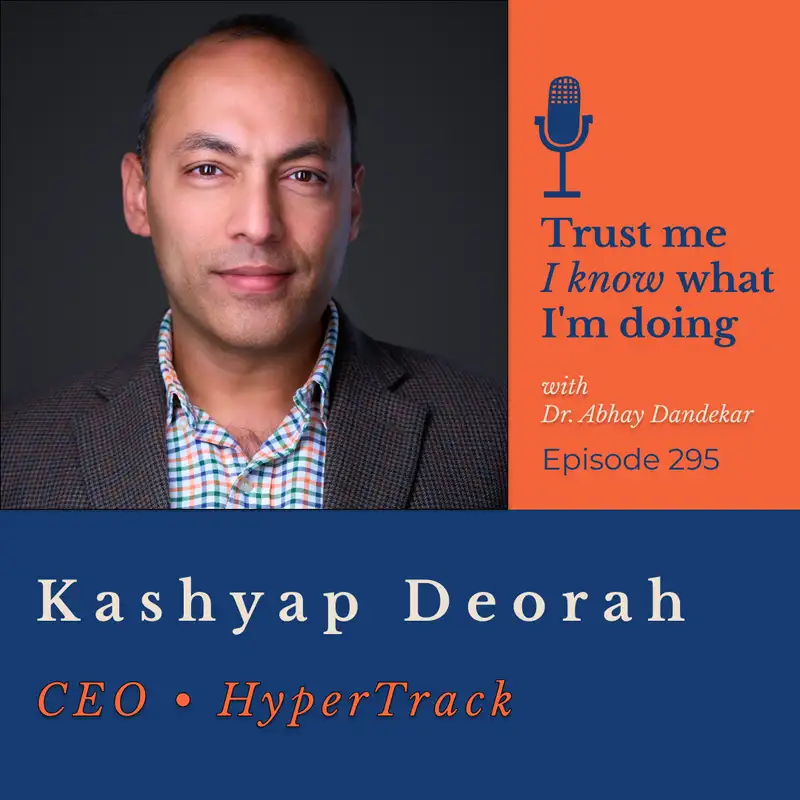
Kashyap Deorah on Startup Exits, VC Buybacks, and Tech Realities
Download MP3Kashyap Deorah (00:01)
what I found is that technology accelerates human behavior rather than equalizing opportunity. I'm still unpacking where that overlaps and where that diverges.
Kashyap Deorah (00:12)
People are building things out as much as we want to believe machines are doing the work. the people centricity and and people operate at an emotional plane, so how do you connect with people, build relationships, remains important.
Abhay (00:25)
what do most founders perhaps misunderstand
about that life cycle coming to terms with your own finances or even the merger and acquisition process.
Kashyap Deorah (00:35)
the venture business itself is getting more and more focused on higher concentration of capital, fewer companies making it and making it to a higher degree and that degree that needs to make venture capital worth it is becoming more and more acute.
hi, I'm Kashyap Deorah, entrepreneur, investor, philanthropist.
and this is
trust me, I know what I'm doing.
Abhay (01:27)
thanks everyone for listening and watching, sharing with your family and friends, and don't forget to subscribe. TRUST ME I KNOW WHAT I'm DOING is brought to you by Travelopod.
For destinations like Africa, Japan, Antarctica, India, and the Northern Lights regions, start your journey with Travelopod. Visit vacation.travelopod.com.
Abhay (01:46)
welcome everyone to this episode of Trust Me, I know what I'm doing. You know, one thing I know about myself, and I bet it's a common thread with others, is that I love to build things and I equally love to destroy things. Of course, with the intent of building again and finding a fresh way to solve new problems. And sometimes that may come at the expense of enjoying how to maintain things, but maybe there's actually a sweet spot where.
maintaining the consistent hum of creating and refreshing or even reimagining projects over time can be scaled and shared and even evangelized. Maybe there is some maintenance hum there and a sweet spot to be enjoyed by all of us. And I think that's where I find myself fascinated to share a conversation with someone who's no stranger to this cycle, especially in serial entrepreneurship as an investor, an author, and a tech veteran.
And that's Kashyap Deorah Kashyap's career has bridged many eras especially from the dot-com era to the tech venture Superbloom, as he went from IIT Bombay to building and exiting three different tech ventures and writing the insightful bestselling book, The Golden Tap, which was a candid front row seat capture of the many twists and turns of the Indian tech ecosystem.
He's now the founder and CEO of HyperTrack, which is a global platform for last mile logistics and location intelligence for a wide, wide suite of business applications. He's a startup mentor and serial investor and a fellow EastBay guy. I'm so pleased to welcome him for a chat. Kashyap thank you so much for joining me on Trust Me, I know what I'm doing.
Kashyap Deorah (03:24)
Thanks so much for having me, And I'm not sure if I know what I'm doing, but very happy to be here.
Abhay (03:32)
That's great. We'll we'll try and and walk our way through that that trust part particularly. You know, you know, it's sometimes easy to pinpoint the origin story of a serial tech journey. But I'm wondering if you remember when you first fell in love with being a tech entrepreneur.
Kashyap Deorah (03:53)
I very much do. I was in engineering college back in Mumbai, the city where I grew up I used to live on campus and I found myself as an adult
in that experience and felt that autonomy and independence living away from my parents, you know, for the first time. And this was between the years ninety six to two thousand. Those were my four years
And I was just trying a whole bunch of things with this newfound independence. I was doing sport, I was acting, I was organizing events, and something very era defining happened during that that time and that's the internet.
I remember ninety eight was when I first saw the Google dot com screen where I was waiting for it to load. And it was very normal at that time to to wait for the internet to load. I was like, why is this page not loading? Then I realized, wait, it has loaded. It is a blank page with just one piece of text. So the internet was happening and I was smitten by the internet. in the events that we were organizing, we had alumni
visiting from Silicon Valley talking about what's happening at Stanford, what's happening
In the Silicon Valley. And I think that that was the bug that bit me. So with that
Abhay (05:19)
Mm.
Kashyap Deorah (05:20)
newfound confidence, I I said, you know, if college kids in the Silicon Valley can can start companies while they're at college, why can't we?
Abhay (05:29)
Sort of a a parallel peer experience, if you will, that may be sparked by that one word on the screen, which is just the Google page. And, you know, when you think back to that first experience of kind of falling in love with that notion of being an entrepreneur and building something and designing something, especially from scratch, and something that clearly had a lot of ambiguity and so much unknown in those days.
now sort of fast forward and think about all the crystallization of those concepts and those ideas that have happened since then and even today, the the parallels of so much that is ambiguous and unknown. I I wonder if the pace of entrepreneurship and starting or scaling a company has changed from your eyes? Or are there some common threads even from those days that that still remain anchors? is there maybe a change in the anatomy?
Of what a founder looks like in 2026 compared to when you were first starting your journey.
Kashyap Deorah (06:32)
Very much, you know, and and I think the pace of change has increased with every cycle. And in in some ways I think it goes back to the agricultural revolution where humans first started controlling nature to their own advantage. and then the industrial revolution and then the tech revolution and within that, if you talk to Kanwal Rekhi and
The initial Silicon Valley Indian entrepreneurs about the semiconductor industry there was this newness to, there's this new thing which has changed the world. and then the personal computer came along, the internet came along, the the mobile smartphone came along.
And now with AI, I think the pace of change has only accelerated with every cycle, to the extent that everything I learned as an entrepreneur in my cycle is obsolete. and I need to unlearn that and reinvent myself if I wanna continue innovating. I need to sort of learn from the new cycle. And
AI native is more valuable than those who are trying to pivot to AI. it's high school dropouts starting up now
versus college dropouts. It's zero to hundred million in in eighteen months rather than zero to one million in eighteen months, right? So in every possible dimension, the pace of change has only accelerated it's become for that reason that much harder to predict the future. So the uncertainty has increased.
Abhay (08:16)
Do do you think even as the pace has changed, as the uncertainty has increased, as the sort of s magnitude and and even amplitude of how fast you have to go, especially in the beginning, has changed. And yet are there are there some common anchors that have really not changed? are there still some elements of that blueprint to a startup, or at least the mindset of a founder that still has has not really has been quite consistent.
even from comparing your early days to now.
Kashyap Deorah (08:47)
For sure, yeah. I think yeah, some of the laws of physics remain the same always trying to find
Abhay (08:53)
Right.
Kashyap Deorah (08:55)
trying to find what has stayed the same and what has changed.
has become an interesting journey. You know, there are times where I've embraced things as, this is not gonna change, but and I find out the hard way through through hard knocks that it has actually changed, that that law of physics doesn't apply anymore.
You know, the resilience remains important. listening to users, listening to customers, truly listening at a subconscious level, you know, for not what they're saying, but where they're coming from
People are building things out as much as we want to believe machines are doing the work. it's the people centricity and and people operate at an emotional plane, even when they don't know it. so how do you connect with people, build relationships, remains important.
so yes, there are bunch of things that that do remain
in the core OS, if you will.
Abhay (09:53)
Yeah, I love that. I I do love the idea that human relationship building and empathy and and really deep listening are still anchors in that core operating system, as you mentioned. I I really enjoy thinking about and in many ways sort of imagining the concept. and now of course you've actualized it w with HyperTrack to automate and authenticate the gig work.
environment and the logistics of operating in the field. how do these location and digital field automation tools fit with how you believe the real world workforce and the supply chains that fuel that workforce are changing so rapidly in the global economy, not just of course where we are in California or or the states, but
because everything is so interconnected, how does HyperTrack perhaps do you have a lens on how that workforce is evolving and where does HyperTrack fit into that evolution?
Kashyap Deorah (10:58)
No, absolutely. So, you know, the pace of change is increasing across the board and the workforce is not an exception to that. what workers want around the world is more flexibility to make more money on their own terms, in their own time. gone are the days of I'm I'm working the same job for
years at a time I'm working from nine to five, going to an office. in in every possible work, you know people are seeking flexibility. And similarly the employers are finding it hard to predict the future. So for them to lean entirely on a full full-time employed workforce to
get everything done in their business you know has changed. and we saw the whole location powered commerce happen through ride sharing and then it it came to food delivery and grocery delivery and and so forth. So we can feel that convergence of technology with our offline world. so I predicted that that would happen in in the larger workforce
Scenario as well. And what we've seen is exactly that. You know, over the past decade of building HyperTrack, what I've seen is in various shapes of arms, in every industry, there are these businesses that are creating these networks of people looking, you know, companies, employers looking for workers in a per shift, per contract, per
task sort of way. And when you see that world, you you need certain technologies that time in attendance or that ensure that people who are supposed to show up at a certain customer are actually showing up. They are on the way, they are making it there on time, they are spending the right amount of time there.
days of sort of having a biometric check-in and clock-in with these punch cards and time sheets.
they do still exist but it's it's really hard to use that to get everything done so what HyperTrack really solves is in that world of high change, how do you
maintain predictability and reliability? How do you make sure that workers get paid for the right time on the same day? How do you make sure that your customers are billed for what was actually delivered? how do you do all of that in a way that that automates the sort of madness of of all this happening out there in the real world at scale?
Abhay (13:36)
I I think about that in especially the use case for home health workers. And when there are so many so that's such a huge need for this in the population, how can you guarantee all of those things you mentioned in a very frictionless way? And on top of that, guarantee excellence at the at the bedside. It's a very human task. And yet, if you want to increase the workforce to be able to do this at scale.
I
think tools like this are needed. Is the developer is the developer first model and the developer experience still crucial for building a two point version of this or a globally scalable company that does something similar in twenty twenty six and beyond?
Kashyap Deorah (14:21)
Yeah, you know, we started HyperTrack as a developer first model and we realized over over the years that it you need to be a far more horizontal business to succeed with a developer first model.
only. if you look at Stripe or Twilio, the the number of developers building applications for communication or for payments is far wider and in one or two orders of magnitude more than the number of developers building on-demand commerce, on-demand economy apps.
so we realized at some point in our journey that the developer first model will only go so far and to build a real business and a scaled business, we need to go top down and and pick a vertical. And in that journey we actually picked last mile logistics, you know, delivery as our first vertical and we timed that very poorly because last mile delivery
in twenty twenty two and twenty-three was going through a bubble burst, you know, post COVID reopening. and then we pivoted to field service and staffing.
And that's where we found product market fit finally, you know, and it took us several years actually to to get to that product market fit. And we're very much a top down mid market and enterprise focused company selling to staffing firms that that need to automate their middle of office time and attendance validation.
Abhay (16:28)
Hi friends, this episode of Trust Me, I know what I'm doing is brought to you by Lotus Lane Coffee, a South Asian woman owned coffee brand that's roasted in Columbus, Ohio.
Every small batch bag begins on farms across India and ends in your cup with depth, intention, and story.
Lotus Lane Coffee, rooted in India, roasted in Columbus. Discover the beans, the mission, and the journey at lotuslanecoffee.com.
Abhay (16:53)
in that thinking where there are several different models of building here, in the experiences that you outline, and since you wrote Golden Tap to share your thoughts on not only just the journey of startup, but of course the capital that that starts that, or the venture story, at least, especially in the Indian.
tech ecosystem. when you think about companies similar to HyperTrack or the companies that you founded and exited, in this kind of triangle of India, China, and Silicon Valley, when you think of that tech ecosystem triangle, has the shape of that triangle
because
that that triangle is changing so much every day, does it make it harder to kind of understand it in a sustainable way?
Kashyap Deorah (17:44)
You know, the world has become much smaller and keeps getting smaller. the speed at which information is available from anywhere in the world to anywhere else in the world is just much faster. know, it there's no lag between what happens in the valley and what happens in Bangalore or what happens in
Shanghai and and what happens in Santiago in Chile. at the same time, this has also caused in some ways countries becoming more closed. You know, nationalism is on the rise and countries saying that, we we don't want this much integration with the rest of the world. We want to sort of take care of ourselves, the pace of change is too too high and
There are those factors that have come to play way more than let's say 25 years ago when I started my career and it was all about globalization and and you know the world becoming smaller and and that being generally accepted as a good thing. So
I would say the venture business itself is getting more and more focused on higher concentration of capital, fewer companies making it and making it to a higher degree and that degree that needs to make venture capital worth it is is becoming more and more acute.
you need to be zero to one billion
within a few years you know valuation for the VCs and Vs to to make money and to be viable. and that means the survival rate is is that much lower and lesser companies will qualify for that venture treadmill.
So it leaves a number of companies that are viable, are profitable, and yet not venture fundable. to to give you an example that is close to home, Hypertrack actually started being very focused that we're gonna be a venture sort of growth company. We started with an angel raise followed by a VC cross-border.
a VC raise followed by one more PE kind of capital infusion and what we recently had to do you know the VC and the PE investors were actually looking for faster growth than what we were able to deliver and we are a profitable business growing pretty well and we
did not see the situation similarly as them. Like we are doing our best to grow it as fast as possible and yet it it wasn't good enough for them. so our destination started getting misaligned in what they wanted the company to do and what we wanted to do So we actually ended up of buying them back.
parting ways where we are now a management owned company, that is primarily owned by common stockholders. We still have the early angels who are supporting our growth. And we're very clear that we're we're probably not gonna be venture fundable company, as we move forward. And it has them happy 'cause they've exited and they don't have to think about us anymore. And it makes us happy that we we have the
optionality of continuing to build this business for a long time or becoming part of another larger play where the upside is aligned with what we've built.
Abhay (21:08)
Let
me ask you something because when you tell that story of sort of mutually parting ways and you know it seems like an amicable breakup from the storytelling part of it, but are are people caught by surprise to hear that, especially when the I guess layman's or the naive version of looking at this finds that not to be the norm at all in in how, at least the thinking of
many companies in this space i is geared towards.
Kashyap Deorah (21:37)
Yeah, you know, so I think the backdrop of things are changing very fast and what we consider a norm just keeps changing with every passing year and and now with every passing month or every passing week or every passing day. because of my vantage point as an angel investor with, you know, several entrepreneurs that I work with or I get updates from,
and and being, you know, on on on some boards or or being an advisor. I have the benefit of seeing patterns beyond just my own company. And what I found was, there's a lot of capital infusion that happened and
in the covet cycle in the twenty twenty to twenty twenty two time frame at valuation multiples which bubble like and a bunch of changes that happened after that the
COVID reopening, the interest rate change, and then of course AI, the the biggest, latest change in the middle of all the political uncertainty and tariffs and
wars and and and this and that a lot of investors found themselves and a lot of companies found themselves in a situation where they would not be able to live into the valuations at which they raise money and over the last two years or so that has precipitated to the situation where a lot of companies you know and I would consider that a norm are find themselves
themselves at various stages, early or late, in a situation where they need to live into those valuations and they know they can't. So there's a breaking point of something's got to give, right? There are misalignments that have happened in the shareholding. in rare cases, companies have been able to change and pivot and make it to the other side.
in the venture fundable growth trajectory with the revision of even faster pace than the the valuations at which they raised. and that's very, very, very rare and and some entrepreneurs have been able to manage that. in a lot of cases startups have been forced to to exit
either shut down or to get acquired on the cheap, where, investors get most of the money back. They still don't make their money back dollar to dollar but
any cash that the the startup gets due to the sale, most of it ends up going to the investors for for good reason. You know that's that's how venture is is structured. and some in the middle have the opportunity to realign company the new reality.
And again there are various shapes and forms that that can happen. but we were fortunately in that bucket where we were able to, live another day and and restructure the
Abhay (24:37)
It sounds like there's just so much of a a revolution, when it comes to being in this space and especially coming to terms with the realities of finances for for any company for that matter, let alone the in the startup ecosystem. But what do most founders perhaps misunderstand about the
about that life cycle that you just described, coming to terms with your own finances or even the merger and acquisition process.
and, what are some of the quick hits that you help counsel founders about when it comes to navigating through those those early lessons or those early processes, particularly when it comes to dealing with unexpected outcomes.
Kashyap Deorah (25:24)
it's hard. I mean, I I have no single silver bullet advice here. the pace of change has increased, you know, I'm I'm really anchoring on that in this conversation where
It's really hard for us to predict the future. So we have to learn to forgive ourselves and be more resilient in in that, right? of course you have to hold yourself accountable to promises you've made in the past also understand that there's substantial externalities that you could not have seen coming, right? if anyone says they could have predicted global virus that has us sheltered place, you know, it it it's
It's somewhat idiotic to say that that could have been foreseen or that after decades of the zero interest paradigm things would change or that countries would go to war, like in a physical war sort of way, and there is a risk of World War Three and Nuclear Holocaust and or generative AI will will happen and replace knowledge work at the pace at at which it's doing. So
I think it's it's look the one thing that has stood the test of time is not every business is venture fundable.
the bar for that has gone up further and further. So be very intentional. It's not a default thing that if you have a startup, then thou shalt raise venture money. Understand that venture and private equity is also a business and they need to do things to stay viable and choose when you bootstrap, choose when you you know, raise money from family offices or private equity or
Angels versus when you raise from VCNP institutions scrub that against what the latest benchmarks are. So just be intentional with how you're constructing your shareholding, you know. And that's something that my mentors told me 25 years ago and then 15 years ago and five years ago, and you know, I'm I'm passing that along.
And the other side of it also is, you know, when change happens, resist the temptation to assume that things will go back to normal or that the plan you
Abhay (27:35)
Mm.
Kashyap Deorah (27:36)
had or the promises you made before that big change happened.
is is something that you you need to fulfill that will lead to more suffering for the team, for your customers, for your investors, for basically all stakeholders and shareholders.
You need to know when it is time to change and manage that change proactively. As a leader, it becomes your job to give bad news, no matter how much people hate hearing it. You know, telling your executive hire
that, listen, times have changed and I don't know if I can be the company that you joined, or this is no longer the company that you invested in, and and this is why and this is how and this is my plan.
And let's figure out what we can do. I didn't mean for this to happen, but things have changed.
Abhay (28:32)
Yeah, it sounds sounds like you've had to have some of those conversations before and and they're never easy.
Kashyap Deorah (28:37)
And it's it's it's never easy,
and yet I wanna
give people hope that it leads to relief. Bad news is something that is never easy to break, but truth is also something that you can't unsee once you've seen it.
Abhay (28:56)
Yep, great point.
Abhay (28:59)
Hi, I'm Abhay Dandekar and if you have an animal in your life that you love, then I want to introduce you to the Timber Dog Ruff Rest, the only dog bed you'll ever need. compact and light with over 14 travel features, comes in three sizes and has everything from storage for essentials to a built-in sleeping bag. The New York Times Wirecutter calls it a versatile portable dog bed with lots of extras for traveling or camping. Go to timberdog.com to explore Ruffrest
the only dog bed you'll ever need.
Abhay (29:28)
tech seems to democratize and unify us all and have a very agnostic lens when it comes to producers and consumers and and mostly about who we are. And yet what are some of those specific anchors for you that as an Indian American investor and founder and CEO tend to energize you and not only be a part of your identity, but
shape your outlook in these roles.
Kashyap Deorah (29:57)
Yeah, but I I would say that my belief around this has has changed from the time I started as an entrepreneur to where I am now. you know I was one of the techno optimists who used to believe that technology can be an equalizer. it can in many situations.
The internet, the mobile phone, the you know, it has brought market access. It's brought in you know, it's taken away information asymmetry in ways that we all enjoy. And yet what I now believe is that technology accelerates human behavior. let me give you an example of social networks. Social networks were meant to bring people together.
And social networks you know, arguably have separated us, isolated us, made us more lonely more than ever,
Abhay (30:49)
Correct. Yes.
Kashyap Deorah (30:50)
right? Accelerated that. more information, easily accessible.
was meant to reduce conflicts, right? 'Cause if you think like an engineer, all conflicts are because of missing information. But turns out we are now in an information plug. Everyone has access, you know, most of the planet has access to most of the information at their fingertips. And yet we are in a world where polarization has increased. Anything that you believe, you will find infinite information to convince yourself that that is true. And
And and find justification for that, and someone who believes the opposite will find the same. So what I found is that technology accelerates human behavior rather than equalizing opportunity. I'm still unpacking where that overlaps and where that diverges.
And in that journey I've also found how a lot of human impact can happen.
in ways that are not through technology as we know it and not through capitalistic systems as we know it. I still remain
Abhay (32:02)
Hm. Sure.
Kashyap Deorah (32:03)
an entrepreneur and an investor, so I'm very much capitalist, but that's not the only system that I believe works. And and I used to believe that before. And one example I can give there is I'm a Vipassana meditator and
the entire global community of Vipassana runs on voluntary time, voluntary space, voluntary food, everything is voluntary.
There is no money that's required to be paid. it's it's something that's very personal. You can make a community out of it, but the impact is unbelievable. Any part of the world, civilized world that you go to, you will find meditation centers where people are reconnecting with
their consciousness and and helping others do that i in a system that is free of technology. You have to leave your phone behind for for ten days, right? And after ten days you
Abhay (33:03)
Right. Right.
Kashyap Deorah (33:04)
you sort of don't want it
look at your phone really because it tells you what sensations it's causing in your body. when I did
my Pass9 twenty eighteen, after that I turned off notifications for the rest of my life and have not gone back. you know no one can control my consciousness to the degree I was allowing to,
Abhay (33:24)
Mm.
Kashyap Deorah (33:25)
because of the because of And the advertising pretty to
Abhay (33:26)
D did your Indian American background,
your Indian background, your Mumbai u upbringing, has that contributed to at least being able to come to that realization, that it is part of your identity and that, you know, embracing this aspect of whether it's meditation or vipassana
or anything else, I mean, are are those cultural
anchors important to you as a capitalist, as an investor, as a leader in this space?
Kashyap Deorah (33:53)
Very much. You know, I really love Devdutt Pattanaik work. I used to work with him at Feature Group, along with Kishorbiani and Sanjay Jog and I learned a lot from them. And one of the things Devdutt said, he said in his TED talk as well that
I got to internalize it is that we all have subjective realities and the way we look at the world is through the stories that we've grown up with. And and and the stories I've grown up with help me see the world differently from my friend who's
you know, who's grown up in in the US or grown up in a household that had a different religion that that I grew up in. And I think the diversity of those inner worlds and those subjective realities is what makes the world beautiful and and something to learn from. I definitely bring that the Indianness to wherever I go.
it's just part of me. That's how I see the world with my meditations I do connect more and more with
not just the the Indian culture and the Hindu culture that I grew up in, but I also see more of the same in in all different cultures and ethnicities and religions and so forth. So I'm more interested in integration than differentiation. I'm more interested in how everything is one rather than how everything is separate. and I found a lot of insight
and and meaning in in that integration. and and for that I'm thankful to Berkeley as well, right? I mean you both of us live in this in this area where you're you're surrounded with open minded people who are constantly integrating and not differentiating.
Abhay (35:40)
You know, that building those connections and consistently integrating and finding ways for us to find those commonalities. What accelerators or for that matter friction points need to be prioritized when examining your space in the tech world of strengthening those US India tech corridor relationships?
Kashyap Deorah (36:03)
I would say in the tech world most of us by default are in our thoughts, in our thinking. when we relate to AI as well, you know, we are very close to replicating human level thinking. and what we often forget is the evolutionary basis of
Of a system in our being where thinking actually evolved out of feeling. There's a body of work that from neuroscientists and consciousness philosophers and that integrates very well with the you know spiritual leaders who who found this nature of reality is you know thinking evolved out of feeling. It's just a blown-up
way to experience what you're feeling. So the the humans in tech need to reconnect with their feeling selves, with their emotional selves and relate to each other.
better because connection sits in the feeling layer and and not in thinking right you can argue your way to agreement all you want but true resolution happens when you have empathy and you can feel what the other person's feeling and that's when they really feel seen and heard and so forth. So there's there's some really good work in this area happening across the board. Leaders in tech is is one body of work I was exposed to and I got a lot from it.
which which literally brings the leaders in tech, entrepreneurs and VCs, into these T groups and and helps them connect more with their feeling level. And I think it's a very effective way to to lead and to to build technologies for the future.
Abhay (37:44)
Yeah, and and definitely not just the US India Tech Corridor, but for that matter, any tech relationship can benefit quite a bit from those human emotions and those human feelings to at least be the foundational aspects of building and strengthening those ties. I I have two other thoughts. One is, you how has parenting made you a better leader in in the tech space?
Kashyap Deorah (38:11)
I think seeing the world through my kids' eyes. they have no baggage. They are by default getting into this new world order. they have no cycles going into connecting the past baggage with with what's happening now. And the privilege of having that
right in your home at at all times is is is a huge privilege, right? Where you can just tap into how are they seeing the world? How are they connecting with this, that or the other? And that freshness is is what's,
really revealing. it teaches me things which would other otherwise take me a long time to learn. So I try to just be curious about how they're seeing the world and see the world through their eyes. And they also appreciate, a parent who's who's not telling them what to do, but instead trying to understand what they're doing and why they're doing it
Abhay (39:10)
And then finally, you know, as someone who sees the world with a freshness of being a parent and and understanding your own group and the people you lead, but then also having had a front row seat for so many years to the tech space, the entrepreneurial space, the investor space, what makes you optimistic these days about the
Not only just the world at large, but particularly the the tech environment, as again, we started with the pace of of change is so dramatic. and yet the concepts of meditation and human emotion and how we derive our feelings, though those operating systems haven't changed so much. So what make you what makes you optimistic these days as a tech entrepreneur?
Kashyap Deorah (39:59)
This is a tough question for me to answer because
you know, I'm generally my image of myself is optimistic, looking at the bright side, not being cynical and so forth. my recent last few years I've I've gone really deep into
neuroscience consciousness I'm involved with the
Berkeley Center for Science for Psychedelics know as an advisor and quite deep in that science and that area as well. And integrating my understanding of consciousness and nature of reality with the new world order where AI is sort of obsoleting humans as far as
knowledge work is concerned. Starting with that, but definitely not ending with that. there are a lot of things that worry me more than make me optimistic about technology. I I think
techno optimism is is something that really needs to be looked hard at, right? that default techno optimism can lead to some really detrimental things
To our species and to you know, we've already caused enough damage to all living beings on the planet who existed before us. and now we are programmatically making that happen with all human intelligence available through all silicon and all energy out there and throwing more
fuel, you know, g giving more food to that genie that's out of the bottle. so
Abhay (41:34)
Mm.
Kashyap Deorah (41:36)
no I'm worried I'm I'm very worried about the feelingless way that thinking is expanding and and replicating our our species and and
There there's a lot more to say about it, but I I think there's a lot of caution than optimism for me right now.
Abhay (41:54)
Yeah. Do you think that there are elements
of bending that curve, recentering
the focus, finding ways to be thoughtful about how we build? and are those efforts being prioritized? and if if they're whether they're prioritized or not, perhaps is not the question, but do you feel that those efforts are are worthy enough to
deliver as much energy to those efforts as as we can.
Kashyap Deorah (42:25)
Definitely worthy, but far from sufficient. I think the pace of progress and and the way our species is now organized where this high concentration of capital with a few people who are living their subjective realities and and mythologies in a way that everyone else just has to sort of play along.
there is no there's no option to to not I don't know what effort would be worthy enough to balance that out or to hold that to account or keep that in check.
So yes, worthy
absolutely enough not at all. Just it's that's the scary part.
Abhay (43:11)
Well, it reminds us of so much that is going on, so much that's needed to be done, but also so much to to think about and hopefully strive for and remain aspirational about. Kashyap thank you so much for such a thoughtful conversation.
really just such a treat to to chat with you and I hope we can chat with you again down the road.
Kashyap Deorah (43:31)
Abhay. Thanks for having me. It was it was a lot of fun.
Abhay (43:35)
Hey, thanks so Kashyap And thank you all for hitting that subscribe button and for listening and watching and rating and reviewing and sharing this with your family and friends. Shout out now to previous guest Pia Dandiya for winning her Democratic primary in Florida, to California State Assembly members Dasrhana Patel and previous guest Ash Kalra for helping California pass its Diwali resolution.
and to the Maharashtra FDA for banning high fat, salt, and sugar foods from in and around schools. Remember that conversation is truly the antidote for apathy. Till next time, I'm Abhay Dandekar