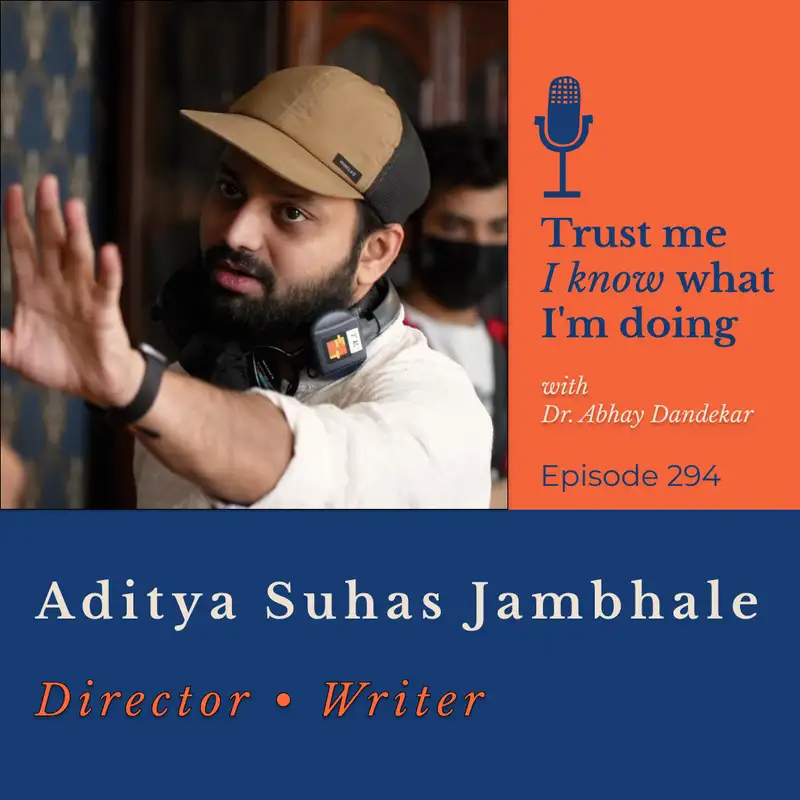
Aditya Suhas Jambhale on Directing Article 370 and Disrupting Indian Cinema
Download MP3Aditya Jambhale (00:00)
first I need to
Abhay (00:00)
Yeah.
Aditya Jambhale (00:01)
prove myself that you know what I found it out because to do a project in the industry is very easy to do a cinema is very tough
Abhay (00:08)
having the security and the courage, both as an introvert and as someone who's discovering through many closed doors. I wonder if through all this, did you really enjoy or appreciate the love of being a disruptor?
Aditya Jambhale (00:23)
I'll be open with you in telling you, I was called Harami for doing these things. if you have an art field, responsibility to make it valuable because if you're not able to make it valuable, you are creating a bad example for anybody who's pursuing art after that.
Aditya Jambhale (00:37)
Hi, this is Aditya Suhas Zamre. I'm a film director. I directed Article 370 and Baramulla. And this is Trust Me, I Know What I'm Doing.
Abhay (01:16)
thanks everyone for listening and watching, sharing with your family and friends, and don't forget to subscribe. TRUST ME I KNOW WHAT I'm DOING is brought to you by Travelopod.
For destinations like Africa, Japan, Antarctica, India, and the Northern Lights regions, start your journey with Travelopod. Visit vacation.travelopod.com.
Abhay (01:35)
welcome everybody to this episode of Trust Me, I Know What I'm Doing. You know, there's a distinct feeling you get when you finish a story, whether it's a movie or a play or a great book, and you realize that you've been truly moved. it could be just a small shift or it could be a seismic jolt, but that emotional resonance is powerful enough that you can't readily shed it.
Even if you wanted to, and possibly it's so sweet that it lingers longer than you expected. Like so many others, I've enjoyed the work of writer, director, and filmmaker Aditya Suhas Jambhale both for the tight content of the stories, but also for the feelings that linger and last beyond the viewing experience. Aditya's career has so far spanned Marathi Naatak in theater to short films and Hindi features, notably, of course, with Article 370 and Baramula.
he's been decorated and acclaimed with national film awards among so many honors And I'm simply delighted to welcome him to trust me, I know what I'm doing. Aditya, it's such a treat to have you join me and thank you so much.
Aditya Jambhale (02:39)
Thank you so much for me too. It's a pleasure being here.
Abhay (02:42)
above all the accolades and all the awards and honors, I I really am so interested in the origin stories behind how people have cultivated their trust in themselves. So I have to ask you, when do you actually remember first falling in love with being a storyteller?
Aditya Jambhale (03:02)
I think it has something to do with me not finding something. That's a sometimes irony of the life is when you go in the wrong direction. think somewhere the conditions and the destiny tells you that this is not the direction where you have to probably go, you're not destined to be. and from my college days also, I was not like right into theater or, you know, films. I remember, but there was one instance which I'll have to mention here, which impacted me a lot. That was the first film I saw in theater.
my father is a dentist, my mother is also a dentist, my father expired long back. But in my childhood, I remember my father and mother taking me for the first time in Goa to one of the theatres and at that time, this is I'm talking about you know, that
1995-96. That time Goa didn't have lot of theatres. I mean I think in Goa there were around 2 or 3 theatres max. So it was something like a, it's a privilege which was like very much rare to really, you know, it's not like you every time go to like how today you can go to a multiplex, a movie.
so whenever Titanic actually got released, I remember my father telling that okay this is a film and my age was that time, I was probably in the first standard if I'm not mistaken.
Abhay (04:13)
Mm.
Aditya Jambhale (04:13)
And
at that time father explained me, you know, there was this ship that got sunk, so you don't have to cry but it's a story, you'll understand even if you don't understand English. And I was always like, I will not understand English because I was already
Abhay (04:25)
Mm.
Aditya Jambhale (04:26)
having that inferiority complex of, you know, not knowing what is English in a way because I came from a
Abhay (04:30)
Right.
Aditya Jambhale (04:30)
Marathi medium.
Watching that film, I remember still, when Leonardo DiCaprio's character dies, at that age, I cried without
Abhay (04:41)
Mm.
Aditya Jambhale (04:41)
understanding a single word of what that film is. That had a huge impact on me at that time, I remember. But never to an extent where I can do something in it. You know, it is almost
Abhay (04:52)
Yeah.
Aditya Jambhale (04:52)
like an impact where, wow, what a power of cinema, I just love cinema, I'm gonna watch it as much as possible. Then of course my...
My school journey started, I started pursuing cricket a lot, okay, like mad, like I wanted to be a cricketer right from the start. I was mad about cricket, like hell,
I used to just practice, literally, it was that crazy passion.
Abhay (05:13)
Right. You were that kid.
Yeah.
Aditya Jambhale (05:16)
Yeah, yeah, yeah, yeah. that was like in till I think I remember till seventh, eighth standard, I was just pursuing cricket. Meanwhile, I was very good at maths. I was good in physics, I remember I started cracking it for Goa for the first time. I started representing Goa in a national level for the first time.
got the opportunity to meet the President of India long back before he won the national awards only because that time I remember APJ Abdul Kalam was the President. my journey in the science and that sector of education was also actually very good in a way because I loved maths and I loved physics. that is little issue because what happens is when you're good at two three things
either it works or if it doesn't work you don't really realize what to do you know so I remember in
Abhay (05:57)
Yeah.
Aditya Jambhale (05:58)
after after giving my 10th I got great thing in 10th and then I went into science stream for the higher secondary so that time I was already representing Goa under 16
I was playing, I got a small injury. In fact, my finger is still a little... this finger. It got a little bit fractured
Abhay (06:13)
Mm.
Aditya Jambhale (06:14)
taking a catch in a season ball cricket match.
Abhay (06:17)
Mm.
Aditya Jambhale (06:17)
And then it led to a kind of a small detour from cricket. And of course, in 12th, you have to think about the career, you have to think about education more seriously. So I left it. Thinking I'll come back to it,
and what do I then prepare for then I have to prepare for IITs because I always wanted
to become an aeronautical engineer.
I wanted to get into flight design I wanted to get into a lot of other factors that were that time possible probably in my imagination and I started
Abhay (06:43)
Yeah.
Aditya Jambhale (06:43)
preparing for IIT and then the reality checked in
because I didn't prepare it with the intent that IIT entrance requires, very frankly. I didn't get into IIT. Then I was just getting into NITs but I didn't get the NITs that I wanted. At the end, I went into Electronics and Telecom.
and like a, like that kind of a guy who is like, you know, there's a tendency when you don't get what you want, you just start criticizing what you have, very immature-ishly, like very stupidly. You think that you are the
Abhay (07:11)
Right. Yeah.
Aditya Jambhale (07:13)
boss, you knew what you wanted, so technically you start feeling like you are the one who wanted it, so you know it. And then whatever you get, you just start, you know, pinning it down to them, like the college is bad, the professors are bad, the education system is bad,
Abhay (07:25)
Mm, yeah.
Aditya Jambhale (07:27)
everything is shit, and I deserve better,
Abhay (07:29)
Yeah, the wor you start pointing fingers everywhere. Yeah.
Aditya Jambhale (07:32)
Exactly.
You start pointing fingers not even, I don't even think you start pointing fingers towards people. I think you start pointing fingers towards shadows, which are not even real in a way. Randomly in the air. Because you want
Abhay (07:40)
Right, randomly in the air. Yeah. Yeah.
Aditya Jambhale (07:44)
to prove to the society, to the family, to everybody that you know what, I did everything possible but it was injustice that happened with me. Which is not true at all.
But I think in second year I remember my HOD was, I had an amazing HOD called Sir Lohani, Dr Lohani I remember he one day said after, you I was a very bad student in that way, like even in engineering,
Abhay (08:04)
Yeah.
Aditya Jambhale (08:05)
I never used to attend classes, I used to go out, I used to go to Bitsbilani, I used randomly if IIT has something I'll go to IIT with and I'll not attend the lecture in the college.
and remember there was something that happened
I'm a cricket fan so that time I there was an India-Australia match and to qualify for the finals, India had to win against Australia like methodically impossibly.
Finally he realised that shit we won. I don't remember which game it was but it was India-Australia. And I came out of the practical, the practical session and I started talking about shit did we just win? How is it possible? And
Abhay (08:35)
Right.
Aditya Jambhale (08:36)
I remember my HOD coming and saying to me, you know what, Jambhale if you can become an engineer now, anything is possible in this world.
and then I started talking to him and then he made me realize that all I do is actually just complain nothing else. at that time, I think you need a mirror and reality check and not it is not going to come from parents or your friends or anybody. It has to come from some kind of a mentor, whichever field he is. But somebody needs to look at
Abhay (09:00)
Yeah, sure.
Aditya Jambhale (09:02)
you and tell you that, know, what is wrong with your your life?
right now, your approach right now and then I stopped. I think that was second year of my engineering and I just stopped complaining completely. I didn't complain about
Abhay (09:12)
Mm.
Aditya Jambhale (09:12)
the education system. I realized everything what I need I have. I will prove if I have the talent in it. If I fail that means it's my mistake not the education system or anybody else's mistake because a student has to understand that at some point. You have much more than what you can get.
And then the point came where you know I didn't understand like what I have to do now because I'm not getting aeronautical engineering. I was a huge fan of F1. So the reason I wanted to get into aeronautical was because of F1.
after cricket if I say it was my dream. So started with one tragedy
Abhay (09:44)
Mm.
Aditya Jambhale (09:44)
and I always felt that I believed it that I'll probably one day play for Indian
Abhay (09:48)
Mm.
Aditya Jambhale (09:48)
cricket.
Abhay (09:49)
Yeah.
Aditya Jambhale (09:49)
There was
no question about that. My mother keeps saying that you don't have scarcity of confidence. You just believe that it will happen and that somehow naivety
Abhay (09:56)
Yeah.
Aditya Jambhale (09:57)
helps you into getting there. At
Abhay (10:00)
Sure.
Aditya Jambhale (10:00)
that time in college, I started actually pursuing art.
Abhay (10:04)
Mm.
Aditya Jambhale (10:04)
Through theatre of course. And that time I remember going through theatre, I just felt a little connect. I felt I can be a guy whom I not or I want to be but I can't show it to the world.
Because I was a very naive kid but yet shy kid. You know those kid in the childhood where know a mother meets a relative, the relative is always going to say you know does he talk ever? You know he talks to you but does he talk ever? That kind of a kid
Abhay (10:30)
Right. Yeah.
Aditya Jambhale (10:32)
and people felt like how can this guy be in a creative field because creative field you have to be expressive and this guy is not expressive at all.
And lot of it had to do with the upbringing, lot of it had to do with the past that I had to face. My father expired long back in, just after first standard my father expired. So I went through things that I feel a child shouldn't go through at that point and that made me little matured and also introvert
But creative field, writing or direction or going on the stage and performing something which is not you,
I just felt like, you know, it's because I was an actor. Before I started as an actor, I didn't start as a writer or director. Because I couldn't act, I didn't get the roles that I wanted to play, I decided to write them. Because
Abhay (11:17)
Mm.
Aditya Jambhale (11:17)
nobody is going to do direct what I write, I decided I have to become a director.
So was an accident, genuinely it was a necessity rather than a passion or you know I didn't know that I know direction. I pretty much felt that nobody's gonna do it because it's just me nobody. Why will somebody direct something that is written by nobody? And there was an arrogance to it also which was I felt right from the start that I know better than what the system knows.
Abhay (11:47)
Hmm. Now I
Aditya Jambhale (11:48)
And that realization,
that I think realization made me feel like, okay, this might work. And in college, I started going through theater, I explored theater for around lot of years, I think 10 years I've done theater. But because I did theater, which is actually the foundation of any creative process that you do, I was so confident getting into the films I was just difficult for the industry to tame. I think that was the,
Abhay (12:12)
Mm.
Aditya Jambhale (12:13)
because I have not assisted anybody.
in my film career also. I have never assisted
Abhay (12:17)
Yeah.
Aditya Jambhale (12:17)
anybody. I have never gone to a film production saying that I have a script and I need funds and I need to direct and you have to launch me.
Abhay (12:24)
Yeah.
Aditya Jambhale (12:25)
Touchwood but because I didn't have to because I always felt if you don't give it to me, I'll do it anyways.
nobody needs to tell
Abhay (12:32)
Mm.
Aditya Jambhale (12:33)
me how I am good at I'll tell the world by the product
So I decided to get into the theatre. I did 10 years of theatre. I did massive project called Vande Mataram, which was like a 2 crore budget. and it had an audience of around 10,000 people. Set which is like around four storied literally like four floor
Abhay (12:50)
Mm.
Aditya Jambhale (12:51)
set. Real animals everybody elephant, horses, real and I got the opportunity to explore the armed struggle of this country
for
Abhay (13:03)
Mm.
Aditya Jambhale (13:04)
who was going to write it, suddenly decided not to write it the producer was pretty much confused and then he said there's this kid coming from a college, he just passed out, maybe he has something because he's doing lot of theatre and he gave me the opportunity and then that is how I got exposed to dubbing and everything because it was a pre-recorded theatre. So, you pre-record everything and you
show it, it's basically lip sync nothing else but the experience of it is pretty much like a a spectacle in front of every you know in front of the 10,000 audience literally. That
Abhay (13:40)
Mm.
Aditya Jambhale (13:40)
gave me the confidence that okay I know how the visual language is I met people like you know I remember Nana Partaker I remember there was this director from Bollywood
he was judge on one of the shows and he came to me and told me that your language is not theatre at all. Like you are right now treating theatre like a film.
And if you're doing that, that means you are actually meant for film. So you have to come down to Bombay and start exploring. I came down to Bombay, saw 22 days I stayed in Bombay. I realized that I have to become an AD. My ego didn't allow me to assist anybody. I always felt I have a better brain than them. And that led to me opening up a company when I didn't even have 50,000 in my bank account.
And I said I'm going to open up a company. I opened up a company. I came back with the same team that actually did theater with me and said we have to do a film. Started doing short films. My first short film got a national award. Second short film got a national award.
So, two back to back national awards and the third film I did I decided to get out of the comfort zone to a Punjabi short film that was called Amritsar Junction which was based on partition. I shot it in Goa
Abhay (14:44)
Mm. Yeah.
Aditya Jambhale (14:45)
not even in Amritsar not even in Bombay with a team that didn't know anything but it had passion to tell cinema.
that film reached Aditya Dhar because Aditya Dhar and me got the national award, my second national award and Aditya's first national award was the same year. So I met him in Delhi and then he said I want to watch the film. He watched the film at that night and decided that I am going to present the film. The moment he saw the film he said I want to launch you.
that point he said that you know what you cannot launch a director until and unless he has a feature So I would rather suggest you that you become an assistant on one of my projects that time it was Ashwathama Which was that time 350-400 crore film that time it was the most expensive film in Indian cinema and I had an opportunity to work with Aditya as probably an associate or something in his team and I just told him in two minutes that I can't do it
I still remember that day I came down to Bombay, my family was looking up for that opportunity and I told
Abhay (15:42)
Right.
Aditya Jambhale (15:42)
my family coming back home that I have rejected the offer because I am not the director. And I
Abhay (15:47)
Yeah.
Aditya Jambhale (15:47)
remember telling the producer of that film, Ronny Screwwalla that
am somebody who can assist Aditya Dhar only because I feel I have two national awards. Aditya Dhar has won. I still remember that line.
Abhay (15:59)
By the way, when you shared
that with people that you've rejected this opportunity, obviously from the outside, that sounds like somebody who is, you know, bold and and daring and crazy to some degree, right? But was that a surprise
Aditya Jambhale (16:14)
Yeah.
Abhay (16:15)
to you? I mean, did that come across as so audacious that it took people by surprise?
Aditya Jambhale (16:21)
It did, it did. I mean, I think it came out as a surprise not just to the people whom I rejected, but I also think it came out as a surprise for my people.
My people started doubting my decisions because they thought that, yarr, this is the worst thing you can do because you don't have any experience, you don't have a godfather and if some opportunity is coming at your disposal, just rejecting it outright thinking that you have what it takes to become a director in this industry which is a pretty much, I mean, let's accept it. mean, Bollywood is not an easy industry to get into as a director. A director
Abhay (16:50)
Yeah, sure.
Aditya Jambhale (16:51)
will at least, in Bollywood, at least he'll need a budget of 20 crores, at least. This is the minimum possible budget.
Abhay (16:58)
Hmm.
Aditya Jambhale (16:58)
presuming
or assuming that you you might get that opportunity in the future just because of your attitude and talent I think the history tells it it's the worst decision ever so my wife my mother everybody doubted my decision at that time saying that maybe you're doing it I mean we're not gonna get into it but just think about it you know
Is it right or do you just take the experience You have to be patient for getting success. I feel that's a wrong narrative. because you have to gauge everything according to the raw material. I don't think you have to gauge it according to the history of what the industry is because Steve Jobs cannot decide
what his Apple is by gauging what other companies have grown up to be into like Blackberry
Abhay (17:41)
Mm.
Aditya Jambhale (17:42)
or whatever it is. The guy has to always think that he is disrupting an industry and if he has to disrupt the industry, the rules are not written at all. So you can't really follow anything. You have to follow something that you genuinely feel with conviction. Yes, I do feel that you have to still bank on the hard work that you do.
So at that time I was very much... It was the worst phase of my life because I felt that everybody is actually doubting what I did. Almost presuming. And I came back to Goa, right? I mean, you are going to Mumbai and then you're coming back to Goa. It's a loss for general society. You're just quitting. And I was trying to explain, I'm not quitting. I'm in fact making a dent in an industry which doesn't have...
you it doesn't know what it is, what you mean by dent.
Abhay (18:28)
You f you
you felt like you were taking a stand.
Aditya Jambhale (18:31)
Yeah, I did.
I genuinely at that time also I felt I genuinely like when I spoke to Ronnie or I spoke to Aditya also I was not trying to make up I was not acting or anything I was just telling him the truth I felt and which I believe even today I always felt that you know I had better in the bag and if I have better in the bag I'm going to trade better it is not that I have a platinum or gold in my bag and I'm going to trade for a silver so I always felt that I even if I do a 2 crore
it's going to stand out more than a 200 crore film because of the talent that I have which even today I feel, I mean even today I feel that people find it difficult to digest it because they are so much engrossed with people who are so desperate to be a yes boss just to get that opportunity just to get that one you know one foot into the foot into the industry that they don't understand that somebody might come here with self-respect and ego so much confident that you know he's going to
reject you on the face of it but I think
Abhay (19:36)
Yeah.
Aditya Jambhale (19:36)
I was also fortunate to get somebody like Aditya I'll tell you the reason because he understood what I'm coming where I'm coming from in fact I would
Abhay (19:44)
Mm.
Aditya Jambhale (19:44)
give it everything because my my destiny was very much shaped better because I was with I said no to Aditya yeah yeah yeah I remember
Abhay (19:50)
Was there a respect was was there a respect perhaps said that?
Aditya Jambhale (19:54)
the first message Aditya sent me after I went back to Bombay because I didn't know that I was going to he's going to give me offer to actually assist I was like
I'm a national award winner. When I met you in the national awards, I was already having won. It was your special moment. For me, it was just a casual routine. I had already done it before. And I'd done it before without any lobby or any support. I mean, my first film got an national award when we were the production company, had not even any reputation. So it's genuine, genuine.
You know, in feature film what happens is, I mean I won't deny it, it always has effects of what is PR, what is happening around, what people are talking about you. In short films, you don't have that at all. So either the jury likes it or they don't like it, simple as that. If they don't like it, they'll
Abhay (20:41)
Right, right.
Aditya Jambhale (20:42)
not get it. Of course, there is a bit of luck, I don't deny that. But nothing like, nothing like, you know, you're trying to say that okay, this project is pretty much important for the country, for the government or for somebody. No, nothing.
It's a simple story. So I came from that confidence that when I'm nobody, I could get a golden lotus. Golden lotus is very rare. mean, it's something that I think I have only two golden lotuses in national awards. The best director in feature film, best director in non-feature film. In my first go, I got it not even for debut director. I got it for film. And I don't take the credit. I don't think my film was the best that year.
short film also. I believe it's not about just the short film being the best. feel the struggle that I had done superstitiously I always believe that the struggle that I had done to make that film I pretty much think that was the best in that year.
Abhay (21:31)
friends, may have visited Italy and seen all the highlights, but exploring Europe or Asia for a more immersive vacation is where the details truly matter. That's why so many trust Travelopod for personalized custom experiences. From small
group travel to complex planning for any destination, the pros at Travelopod can help make your trip seamless, affordable, and unforgettable. With thousands of five-star ratings and stress-free booking and support,
Travelopod is your trusted partner for unforgettable experiences around the world. Visit vacation.travelopod.com.
Abhay (22:05)
Hi friends, this episode of Trust Me, I know what I'm doing is brought to you by Lotus Lane Coffee, a South Asian woman owned coffee brand that's roasted in Columbus, Ohio.
Every small batch bag begins on farms across India and ends in your cup with depth, intention, and story.
Lotus Lane Coffee, rooted in India, roasted in Columbus. Discover the beans, the mission, and the journey at lotuslanecoffee.com.
Abhay (22:30)
I'm trying to connect the dots between the love of a thrilling sport like cricket, the love of a thrilling endeavor like aeronautics, the love of fast, dangerous but incredibly thrilling driving like F1. And, this idea of,
Constantly sort of having the security and the courage, both as an introvert and as someone who's kind of discovering through many closed doors. I I wonder if the love that you that I asked you earlier of being, when did you fall in love with being a storyteller, did through all this, did you really enjoy or appreciate the love of being a disruptor?
Aditya Jambhale (23:15)
Yeah, always, always because I felt that made me feel relevant in some way and if I'm not
Abhay (23:23)
Mm.
Aditya Jambhale (23:23)
able to do it, I just felt useless. If I'm trying to follow what is the norm, I'm just, I'm getting your acknowledgement but that acknowledgement is coming because I'm following certain rules and proving your rules. To opposing that, I feel all the, in fact that's the beauty of the other interest that I had, F1 for instance.
I was a big fan of Lewis Hamilton. Now Lewis Hamilton is not coming from a typical big family in Italy or know in Germany. He's coming from a very small economically backward or let's not call it backward but economically not so good. Yeah modest, modest
Abhay (23:58)
Modest. Yeah.
Aditya Jambhale (24:00)
setting. His father didn't have, his father tried to work three four jobs just to see to it that he can go in go-karting.
But when he came back into the Formula One, he just disrupted so much so that the whole thinking that Michael Schumacher is the best probable Formula One driver we have was completely shattered.
Even today it's shattered because Michael Schumacher is now, now we don't think about Michael Schumacher. We always talk about Lewis Hamilton. You know, was there were Vettel who tried to break his record. Today Westhappen is trying to break his record. But I don't think it's that easy. It's almost like, you know, trying to break Sachin Tendulkar's record. It's going to be tough for even a Virat Kohli, even if it's great. It's one of the best, no doubt.
But the same thing happened with cricket because cricket is so rare, it's so difficult that somebody trying to think that I will be getting into that top 11 itself is a problem for families, for society that it's not going to happen bro. Why are you trying to chase that dream?
That has shaped my upbringing and ideology also when it comes to films. So at no point even in my short film career or even when I did Article 370, the reason I did Article 370 was no director was going to dare do a political drama.
I was pretty
Abhay (25:10)
Mm.
Aditya Jambhale (25:10)
sure nobody has the guts to do it because he's going to say there will be controversy, will be things around, even Aditya. I mean it's one thing to do a film on a Uri attack.
which is an adrenaline rush but when you are told that you have to do a film on a legal standpoint, a legal drama, literally something that is on paper, there is no attack, there is no missile that is going to come and rupture the enemy, you don't have that adrenaline rush. How are you going to make it happen? That how are you going to make it happen made me feel like I have to take that punt, I have to take that risk, I have to climb down, literally.
Abhay (25:43)
Right. Almost that that's
the that's the parallel of the, you know, rebel, the idea of, you know, disrupting the the courageousness, you know, perhaps that it takes. But it also, you know
Aditya Jambhale (25:54)
And I realised that underdogs,
feel also, just cutting you sorry but I
the underdogs now I feel always have to have rebellious thing. We don't have a godfather.
If we go
Abhay (26:04)
Mm. Yeah.
Aditya Jambhale (26:06)
thinking rebellious to rupture things, I think even if we don't end up where we want to, yet it is going to be like you aim the sky, you fall on the tree.
you know because of certain aggression
Abhay (26:16)
Mm. Yep.
Aditya Jambhale (26:17)
I feel and if it is in the right intent if you are giving everything in for it not just trying to say that it's a PR game the people who don't want you to be successful are going to find it tough because you're too strong now so even if I take you down that down is not going to be down enough for you to not get up
which is I think very critical for underdogs who don't have any godfather, who don't know what to do, how to do. So, I understood that era before and plus the politics in this industry, the ego dynamics in this industry are so, so, so deep that I don't think a guy who is coming with that attitude that I'll just prove, I'll be good with my master, I'll just be loyal to my master. No, there is no master.
because that master is also going to give away you and throw you under the bus when the time comes. You have to think that you know you're doing it for your team, you're doing it for the people who are loyal to your vision and then end up the devil in some way. You know even if people don't like it otherwise you can't win.
Abhay (27:16)
Does that do you have to have a loyalty in some way to the craft of being the storyteller? And and one of the reasons that I'm asking that is because when I think about you going from an award-winning s short feature or a short film to then something that has a pretty large grand scale operational production like an Article 370,
is the core of it still being bold enough to know that the story
Is the central anchor to all of this. So you can rally around being loyal to the story, independent of all those deep relationships that you talked about within the industry. Is that what made it easy for you to jump from the success you had with short films to then to a larger sort of feature production?
Aditya Jambhale (28:02)
I'll say both ways, I think you're right in that because the story has to be. See, the ego, the self-respect, the arrogance, whatever you are trying to build your persona on, I think at the core of it has to be the story that you're telling because that is the only USP you have.
So at the end of it, think the loyalty to the craft is the most important thing. But having said that, I think the transition from short films to the cinema became easier because I treated short films like cinema and not like art. Now there is a trick.
Abhay (28:34)
Yeah, sure.
Aditya Jambhale (28:36)
Usually if you see award-winning short films also, sometimes, I mean, I'll be hated for this comment, but sometimes I feel they are boring.
it's not entertaining enough. You can't just show me a guy walking on the road for minutes and say that it is art and it is true, it's so realistic. No! If you want to make that much realistic, very non-dramatic thing which doesn't entertain me at all, then you make a documentary. I understood this difference long back before I started
Abhay (29:03)
Sure.
Aditya Jambhale (29:06)
doing my first short film. So when I did my first short film Aaba Aiktaay Naa my point was the climax has to be still like a third act of a cinema.
It cannot be like, it's trying to make some metaphorical pathos and these big, big words people use, because see what happens is now it's easier for younger generation because writing drama is difficult. Writing an entertaining drama is difficult. Writing a boring drama is very easy. So what youngsters do is
Abhay (29:29)
Right, right.
Aditya Jambhale (29:30)
they try to write a very bad, boring drama and then say that I'm inspired by Satyajit Ray.
Abhay (29:36)
Mm.
Aditya Jambhale (29:37)
And in doing that they are tainting the name of a legend because Satyajit Ray never wrote a boring drama. He never did that. But because
Abhay (29:44)
Yeah, yeah.
Aditya Jambhale (29:45)
your understanding is interesting is maybe when there is an action. Interesting is when there is some kind of a comedy. No. Interesting can be anything where you are invested. You as an audience if you are getting invested even in a scene where people are crying, it's fine. That is interesting. That is
drama. But...
because of that immaturity lot of people try to get away with this fact that you know what I don't I can't write it so let me take this punt of being a very arty director.
Abhay (30:12)
Hi, I'm Abhay Dandekar and if you have an animal in your life that you love, then I want to introduce you to the Timber Dog Ruff Rest, the only dog bed you'll ever need. compact and light with over 14 travel features, comes in three sizes and has everything from storage for essentials to a built-in sleeping bag. The New York Times Wirecutter calls it a versatile portable dog bed with lots of extras for traveling or camping. Go to timberdog.com to explore Ruffrest
the only dog bed you'll ever need.
Abhay (30:41)
So in a way you you always were
thinking of it in reverse, right? So that the idea of making sure that it's entertaining, making sure it's compelling, the same way that a feature would, is why it was that the accelerator for the success in any medium, whether it's Naatak whether it's short films, whether it's features?
Aditya Jambhale (30:58)
Yeah, yeah, I was, I used to get angry when people used to tell me that in my drama I have to, I have to have tickets which are less than 200 rupees and I used to ask them why
Abhay (31:08)
Mm.
Aditya Jambhale (31:08)
and then people used say because we are no one.
And then I used to say that let's put up 500 rupees ticket and let's be arrogant with it because if you are coming after I've worked for three months on that particular drama, I'll make sure that you get entertained but you have to make sure that you market it well. You have to make sure that you are putting a ticket of four or five hundred rupees because of which even in my state, of the people whom nobody used to approach because they used to say if my name comes up, that's a very difficult guy to work with. He's very arrogant. He can be very selfish.
I'll be open with you in telling you, I was called Harami for doing these things. But my point was, if you have an art field, it's your responsibility to make it valuable because if you're not able to make it valuable, you are creating a bad example for anybody who's pursuing art after that.
So you can't take the business out of it.
You have to think about the business, otherwise you think, say that it is a hobby and do whatever you want for free of cost. That's
Abhay (32:03)
Right. Right.
Aditya Jambhale (32:05)
a service that you give to the audience then. But if you are thinking about it as a career, you have to understand that you can't give it. Today I get called to multiple programs and all and I tell them that I can't and they ask me what's the reason, are you not free? I said I am free but I not, I don't want to do a work which is not paid.
For saying that in a society like Goa or a society like even in Bombay where you are, you know people think that the relationships can be used in that way but no it can't be because if the
Abhay (32:30)
Yeah, yeah.
Aditya Jambhale (32:31)
movement I do that
I am depriving the next people who are looking at me and saying that you know what I am going to make a career out of it.
So yes I think at the core of it.
It does matter that knowing the financial aspect of it, going to rupture it but at the same time it has to be a business. How can you make it interesting? the reason why I did Article 370 is because people told me that a legal drama can't be entertaining. That made me feel like, how can you say that? How dare you say that? When you have somebody like me
Abhay (32:57)
Right, right.
Aditya Jambhale (32:58)
in the team. So it drives you, you You might go wrong. I mean completely you might flunk. That scare was always there. It was not that I always knew that I'll be successful.
But yes, it was an energy that I required to be rebellious saying that it is going to happen. This is going to be the first political drama in India and it's going to be entertaining. It's going to be cool. You know, it's going to be sexy in some way.
Abhay (33:22)
When when you think about again the demands that it requires to set the bar that high and
Aditya Jambhale (33:32)
Yeah.
Abhay (33:32)
be audacious and be courageous to say, look, these are my expectations. Like it or not, this is the way it's going to go. the end, of course, like anything else that's successful.
These things are not necessarily individual endeavors, right? They require collaboration, they require a lot of teamwork. You have to obviously work in an ecosystem of individuals. And particularly, I mean, one of the things I loved about Article 370 was not just for the strength of the content, but in fact the portrayal that was done by the characters, and particularly, you know, female characters and women.
In in any of your films, do you have a philosophy that given what we just talked about with how disruptive you appreciate being, do you have a philosophy when you work with strong actors on how to collaborate, what kind of leeway that you're affording them, what kind of opportunity you're affording them, or for that matter, what kind of rigidity that has to be adhered to when it comes to following a particular storyboard or the script?
Aditya Jambhale (34:39)
I'll give you an honest answer to this. think when it comes to actors, there are two sets of actors. One actor is coming with a lot of PR, lot of brand value, like a lead actor for example in
Abhay (34:50)
Mm-hmm.
Aditya Jambhale (34:51)
370 you have Rajesh, have Priyamani and Yami coming.
it literally from from very high at that time I didn't I had not worked with a star in a way and then there are actors which are great actors but they are not leads per se like dr. Mohan Agashe for example I worked with him on article
Abhay (35:09)
Mm, yeah.
Aditya Jambhale (35:11)
370 don't think as a new budding director I ever got that got that liberty I would say
to channelize these demands the way you have actually right now put across. It was a struggle. Again,
Abhay (35:24)
Mm. Hmm.
Aditya Jambhale (35:26)
I will go back to the title that your podcast has right now, which is Trust Me, I Know What I'm Doing. Because you are so young, coming and doing your first probable film in the future, handling a budget which is more than 40 crores at that time.
and you're young, the moment I shave I look like an 18 year old. Okay? So,
Abhay (35:47)
Yeah.
Aditya Jambhale (35:48)
there is always that tendency that the actor would have that you know what I've done 40 films or 30 films or 20 films. And I know better. Which is good, in certain way it is good because it tries to aid their feedback, it tries to mix what they think about a scene and do it. But at the same time, when you are too clear about what you want, then it's a problem.
because the actor is not coming empty handed. So
Abhay (36:09)
Yeah.
Aditya Jambhale (36:10)
it's a struggle which I feel only through right mind games a director can face, especially a new director.
Abhay (36:18)
Mm.
Aditya Jambhale (36:20)
So I think there, in that kind of a portion,
you have to be smart, you have to make the actor fall in love with you, also fall in love with the trust that he has to build. The moment you have that trust factor done, then it is very easy, then it doesn't become a problem at all. Then the actor will come to you and say, you know what, I think this is good, but you tell me what it is, you tell me if there is a problem. But to reach there
Abhay (36:43)
Hmm. Yeah.
Aditya Jambhale (36:45)
from the first stage where you know the actor is saying, I think it has to be like this, this is wrong what you are doing.
From there to reach there, you have to make the actor feel like there is no war but technically there is a war. You don't make him
Abhay (36:57)
Mm.
Aditya Jambhale (36:58)
understand it and just because of the insecurities he has and because of the other vulnerabilities he has, you almost play mind games with him and take him to where you need him to. This is the truth.
Abhay (37:10)
It's kind of a me meandering
relationship that you have to develop.
Aditya Jambhale (37:14)
Yeah, yeah, I do feel
But I think it boils down to that with other actors, the secondary actors or the actor-actor, not a lead actor but actor-actor, not a hero or heroine. I think they are very sorted.
Like with Dr. Mohan Agashe, I felt I'm gonna have a tough time because Dr. Mohan Agashe is veteran Marathi actor since Jayatreya Jayate and all these other eras. To do and direct him at that age, I felt I'm just not... probably he's going to feel that I'm not even worthy. So at after stakes,
Abhay (37:41)
Mm.
Aditya Jambhale (37:42)
I used to ask him, do you want to go on the monitor and check what I've shot? And Dr. Mohan
Abhay (37:46)
Mm.
Aditya Jambhale (37:47)
Agashe told me one line, I'm an old time actor. I believe in my director. Finish. Slitch. Done.
I don't
Abhay (37:54)
Yeah.
Aditya Jambhale (37:55)
doubt it and I don't go to the monitor and try to see how am I looking. You will know what I have to do. You will do it very well. I was so surprised because the new age actors don't have that ethics. I feel they are so much worried about how their hair looks, their makeup team is gonna come and do...
shit off loads even if a take is good they will say I need a retake because there's a there's one hair but that actually remained on the face you know and they want everything to look like it's a it's a cotton candy Diwali kind of a frame
Abhay (38:24)
Picture perfect, yeah.
Aditya Jambhale (38:25)
picture perfect you know and but these veteran actors I think teach you so much about the old ethics of the actors real actors I would say so that was a great great learning also for me
Abhay (38:37)
I mean, it's almost a a a very healthy professional swagger that you learn. And I'm I'm imagining that on the set or with a team that it actually makes you a better leader and it actually, you know, develops that team trust also.
Aditya Jambhale (38:53)
Yeah, yeah I agree, I agree. see the team is also, see team is the most closest to the director. They know what the director is wanting because they are sitting with the director for a long time, even more than the actor. So when the actor suddenly starts saying no, no this is not how we have to do it, this is the way we do it, the team feels vulnerable. Team is almost trying to understand it doesn't make sense, so how are we going to do it? If we do it that way, film is not going to be good or the scene is not going to be good. At that
Abhay (39:18)
Mm.
Aditya Jambhale (39:19)
time when they see a director,
maneuvering through what he wants, you know, sometimes you have to tell the actors, you know, when they try to act too smart, you have to tell them, okay, okay, fine, you know, maybe, maybe it is good, let's do it, let's take one take, whatever that take is, even if it is stupid, even if it's not that all good, I just say okay.
the actor is happy, I took it. Then I come down and say, you
Abhay (39:37)
Hmm. You did it.
Aditya Jambhale (39:39)
know what, let's do it another way also so that we have a backup otherwise we'll not have anything. Then he's like, okay because
Abhay (39:43)
Yeah. Right.
Aditya Jambhale (39:46)
you have done and acted according to what my demand was, it's great. But now the problem here is the moment I say I need it in certain way, now I'm going to make him struggle for maybe four more takes.
because at first take
Abhay (39:56)
Mm.
Aditya Jambhale (39:57)
for me, I was always an NG but he doesn't realize it. I am going to decide it on the edit table and by the time the actor is going to watch the film, he is not going to remember what he did because by the time he is doing 2-3 more films and coming back to it. So, it's a politics. mean very frankly it's politics, you know, but for good. I think it's a politics but for the good for the film. I think it's the intent is never wrong or ego. It's to make the film better. That's the only agenda. If at some point maybe actors are right. So, I also enjoy that when something that actor says
either it came out right then I don't mind actually completely trashing what I did only because it's
Abhay (40:30)
Mm.
Aditya Jambhale (40:31)
working for the film it is very great it's great for the film you know overall
Abhay (40:35)
it's still out of respect for you know what the ultimate
Aditya Jambhale (40:37)
Yeah.
Abhay (40:38)
outcome and the product is going to be. I wanted to ask you because out of all these, right, it it seems like your approach to a project comes with again the audacity of being able to do something that somebody else may not be willing to do. And I was struck, of course, by again trying to connect the dots here, but if you go from
The connectivity between Article 370 and something like Baramula, with the common anchor being in Kashmir, is there a natural connection that you found as a filmmaker that goes beyond just the geography and the environmental setting, but still kind of respects the idea that these both of these projects were anchored in Kashmir? And and by the way, I mean, did did you have fun going from
This kind of project like Article three seventy to sort of a dramatic horror type of genre?
Aditya Jambhale (41:33)
I'll tell you now the reality. The reality is I shot Baramulla before Article 370. Technically, Baramulla
Abhay (41:39)
Mm.
Aditya Jambhale (41:39)
was my first film, debut film. Article
Abhay (41:42)
Right.
Aditya Jambhale (41:42)
370 was done after Baramulla. So, the reason of it is very simple. When you're banking on a new director, the budget is always going to be a problem, the casting is always going to be a problem.
So when I wrote Bara Mulla, I went from top actors and you know I started going down, going down, going down, going down, going down and at a point I realized if I try to look at it that Bara Mulla with star, I think I'll never be able to shoot that film. Like you know a star because I went to stars
Abhay (42:08)
Mm, okay. Yeah.
Aditya Jambhale (42:10)
that time.
And I also realised that the film demands lot of performance which is a tricky thing, a star might not be able to do that and maybe he takes it over to a different genre altogether. And it's your first film, it's your first baby, you don't want it to be a different baby altogether. You want it to be what you want it to be. At that point I took a hard decision with Aditya saying that you know what, I have to shoot it, so I'll shoot it with an actor.
Aditya said there is only one ground ball, if you shoot it with an actor you have budget which is nothing basically. So I had a budget of 15 crores for Baara Mullah. We shot that entire film in Kashmir in 23 days. I still feel in the next coming decade also it's gonna be the fastest shoot ever in Bollywood. 23 days is impossible
Abhay (42:49)
Mm.
Aditya Jambhale (42:50)
task for to shoot a action thriller film which has so much of climax, so much of emotion, so much of action around chase, this, that and you know it's a lot and in 23 days you are shooting it in minus 18 where probably the
day length is pretty much not more than 8 or 6 hours because after that the sunlight goes so you can't even shoot. So it was like that first baby which nobody trusted apart from the director and the team.
Everybody felt this was going to flunk big time because it doesn't have the budget, it doesn't have the resource and it is actually being shot in Kashmir which was against whatever my producers told me. My producers told me
Abhay (43:24)
Mm.
Aditya Jambhale (43:25)
you shoot it in Bombay, make up a set, probably just shoot the exteriors in Kashmir, rest everything you have to shoot it in Bombay. I said in my first film I don't want to cheat the audience because I don't trust the VFX departments in India at all. No disrespect but I think it's a reality check. We're not at all good. We're just
Abhay (43:40)
Sure. Sure.
Aditya Jambhale (43:41)
ruthlessly bad at it.
So I said I want the audience to feel the cold, I want the audience to feel it, that's why I shot it in 23 days in Kashmir. The moment I finished the film, I remember I came back to Bombay and then in seven days I got a call for Article 370 because the output
Abhay (43:59)
Mm.
Aditya Jambhale (43:59)
of Baramulla, whatever it was, people thought it's just not a 15 crore film anymore. They felt like
Abhay (44:06)
Mm.
Aditya Jambhale (44:07)
the way the visuals look, it looks almost like it's a 40 crore film at least.
Abhay (44:12)
Right.
Aditya Jambhale (44:12)
So you are trying to portray something that was not even in the resources and you know Kashmir so much. Aditya was not in a position to direct Article 370 at any point. He was not comfortable with the fact that there is no adrenaline rush in the film. It's too much technical.
Abhay (44:27)
Mm.
Aditya Jambhale (44:28)
As an engineer, I loved that. As an engineer coming out of
Abhay (44:31)
Yeah.
Aditya Jambhale (44:31)
information, I just felt information is a USP in this film. We have to utilize it. It's a
Abhay (44:36)
Mm.
Aditya Jambhale (44:36)
drama. That all deleted clause and everything. It's superb. It's just like you have to make it cool. Then people are going to understand it. It's going to be a civics lesson maybe for people who coming ahead. And then I made Article 370 Kashmir again. But if you ask
Abhay (44:50)
Mm.
Aditya Jambhale (44:51)
me, Kashmir, the first time I actually chose Kashmir, there is a connect between Goa and Kashmir, feel.
Lot of people don't know that but like what has been portrayed in Baramulla, 1990, genocide and exodus and everything. mean Goa has gone through way worse. Okay,
Abhay (45:09)
Mm.
Aditya Jambhale (45:09)
I just feel it's just not known to the public because of the way cinema has portrayed Goa today. Goa has been portrayed like it's a land of, it's a tourist land, it's a land where you can get alcohol very cheaply, there are clubs around, there are beaches, it's hippie culture and everything.
It's not that at all. I always keep reminding people this. Yes, India went through a colonialization of 250 years, right? Where we lost so many lives, we went through so much of discrimination, so much of,
Abhay (45:37)
Sure.
Aditya Jambhale (45:37)
you know, issues and everything. But I used to always say this and people hate me when I say it in that way. I always feel when it comes to Goa now, they eat that colonialization chapter for breakfast because Goa was ruled for
Abhay (45:50)
Mm, sure.
Aditya Jambhale (45:51)
450 years.
450 years of colonization and yet if you compare it with any other land in the world where colonization is so much even in pan India if I look at the cultures in Kashmir for example they have died
Abhay (46:09)
Right. Right.
Aditya Jambhale (46:10)
The
culture that was there in Kashmir, has completely died. If you go to Kashmir today, you will not see that the old 70s ka thing, will not see the pancha tantra, you will not see anything. You will probably see the residue of certain things which are left. You come down to Goa, the cultures are surviving.
They have not, forget about extinction, they have not even deteriorated by 5%. So, I
Abhay (46:33)
Mm.
Aditya Jambhale (46:33)
always feel I have that ancestral baggage which I understand what it means to be resilient in your culture. How do you make a culture resilient enough that 450 years of it and mind you there was a huge chapter of 150 years in that 450 years which was the darkest chapter which is literally
something that the entire Indian subcontinent has never seen. You can see, go back to Goa, look at it, you'll understand the torture. It's nothing close to what we talk about anywhere else. That pain
Abhay (47:06)
Yeah. What
Aditya Jambhale (47:08)
connected me to Kashmir.
That pain I felt, I didn't feel like I'm doing and exploring a different land altogether because when I met Kashmiri Hindus in Kashmiri Pandits and Kashmiri Hindus in Goa, in Bombay, I realized that that want of the resilience and that resilience saying that I'll still go back to my home, that hope to say that I'll still try and survive, I'll still make up a good life and I'll teach my grandchild what Kashmir meant, you know, why you have to also go back there and see what is snow.
And that grandchild is growing up in Bombay, he growing up in Delhi, he doesn't have that urge. But the grandfather's urge to make him understand why you need to have that urge. When I saw that, I felt connected to it in a way where I didn't even feel that it was a different place. Yes, the dialect is different, language is different, culture is different, no doubt. But the soul of it, no, the backbone of it, I felt, it's pretty much a subset of Goa.
I don't think
Abhay (47:59)
Mm.
Aditya Jambhale (48:00)
it's like Goa, I think it's a subset of Goa. It probably is like a 10-15 % of what Goa is. So that gave me the love and everything towards the land and then I started really preparing Kashmiri dishes in my house when I was writing it. started
Abhay (48:15)
Hmm.
Aditya Jambhale (48:16)
speaking a little bit of Kashmiri. I started, when I shot in Kashmir, I was one of the only crew members to always be in Pherans
I like most of the times I was to be in Pheran because it made me feel like I belong to the place only then I can do justice to it
Abhay (48:29)
Yeah. Right.
Aditya Jambhale (48:31)
and when you do it so convincingly the only aspect which can be little tricky is when you do that kind of a film and the producer is a Kashmiri Pandit lot of people try to evade that fact thinking that you know what
Abhay (48:43)
Yeah.
Aditya Jambhale (48:44)
a Kashmiri Pandit was a producer so probably Kashmiri Pandit had lot to do with it but
Abhay (48:48)
Mm.
Aditya Jambhale (48:49)
When you do it with such a great involvement, it makes it so believable that you might even try and link it to somebody who is a Kashmiri Pandit in the team and say that you know what, probably that was a guy who was very helpful in that. Of course, Aditya was but at no point I felt I needed anything.
At no point I felt that I genuinely needed the emotional factor of Kashmir. I already had it. Yes, technical factors I needed the support. You what is it? What do you say? How do this dialogue will come out? You know, that all. But overall, think and another trick was that I worked with Kashmiri actors. didn't take 70 % Mumbai actors, transferred them to Kashmir and said this is a Kashmiri film. In Bara Mulla or
Abhay (49:30)
Mm.
Aditya Jambhale (49:30)
Article 370, huge amount of actors are Kashmiris. In Bara Mulla, I think it's more than 85-90%.
I think more than that other than the main lead actors I think nobody and even main lead actors are technically Kashmiris so Basha Sumli is a Kashmiri, Manav Kaul is a Kashmiri so
Abhay (49:46)
Right.
Aditya Jambhale (49:47)
you might find maybe two or three characters in the entire film who are not Kashmiris which helped me a lot because they came with that culture I didn't have to struggle much
Abhay (49:56)
You you know, when you embark on some of these stories, which you're passionate about, right? I mean, making the link between something that holds a dear place in your heart, like the place you've been brought up and raised, to a flashpoint of an area like Kashmir that is much, much more sensationalized and has the attention internationally.
as much as the attention that a place like Goa and its backstory demands and deserves, you know, having gone through the experience of taking a story like Article 370 to a place where it is now, securely anchored in the public discourse and what the dialogue is around film and cinema from the last few years.
obviously with its award-winning stature, but you've had to, in a way, in the aftermath, sort of thread that needle between telling a story and what some would call is propaganda. And when you think about that, is there room to spark debate and public discussion? Or is that kind of constant polarizing you sit on one side or the other?
because that's unfortunately the society that we live in right now, that kind of black and white they want you to take aside. is that unavoidable when you're thinking about this? Meaning that, like as you're even creating the art, as you're even telling the story, that narrative is that always in the background of trying to thread that needle between telling a story about a legal judgment.
and of course the idea of propaganda out there.
Aditya Jambhale (51:41)
Yeah, yeah, I think so. think so. knew it when I started article 370. I knew that this problem is going to happen. We all knew it rather. We knew that the propaganda narrative is going to come the moment the first asset is going to come out. What I feel
Abhay (51:53)
Mm.
Aditya Jambhale (51:53)
is see, I think there is one thing which I keep mentioning. There is a responsibility of a filmmaker and there is a responsibility of a reporter, a news reporter. I feel news reporter cannot have an opinion. He can tell you what
Abhay (52:05)
Sure.
Aditya Jambhale (52:05)
is what has happened. This is what happened. This is what happened.
Okay, both the sides. But he is not allowed to say this is better or this is not better or this is what I like as opposed to this is what I hate. A filmmaker however, I feel, has to be expected to give an opinion. Because if he doesn't have an opinion, why is he doing the film? Then it is a documentary. Then it's a docu-film. Then you can call it a docu-drama. So, when it came to Article 370, I asked one question to myself.
Do I like the fact that Article 370 was abrogated? From the knowledge that I have about Kashmir, about my country, about the politics of last 70 years, everything, from since the partition, everything. And I was always interested in history. So I was always somebody who loves, not just this country's history, I pretty much like studying Middle East, like studying US, I like studying US politics, Democrats, Republicans, everything. It's one of like
Abhay (52:54)
Sure. Yeah.
Aditya Jambhale (52:55)
my favorite topics.
I've asked myself, did I want Article 370 to be abrogated? And the answer was, of course, hell yes. Because my simple notion was, take any country in the world, so-called the the Masiha of democratic country and democracy, which everybody thinks it is US, if tomorrow there is something like that happened in Chicago,
Somebody is doing a civil unrest and saying that okay, we have a different distinct nothing is going to apply from what you say in the White House what happens next day? If you decide tomorrow in Chicago that let's have our own national anthem. Let's have our own flag Okay, even if it's like just 200 people sitting together In no country in the world. This is going to be ever tolerated that there is a separate
entity you are doing some modifications in the law to give it almost you're not calling it a nation but it is almost a nation. They don't need to stand up when there is a national anthem and my second point was it is not like it is not an issue like you know it's a disputed land for me at all ever. It has a
Abhay (54:02)
Mm.
Aditya Jambhale (54:02)
history which is four five hundred years old history you know the name Kashmir is coming from Kashyap.
Panchatantra was written there. So yes, there have been seven exodus till date in Kashmir of Kashmiri Hindus. So I asked myself, where do I stand on this issue? And my standpoint was, yes, it had to be abrogated in this country. Whatever happened on that date in 2019, it had to be done. Now, the second question, why the story has to be told? The story has to be told because not even CIA has that kind of a success rate in any operation.
not even America, they tried to get out of Vietnam, they got pardon my language but they got screwed to the core, they tried to get out of Iraq, screwed to the core, they tried to get out of Afghanistan, they just got screwed to the, it was an example to set now, the way that the pictures, images on internet are enough for us to understand there was no plan whatsoever. However, on the contrary,
you have Indian nation which is not expected to do much good in these kind of aspects is able to do that so strategically in a way where there is no chaos, no stone pelting, no death of innocent on the streets, and yet it is able to take the abrogation out completely. I think that deserves the credit for the team.
I not saying for the government or for the leaders alone. I think it's the team which
Abhay (55:24)
Sure, sure.
Aditya Jambhale (55:24)
is working on the ground root. I think that was enough for me to understand that the intent is right. Now,
Abhay (55:30)
Mm.
Aditya Jambhale (55:30)
the narrative about the propaganda, there is no way you can avoid it. I
Abhay (55:34)
Mm.
Aditya Jambhale (55:34)
got criticized for showing PM Modi and Home Minister. My question to always people was, do you think you can abrogate Article 370 without the help of Home Minister and without him and the PM of this country being part of it?
the actual mission, the research papers that I got, not even the, not even the PA of the Prime Minister did know that what is the actual bill being passed on 2019 that day,
So you understand how much covert it was kept. Yes, were speculations around but there was also speculation around that Yasin Malik is going to be hanged. were speculations around
Abhay (56:07)
Mm.
Aditya Jambhale (56:07)
maybe something else is going to happen. The way they kept it under the wraps took the international support also of course everything has politics in it. It is not like a I am not saying it's a great thing to do like WIP leader has resigned on the morning of that bill passing. Now WIP
Abhay (56:21)
Yeah.
Aditya Jambhale (56:22)
leader has the opportunity to actually disqualify the votes coming from his party to the present party. So it's
Abhay (56:27)
Mm.
Aditya Jambhale (56:27)
almost like if Congress five people
are voting for BJP, a whip leader can say these votes are nullified, they are zero, I am not counting them. But why does a whip leader on the morning of the actual 5th August, he is resigning on Facebook. Imagine the drama that must have happened behind and it will be
Abhay (56:41)
Right. Right.
Aditya Jambhale (56:43)
arm twisting, I am not saying it is not politics, it must have had some dark things also in it. But this
Abhay (56:46)
Yeah. Yeah.
Aditya Jambhale (56:48)
is exactly what happens in politics, so when you are saying that you have to do a political drama, that's what it is.
so when it came to propaganda, my answer was only this that you know, my PM is coming when he's needed. He doesn't come in the first half. He comes after Pulwama, after we have been hit so badly.
That is the time
Abhay (57:07)
Mm.
Aditya Jambhale (57:07)
when my Prime Minister shows the face to the country and to the audience. So I think this is the maximum thing I can try to not cross that thin line because it is a thin line. At any point if I start enjoying that process I feel I should tell my actors I'll tell you that that incident. So Amit Shah got such a great response the character he got such a great response in the theatres people used to blow whistles and all.
One line I used to tell Rajeshwari and Amit Shah's character again and again to Priyamani and Kiran Karmarkar sir was, don't enjoy the joke or taunt that you are making.
Abhay (57:38)
Mm.
Aditya Jambhale (57:39)
There's a difference. You making a cracking a joke on the opposition or giving a taunt which works greatly and people laughing at it and you saying, you presuming that look how I nicely have made a joke.
That is, that is wrong, that is propaganda for me. The day you do that, now the actor starts preparing like, this is a Masiha, this is a great guy, look how I defeated him. No. B, just respect the Aadhaar that a Home Minister will have, respect the subtlety he will always carry by respecting the opposition. Even if you look at the opposition character the way we have shown it, he is a very smart guy.
Abhay (58:14)
Mm.
Aditya Jambhale (58:14)
He's
taking out the right points. I mean, I'll be hated for this comment also, but I don't think there were smart guys enough during that argument, actually. I tried to show it in the film just to make opposition feel stronger in some way because there is a balance. So, it all boils down to not enjoying it at any point. You can't, as a filmmaker, you can't be like, look how greatly, look, this is against this particular government and that government is great. I'm going to make a C.T. Marr movement at that particular point. No.
You have to do it with authenticity especially with a political drama like this. If you do it with that intention that you know I am also enjoying. I love Amit Shah. I as a filmmaker is loving Amit Shah the way he did it.
Wow! Wow! am screwed.
Abhay (58:52)
Hmm. Yeah.
Aditya Jambhale (58:55)
I am done. Because then you will see that through the screen. And then on that screen you will see my intent not very clear. You will feel that he is so obsessed with something that he is telling a story. But obsession cannot come into the
Abhay (59:06)
Let me
Aditya Jambhale (59:07)
screen.
Abhay (59:08)
and and with that same ethos, let me ask you this, Aditya, because
Aditya Jambhale (59:12)
Yeah. Yeah.
Abhay (59:13)
you know, going through an experience like that where it is in the back of your head and you are really traversing very, very uncharted territory for yourself, did the experience make you stronger and more empowered in now that you are, you seeing new projects or or thinking about other possible topics?
or did you feel sort of like boy that that really took a lot out of me and did not necessarily defeated, but you know, it took its it took took its toll, perhaps.
Aditya Jambhale (59:45)
No, I don't think it took a toll, rather it took me, yeah it made me strong as definitely because it was such a huge exposure coming because I had done Baara Mullah which was a very different film. Nobody was there, if we ask for a BMW we'll get a Bail Gadi. That is the scenario in Baara Mullah. Okay. And suddenly
Abhay (1:00:00)
Yeah. Right.
Aditya Jambhale (1:00:02)
here I am saying I need five Range Rovers, then I get six Range Rovers. So that there is one backup.
Abhay (1:00:07)
Mm.
Aditya Jambhale (1:00:09)
I didn't see that kind of a thing in Baramulla. In Baramulla it was a very different film. It was a very indie type done film which doesn't have any resource. It's done with real grit and power and blood. Here on the other hand,
The diaspora and the overall exposure was way bigger, the responsibility was way bigger, per day cost was way bigger. Like Pulwama, I remember that day was the costliest day ever because that Pulwama doesn't have any VFX. It's actual blast,
Abhay (1:00:32)
Mm.
Aditya Jambhale (1:00:33)
blasting an actual bus with that kind of ammunition to get it real on the screen. I felt that pressure also at some points where, people are believing me.
You know, like, they are believing me enough to say,
Abhay (1:00:43)
Hmm. Yeah.
Aditya Jambhale (1:00:45)
okay, let me spend almost crore or a lakh on what, so many lakhs on a single day and not get it through VFX only because director is saying I don't need VFX, I don't want it. So, it made me stronger also because the politics also increased.
Abhay (1:01:00)
Yeah, sure.
Aditya Jambhale (1:01:00)
because
see I'm not going to get into it but internally the politics were huge in a film like and I think it is but natural because my Baramulla hadn't released so technically it became my first film suddenly it was going to become a theatrical 100 % you know there were a lot of people who didn't like it there were a lot of people who felt it's not going to work so they decided okay let them start
But the good thing that time my writer friend, Munal Thacker, who will always I mention again and again and my DOP Siddharth Vasani, my HODs, all of the HODs. I think my chief AD was Rohan Regay, who is right now was who did associate director on Dhurandhar.
these people genuinely came there because of the vision of the director. So, whenever the politics came into the picture, I always knew that if I twist the right hands in the right way, I'll have the entire team rally behind me as opposed to rally behind somebody. This
Abhay (1:01:59)
Yeah, yeah.
Aditya Jambhale (1:01:59)
politics was very draining because you are almost... My daughter had just born, so I was staying away from my daughter literally as soon as she was born.
See, with 370, I understood politics more. In Bara Mulla, nobody expected anything. It was just like some bunch of kids going to Kashmir and shooting something and coming back.
Abhay (1:02:17)
Yeah. It's like an after school project.
Aditya Jambhale (1:02:20)
Exactly
in 370 there was PR. I saw how things get twisted in the PR How much
Abhay (1:02:25)
Mm.
Aditya Jambhale (1:02:25)
money goes into the PR and coming from a background like Goa I'm not somebody who invests lakhs and crores of rupees on PR and I don't understand the logic of it But then I understood there is counter PR that is actually going against you in some way and these things I understood the dynamics of the industry the groupism and everything very quickly and that whole experience to reach the finish line was a very draining experience but the fights I did even till the last
day of 370 I can't tell you, I probably will write about it in when I when if I becomes as big as you know somebody worthy to write an autobiography. I think after
Abhay (1:03:00)
Mm.
Aditya Jambhale (1:03:00)
40-50 years probably at that time I'll write something about it but it was the fights were just the world will not believe what I had to do to make the film reach the finish line
but
It did teach me a lot because the moment you press on and you fight, even if you're a layman, We always presume that the industry and people are strong and they're going to be flamboyantly, strong in front of you and, you know, be authoritative. When you look at them in the eyes now, when the devil is literally seen through the eyes,
I think they falter very quickly. It's not like a big
Abhay (1:03:33)
Yeah, yeah.
Aditya Jambhale (1:03:33)
deal. It can and I think that is a message that I keep telling the youngsters that you don't have to think
Abhay (1:03:38)
Mm.
Aditya Jambhale (1:03:38)
about everybody as you know every Tom and can have in this industry like a stalwart. No, it's not. At the end of the day, it's a
Abhay (1:03:43)
Sure. Sure.
Aditya Jambhale (1:03:44)
money. The moment you make them realize you lose money, you will lose something and I'll lose less than you. If you do this, I have less to lose than you. Then they get the insecurity kicks in and then it's mind game again. That experience made me so strong that
Today, even right now people are me that you know are not directed in two years. Pretty much like people also start this narrative that you know if I am in Goa to write something there is another PR that starts happening in Bombay which says know Jambhale is probably finished, he probably has quit. And lot of people come to me
Abhay (1:04:15)
Right.
Aditya Jambhale (1:04:15)
and say you have to put up a post that you have not quit.
Abhay (1:04:18)
Yeah.
Aditya Jambhale (1:04:19)
And you know you are there because otherwise people will forget it. And I keep telling them I trust the delivery of this industry so much now. That let's say I am not
Abhay (1:04:27)
Yeah. Yeah.
Aditya Jambhale (1:04:28)
there.
I am pretty sure this industry cannot give 12 films in a year which are good. So,
Abhay (1:04:34)
Mm.
Aditya Jambhale (1:04:34)
if there is an industry which can't give you 12 good films in a year.
then no matter where I am, can be in Hong Kong and still once I give you a good script, you'll be like interested and I have to do this film somehow. this comes from the crux of what that meat is because this is such a bad place for an outsider to come in and get into this politics and be around this plastic smiles and get into the parties and try to fake sell themselves that you know how great we are and everything. It just muddles the real picture. People think that it is required. I completely disagree. It is not required.
In fact, it derails you from your actual objective. I don't think you need to get into it. people are saying okay, you know, they are taking a fake PR. Let them. It's like, I don't think we are an industry. People say, but we are a family. I ask them one question. Are we sitting on a dinner table at night every day? No, Khatam. That's it then. It's not a family.
Abhay (1:05:25)
Yeah.
Aditya Jambhale (1:05:26)
We are not a family. If there is another film coming in on this Friday, this whole narrative that that film also should do good, our film also should do good, come on give me a break. Are you idiot or you are actually talking sense? Talking sense would be I need to destroy that film. It can't survive otherwise my profits are going to go down. It's business. Which company? Pepsi can't come and say you know Coca Cola let them also do the profit. We will also do the profit. What kind of strategy is that?
Abhay (1:05:49)
yeah, it's a it's a cannibalism that of course, people don't necessarily always acknowledge. and yet it's the reality of it. You know, after all of this, right? The the frankness and the candor and the idea that, you have been able to be resilient and get stronger through some of these.
experiences and conversations and projects that you've been on. And again, develop that trust and confidence in yourself. I'm just so curious as as you go forward, what do you feel you still have to prove to yourself? Or what do you feel that you still have to let go of in order for your work to succeed?
Aditya Jambhale (1:06:29)
I think this is a great question. think there two questions. The first question is what do I have to look for all you know to satisfy myself or you know prove to myself. I think there's lot. I don't think I did Article 370 the way I wanted. I couldn't do it and I'm saying it
Abhay (1:06:41)
Mm.
Aditya Jambhale (1:06:42)
to you directly right now. I don't think Article 370 is a It's not a great film. I don't consider it as a great film and the reason is very simple. I wanted to do Aaron Sorkin's
Was I able to do Aaron Sorkin's? No. What does Aaron Sorkin's do? Aaron Sorkin's does chops. Look at what he's doing in
Abhay (1:06:57)
Yeah.
Aditya Jambhale (1:06:57)
West. I'm not able to do that. I decided to do it. Did I reach the end line with that goal? No. At no point. And I could
Abhay (1:07:05)
Mm.
Aditya Jambhale (1:07:06)
have. Maybe I didn't find the way, maybe the time was less, whatever the reasons, you can come up with thousands of excuses, but it doesn't change the fact that I wasn't able to do Sorkin's. When it came to Bara Mullah,
I wanted to do what Haunting of Hill House or Haunting of Bly Manor does which is basically,
Abhay (1:07:20)
Hm. Yeah.
Aditya Jambhale (1:07:22)
it's a horror but when you look at it, there is no ghost there is no entity that you see but yet you are scared and when you get out of the screen you just cry emotionally yes I was able to make people cry after Bara Mullah, no doubt but when they go back home and they switch off the lights the horror should kick in
Abhay (1:07:40)
Mm. Yeah.
Aditya Jambhale (1:07:40)
The horror should be lingering
factor. Then the horror genre is genuinely reinvented. Yes, right now lot of people call that Baramulla has been a new genre in Indian cinema. In serious horror genre, I do believe that also. But I think did I reach the goal that I wanted or I set up for? No way. I didn't.
I think this is what I need to prove to myself now and it has to be proven in different genres. I don't want to do a similar genre again. So I did a horror, I did a political thriller. Now there is no way I am going back to Kashmir. I now in no way I am going back to India, Pakistan, ISI. No. The genre that I am right now exploring is dark comedy. The another genre
Abhay (1:08:18)
Mm.
Aditya Jambhale (1:08:18)
that I am exploring is basically revenge action.
the other drama that I am doing is basically Biopic and all these three things by the way they're not even sanctioned yet this is my struggle first I need to
Abhay (1:08:28)
Yeah. Yeah.
Aditya Jambhale (1:08:30)
prove myself that you know what I found it out because to do a project in the industry is very easy to do a cinema is very tough
projects I can get thousands of, know, right now I'm in demand, it's very easy and the industry doesn't take it well. I think when you say I don't want to do it because I don't like it, you I just genuinely don't feel it's going to be anything. People take it to their ego and everything.
Abhay (1:08:50)
Yeah. Sure.
Aditya Jambhale (1:08:52)
What I feel I should let go, I would say, I think the politics part of it.
Because at
Abhay (1:08:59)
Mm.
Aditya Jambhale (1:08:59)
some points, genuinely, like in Article 370, I remember even Bara Mulla. Bara Mulla, imagine the film took three years to get completed. So there was huge, huge convincing parts. There were huge things that I had to do. I did Sama, Dama, Danda, Bhed, everything. All four things I did. I'm proud of that fact. Today I can tell because
Abhay (1:09:18)
Yeah.
Aditya Jambhale (1:09:18)
nobody can do anything to the cut that I finally gave and it got released on Netflix but...
But that struggle you know because you are young and you know it's not easy. The first half, the first part of
Abhay (1:09:28)
Short.
Aditya Jambhale (1:09:28)
convincing becomes so tough na that it's unnecessary stress because you know you're right anyways and people
Abhay (1:09:34)
Yeah.
Aditya Jambhale (1:09:35)
understand that you're right after you do Saam, Daam, Dand, Bhed But the issue is in doing that you have wasted your energy so much, your time, the pictures time, the movies time, everything. It's just useless. So I just
Abhay (1:09:46)
Mm.
Aditya Jambhale (1:09:47)
want to take that past away. That's why I feel right now I'm at a stage where I'm just like I have to be blunt.
Abhay (1:09:53)
Yeah.
Aditya Jambhale (1:09:53)
You know,
I try to be very blunt with people saying that you might hate me, that is good. But if you think that you like me and tomorrow you create a problem for me, problem is if I compromise, you will like me and we both will be great friends. But my baby has lost its soul. My baby is already no more. That is
Abhay (1:10:10)
Sure. Yep.
Aditya Jambhale (1:10:11)
useless. The day that happens, I have to go back to Goa and probably start doing cashew farming. I don't need to be in this city at all.
And I think somewhere that is also my USP because people see when you have that kind of extreme no compromise thing and you always like always are saying you know what if you don't like it then let me just go back you know I'm
Abhay (1:10:30)
Mm.
Aditya Jambhale (1:10:30)
not gonna do it
Abhay (1:10:32)
And it's not a false threat either,
right? I mean, you've proven that yeah.
Aditya Jambhale (1:10:34)
No, it is not, it is not. It
is something which makes you sleep better at night. You know, what's the point of doing like today you are talking to me because of two films. Imagine I do a third film where I show you that I am a sold soul, I am a sold up soul. Where you feel, arey yaar, he had some integrity but now whatever he did na, he actually sold himself for maybe money, for whatever it is, for glamour, whatever, I don't know. I have lost you for eternity, then you not going to come back to me at all ever. So, what's the point of making a film like that?
It's okay tomorrow I try something with integrity and I fail, you know I always say box office is great but I think box office failure is only because of our attitude, we don't understand the
Abhay (1:11:13)
Mm.
Aditya Jambhale (1:11:13)
audience and presume that we know them, I think that is that.
And I might be completely wrong, this is coming from a naive mind who just looks at films like a layman, like an audience. I think that is very critical. I feel we as my assistant and my team, we always look at films not like filmmakers, we look at it like an audience. And our question is always, is my aunty going to like this film? Will my aunty like it? It's not just about intellectual brains of us that you know we love it, great, great, it's Nolan Nolan. Tomorrow Nolan can come into India and say you have to shoot it on film. Bhai, but wo parwadega kya?
So at
Abhay (1:11:43)
Yeah.
Aditya Jambhale (1:11:44)
some point I think we need to also understand that what are we chasing? We don't have basics VFX. Right now we talking about Ramayana. But that is what, 3000 crores? That's like insane budget.
Abhay (1:11:55)
Right.
Aditya Jambhale (1:11:56)
In 3000 crores I'll have fucking 3 defence budgets.
It's that simple. I'm not chasing it also either. I'm not chasing to do a film which is so big that it might be more than GDP of some nation.
It's useless then,
Abhay (1:12:09)
Hmm.
Aditya Jambhale (1:12:10)
if I make you feel like my film is costing maybe 1000 crores but I did it in 200 crores, that is a, then I am a winner, then you will say Jambhale is something special,
Abhay (1:12:21)
Well, I know that many audiences and many teams out there are thinking that Jambhale is is something special, but most importantly, I know that especially making stories and doing it with an audience's empathy is something that's very special as well. I I think that thank you so much for for joining me today. This was really a treat. I hope we can visit again down the road.
Aditya Jambhale (1:12:45)
thank you so much thank you so much it was pleasure talking to you great questions great sharing
so much for the work that you're doing. and all the best in the future. Great. All the best for your family, everybody living back there
so just just
Abhay (1:12:58)
There you go.
Aditya Jambhale (1:12:59)
wishing you all the good luck
Abhay (1:13:02)
Hey, thanks again, Aditya, and please check out Article 370 and Bharamullah available on Netflix. now, whether you're celebrating getting freed from centuries of colonial rule and gaining independence, or you're just learning about being part of the Desi Diaspora, hope you can subscribe and share this with your family and friends, because conversation is truly the antidote for apathy. Till next time, I'm Abhay Dandekar