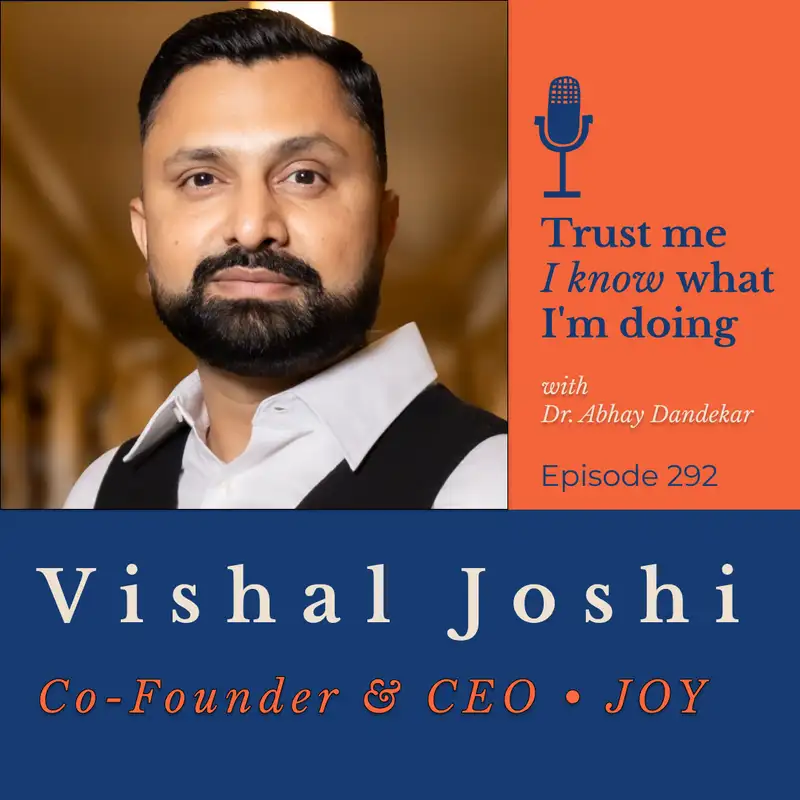
Vishal Joshi on Building Joy to Reimagine Event Planning
Download MP3Abhay (00:00)
thanks everyone for listening and watching, sharing with your family and friends, and don't forget to subscribe. TRUST ME I KNOW WHAT I'm DOING is brought to you by Travelopod.
For destinations like Africa, Japan, Antarctica, India, and the Northern Lights regions, start your journey with Travelopod. Visit vacation.travelopod.com.
Vishal (00:19)
you're throwing the biggest party of your life, right? you're doing everything in your power possible to make your friends and family feel welcome and excited about the whole thing.
We just basically said this duration of time that you're planning, we're gonna try to make that joyful.
Abhay (00:34)
what have been the most surprising lessons.
around the evolution of wedding planning over the past decade where these are not just trends, but they're seismic shifts, especially as you see that data unfold right in front of your eyes.
Vishal (00:48)
tying these different experiences together in a seamless way has been the driving force.
it is about bringing friends and family closer together right like we've always tried to build this product which we love blending design
and technology to do things which otherwise feel hard. But then when they happen, then it gives you a magical feeling.
Hello, I'm Vishal Joshi. I'm the co-founder and CEO of Joy. And this is Trust Me, I Know What I'm Doing.
Abhay (01:46)
welcome everybody to this episode of Trust Me, I Know What I'm Doing. So over the past few years, I've actually been honored to be the officiant for a few Indian weddings. And in the process, I've rediscovered why nowhere else can you experience all at once a swirl of love, celebration, communion, family, tears.
Food, cooperation, negotiation, festivity, chaos, and beauty all at the same time. Now, for every couple and the people they are gathering, a wedding is their Olympics, it's their Super Bowl, it's their Oscars and their Met Gala happening all at the same time. And orchestrating this grand event seamlessly, gracefully, and in one piece can be a major challenge. And coincidentally, that's exactly where Vishal Joshi decided to plant himself.
Vishal (02:34)
Mm.
Abhay (02:35)
As the co-founder and CEO of Joy, an end-to-end wedding and event lifecycle
Vishal (02:38)
Okay.
Abhay (02:40)
orchestration platform, Vishal has been growing the company for the past decade with a deep background in product management and software engineering. And after garnering serial rounds of funding and investments, Vishal and Joy are finding new ways to conquer the burdens of planning and experiencing sentimental events.
For over fifty million people in over a hundred and fifty countries. So it's terrific and great now to catch up for a chat with Vishal Joshi. Thanks so much, Vishal, for joining me this morning.
Vishal (03:11)
Thank you so much Abhay for having me. It is such a
Abhay (03:13)
So
Vishal (03:13)
pleasure.
Abhay (03:14)
pleasure's mine. so and and like I mentioned, I've had a chance to experience this firsthand. And I have to ask you, so you know, you've taken a deep dive and have a very active front row seat to the wedding planning experience and and trying to orchestrate this. But have you actually have actually you or the AI agents that you employ found a way to dealing with wedding aunties and uncles, guestless drama?
Vishal (03:38)
Thank
Abhay (03:39)
that diplomacy that's involved there. Tell me you've pleased and figured out or or unlocked the secret to this one also.
Vishal (03:47)
Now we've done a lot of heavy lifting when it comes to the technology part of it, but the human and emotion part of it still stays as to everyone. And we face this many number of times. You were talking about the dramas, like we will have scenarios where people would say, my sister-in-law has not got the invitation yet. And we are like, how can that be that our system decided to exclude this one person?
from the invitation email. But the funny thing is that those things inspired us to build features. So we basically now have a full tracking of who has received the invitation, who has clicked it, who has opened it, so that we can get out of the family drama and let you deal with your family drama
Abhay (04:36)
you know, it's great that you can have a way to not only synthesize that and and track it. I suppose that auntie and uncle drama and trying to manage guest lists is gonna be an age-old problem that hopefully that that human
Vishal (04:49)
Yes.
Abhay (04:51)
experience gets better and better at. you created Joy out of the experience when you were helping your co-founder Dorian's sister,
Vishal (04:59)
Yes.
Abhay (05:00)
You know, to plan a custom non fragmented wedding experience. And and so I'm curious, ha has the basic premise of the problem statement at all changed in the ten years since you started this?
Vishal (05:14)
No, actually, it has not changed at all. you just mentioned this, you're throwing the biggest party of your life, right? And you're doing everything in your power possible to make your friends and family feel welcome and excited about the whole thing. And what you really realize is that the whole thing leading up to it is not joyful because it is full of stress and it's like, so we...
We just basically said this duration of time that you're planning, we're gonna try to make that joyful. And over a period of time, we have built so many systems. Like we now do websites and save the dates and invites and guest list and communicating with hundreds of people in case of Indian weddings, thousands of people. These things were not possible before. And so the premise which you said that like of...
tying these different experiences together in a seamless way has been what has been the driving force.
And it is still now the same thing, which is driving it. And it started with Dorian's sister Amy. we still tell ourselves this thing every day, Abhay, that let us try to make sure that whatever we are building, we would build it for Amy's wedding.
Like that allows us to keep our compass straight. You know, like it allows us to think from this point of view that like, would you do it for your sister's wedding? And if you build it for your sister's wedding, then it will probably be fine for everybody else's wedding. And that's kind of like the reason why it has widely grown so much is because we try to keep true to that ethos of the way we build the product.
Abhay (06:51)
Yeah, it's a deeply personal one. You know, it's the same way that we we hopefully practice in any either business or service or you know profession where we'd want our our consumers and our customers and and those who are in our ecosystem to experience the same thing that we would for our own families. I I'm curious, you mentioned this, like you know, your your North Star is sort of planning this as if you're planning your own sister's wedding or someone in your own family. What do what do you think stands out about?
your own wedding experience and even your own cultural understanding of of Indian weddings and or any kind of similar magnificent event, what have those experiences maybe helped when it comes to informing the product design, the strategy and, you know, really your your sort of vision when it comes to Joy?
Vishal (07:37)
So talking about my wedding, coincidentally it happened during COVID. So
Abhay (07:42)
Mm.
Vishal (07:44)
we couldn't use the glamour of Joy when I planned my wedding, but that is due. We are probably going to celebrate like some kind of
wow renewal but now we have two kids they keep us super busy so that has not happened but
we've obviously experienced so many weddings like over two million weddings
so far and it is basically like Ty told us one fundamental thing is that like it is about bringing friends and family closer together right like we've always tried to build this product which we love blending design
and technology to do things which otherwise feel hard. But then when they happen, then it gives you a magical feeling.
I was mentioning this that before Joy did this thing, there was no way to communicate with 200 people attending your event. You would send
Abhay (08:35)
Mm.
Vishal (08:36)
out an invitation card and you'd keep your fingers crossed and you would hope everybody will show up.
And this is how weddings have worked for centuries.
Abhay (08:46)
Right.
Vishal (08:48)
technology has come in and nobody thought that communicating and broadcasting text messages to 200 or 500 people or sending emails to all of them at the same time would be meaningful. Because you know somebody is going to ask you, hey, are you going to have the wedding outdoors or indoors? I wear high heels? And then you realize everybody is going to ask that question and you have no way to tell them. Yes.
Abhay (09:11)
Not to mention, by the way, ask that question ten minutes before the wedding's gonna start, right? Yeah.
Vishal (09:17)
These type of things where you actually use technology to make people's life better is just what we have always driven towards. And I think that's what drives us even now to use technology in a meaningful way where it is powerful below, but it is extremely simple on the top.
Abhay (09:34)
Yeah. When when
you think back to weddings that that you grew up around or events that you grew up around, that in in your own upbringing or from a cultural standpoint, ha has that also played a role in how you've been able to shape and design and and figure this out? Because again, like the fragmentation, the chaos, the ability not just to communicate with guests and and stakeholders, but with vendors and with
all the different
Vishal (10:02)
Yes.
Abhay (10:03)
components. It's just a a swirl of being able to try and do this and organize it, let alone when it comes to an Indian wedding, a Marathi wedding. you know, those kinds of backdrops
add another completely different layer to this.
Vishal (10:17)
So I tell this thing that like Joy is now used in so many different event types, not just weddings, right?
Abhay (10:22)
Right. Yep.
Vishal (10:23)
But we said, we championed the event which had the most amount of complexity from a human emotion standpoint, right?
Abhay (10:31)
Hmm. Yeah.
Vishal (10:33)
And wedding is essentially like where you, if you champion wedding, you've dealt with almost all complexities from an
emotional standpoint that you could. And you were asking about my background. I mean,
An average American wedding has 150 people. An Indian wedding has a thousand people. So
Abhay (10:53)
Right.
Vishal (10:54)
we dealt with like almost close to 10x the complexity of the most complex event. So clearly that helped us a lot in knowing how that would go. Because when you talk about like gathering thousand people together in
a seamless way, it is something. I think so that made us, and we were also working before this.
I was part of the team that created Azure and we built systems with scale. But I think the combination of building technology which scales and it's built for highly logical people to building something for highly emotional audience. That combination has actually helped us build
technology which is delightful, meaningful, but at the same time something which scales to like
Abhay (11:42)
Sure.
Vishal (11:44)
60, 70 million people every year. But
roots have definitely helped a lot.
Abhay (11:51)
Right. And I mean, you know, whether it's a wedding or being able to drive, if you can intend a wedding in Mumbai or drive in Mumbai, you could probably do that just about anywhere else. and
Vishal (11:58)
You're right. You're right. Yeah.
Abhay (12:01)
and you know, it's a team effort, right? So to be able to harness a team, to scale a product, design it thoughtfully, secure funding, grow your people capital. I'm curious what you've potentially had to unlearn about yourself.
Or your even previous professional experiences, you just mentioned your experiences with Microsoft. what have you had to maybe unlearn about yourself to be an effective leader of that team to be able to make this so successful?
Vishal (12:34)
So there are certain things which has always stayed with me since the very beginning. Like fundamentally, I probably am not the most intelligent person most of the time, but I am always the hardest person almost all of the time, hardest working
Abhay (12:47)
Hmm. Yeah.
Vishal (12:49)
person. And I feel like that is something which has stayed consistent across everything that like I used to work hard even when I was at Microsoft, I work hard even now.
And I feel like that is one meaningful lever which we can always control in our life, right? But through the journey before Microsoft, to Microsoft and to Joy, it was actually a full circle moment for me because I came from an extremely modest background in India, staying in one bedroom house. You probably have heard numerous stories like this, six of us.
my Aaji Ajoba all of us living in a single place. From there to like try to make yourself and your efforts matter to get into Microsoft was a journey of like being completely unknown and unnoticed to doing something which would be meaningful and noticeable. Like I would go to these Microsoft conferences where would be people paying five to $10,000 to hear these people speak.
And the thought always was like, why is this person's work so meaningful that I'm paying $10,000 to just listen to them? And how can I make my work that meaningful?
Abhay (15:03)
coming from that background and then being in a place like Microsoft and now even with Joy, did the idea of like really understanding what value is and particularly when it comes to, you know, the humility of that value, is that something that stuck with you, especially during this journey so far?
Vishal (15:23)
Yeah, I you know, I grew up in Gujarat, right? And I always knew that Dhirubhai Ambani used to pump gas at the gas station. And he eventually built, he controlled refineries all over the world. So like the modest background was never going to stop me was a meaningful lesson at
Abhay (15:41)
Yeah.
Vishal (15:42)
that moment itself. But at the same time, it was not going to come as a privilege.
and it
Abhay (15:48)
Yeah.
Vishal (15:48)
had to be earned was something which was very clear. bringing back to the point where I was saying, looking at these Microsoft people who were like speaking at conferences with like 10,000 people paying $10,000, I was like, how can my work be that meaningful? and then eventually I was doing that and I built Azure and my work was meaningful that way as well. It was very logical.
and people were paying $10,000 to listen to me on what I built in Azure and stuff. And it was all like great. but I always wanted to build a company since childhood, since the
Dhirubhai Ambani stories.
and Joy was actually a demo app, which was something that I would present at the conferences at Microsoft to present Azure. And then, you know, like Amy, Dorian's sister,
said why do I have better apps to take pictures of my breakfast than I have for my wedding? Why don't you
Abhay (16:43)
Right.
Vishal (16:44)
guys build something which you can use as a demo too? So I built this thing with my co-founders to actually just help Amy. so I leave Microsoft, I start Joy and in Microsoft you got I was there for 10 years so
Abhay (16:58)
Mm.
Vishal (16:59)
I got used to whatever you do instantly everybody is going to want to know what you built.
and everybody's gonna want to hear. And there you build Joy and you have it out in the world and nobody's visiting the website. It was
Abhay (17:12)
Mm.
Vishal (17:12)
like, oh, nobody cares again. Nobody
Abhay (17:15)
Yeah.
Vishal (17:15)
again does not care about what I work on. And it was again a long journey to make something which you rebuilt like from scratch or like started from scratch to be actually something which people about. And that is not something which you can take for granted.
When you're in Microsoft, you can take those things for granted. But when you're building something from scratch, like people will like it and use it is not something which you can take for granted. And that was probably the point which you were asking,
Abhay (17:47)
It's a hugely different layer, the perspective and the actual microscopic view of being the CEO and founder and and that kind of a stakeholder versus part of a really giant machine like Microsoft. I I wanted to pivot to ask you something because AI is just simply swallowing everything in sight right? And every reproducible task, every creative endeavor opportunity. So
You know, in that race to grow and scale, you mentioned you started this w as a project for, Dorian's sister Amy. But as you scale this and as you grow this, how do you keep the purpose and the outcome of Joy truly human? We mentioned this at the beginning, right? That there's a major human element of this. But you know, as AI really does help and and help grow and scale, how have you been able to try and
Vishal (18:21)
. .
Abhay (18:41)
maintain that incredibly human element of all of this.
Vishal (18:45)
See, the interesting thing about AI is that it's doing the chores. The beauty of the events in our world is where it brings people closer together, right? So
Abhay (18:57)
Yeah.
Vishal (18:57)
we are still ultimately at the service of trying to bring people closer together. The same 150 at a wedding to a thousand in Indian wedding to 5,000 at a conference, there's still people coming together. It just is that like doing that,
When people were pulling hair, now they're pulling less hair. And with AI, we are basically building ways by which it is extraordinarily easy to plan these events. Because we're working on an AI event planner, which we are going to launch here soon. But that product, essentially, you can speak to it, and it will actually be like your assistant. And that is something which most people do not have the ability
to have, know, only 18 % of the weddings can actually afford a planner. For all the rest of them, like we are going to be able to provide an AI which can actually plan the whole thing. it will, it is all that it is doing is to make you less stressful, not really
Abhay (20:00)
Mm.
Vishal (20:01)
trying to swallow everything. I mean, like we are embracing it. I did neural network research when I was in school and now I can basically like for the first time, the time is right, the technology is there.
and we will be building and we will be launching the world's first AI planner.
Abhay (20:15)
I wonder if we're, you know, with AI being so democratized. And like you mentioned, right, this is really helping to take the chore away from some of this. But with AI being so democratized, will there be a time when my AI agent will simply be talking to your AI agent you know, to plan and produce all the pre-human steps? And we'll sort of come in at the very end and all the commerce and the negotiation and the transactions will be sort of taken care of, leaving really just the more
hopefully enjoyable parts for us. And yet those are kind of what those negotiations, that friction, sometimes that's exactly what develops human relationships going forward. So it is there, even though our agents will make things so seamless, is there actually a cost to that?
Vishal (21:01)
I mean, there is going to be cost to the fact that you're not grinding together in the same way as you used to.
Abhay (21:09)
Yeah.
Vishal (21:10)
I'll give you a more practical example. We grew up in a way that
We didn't have lots of means growing up. We could eat only two parlages a day because that's all we could afford. A lot of time of our family was spent in basic survival. And lot of time of my family today is not spent in basic survival. holes in my backyard and used a stick to play golf.
Today I'm able to go and take my daughter to a golf camp, probably like two golf camps and go and play with her. And that has removed the struggles. It has reduced the memories, the romantic memories of digging holes and playing golf, that it has taken away. But it has given me more meaningful time with my daughter to actually learn the skill that we might probably play when I get old.
So if you think about it, did that smoothness actually just remove the friction? Yes, I'm not struggling, but I'm actually fine not struggling. And I actually think that you might grow to like this world where we don't struggle, but the agents fought so that we could go on a walk on the Pacifica beach. That might not be as bad, you know? So I'm very optimistic.
Abhay (22:35)
right. No, I think it's, you know, making sure that we also, heed and and really pay attention to the value of that outcome. and yes, there is a power to making sure that human conversation is still at the root of a lot of this. I I imagine that the model for weddings has such endless possibilities, like you mentioned, for event planning or for other sort of
you know, terrific occasions and experiences. Does building that breadth horizontally to navigate through other non-wedding experiences, in a way, does that actually get risky to divert away from the attention of the vertical success you have with, like you said, this is the like Super Bowl of all events, which is a and the most complex of all events, like a wedding. do you take some risk in in now trying to, you know, spread that to other
venues or other events or other experiences.
Vishal (23:29)
So by the way, we drove our business from the very beginning when it was not even a business, it was a project. But the way it was, was mostly like
You just think about it. are brown and Asian men building a software for predominantly at that time, women. But we were good at technology and design. we didn't know really any nuance of this whole thing. And the way we actually did this was I spent hours listening to customers.
on our support channel. And I would personally go and say, I'm the co-founder and CEO of Joy. Like, yes, you need this thing. We will build it. I would listen to them understand. And then we would go and build that feature. And we've been doing that since the beginning. That's why most of Joy roadmap is never driven by what others have built or what other things exist. It's mostly been trying to listen to the customer and trying to build the feature that they want, which is why almost all of our features are
slightly different than the way they would work anywhere else because they are driven by these insights of speaking with the customers. So when we evolved, what we landed up doing is that we built this software, which is pretty scalable across all different types of events. And what has happened is that people started using Joy for all other types of events without we trying to go there. So it
Abhay (24:52)
Hm. Yeah.
Vishal (24:53)
is used in birthdays, it is used in bar mitzvahs, it is used in corporate retreats.
on conferences, at Stanford graduation ceremonies, and all these types of things in PhD dissertations, which we never planned for, but we just built it with our roots of Microsoft, or trying to build something which is scalable by design. And so a guest list at Joy can hold tens of thousands of people, and it will be fine. And you can tag somebody as a coworker if you want, or you can tag somebody as like AI sessions versus cloud sessions. And the thing just works.
So it's not usually that we are trying to consciously go towards anywhere. It just is that we have always been the company which has been pulled to go whichever direction the customers have been pulling. And now we are seeing people pulling us in these non-wedding events direction. And so now it is just natural to just go there rather than a meditated strategy. In fact, that's what I always say that like we didn't have a meditated strategy.
Abhay (25:55)
Mm.
Vishal (25:55)
We
just listened to our customers and they just took us wherever we went and we were lucky to just be successful along the way because we just listened to them. So we followed that and we continue following from Amy till now.
Abhay (26:08)
Yeah.
It's sort of a nice way to have that organic pathway develop in front of you. And and thankfully there are open doors and open opportunities that you see because you're, you know, being driven in that way again by by your customers, by your consumers, by your stakeholders. with the amount of
behavioral data that you have at your fingertips you know, and the I would say, components of an institution like you know, from honeymoon choices to registries to style choices, and then how it transcends into other events and and other experiences, what have been probably the most surprising lessons.
around the evolution of wedding planning over the past decade that you've seen, where like these are not just trends, but they're seismic shifts, especially as you see that data unfold right in front of your eyes.
Vishal (27:00)
You're so right, even pointing and noticing this because we, over 200 or 250 million people have used Joy, right? Like every year, 60, 65 million people use it, but that's a lot of people. And there is a lot of interesting graphs that we see, trends that we see, you know, like how...
California is more vegan and Texas eats more steak and like all sorts of different things that we have seen. And that data is extremely valuable, meaningful, even in training of AI to like actually learn on like what, how a good event planning can be, right? And when you talk about seismic shifts, like there is actually a reasonable amount of digital revolution that we saw.
happen in front of our eyes. To give you a case in point, almost everybody used to do physical, save the date, physical invitations, physical everything, right? And even now you will do physical invitations for grandma's sake, but save the dates have shifted to becoming digital because when I'm at an event and I wanna know when is your wedding so that I don't schedule something else,
like the postcard on the fridge is not going to help me. And
Abhay (28:17)
Mm. Yeah.
Vishal (28:18)
so we've seen people move digitally more and more as time went by. That was a very interesting shift. Photos, had become like the smartphones essentially taking photos became obviously a very logical thing The other very interesting thing that we saw in American society in particular is moving from gifting physical things to gifting cash.
Abhay (28:43)
Mm, yeah.
Vishal (28:44)
So you
imagine that all over the world, cash is gifted anyways, right? Little envelopes, name somebody sitting next to you collecting all the envelopes, you know that system. So that existed, collecting cash. In the US, it was a big taboo to actually collect cash and rather just like have physical But in the last three, four years, that has just like from Gen Z is getting married. Like I think it has just completely shifted to collecting cash.
And now we have a product where you can actually just digitally give cash rather than bring envelopes. And that's like blown like crazy. It's like growing two, three X year over year. And so things are shifting. is traditions are still the same and they still are meaningful. I mean, if you think about it, what is a wedding besides like just a meaningful tradition, right? So like
Abhay (29:37)
Yeah, yeah.
Vishal (29:38)
that is still preserved.
and the human touch and the human connection is still preserved. But the way these things are being orchestrated are just getting much, much more easier. I would think it is much easier to plan a wedding now than like probably a few decades ago. And so I think that's something which we have seen. The other thing which is probably like less of a nicer trend, but I wish we can change this somehow, is that previously the whole community used to get together to plan an event.
Right? Like you can imagine
Abhay (30:08)
Mm.
Vishal (30:09)
that in a village when somebody would get married, everybody would in the village would contribute putting up the place, setting up the thing and stuff
Abhay (30:16)
Sure.
Vishal (30:16)
like that. And over a period of time in the US in particular, in most Western places, it has become a chore for just purely the couple. Right? Like they do it almost entirely by themselves. So it has become like a big DIY thing. Parents help, obviously, but it is no more a village.
And that is the reason why think that why Joy was able to make a difference is because we kind of like substituted some of the things which the village used to do. Because
Abhay (30:49)
Sure.
Vishal (30:49)
otherwise you would just be overwhelmed doing it all by yourself. And so those are some of the trends that we've seen that like, yeah, people are planning more by themselves and you wish there were more people planning with them. But at the end, everybody shows up and everybody has a lot of fun.
That's what counts.
Abhay (31:04)
Right. Yeah, that
is what counts. And I'm I'm that, you know, from vendors, from products, from the like, you know, drive commerce, you know, to this, it you know, bonanza potentially of you know data trends that that they can tap into and and sort of like help when it comes to accelerating and growing the business. And to be honest, also provide a lot more choices to couples and and families as they're planning all this.
Let me get you out of here on this one. that is, you know, we've talked a lot about decreasing friction. And we've talked a lot about finding ways to leverage technology. And and as your users crave that frictionless planning often at a time in their lives that, like you mentioned, they are just stressed out, they are guided in a way by a lot of emotion, expense and
Vishal (31:46)
.
Abhay (31:57)
how has tech and software and you know living in in this space and particularly problem solving in this space, how's it made you more empathic and equipped to handle the emotion and expense and stresses of running a company that that is really helping to try and solve these problems?
Vishal (32:18)
I mean, honestly, the key driving force, if you always think about it, been that we work in a space which is full of Joy.
Right, like it's ultimately like you can imagine that like people are always they're stressed, but for happy reasons. Right. And that that has defined us in in many ways, because one of the reasons why we continued instead of like building something in cloud and AI, we built something which was so against our grain was because it was such a fun thing to do. Like every time you would basically go and see
I would build servers which would scale like crazy. But here, you build a little thing where somebody can send a text message or somebody can create an illustration of themselves and they are happy and they send thank you notes and they sometimes invite our team to their wedding. And that is just such joyful experience in building this thing. That is what essentially keeps us going.
And it naturally builds empathy because you can imagine that for 10 years you're building things from the engineer to the engineer for the engineer, right?
Abhay (33:28)
Mm.
Vishal (33:29)
And then you're basically like building this very different type of a company. It obviously makes you a different person as well, right? And it makes you also like care about things which they care about. And if you look at it from their point of view, it just naturally makes you want to do it that way.
And so think that just living the world from our customer's point of view and internalizing it has been the only way we could have built it because we were not them.
Abhay (33:59)
Yeah. Has it changed any of the
ways that that you've cultivated your own relationships outside of of Joy?
Vishal (34:06)
noticed is that the thing which brings people together, right? Like how a couple comes together,
If people can continue keeping that same thing in their mind, that like, this is what brought us together, that actually like keeps you going a long distance as well. Like my wife is an actress, she has done 36 movies and Broadway shows and she is a TV host and stuff like that. And she's like so much more charming than I am. And the thing is that like I always learn from her.
And I think that in that relationship thing, the thing which I've always learned is that if you can continue learning from your partner, like that naturally will take care of a lot of things because if they learn from you and you learn from them, I think that that usually will just keep things going in the right direction because that's probably why you first fell in love with them. And
Abhay (35:03)
Mm.
Vishal (35:04)
so I think that when you talk about relationship, I have noticed that like this natural admiration that couples have for each other.
is at the peak at that time. And like, how do you actually like keep that going for the rest of your life? And it just is like reminds me every day because I see we do 1800 weddings every day. You know what I
Abhay (35:24)
Yeah, yeah.
Vishal (35:25)
mean? So like you remind you every day that like these people
Abhay (35:28)
Right.
Vishal (35:28)
are so much in love and they appreciate each other so much and they respect each other so much. And I wish that we all did that all
Abhay (35:36)
Which is great. And and learning from each other and constantly building on that. And of course, bringing lots of people together for terrific experiences and events like weddings. Vishal, thank you so much for for spending some time with us today. This was really a lovely conversation, and I hope we can visit with you again down the road.
Vishal (35:54)
Likewise, thank you so much Abhay for having me.
Abhay (35:57)
Hey, thanks so much, Vishhal. And you can learn more at withjoy.com.
Many thanks to all of you for engaging and hitting that subscribe button wherever you're listening and watching. And if you're enjoying these conversations on Trust Me, I Know What I'm Doing,
Please try and share them with your family and friends. Remember to be smart, be safe, and be kind.
Till next time, I'm Abhay Dandikar.