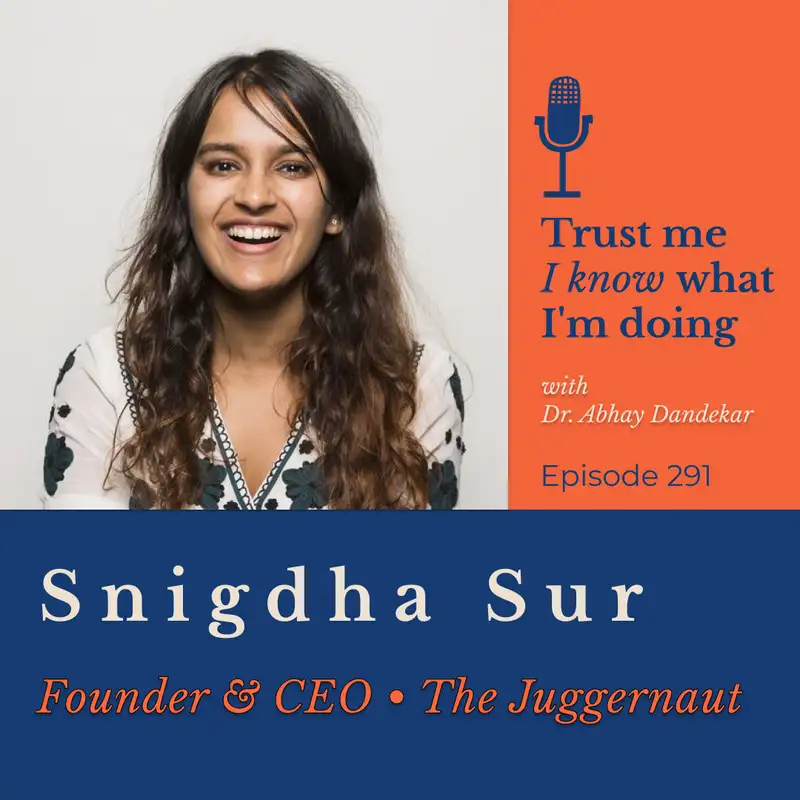
Snigdha Sur on Smart Context over Shallow Representation
Download MP3Abhay (00:00)
thanks everyone for listening and watching, sharing with your family and friends, and don't forget to subscribe. TRUST ME I KNOW WHAT I'm DOING is brought to you by Travelopod.
For destinations like Africa, Japan, Antarctica, India, and the Northern Lights regions, start your journey with Travelopod. Visit vacation.travelopod.com.
Snigdha Sur (00:19)
I always think the Jargonaut has been very good at kind of articulating something that's been happening in our community, but no one really wants to talk about it. But then we'll take the research and back it up.
Abhay (00:29)
how much do you say does the Juggernaut test or even push the boundaries?
for the diaspora so that it actually asks itself these questions and that the juggernaut can be both that mirror and that window for people who are interested and curious about it, but also who are living it.
Snigdha Sur (00:48)
We want to be your smart best friend that like you can go to the juggernaut, whether it's our newsletter, whether it's our Instagram page, whether it's our paid for articles, whether it's our event, and feel like we are your smart best friend who's catching you up on the most important things you need to know.
I'm Snigda Sur I'm the founder and CEO of the Juggernaut, and this is Trust Me, I Know What I'm Doing.
Abhay (01:40)
welcome everybody to this episode of Trust Me, I know what I'm doing. So I've said it before and I've s and I'll say it again. We as global Indians and global South Asians have a beautiful and equally messy and fluid existence where there is nuance and context to it all. And while there's no single lens, obviously, there are definitely some specific things to ponder in the diaspora.
We celebrate and cling to our history and heritage, and we also debate it and challenge it so voraciously. We fixate a lot on movies. There's politics involved on multiple continents. We love cricket and music and tech, and we crave hing in our foods and store that food in old sour cream dubas. And and we have names that involve aspirated consonants like ba and ga and the.
and so it's nice to share some time with someone who's committed to chronicling and helping curate and make sense of it all. And that's Snigdha Sur the founder and CEO of the Juggernaut, which started out as an emailed newsletter and has grown, of course, into a media tech company that's a go-to for so many in the diaspora and beyond. She was born in India and grew up in the Bronx and Queens and has worked and lived in Mumbai.
I truly appreciate the range and breadth of her work and I will add that she is the only three time guest on Trust Me, I Know What I'm Doing, a true friend of the program.
Snigdha Sur (03:03)
Dr. Abhay Like you will always yeah, I will always show up for that.
Thank you so much for having me, especially when you literally have a full-time job with patience. you know, it's like we do 500 things, don't we? So thank you for running this wonderful podcast.
Abhay (03:19)
Hey, thank thank you for showing up and
and you know being here in the moment. by the way, I I something I just keep rediscovering about people as I learn about them more and more. I knew you were a Bollywood encyclopedia. What I did not know was that you are indeed a spelling bee champion. I didn't know that you had that tucked away in your back pocket someplace. How in how incredibly Indian American and South Asian of you. by the way, does this mean that in late May when the
Snigdha Sur (03:36)
Yeah.
Ha ha ha.
Abhay (03:45)
script national spelling be is taking place that you actually take off on that day of the month or you your your eyes are peeled to the to the T V set?
Snigdha Sur (03:54)
my goodness, like the Spelling Bee like my Met Gala. Like that is my Met Gala. Like I tell my entire team, like, please don't bother me from like 8 p.m. onwards. I am glued to the television. I'm watching. And you know, I'm usually spelling along. And it's really funny, but I I also kind of get to know the spellers. Like they're I think they're much more open to chatting with me because I was a national spelling bee participant. So this year's Spelling Bee Champion, I actually got
Abhay (03:57)
Yeah.
Snigdha Sur (04:21)
him and his father and two other members of their family a reservation at Sema because Chef Vijay I was like texting Chef Vijay I was like, Chef Vijay I have a favor. I need you to find a table at short notice because they had a very quick trip to New York because after he won this the National Spelling Bee Champion goes to New York City to talk to all the media. And it was like Chef Vijay I know this is a really last-minute thing I'm making you do could but can you please find a small table for the National Spelling Bee Champion and Chef Vijay
Is such a sweetheart and such a stalwart of the community himself. And he's Singha, I will find something at the bar, I will make it happen. And they all got to chat. And then his dad, Shrey's dad, texted me afterward and was like, I didn't realize how difficult it was to get a table at Seba, but thank you for making that happen. And so I think for me, the selling bee just holds such warm memories. And you have to remember, I I know it seems like so obvious now that, you know.
Abhay (05:05)
yeah.
Snigdha Sur (05:15)
The spellers, the champions tend to be Indian American. But when I was doing it, that wasn't obvious at all. So when I was in the spelling B, this was around 2001 to 2004, there were a whole wide range of outcomes. And many of the winners tended to be homeschool kids who weren't Indian American. So that shift only happened in more recent years, which I think is kind of interesting that that's become such a trope that in such a short span of time,
Abhay (05:21)
Right. Right.
Snigdha Sur (05:42)
That people now can't imagine a non-Indian American winner when, you know, when I was growing up, that wasn't even that was actually the opposite. It was like we aspired to be like Nupur Lala and spellbound, who I've gotten to meet. and some of them I'm still friends with, like many of my co-spellers I'm still friends with. We we see each other on Instagram. We're now like living, breathing adults with other dreams and aspirations and spelling. But yes, I I was the typical Indian American kid, I feel, in a lot of ways growing up.
Abhay (05:53)
Yeah, yeah.
I love that you have co-spellers who are our peers, in this journey of of spelling. And and I love how you also, brought that back to the tentacles of, a this is a recent development, this in in some ways. And of course, having some generational change is always something that we have to, look at carefully and also, kind of celebrate in in that way. I I know it's a layered thought question, and we've talked about this before, but right now.
for you, what what does it actually feel like to be an Indian American or South Asian, not just in the context of running a media tech company, but you know, just taking in the Zeitgeist of of twenty twenty six and in that sort of, capacity of a, you know, being in a diasporic country like the US?
Snigdha Sur (06:55)
Yeah, no, that's a great question. So I have a little bit of an unfair advantage where I was one of my colleges, I know we've spoken about this before. I was one of my college's early South Asian studies major graduates. So when I went to Yale, I majored in economics and South Asian studies. So I have that unfair advantage where I got to have the very opportunity and the privilege of studying the discipline in a very deep manner. And so my answer is probably not the typical answer. I know there's also a lot more.
Abhay (07:00)
Yes.
Snigdha Sur (07:25)
sensitivity around words like Indian American and South Asian American and when do you use those terms? And you know, at the Juggernaut, for example, we always use the most specific term available. So for example, off campus is now the thing online. And I'm gonna pronounce this last name wrong. I'm so sorry. But Josh Heuston and Mika Abdallah are dating. We did this post and they are actors on the show. And we don't call him South Asian.
Right? We said he's of Sri Lankan descent because that's the most specific thing we have. Now, if for some reason he were Sri Lankan and he were also Indian and he were also Bangladeshi, maybe South Asian is a better term, but we'll always kind of use the most specific term. so for me, you know, I identify as Indian American, I identify as Bengali, I identify my ancestors are from what is now present-day Bangladesh. They had to leave because of partition. So, some people perhaps could call me
Bangladeshi in that sense. my grandpa and my dad's family grew up in Burma. So, like, what does that make us? You know, like I actually think, for me, it's so important to think about every single geographical place in the time it was in. And for so much of history, what the Indian subcontinent was wasn't really defined by borders, but was really defined by trade. And many of those present-day countries, you know, present-day Pakistan, present-day India, present
Abhay (08:24)
Mm.
Snigdha Sur (08:45)
Day Bangladesh. First of they didn't have borders. They were all united into one land. And second, they were, you know, trading comfortably with Burma. They were trading with Indonesia. They were trading with all these places. and so I'm not answering your question directly. But in 2026, I feel like the terms have a lot of sensitivity. And I I wish it didn't. But I also would like to tell people that there are a few tips and tricks you can have up your sleeve to navigate it, which is if some people yell at you about it, be like, yo.
Abhay (08:48)
Yeah, right.
Snigdha Sur (09:13)
I'm using the most specific term. And if, you know, if something does involve more nations than just India, modern day India, we do use South Asia because there's no other term to describe that region. but honestly, I feel like my my theme, my feelings in general are just all about learning. Like every day I'm learning something new. I'm learning something.
Abhay (09:31)
Hmm. Yeah.
Snigdha Sur (09:34)
Wildly new that I just didn't even know about. Like I didn't even know. Some one of our interns just taught me this week that in the Star Spangled Banner, this lyric, the rockets red glare, is referring to rockets originally from Mysore, India. And I was like, what? So anyway, those are things that I'm I'm not answering your question directly, But that's all my feelings right now.
Abhay (09:52)
Yeah, yeah.
and I I you know
I I I reflect on that and I I think for me, I wonder when I think about that question for myself, you know, is it actually like you said, that you're learning and you're growing all the time, you're figuring out how incredibly diverse the diaspora continues to become, right? This is not a a static, it's a very dynamic and flowing and evolving one. And you can't just have the academic lens on things.
the viewpoint from the cab driver versus the hotel or motel owner versus the entrepreneur and the CEO are gonna be very different as well. But I think I like what you mentioned about this specificity, right? That like, you know, we crave more and more specificity as we actually, get more and more diverse, right? and and with that, then when you try and curate
Snigdha Sur (10:43)
Yes.
Abhay (10:47)
stories and storytelling and news. when you think about when you first started The Juggernaut, maybe that very first day when you sort of opened up shop to now, has the strategy for trying to showcase the brown gaze also sort of evolved because of that development, because of that maturity, because of the things that you're learning in your newsroom? Tell me a little bit about that kind of evolution for you.
Snigdha Sur (11:15)
Yeah, I think that's a very good question. I would say that in terms of the gaze, I think the strategy, the overarching strategy has never really changed in that set in that way, but I will say the tactics might have. So the strategy that we always had is like we want to be like your smart best friend. Like if you've somehow gone to the beach or you're on vacation or you're busy as a doctor or you're busy as a professional or you're busy as an Uber driver or you're just busy as a student.
We want to be your smart best friend that like you can go to the juggernaut, whether it's our newsletter, whether it's our Instagram page, whether it's our paid for articles, whether it's our event, and feel like we are your smart best friend who's catching you up on the most important things you need to know.
So that strategy has never changed in terms of like the job to be done. You know, we are your favorite auntie in your WhatsApp group chat.
We want to be your favorite. We wanna be trusted. We wanna give you smart context That those words smart context were there from the very beginning. and that's never really changed. And if if my teammates ever submit articles or newsletter blurbs or social media posts that don't have smart context I'm like, we're gonna rewrite this. So like I I'll go back to that dating example. I was really concerned about like writing a social media post about two people dating, but I was like, you know what, we gotta make this post about Josh.
Let's talk about his Sri Lankan heritage. Let's talk about his journey as an actor. Let's talk about what it means for him to do roles with like like Dune prophecy with an actor like Tabu So we made the social media post about what you think is casual, like dating, like two levels higher. Cause now you're thinking about representation and Dune prophecy. You're thinking about Tabu working with this guy. You're thinking about Sri Lankan dads being proud of him. So now you're thinking about all these other things, right? And so that that's important to me.
Now, in terms of tactics, I think of course we've grown. We've learned so much. Like, I didn't know how to use Adobe Premiere Pro until this past September. And now I'm a video editing pro. I edit most of our videos now for the juggernaut. It's really fun. I would say that we've done way more interviews now, just like you have. Like there were people on my list of dream people to interview. Like the other day I had a chance and opportunity to interview Madhuri Dixit and
Abhay (13:15)
Yeah. Yeah.
Snigdha Sur (13:29)
you Madhury Ji I would say. And she is a woman I've looked up to my entire life. And like being in front of her and getting to ask her about her latest roles and how she brings so much depth and smartness to them. That was just such a privilege. So I think I don't think the strategy's changed, but to your point, we have evolved. We've gotten smarter. I've gotten smarter, hopefully. If I haven't learned something that in seven years, that's a bad sign. my team has gotten smarter. I think we're more willing to experiment with things.
It also makes our job harder because, you know, the most obvious stories we've already told. So, you know, we do a mix of like evergreen and news stories. The news stories are coming. So that's gonna be happening, the social media posts, the newsletter stuff. But we also have like a trove of evergreen stories we've written. At this point, we've noticed a lot of people copying those trove of evergreen stories when we go really, really deep. And, we've done the first layer, I feel. So now it's like going to the second layer, third layer, fourth layer, fifth layer.
Abhay (14:03)
Yeah.
Snigdha Sur (14:24)
Of stories because there's just so many from South Asia, from India, from Pakistan, from Bangladesh. That like, I mean, just the other year I learned a couple of years ago, and I was a South Asian studies major, that I did not realize that Pakistan is an acronym that where each of the letters represents a different part of the province. And I was like, how did I not know that? Why was that not covered? Like I'm so confused, you know. So I think that like, you know, I think that that's our job, which is we want to always be your smart best friend.
Abhay (14:38)
Mm.
Right. Yeah.
Snigdha Sur (14:51)
We will never stop being your smart best friend. Now the question is, how do you receive that information? and I more and more people are receiving it through video, more and more people are receiving it through live events, more and more people are receiving it through really, really strange investigations or deep dives. Like we've done two major breaking true crime stories this year, at least from Sunny Naqvi to Chirayu Rana and I'm really proud of that work. And so I would say strategy has never changed, tactics definitely have.
Abhay (16:16)
Tell me, you mentioned the word experimentation, right? And so like when you think about different tactics and different methods and different ways to not only attract eyeballs, but to really sort of develop and cultivate that trusting relationship with the consumer, with the person in the diaspora, when it comes to experimentation, how much do you say does the Juggernaut test or even push the boundaries?
for the diaspora so that it actually asks itself these questions and that the juggernaut can be both that mirror and that window for people who are interested and curious about it, but also who are living it.
Snigdha Sur (16:54)
Yeah, I mean, I think in terms of pushing the boundaries, I think one would have to actually ask go and ask the customers. I would have to like go through all the I do sometimes read them, but it's for your mental health. You shouldn't read always them. You shouldn't read them always the comment section. so we do read them, especially if they're from subscribers, but sometimes it's just general visitors who aren't actually your readers or your customers or paying customers and you to kind of wait a bit less. in a weird way, so much of my experimentation and our
Abhay (17:07)
Right. Correct. Yeah.
Snigdha Sur (17:22)
Teams experimentation is only possible if our well is deep. So let me explain that. Which is in in in news organizations and in storytelling organizations, burnout is very real because you're constantly, you're chronically online. So I'm not just online to enjoy a reel anymore that stopped like seven years ago. I'm online, so I can like every single thing I consume, I'm like, where's the story in this? And that can get very exhausting.
And when you're constantly editing, when you're constantly writing, when you're constantly video editing and, pushing stuff out for other people's consumption, you're constantly creating, creating, creating, you're taking some of your energy and putting it onto the world, right? And so that can be very
You're depleting yourself to serve others. And so I would say, like the way our experimentation and pushing boundaries comes is I always think the Jargonaut has been very good at kind of articulating something that's been happening in our community, but no one really wants to talk about it. But then we'll take the research and back it up.
Abhay (18:05)
Sure. Yeah.
Snigdha Sur (18:22)
I'll give an example. So, you know, our community doesn't really want to talk about mental health. Our community doesn't often want to talk about
I'm not saying this with a broad brush. I'm saying parts of the community. you know, so when we did the Sunny Nuckve story, this is an example, if people don't remember, this was a woman who claimed that ICE had detained her. And she was a US citizen born in the US. And it was coming at a really crazy time when this was actually happening where, you know, ICE was detaining people, but this was the first time we'd heard a US citizen born in US in the US being detained. And so every news organization ran with it.
Abhay (18:34)
Typical, yeah.
Snigdha Sur (18:59)
We didn't. no action is an action. And I was like telling my editor, this story smells really fishy. There's just really something fishy about the story. We need to wait and do our own investigation. And lo and behold, we found that this person was like based on all the evidence in front of us, was lying about this dissension. When we published the article, we got a lot of hate mail. We got a lot of hate messages. We got
claims of us being like anti like Islamophobic or anti-Pakistani and all these things. And we're like, look, we're not trying to take a stand on those issues. We're trying to actually just tell this person's story. based on the evidence that we have available to us. And it took weeks before the police actually released their own press release that confirmed what we had found. And so I think a lot of what it means to push boundaries and to ask people to question themselves and question what they think they know is by
looking at data, looking at evidence and bringing it forth to our community. And they might hate you for it. They really might hate you for it. but my job is not to be loved. My job is to be your smart friend. And sometimes you hate your smart friend because they're too smart. You just genuinely do. You think they're a jackass. You think they're a smart aleck, right? There's words you come up with. You know, even when we were looking at Zoran Mamdani's rise in New York, the data shows that most of the people who voted for him weren't South Asian.
Abhay (20:02)
Hmm. Yeah.
Right. Right. Yeah.
Snigdha Sur (20:19)
There were mostly white educated women. And a lot of black and Hispanic people were voting for Cuomo. Now that's a very inconvenient truth for some people. were voting for Cuomo. But our chart showed the data showed that. It's it's i it is what it is. So we have to we have to present that. When we published that article, you know, Zoran Mamdadi's unlikely fan base, people didn't wanna believe it. So you gotta do what you gotta do.
Abhay (20:28)
Yeah.
Yeah. Yeah.
in in trying to be that that sort of smart and intelligent voice and staying with your true North Star, the data, you know, data doesn't lie. And also your instinct and your experience and the wisdom you gain as a leader in, curating this for many, many years now. is is that where
Snigdha Sur (20:57)
Yeah.
Abhay (21:09)
the real leadership comes through and being able to know when to pause and being able to know that like, look, data is going to drive this. And my instinct is telling me that, yes, this is an inconvenience story, but it's a true story and it needs to be told. And like you said, sort of keeping that, you know, you want to be that intelligent auntie or that intelligent friend and that smart friend who's having that voice and and bringing that forward. You're the audience or the
l listener or the readers or the viewers reaction to it is irrespective.
Snigdha Sur (21:41)
Yeah, and I you know, I have to mention we also got a lot of reactions after our Churayu Rana story where people were like, how did you guys get that interview? Like how could small magazine get this interview? So you're often underestimated.
I mean, you're a doctor as well, so I I think you've seen some of these studies, which is like so much of what people say is intuition is just repetition, right? Your body is repeat doing repeated actions and through it it gets subtle cues, like psychosomatic clues about things, right? And some people call it psychic intuition, some people call it just intuition, some people call it, like you said, insight, some people call it wisdom or experience. but yeah, I would have to say that a lot of it is just seeing these new cycles over and over again.
I am gonna go back to the off-campus dating thing, but we actually waited until we had conf confirmation from sources from us weekly and other sources before we published the dating rumor because we, you know, sometimes it's good to be early, but sometimes it's also okay to wait. patience feels expensive, but actually it's not when you have a reputation. Patience can be the most
valuable thing to like really wait to verify things. which is why, you know, when people copy us, when people like literally steal our stories or steal entire social media posts, my editor and I, we get a little bit salty, but then I'm like, they can't really outthink us. Like they can copy us, but they can't really out innovate us or outthink us. So good luck. Like, you know, because you're the best you will be is
Abhay (22:58)
Hmm. Yeah.
Yeah. Right. Right.
Snigdha Sur (23:07)
Aggregating and copying other people, you won't ever be able to create that thought. And that's really sad in a world of AI, which is like, I do think we're entering this barbell world where there's gonna be a group of people who are going to be spitters outers of like existing information. And there's gonna be a group of people who are just gonna be creating and creating and creating. And that creation is gonna become increasingly priceless as there's gonna be a whole 80% here, which is just like regurgitated information.
Abhay (23:37)
When you talk about the kind of saltiness of reacting or the wisdom of having patience, and now this, barbell effect or even the the way that AI is going to continue to integrate and disrupt and and change our our media consumption experience, when I've asked this to other artists and and creators and musicians and and whatnot, in that how they observe or how they experience
their work externally. do does being a media tech professional and a leader and someone who's now even, again, even a casual fan of this to some degree, does that still bring you joy when it comes to thinking about like constantly, like you said, having reactions and, you know, having to think about this as to like where does the story? is there a still a optimism and a joy in thinking about that carefully as a leader?
Snigdha Sur (24:34)
think this kind of goes back to that conversation about, you know, when is your well full? When are you depleted? When are you burnt out? I feel like when you're a solo founder, because you don't have many other shoulders to really share all the burdens of running a company, like my editor, I sometimes joke with her, she only sees like probably thirty percent of what I do because it's the editorial side, but then there's like seventy percent that's like hidden because it's like all the other stuff, right? Which is like hiring and
thinking about events, thinking about monetizing, thinking about data for subscriptions, all of that's like here. for me, I think it's easier to find joy when my well is full. I It's harder to find joy when you feel depleted and burnt out. And so then whenever I f start feeling tired, I have to figure out ways to find joy again. And for me, I have a few go-to's. It's I you know I go for a weekly run on Saturdays.
I go for yoga on Sundays. I try to find a book that I can't stop reading. written before 2021, that I can't stop reading and that I have to like keep turning the pages. Sometimes it's a good show. Sometimes it's like an entertaining show that makes you want to parse it through. Sometimes it's great movie,
And so whenever I feel like I'm stuck in a rut and I and the joy has disappeared, I have to go find other people's creations that give me joy, that fill up my well, so that I can continue creating. I think so much about creating is like a circular economy where you have to feel full and feel excited and feel energized and feel creative. And you can't unless you
Abhay (25:56)
Yeah. Right.
Snigdha Sur (26:11)
are also yourself consuming good things.
Abhay (26:14)
When when you escape to a show or something like that, do you sometimes find yourself actually saying, Boy, you know what? I don't I don't know what it is that I want, but wherever I escape, I want it not to be brown.
Snigdha Sur (26:28)
no, no, I don't think that happens. I think funnily enough, I just go for what I think is good. And then if there's like a South Asian connection, I just find it to be like a bonus. Like I just started watching off campus because all the other millennial women in my life were like, you have to watch this show. And I was like, okay, like it's about hockey in college. I really don't need to know about this.
Abhay (26:35)
Yeah.
Snigdha Sur (26:50)
The only person actually my one of my best friends in college did play hockey, Bennett, please don't hate me for saying that. so I watched a show and I couldn't stop watching it. But I knew about Josh Heuston I'd interviewed Tabu for Dune Prophecy and I knew he was part Sri Lankan.
And if you I did not know going in that he was in the show and I see him in the show, I was like, my god, there's a South Asian connection to this wonderful show. Why did nobody tell me? So no, I usually just go for really great things. And then if there is a connection, it's like the cherry on top. And if there isn't a connection, I still just get to be in awe of wonderful creators. Like Indy Navarrett in obsession, that woman is.
Incredible. Just shaf kiss. Chef's kiss.
Abhay (27:29)
Sure. Yeah.
Yeah. I I think, you know, because so many in the diaspora, whether they are they or not, or whether they are diasporic and, you know, Indian American, South Asian American, again, all the specificities that we that we just referred back to, you know, it's hard not to constantly be straddling or code switching or or figuring it out as you go along, even as for me, you know, being a a consumer of your media.
You know, I look at some of the stories with incredible intrigue. And I look at it with just such a great, you know, as great growth opportunities or learning opportunities. And then I do look at other stories and I'm like, so what? Right. I mean, I I I in for me, I I don't really care about Josh and you know, and Mika and whether they're still officially together or not, but I do care about Sushruta and I do care about the Star Spangled Banner or WhatsApp's new CEO.
Snigdha Sur (28:16)
I know.
Abhay (28:26)
I guess is that sort of the point though? Is that really the kind of sweet spot where you don't have to care about everything? And in fact that's it's important that you don't care about everything.
Snigdha Sur (28:37)
Yeah, I mean that's I think that's at the end of the day, like, you know, one of the things that was really important to me is we don't really write articles. And I think we talked about this last time that are just about representation. I find that to be so boring. I just want the topic to be South Asian or the angle to be South Asian, but it doesn't have to be about quote unquote representation. I just think that's like just not fun. And I think that is a point, which is that we're we as a community are so diverse. We have such diverse interests. If somebody actually liked every single one of our posts equally,
Then we should all of our posts should have the equal number of likes from the same exact people. But that's not what's happening, right? Because we're all so diverse. There will be people among our community who are so interested in tech, where the WhatsApp news was like the biggest news of Monday. And there's some people who are living in their off-campus world and do not care about anything except for pop culture and the latest like TikTok song, right? And this the there should be people who are obsessed with Indian history, whether they are doctors or not, who are gonna be obsessed with social that I was obsessed social because I was like,
Abhay (29:10)
Right. Yeah.
Snigdha Sur (29:35)
This guy's so cool. Like, he invented all this stuff way before people even had a name for it. I read The Covenant of Water by Dr. Abraham Verghese and he also talks about it. So, like, I was obsessed with it as a history nerd, but I then, like, my editor, I was like, because you know, we have pitching sessions for social media. So I pitched the Sushruta one. And she's like, She's like, Are you sure about this? Like, does anybody even know who he is? I was like, no, no, like I think this is so cool. So that's the goal, right? Every person on the team, when they pitch a social media thing.
Abhay (29:40)
Right, right. Yeah.
Snigdha Sur (30:03)
We don't want everybody to like everything. We just want when you pitch the w social media idea that you're genuinely excited about it, that you know specifically why you're excited about it. And I knew why I was excited about it.
Abhay (30:13)
Tell me about something that, when you're in that pitch room and you're trying to decide what either, makes it into online or into a social media post, what are some things that don't make it in? Like, is it just like a a debate? are there things that are just like, well, you know, like what's an example of something that doesn't necessarily make it in? and kind of like the debate around.
Snigdha Sur (30:31)
Yeah.
Yeah, there's an entire category of stuff that doesn't make it in, honestly, because of shadow banning on the internet. So, for example, like one category that you will find a lot more richness in our newsletter. So please subscribe to the newsletter. It's free, thejuggernaut.com slash newsletter, is politics. So a lot of political stories we cannot unfortunately put on Instagram because of rampant, rampant shadow banning. So sometimes people are like, why don't you talk more about Sri Lanka? Why don't you talk more about Maldives? Why don't you talk more about Afghanistan?
Abhay (30:38)
Mm.
Snigdha Sur (31:01)
Actually we do in our newsletter every single week. We've had over three hundred and sixty issues, I believe, week in after week out. And so our our insiders, there's about a hundred and fifty thousand readers of that newsletter. There's over seven hundred that like six hundred about seven hundred thousand followers on Instagram. There's a huge discrepancy there, right? Between one fifty thousand, seven hundred thousand. So a lot of the people on our Instagram don't realize the richness of our political coverage that in our newsletter, where we really cover
Abhay (31:07)
Yeah, yeah.
Snigdha Sur (31:29)
a lot of things that are happening in politics and economy. So I would say that's one category that often does not get covered. And other times I will say is like we're not perfect. Sometimes we think something's gonna do so well online and it's just not gonna on Instagram. It just happens. But I always tell my team to keep going. Like you can't be sad about it because every day is a new day. You just had to have to keep trying. and sometimes things that seem really tiny become really big. One of my favorite videos I championed was
this beautiful gymnastics routine by a Sri Lankan American woman, where I was like Bollywood, b gymnastics, but make it Bollywood, and she had her entire set set to several Bollywood songs. And that became one of our most viral videos at the time. it wasn't news, but like when we after we published it, the New York Times picked it up, other people picked it up. So we made it news. So I think that's like one of the fun parts too. There was another doctor who had done the first like like surgery over like
thousands of miles and we cut that video. Yeah, the remote surgery and we cut that video. And people had seen it online, but our video went viral, where a lot of people were like, thank you so much for talking about this, because we don't often talk about, despite how represent represented Asian Americans are in medicine in America, we don't really talk about and the diaspora, we don't really talk a lot about, I think, South Asian contributions to global medicine. And I think that just hit a nerve.
Abhay (32:26)
Yeah, the remote. Yeah.
Snigdha Sur (32:52)
So yeah, I'm not answering your question perfectly, but often politics is stuff that gets nixed. Not because we don't want to talk about it. We are talking about it, but it's often being talked about in our newsletter, which has less of a chance of being shadowed.
Abhay (33:04)
I've heard people who are on staff at the Onion talk about this stuff where this like, look, sometimes you, you know, you pick stuff and it lands. And other times, like even the stuff that's amazing, it's on the cutting floor and it never made the light of day. in your case, as you've iterated on this now for for many, many years, what's something recently that you have had to perhaps either let go of or unlearn?
Or for that matter, relearn in order to sort of like keep momentum going for your team.
Snigdha Sur (33:35)
when I was a younger founder, I would relentlessly read the comments because in Y Combinator, you're taught to always talk to your customers. But I think I had to really learn the hard way that not everybody is my customer, right? Because some people who are commenting are just casual passers by. They're not ever going to buy anything for my business. They're not gonna ever come to a juggernaut event. They're not ever gonna sign up for the newsletter, they're not even gonna pay for a subscription, they're never even gonna,
Abhay (33:47)
Yeah.
Snigdha Sur (34:01)
Comment something nice. So, like, you know, those are the customers you technically fire, right, in the Y Common Eater framework. And my equivalent of that is that I stop reading their comments. So I think that, you know, when I was a younger founder, I was like so diligent of reading everything and trying to change people's mind. And I realized that my job is not to change your mind if you're already negatively predilected. My job is to do my job for the people who understand our value. My job is to actually serve our actual readers, serve our actual,
Abhay (34:02)
Mm.
Snigdha Sur (34:27)
newsletter readers. And by the way, that doesn't mean that they can't have negative feedback. I will always take negative feedback from a paying subscriber. So when a paying subscriber emails me and they're like, you know, I didn't like your coverage of this story, or I didn't like this newsletter blurb, or I didn't like this headline, I always respond. And I think they're kind of shocked. They're probably shocked, like why is the founder responding to me? Why why am pen pals with this person? But I care because they're a paying subscriber. If they weren't a paying subscriber, then I'd say, I don't I don't really care.
But if they're bothering to give me feedback about something that they are gladly paying for and they have an issue with, I want to engage with them because that is a customer I need to know about. So I would say that's something I've had to unlearn, relearn, or like learn the boundaries of because it's actually quite it's quite nuanced. And I think when people are younger in their founder journey or earlier in their founder journey, I think they mistake everybody to be their customer and
Abhay (35:04)
Hm. Yeah.
Snigdha Sur (35:19)
You're gonna say, you can just convert that person. I'm like, Some people just have a lot of negativity around them. Not b not bothering, not bothering for my mental health.
Abhay (35:28)
Well, and let me get you out of here on this one. You know, you you speak to those people who are entering into the Juggernaut's ecosystem and therefore into your ecosystem. So cultivating a relationship that's based on trust involves dialogue and that feedback, deserves dialogue then. So, you know, for those people who are, in that ecosystem, they're visiting and revisiting.
Snigdha Sur (35:43)
Yeah.
Abhay (35:52)
And then those people who are not the mean browsers, but the but the new browsers and the people who are, you know, trying to enter the ecosystem, when they first learn about you and your work and the juggernaut, how do you hope they feel?
Snigdha Sur (36:06)
Yeah, I mean, I know I keep going back to this vibe, but I want them to feel a few things. I want them to feel and not every post or story or newsletter will do this. I want them to feel delighted. I want them to feel informed. I want them to feel entertained. I want them to feel surprised. I want them to feel curious, like, I want to learn even more.
So I feel like I that's actually something we talk about in the editorial room, which is every post, every article you write, every newsletter blurb you write, every event should make you feel something. And if it doesn't make you feel any of those things, then then it's not really storytelling. And so I want when people enter to feel those things. And then there's some overarching things that are true, that are kind of qualities that you want to be true for everything.
And one of the things that I always say that is true for us is inclusivity. I had grown up, you know, definitely being bullied in kindergarten and middle school and high school for being different. And one of the things that was very important to me, because I've been several, several South Asian or Indian spaces or, you know, Bengali spaces, which feels like you have to have the right amount of followers or the right amount of money or the right clothes to attend these parties or these events. And I never want people to feel that way at the juggernaut.
And that does mean that that means our events are ticketed. My goal is that anybody can purchase a ticket to go see Zoya Akhtar. And that event was not ticketed, but any subscriber, because you're a paying subscriber already, can come see Zoya Akhtar. You don't have to be a influencer with a million followers. That is not the goal of the juggernaut. The goal of the juggernaut is to make it democratized where anybody can come to our summit. Anybody can, you know, do these things. Because
Why do you have to have a certain, vibe about you to be deemed worthy? So I when even when you read our posts, we always say we don't try to condescend, right? We want it to feel like again, your smart friend. It's like we will say things in a way that it feels like, wait, I'm learning something, but also like if I already knew this, I feel like there's something more I could learn as well. So yeah, I want you to feel included.
I want you to feel delighted, I want you to feel entertained, I want you to feel informed. but I never want you to feel excluded.
Abhay (38:17)
Well, sharing all of this and sharing all the feels and making people feel included and delighted and and all those superlatives. I know people are appreciating it more and more. Snigdha what a treat to catch up with you again. And I wish you all the best and I hope we can visit with you again down the road.
Snigdha Sur (38:20)
Yeah.
Thank you so much, Abhay it's always a pleasure and it's been such a delight to see you grow and like bring all these amazing people to converse with you and share their stories.
Abhay (38:45)
Hey, thanks again, Snigda. And please check out more of her work at the juggernaut.com. a quick old school shout out now to Sheila Bhart, Britikadra, Arti Koli, Latika Malkani, and Dharini Rasia,
who, as editors of the anthology, our feet walk the sky, women of the South Asian diaspora were among the US pioneers sharing stories about identity and history and experience back in the mid-90s. A World Cup Shabbas to Espana, and shoutouts now to Hydrogen Trains, to everyone behind Vikram One, to astronaut Anil Menon and of course to They see me dating.
Thanks again to you for subscribing and sharing this with your friends and family. Remember that conversation indeed is the antidote for apathy. Till next time, I'm Abhay Dandekar