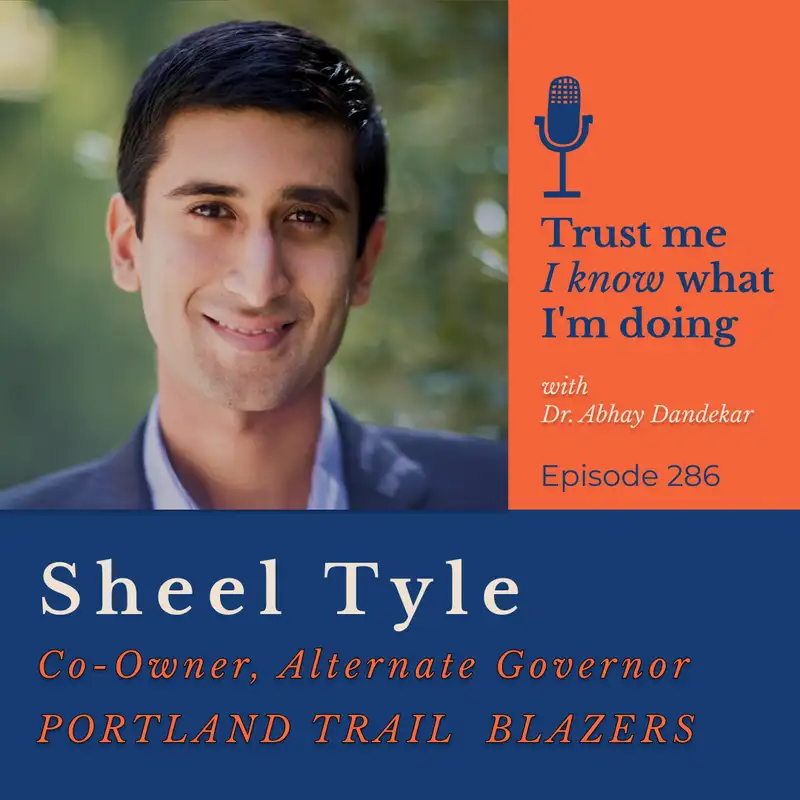
Sheel Tyle on Why He Bought an NBA Team
Download MP3Abhay (00:00)
thanks everyone for listening and watching, sharing with your family and friends, and don't forget to subscribe. TRUST ME I KNOW WHAT I'm DOING is brought to you by Travelopod.
For destinations like Africa, Japan, Antarctica, India, and the Northern Lights regions, start your journey with Travelopod. Visit vacation.travelopod.com.
Sheel Tyle (00:19)
think folks think of the NBA, example, as something that is legacy asset. But the flip side is it's, an organization that is rapidly changing and it is open to change and is excited about change the league is constantly innovating.
Abhay (00:34)
within a
growth mindset, but also with youth at the forefront sometimes. Is there a philosophy that you've rapidly seen so far as a new NBA owner the focus can stay on the product, but owners definitely have to play a central role in that?
Sheel Tyle (00:49)
I wanted to make sure people in Portland
and people in Oregon and people in the Pacific Northwest access big four sports team. I believe sports in this country and in this together all shapes and sizes and stripes in ways that few things can,
Hi, I'm Sheel Tyle, founder and co-CEO of Collective Global and one of the new owners, alternate governor of the Portland Trail Blazers. And this is Trust Me, I Know What I'm Doing.
Abhay (01:45)
welcome everyone to this episode of Trust Me, I Know What I'm Doing. So I've come to believe that there are serial quantum leaps that we take in our lives that are huge, expansive openings to new pastures of opportunity. Now that could be in our relationships and our families, in our careers, in this dance between individual identity and community.
or even simply in that internal thought engine that is constantly running for us. Now those quantum leaps sometimes are big, fast and obvious, and other times they're small, slow and subtle, but nonetheless, they're always substrate for growth. some, quantum compressed in a short and early amount of time. And that's certainly the case for Sheel Tyle, an entrepreneur and venture capitalist who is the CEO and founder of the investment firm Collective Global.
He's a parent in his mid thirties. He holds a law degree and among his many other endeavors and accolades, Sheel also recently became co-owner and alternate governor of the Portland Trail Blazers as a founding partner of the rip city rising ownership group. He's now part of a new generation of leaders that are reshaping the intersection of global tech investment and professional sports. It's so terrific to welcome him for a conversation. Sheel thanks so much for joining me on trust me. I know what I'm doing.
Sheel Tyle (03:00)
Thanks for having me and thanks for what you do for the community.
Abhay (03:03)
Now, I have to tell you, as a proud Cal Bear, I'm not completely sure how I feel Stanford alum here. But as we say, we'll build bridges.
Sheel Tyle (03:11)
Absolutely. I can live with that.
Abhay (03:12)
⁓
You can live with that? All right, good. You know, you're proud Portland resident and with your family, in tow as a new professional sports franchise owner, how has local life changed for you Portland?
Sheel Tyle (03:28)
Yeah, you know, my wife and I moved to Portland a couple of years ago and it was really for her job and her career. She became the, the equivalent of the health secretary and secretary of health of Oregon. And so it was funny because my wife is the public figure in Oregon. It's not me, right. And, for the last few years, I've been known as Sejal's husband, which I'm thrilled with. And I, I am still known by the way as Sejal's husband. I would say over the last
Abhay (03:45)
Right.
Sheel Tyle (03:54)
month ever since we bought the team and I've had to become more visible, you whether it's at press conferences or games or meeting government officials or whatever. It's become, I would say a little bit, I mean, obviously I've become a little bit more recognizable in the community, but I think that's important. You know, like the whole reason I did this is because I wanted to make sure that people in Portland
and people in Oregon and people in the Pacific Northwest had access to a big four sports team. And, you know, for me, I believe sports in this country and in this world bring together people of all shapes and sizes and stripes in ways that few things can,
right? And so to have somebody local, to have somebody who's around, I think was actually important. was the reason I did this.
Abhay (04:45)
certainly, you know, when we're thinking of things from a civic standpoint and your wife's a great example of how to bridge all of those things together as a government leader, as a state leader. But on top of that, you know, for you, when you think about life in Portland, whether it's just, walking to get a cup of coffee or, you know, the work that you do with now a big four sports franchise, do you think of the activities and the
Ongoings a little bit differently now, more as now an investor and thinking of this as sort of like the return on investment that happens all around you, not just from the sports stand.
Sheel Tyle (05:22)
Yeah, I mean, it's funny because I feel like the IRR here, so to speak, the internal rate of return is really in this case, an external rate of return, right? I I think from my perspective, there are better financial investments, frankly. I think sports teams have been a good financial investment historically, but maybe not at the price we're paying now, right? So like, and I'm pretty sure that there are better uses of capital, especially where...
in a world where AI, for example, is proliferating and things are just going gangbusters. But for me, it wasn't about that. Like this wasn't, what is the profit maximizing investment that I can make? It was really more about what is an investment that I can make and be a part of, maybe singularly, that if I am not involved, right? If I am not a part of this, might turn out very differently.
Abhay (05:52)
Nuts, right.
Sheel Tyle (06:12)
And, you know, 10 people can invest in AI company. If I'm one of the 10, the AI company is still going to succeed or fail, right? Irrespective of me. Whereas I think being a part of the Portland Trail Blazers as the only local owner was very important. And I think it was something that the community hopefully appreciates. It's a big responsibility because it means, there are times where I may disagree with the rest of my ownership group. There are times I might disagree with the community.
and agree with my ownership group, right? So sometimes I end up getting caught in the middle, which is a thankless situation on both sides. I think it's something that is, it's the reason I did this, right? I think the best investments are never the easy ones. In fact, they're the hard ones. And I think this is gonna be a hard one, but I think it's gonna be a really fun one.
Abhay (06:42)
Yeah.
navigating that friction between thinking about, well, how do you balance the needs of the community? there's always feedback from everyone all around you, including those partners who are not necessarily local. You've identified problems and scaled companies in the past. So you've gone through these kinds of decision-making processes, both as an entrepreneur and a VC leader. Is an NBA franchise in your eyes now thinking of sort of like the macro?
Is it sort of like a mature legacy asset that needs preservation or are there disruptive kind of VC principles that you're hoping to bring to this that you think the league is kind of poised and ready for in 2026 and beyond?
Sheel Tyle (07:41)
Yeah, think the, I think folks think of the NBA, for example, as something that is a legacy asset. It's been here for a while, right? In my case, it's been there as long as I've been alive. But the flip side is it's, an organization that is rapidly changing and it is open to change and is excited about change at the, at the league level. mean, I now go to board of governor meetings and the league is constantly innovating.
You know, it also is constantly looking inward and seeing how can we improve the big topic that we're all talking about right now is rules around tanking, right? And how do you fix tanking and how do you make sure that you preserve the integrity of competition and for a league to admit that and to offer proposals for change, I think shows that this is a league that is secure, but also
willing to adapt and willing to make the product better long-term, even if short-term, that means admitting fault, right? I also think there's a lot happening at a global level. know, my wife and I are going to Japan next week, partially because we want to make the Blazers Asia's team or certainly one of Asia's teams. And I think you're seeing this push
by the NBA to be more international. I mean, it already is one of the most, if not the most international sport. It's always basketball and soccer that sort of go back and forth, right? But soccer has many leagues, many, top leagues, whereas the NBA really just has, basketball really just has the NBA. But, you know, the NBA has announced that we are looking into launching a Europe league. There is going to be an Africa league. And so, I mean, in some sense, the NBA
is to Series A company, right? It's maybe past the seed round. And we, you know, we have the teams, we have 30 teams right now that could go to 31 or 32 with potential expansion in Seattle, Las Vegas. We might do Europe, we might do Africa. Maybe there's more on the horizon. I mean, it's, it's a very exciting league. And I think the fact that, you know, I'm now one of the owners of the Blazers. We play more international minutes than any other team in the NBA.
either number one or number two over the last few years, have players from Israel, China, Belgium, Canada, Australia, France. We had a player from South Sudan. I think that's the beauty of sport and especially the beauty of something like basketball in 2026. You get people from all walks of life just playing together.
Abhay (10:17)
Yeah, I mean, it's not just connecting international players, but they're connecting international markets and, you know, certainly having the vantage point on that as scaling and thinking globally, but definitely acting locally is something I know that you're doing so well. among the league's youngest owners and leaders with the Portland Trail Blazers and with the franchise out there, as you age, right, in your career,
how do you, as you've coined before, as you age, how do you stave off that innovator's myopia?
Sheel Tyle (10:47)
Yeah, it's good question. I did talk about innovators myopia when I was younger. How, you know, it's as an innovator, sometimes you got to not focus on today. have to focus on tomorrow and sometimes completely ignore throughout what is common today. And I remember using the example around Henry Ford and creating the car. And actually, if you were an innovator in that time,
you were on horses, right? So an innovator would think about how do you make a horse faster? Not how do you completely replace a horse with a vehicle? And so I hope to just continue having that mindset. I think the amazing thing about sport is I might be getting older like we all are, but the players are pretty young, right? And the players tend to stay young. I mean, usually they're in their twenties and thirties. You occasionally you have
a once in a generation player like LeBron James, who is competing at the highest level in their forties. But I think surrounding yourself with young talent is to me invigorating. It's inspiring. It's what I like to do as a venture capitalist and entrepreneur. like to surround myself with, you know, kids in college or kids right out of college who are some of the most inspiring and innovative people on the planet right now. and players are similar, right? I mean, they're, constantly getting better. They're constantly improving. constantly taking.
to the next level. So I think as long as I'm around those people, I hope to continue being innovative.
Abhay (12:12)
I mean, one of the things that that's out there, of course, is that it's rare for not to be relevant, particularly ⁓ in a sports franchise or with a sports product. And then there's owners out there who are super high profile, Jerry Jones or others in the NFL, certainly in the NBA as well. I wonder if at this thinking about that, thinking about the idea of constantly within a kind
growth mindset, but also with youth at the forefront sometimes. Is there a philosophy that you've rapidly seen so far as a new NBA owner where the focus can stay on the product, but the owners definitely have to play a central role in that?
Sheel Tyle (12:53)
Yeah, so, you know, our first game, we bought the team March 31st, 2026. Our first game was against the Clippers in LA. And I went to LA and Steve Ballmer is the owner of the Clippers. And he spent an hour with my partner, Tom and I, just, you know, was talking about welcoming us to the NBA, but also immediately diving into giving us an arena tour, showing us all the innovative things that...
he had built at Intuit Dome. And the nice thing about the NBA is we might compete against each other on the floor, but there's a camaraderie off the floor because we all want the best for the league, right? And if something's good for the Clippers, it's probably good for the Blazers too, right? And so I think what we're finding is this new generation of owners is younger, it's tech forward, and it's willing to learn and adapt.
We played San Antonio in the first round of the playoffs. And I was in San Antonio for game one. And Peter Holt, who's the owner of the Spurs, came up to me and we spent quite a bit of time together. And he's one of the younger owners actually in the league also. And I think folks understand that technology is about to reshape everything. It already has reshaped everything. And AI is probably going to reshape sports in many ways. And folks are starting to think right now, like,
How do we incorporate AI into what we're doing on the court? Does that mean better analytics? Does that mean using technology to figure out weaknesses or strengths of individual players and different formations and lineups? How do we incorporate it into the game day experience for fans? So I think there's a lot happening that will continue to happen. When you look at the transactions that have happened, the Timberwolves were bought by Mark Lohr and Alex Rodriguez. Mark Lohr is an entrepreneur. He's the founder of
jet.com previously the founder of Quincy. You have Ryan Smith who bought the jazz, who was a amazing tech entrepreneur in his own right. I know some of the guys looking at both the Seattle expansion team, as well as the Las Vegas expansion team are, are folks who made money in technology. So I think what you're seeing is that there's a lot of, there's a lot of interest and enthusiasm in adapting sport.
to technology and vice versa.
Abhay (15:09)
Yeah. You know, I've heard you talk about the sort of CelTel experience in Africa as being sort of like this inspirational inflection point. we think inspiration and aspirational models,
that have really taken not just people and franchises, but countries and nations and ecosystems to the next level. In this age of have and have nots, and thinking a little bit about the investment space and the tech space and the incredible speed and power with AI in its current state and in whatever future state it's gonna be, what do you think is the next sort of CelTel
⁓ story that's being written out there for the NBA or for that matter for you personally when it comes to prioritizing and even problem solve.
Sheel Tyle (15:57)
It's a tough question. I would say I'm still getting to know the NBA. only been an owner for month and a half. So maybe I'll speak more personally or in my portfolio. I would say the inspiration behind CelTel for me was the realization that entrepreneurship in emerging markets can completely transform how people live. I mean, in CelTel's case, you had a founder
who, because he put up cellular towers in Africa, CellTel was the first company, by the way, to bring mobile cellular infrastructure to certain parts of Africa, that innovation transformed how people lived, right? I mean, a woman having a kid in Lagos, Nigeria had to yell for help before cell phones existed. After cell phones, she could pick up the phone and call. So I think the point of my CellTel example was showing that
small innovations can completely transform how people live. And when I look across my portfolio in my venture capital firm, I see a number of companies that are solving targeted problems. You can argue maybe they're small problems, but if they actually work, they could create tremendous disruption in people's lives for the better. And I really just hope that they succeed.
I mean, since Seltel is an African company, I'll tell you about one of our African businesses, which is now a global company, but had its roots in Tanzania. It's a business called NALA. N-A-L-A. And what they do is essentially help people transfer money from, it started as Europe to Africa, but now it's all over the world to Africa at a much lower price point than companies like Western Union. And...
It's very simple innovation. It's like, let's drive down the cost of remittances by using technology to essentially have better verification and security. Because part of the problem with Western Union, which is why they have high fees is infrastructure and security is low. So you have to bake in margin for fraud. Right. But if you can better understand who the end customer is and who the sender is, you can actually let
the end person get more of their money, which is, I think, critical. Essentially, if you allow people to get more of their money and less goes to a middleman, then that simple thing could increase the quality of life and the standard of living for millions of people. So I think it's like those types of innovations that I seek out. Some are, of course, in today's world AI-based, but many are not. Many are just simple innovations that may use elements of AI but are just
something that I feel like if they work could really transform how people live.
Abhay (18:39)
Is that what motivates you the most by the way? mean, certainly there's financial gain and there's money involved, but is that impact what you seek as the kind of ultimate realization of just about any investment, NBA, your VC firm socially, is that really what it's all about? Like, what is gonna be the social impact or even the kind of global impact of an investment you make?
Sheel Tyle (19:05)
I think they go hand in hand. mean, initially I was very focused on the social piece of it. And then what I learned, and this was in college, and then what I learned is that the best investments in the world, the best companies in the world, the best organizations in the world are the ones driven by a mission and a purpose. Full stop. Right?
Abhay (19:28)
Hmm.
Yep.
Sheel Tyle (19:29)
It's
not actually focusing on money that leads you to build something of meaning and substance. It's focused on a mission and a relentless pursuit to that mission. And when you relentlessly pursue a mission, that is how you get through tough times. That is how you say no to acquisition offers in the company world or build a championship winning team in the NBA world. Right? When you're focused on a mission, that is how you succeed.
And when you succeed, money is a by-product, but often it's actually the least important by-product, but it is a by-product of relentless pursuit. And so when I look, when I approach building companies or organizations or making investments, my number one question always that I'm trying to figure out is how, why is somebody motivated to do what they're doing and how hard are they going to work?
How much are they gonna run through walls to achieve what they wanna do? And if I come across, if I feel like this person or this group of people is not going to stop at anything to succeed because they're relentlessly focused on changing this thing about the world, then they deserve a shot. And if you make enough of those bets, I think some of them will work. And that's been my thinking.
Abhay (20:43)
Right.
Now that philosophy also comes back to this idea of how much does instinct and wisdom factor in there. And I want to ask you a little bit about that, back to the NBA, that landscape is constantly fed by feedback and information and sports talk radio and fans and stakeholders in the ecosystem. But they loop on everything as such as hot topics like tanking to ticket prices, to trades and talent acquisition.
In the end, what you just mentioned, this example about what motivates you to invest in something, but also asking those very difficult questions of those founders perhaps who are seeking your investment, how do you balance instinct and wisdom with data and sometimes dispassionate analysis when making decisions as an owner or an investor or an entrepreneur?
Is there some marrying that you have to do? And by the way, has that evolved for you over time in that you have a better sense of your own sort of instinct and wisdom?
Sheel Tyle (22:24)
It's a great question and it's something that I feel like I have been thrown into the deep end with the NBA over the last 45 days on.
Abhay (22:34)
Yeah, I would think so.
Sheel Tyle (22:36)
It's so funny because I actually think my, my entrepreneurship and venture capital training was very good for this because in venture capital, you don't actually know if you're in a good or not for a long time and companies go up and down and up and down. Right. And so you just have to stick to your conviction, but you have to let data guide you. And, know, growing up, I actually did compete in a lot of science fairs. And one thing that the scientific method teaches you is to trust the data and be willing to change your hypothesis.
have a hypothesis going in, but allow data to prove or disprove it. And in some sense, dispassionately listen to the data, right? And what's interesting about the NBA is there are a lot of opinions and our product is on the floor for everybody to see. So after a win, my DMs or my, you know, Instagram, Twitter, wherever, everybody loves us, right? These were brilliant decisions. You know, he played well.
great sub, whatever. After a loss, I mean, we are the dumbest people on the planet, right? I can't believe you played this person, know, fire this guy, fire that guy, cut this guy, trade that guy, right? And so I think we have to be, we have to, in those moments of losses, we have to be very data-driven, right? We can't listen to the emotion of, this person had a bad game or a set of games, we must cut this person or we must trade this person.
And the flip side is also true. This person had an amazing game. We must extend that, right? At a max contract or whatever. I think you just have to realize that data plays out over a period of time. The sample set needs to be large enough to be statistically significant. And we need to stick to our method, right? And our method might be wrong, but what I know is definitely wrong is constantly changing your opinion of something based on one data point,
It's been interesting. mean, I do my best to ignore all the messages. Sometimes my friends will send me messages too. And so it's harder to ignore texts from your friends or your family even,
Abhay (24:40)
how much has the uncle and auntie DM and WhatsApp crowd peppered your in baskets so far?
Sheel Tyle (24:46)
It's great. I honestly, I appreciate that they're watching the games now. I mean, it's been so funny because, you know, I have family members who probably have never watched a basketball game in their life. And now they have opinions on what we should do, which is amazing because it shows that they're watching the game. And that's what I love because I love that people are excited about this. And I mean, you know, the Indian community or South Asian community, like this is a family asset, right? And so all of us, the whole Tyle family broadly.
Abhay (24:58)
Right, right.
Yeah, yeah.
Sheel Tyle (25:14)
is just super excited about this whole, this purchase.
Abhay (25:19)
me ask you about that. mean, how has being an Indian American sort of factored into the various personas and leadership roles now that you wear, whether in the previous incarnation or current incarnation as an investor and entrepreneur, but now as an NBA owner, like you said, there's visibility to this. how is that Indian American-ness sort of factored in to the importance as a community member and for that matter, as kind of a global citizen?
Sheel Tyle (25:46)
Yeah, it's been something that I've been proud of, honestly. mean, in the entrepreneurship world, it is much more common. There are so many examples of success amongst the Indian community, born in India, immigrated here community, and then the Indian American community, right? And maybe more like me, born in America to immigrants from India, both have had tremendous success. I think in sports, it's a little newer.
And I think it's newer because we haven't had any NBA athletes who are either Indian or Indian American, really. I mean, there've been some prospects, but there haven't been any that have played real minutes. And in terms of owners, the owners have mostly been, there aren't that many Indian owners, but Vivek Ranadeve at Sacramento Kings is one, the Bhathal family, the old governors of the Kings and...
own actually the WNBA team and the soccer, the women's soccer team in Portland. You know, that was Raj Bhathal similarly Indian immigrated to the US. So I think as far as I know, I'm probably one of the first, if not the first Indian Americans to call it like born in America. And I think that's actually really, it's a responsibility that I hold dearly because
You know, our parents' generation, they took a lot of risk, right? They immigrated halfway across the world, often with nothing. And in many cases, through hard work and perseverance and achieving the American dream, they were able to provide a better life for their kids. But what I have seen with many immigrants, including my parents and their friends and whatnot, is they then want the opposite for their children. They're like, okay, we took the risk. So you...
should be in a more stable career, go be a doctor, go be an engineer, go be a lawyer, go do something that is respected and stable. Because I took the risk, you don't need to take the risk, right? So it's actually funny, because when I look at their investments, the investments of that generation tend to be the polar opposite of all the risks that they took. And so what I want to show is that our generation should take that risk too. And our generation...
Abhay (27:51)
Right, right.
Sheel Tyle (28:01)
We might have been more comfortable. We certainly, in my case, I was way more comfortable than my immigrant parents who had nothing, right? I mean, we didn't grow up with very much, but we definitely grew up with more than zero. but we should take that risk too, you know? And it's by taking risk that you can make the world a bit better for other people. You can achieve your dreams and there's no industry and there's no field where you shouldn't be able to take that risk and have success.
And we're starting to see that in industries where Indians and Indian Americans were not part of politics is another great example, right? We didn't have many political leaders who were South Asian, now we do. So I think the world is changing.
Abhay (28:42)
No, I love that. right, thinking differently about what courage and taking risks and our calculus is as a community is hopefully something that's quite dynamic and learning from the past, but certainly moving forward and exploring a lot more. You mentioned Vivek and Aditya and others who are in the sort of ownership circles there in that same vein of being an Indian American.
and thinking globally, but acting sort of locally, with that community that's growing and with the global product that's out there, I mean, is it going to take that kind of courage and exploration to penetrate markets like India that are just so cricket heavy and they're just so steeped in cultural anchors where the NBA product is not necessarily the same? I mean, how do you propose as the market explodes and expands,
to tackle some of those, you know, real cultural barriers sometimes in growing and scaling something like the NBA.
Sheel Tyle (29:43)
finding with the NBA and I'm still learning, but what I'm finding with the NBA in Asia, let's sort of zoom out, Asia for a second. And I know Asia is very different. All these countries are extremely different. But actually one common thread is that basketball is one of the most popular sports in most Asian countries. In China, in Japan, you could argue it's one of the top two most followed sports, not the most followed sport. In the Philippines, it is the most followed sport.
Most teams actually, it's an interesting stat, most teams in the NBA have more fans in the Philippines than they do in America, which is crazy, right? Cause they just love basketball. ⁓ I was, was meeting a friend from Indonesia last week. He wants us to play games in Jakarta. He thinks there would be a huge opportunity in Indonesia. So I think just taking us to, and then of course I mentioned going to Japan. And
Abhay (30:18)
Yeah, that is crazy. Yeah.
Sheel Tyle (30:35)
I just think that Asia broadly is very excited about basketball. Moving to India, India seems to be quite excited what I remember is the Sacramento Kings played, I think, a handful of preseason games in India that were extremely well attended. Every Bollywood star, every person was at the games. And culturally, basketball carries...
Abhay (30:52)
Yeah.
Sheel Tyle (30:59)
immense weight. I I would argue it's probably the sport with the most cultural influence in the world, right? Just in terms fashion, in terms of who people follow as icons and celebrities. Of course, you have a couple in soccer that everybody follows, but you have a lot in basketball. so I think in India is a India has immense culture, right? I mean, I'm very proud of my Indian heritage and all that people are and stand for.
and can be in India. And I feel like there is a natural symbiotic relationship between the Indian culture and basketball culture in some sense. And so I am excited about getting more South Asians in basketball. think all it's going to take is one superstar Indian player to make it to the NBA. And then you'll have a billion people watching. I mean, I remember
Abhay (31:50)
Right. Yeah, yeah.
Sheel Tyle (31:53)
In January, I was in China, had dinner with Yao Ming and he was totally, like we dropped this player named Yang Hansen at the Blazers and he was watching everything, right? I mean, the whole country was watching Yang Hansen and Yao Ming was a megastar in China. I mean, you could argue he's probably the most famous person in China, you know, period, right? And so I think that we're one star away from India being
Abhay (32:14)
Hmm. Right.
Sheel Tyle (32:21)
in amateur basketball.
Abhay (32:23)
Yeah, yeah. mean, whether it's Yao, whether it's Shohei, there's so many examples like that where it just galvanizes an entire sort of market and population to get really jazzed and interested about things. I want to pivot to one quick question because it's relevant to both of us, not only who we are, but certainly for me, what I do. How has ⁓ being a parent what has being a parent or what has parenting maybe taught you about being
an NBA owner or a leader for that matter, or maybe vice versa.
Sheel Tyle (32:54)
Yeah, I mean, I think being a parent has been a huge blessing and I think it's given me an incredible appreciation for my wife, you know, I mean, for all that she had to go through during pregnancy, delivery, and then following delivery. I joke with my guy friends, if men had to give birth, there'd be a lot less people on the planet, you know, I just think.
Abhay (33:18)
Yeah, there's...
Sheel Tyle (33:20)
Women are pretty strong. mean, it's incredible how strong they are. So I think that's the first thing. It's given me an incredible appreciation for my wife and just women generally. My mom, my wife's mom, all that they had to go through, my grandma, right? And I also think from an NBA perspective, it's given, it's reminded me that this is much bigger than any of us, right? I mean,
Abhay (33:22)
Right. Yeah.
Sheel Tyle (33:46)
What am I actually doing this for? I'm doing this because I believe sports brings people together and I want Portland and where I live to have that, right? And I felt like me being here and me being, you know, an important part of the ownership group was helpful to that regard. But why? Why do I care? I care because I want my daughter and all of her friends to have that same experience of a place that they can come together and cheer for and really believe in and be a safe space.
So I think it's more changed by just mentality on life, which seems to influence every other part of it. I also prioritize it, right? Like I left, I was, there have been multiple instances where I am flying back and forth just so I can spend an extra day with my daughter. So for example, after gate one in San Antonio, our next game was a couple of days later, I hadn't seen my daughter in many days. So I flew back to Portland.
in between the games to go spend time with my daughter. And that was important to me, you know? And I think it shows that there's so many things that are important outside of family, but family is the most important. And, you know, I'm willing to sacrifice lots of things to be able to spend time with my daughter. And that includes if I have to not go to a game because I'd rather spend time with my daughter, that's okay. I'm okay with that decision. And I will continue to make that decision.
Abhay (35:05)
Yeah, no, it's a completely different way to anchor your life and provide such joy and so many buoys to all the other things that we do. Let me get you out of here on this. mean, we've talked about the entrepreneurship journey a little bit, the NBA journey a little bit, but I'm curious now when you introduce yourself at a gathering or a party or to friends and people are meeting you for the first time and they're hearing about your endeavors, your work.
You know, when they think about you as an NBA owner or as a CEO or an investor, how do you hope they feel after meeting you and learning a little bit more about you?
Sheel Tyle (35:45)
It's a good question. feel like it depends on the gathering of the crowd I would be with. But if it's a group of young people, I would hope that they come away thinking that if this is something that they want to do too, that they should, they can achieve those dreams. Whatever they want to do, they should come away feeling that they can do it. One of the amazing things about being an NBA owner is I surround myself with people who have achieved their dreams.
right, and have worked really, really hard to achieve their dreams and are still not satisfied. I mean, I, you know, I was in the gym this morning and came back and ⁓ the first guy in the gym is Damien Lillard, 6.30 AM. He doesn't have to do that. He's a superstar. He's already the highest paid guy in the league right now. And he's the first guy in the gym, right? And so for me, what I hope that people take away when they meet me is that dreams are possible.
You can achieve your dreams. Literally many of the people in the NBA who achieved their dreams were people who also came from nothing and achieved their dreams. anybody has that ability and potential to achieve whatever their dream is, but you have to work really hard and you can't stop grinding. And actually it is the best of the best who grind the most and continue to grind the most. So I think that's what I would hope if I was meeting young people.
Abhay (37:09)
You know, ⁓ does that, have you been able to in fact share a little bit in that grind and reflect as you kind of go forward and in these quantum leaps as we started with on this idea of being content? Is there a place where being content also has an importance in your life too?
Sheel Tyle (37:30)
Yeah, and I think you can be...
So this is an important distinction. I think you can be happy and you can be content while continuing to strive. I am of the belief that contentment does not mean stasis. In order to be content and happy, you have to keep moving forward. Because I think in life, if I were just to sit in this chair all day, I probably might be happy for...
an hour, but then I'm pretty sure my physical fitness and levels would drop. And if I were to sit in this chair for three straight days, I guarantee you that's not good for me. Right? So I think you're either moving forward in life or you're moving back. But grind doesn't have to be a bad thing. I mean, you know, I use this Damien Lillard example. He's happy to be in the gym. Like he doesn't view this as something that, oh, I can't believe I'm in the gym. On the contrary, he's like, it is a privilege.
to be in a position where I can wake up, I can go to the gym in the morning, I can achieve, I can be on my path to achieve my goals of winning a championship, right? I mean, that is what makes them happy. I think the opposite of just sitting at home and being content and reading a book might be exciting and fun for a small period of time, but I think what's really exciting and fun is trying to achieve your dreams.
Abhay (38:54)
Yeah. Well, moving forward and helping those who are around you to move forward as well, and certainly building a lot of community and success along the way is something that I know that audiences and fans and stakeholders in your world are enjoying quite a bit. Sheel thank you so much for joining me for a little bit here. What a treat. And I can find a way to ⁓ connect again in the future.
Sheel Tyle (39:17)
Yeah, thank you for having me and thank you for doing this. you know, I've seen some of the other stories and some of the other interviews you've done. They're incredible. So thank you for what you do.
Abhay (39:27)
hey, thank you again, Sheel, and good luck to you and to the Blazers. Shout outs now to the Spurs and the Knicks and their fans out there for holding the space till my Lakers are ready to play June basketball again. Shout out also to Vaibhav Sooryavanshi for stepping up in the T20 and to Nithya Raman for closing the gap as those votes are still being counted.
A big thank you to all of you for subscribing and sharing this with your family and friends. Don't forget to be safe, be kind, and be smart. Till next time, I'm Abhay Dandekar