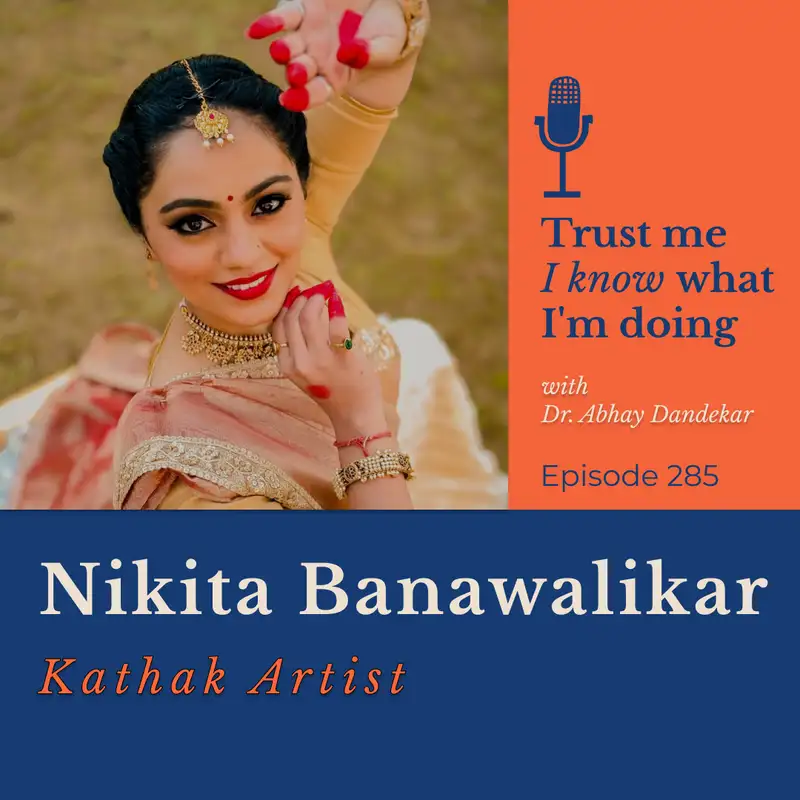
Nikita Banawalikar on Kathak Feeling Like Home
Download MP3Abhay (00:00)
thanks everyone for listening and watching, sharing with your family and friends, and don't forget to subscribe. TRUST ME I KNOW WHAT I'm DOING is brought to you by Travelopod.
For destinations like Africa, Japan, Antarctica, India, and the Northern Lights regions, start your journey with Travelopod. Visit vacation.travelopod.com.
Nikkita Banawalikar (00:19)
Kathak itself is what I can call home because the vocabulary speaks to me. And I don't think my body can move any different or my brain can think any different or differently from it.
It just goes hand in hand and I guess So how do you not fall in love with it then?
Abhay (00:31)
That's right, yeah.
as a Kathak artist, as teacher, as a lifelong student what elements of Kathak continue to kind of nourish and motivate you?
Nikkita Banawalikar (00:42)
As you start growing into this field, automatically everything around you starts inspiring you. It is not just the nature but also the people. It is the stories that you listen to every day.
Hello, this is Dr. Nikita Banawalikar I'm a Kathak exponent, choreographer, educator, and a scholar.
And this is, trust me, I know what I'm doing.
Abhay (01:31)
welcome everyone to this episode of Trust Me, I Know What I'm Doing. Now movement and dance are timeless modes of storytelling and expression in virtually every culture in the world. And among the Indian classical dance forms, Kathak signifies this so beautifully, of course, as an exponent of our culture to the entire world. And I'm so pleased to welcome Nikita Banawalikar.
A distinguished Kathak dance artist, choreographer, and scholar known for her seamless fusion of traditional classical foundations with modern presentations.
trained under legendary gurus Manjiri Dev, Padma Vibhushana, Kumudini Shama Bhate she combines technical precision with profound abhinaya to craft compelling, nuanced performances.
Beyond the stage, she's a dedicated academic and an educator whose work reflects a unique synthesis of refined artistic brilliance and scholarly rigor. And of course, she's also recently obtained a PhD in Kathak and a well-deserving title of Dr. Nikita Banawalikar I am so pleased and it's such a treat to share some time with her. Thank you so much for joining me today on Trust Me, I Know What I'm Doing.
Nikkita Banawalikar (02:43)
Thank you so much, Abhay Ji for calling me and it's been an honor to have this time with you wherein I can share my thoughts and learn something from you and we could have a good discussion about the art form and life in general.
Abhay (02:56)
I can't wait. You know, it's morning for you and I know that ⁓ probably like many, there are a variety of routines and rituals that govern all of us. But I wanted to know from a perspective of dance, how often do you dream about dance?
Nikkita Banawalikar (03:13)
That's a tough question. I don't think currently is a phase in where I dream because I live that dream every day. As a child, if you could have asked me, this would have been a question to answer. But right now I'm living my dream. Who else would be having this lifestyle wherein they get to enjoy their hobby as a full time profession? So I guess this is not a dream anymore. I'm living my dream and I hope that this dream never ends. So there's no dream. It's a reality.
Abhay (03:20)
Hmm.
When you think those dreams that we have that are so involved and they seem like they carry over, of course, into our daytime activities, for you then, do you have any particular daily routines or rituals that first welcome your day when it comes to life as a dancer?
Nikkita Banawalikar (04:01)
guess the first thing that naturally happens right now is because I start my day with a class. So my day starts pretty early in the morning. So it naturally starts with a class because I have students based abroad. So the timing fixes in that pattern for them. So it's a blessing that I can start a day by my work. and then from there we move to some.
yoga which I practice on daily basis because we all are growing old and we start realizing the importance of having a good healthy routine. And then it depends on how the day functions forward. I prefer doing my practice divided in both the sessions whether it is the morning if I'm free in the morning if not in the evening. But it's not a fixed schedule as such there's no fixed routine and I guess that is a blessing to have that my everyday looks different from the day prior to it.
That is probably what I'm enjoying right now. So there's no fixed routine as such, but gladly nowadays that I'm starting my day is with dance.
Abhay (04:59)
I wonder then, does that mean that for the majority of the day, because it's kind of going from one anchor to the next when it comes to dance, does dance sort of pervade even your everyday life, right? So like, if you watch someone or something or something in nature and you're thinking about what kind of expression or manifestation that might make in a future dance move or in a future composition.
Nikkita Banawalikar (05:07)
Yes. Yes.
As you start growing into this field, automatically everything around you starts inspiring you. It is not just the nature but also the people. It is the stories that you listen to every day.
is generally if you're traveling somewhere, if you see something just passing by. Even right now if you watch a hoarding which is beautifully designed, you just have some thoughts flowing, colors, everything excites you. It's not a mundane life for you anymore. Everything around you inspires you to build something. You're not actually going to sit and build it up.
Abhay (05:44)
Hmm. Yeah.
Nikkita Banawalikar (05:56)
But at least there is something that triggers in your body, something in your brains. It is not just the dance that you look at. You start looking at people in general. You start observing things around you. You start observing photos. You start observing paintings, sculptures, beautiful architecture. Just walking around, if you see something that is beautiful in design, naturally you start feeling that, can I implement this as a dance move?
How will that be reflected? books that you read naturally turn out to be stories in your head. So it is not just letters anymore. It is a story that you want to read. Of course, not everything can be portrayed to dance. Well, having said that, it can be. But it takes a long time to make it all come together. And I guess that is what is growing as an artist, right?
Abhay (06:36)
I imagine that,
yeah, no, for sure. I imagine that that brings so much joy to looking at things in a little bit different perspective and how they can be translated into the story. How does it also translate to getting through the mundane things about anyone's day, right? Where like you're waiting for somebody or you're actually stuck in traffic. I mean, how does dance help you in a way?
kind of traverse some of those kinds of, frustrations that we can sometimes have on a daily basis.
Nikkita Banawalikar (07:07)
When you mention traffic, it's nice to say because I come from a city like Mumbai, half our life has just gone on roads. yeah, but music helps a lot. I keep listening to a lot of things. I keep watching a lot of things around because that's a lot of time that we take in our travel. How do you utilize it? I have started reading a lot of books. So that is how I pass my ⁓ mundane life cycle.
Abhay (07:14)
Correct.
Nikkita Banawalikar (07:32)
not initially. Initially, I used to be just too frustrated with what is happening around. But as you grow up, you start realizing the importance of every second of your life. And yeah, you utilize it either for your relaxation or either for your inspiration. So
Abhay (07:49)
when when thinking back a little bit and when you perhaps first were starting to dance and even now, if you connect the dots between then and now, do you always see the world through a prism of rhythm and music and movement? Or are there actually times when you intentionally need to create kind of non Kathak spaces in your brain?
Do you need to actually sometimes truly just shut that off?
Nikkita Banawalikar (08:17)
Yes, to be honest, as an artist, initially, of course, I never dreamt of becoming a dancer. It just became a part and parcel of my life. Me 10 years before and me 10 years later, or me now, are completely different individuals And initially for me, dance was just a practice routine. And you go back to your normal life. But now it is my life.
So everything revolves around it.
is no spacing when there is I have to bifurcate that this is my time as an artist, this is my time as me, this is my, no. I don't think that is a liberty that I have anymore. I'll give you a nice example. A couple of friends asked me, how does your weekend look like? And I started questioning myself, do I even have a weekend schedule? Or is my weekday different from my weekend?
Abhay (08:52)
Mm.
Nikkita Banawalikar (09:03)
Is my brain going to shut off thinking about dance? No, because everything around me just somewhere connects me to the same dots. So I don't think I have a life different from my art form. Of course, I have space away from I'm not going to sit and dance every day, but it's not going to stop me from thinking about it. and it has never been the case when I was doing my chartered accountancy.
Abhay (09:22)
Mm.
Nikkita Banawalikar (09:26)
⁓ That time when I used to go to the classes, I have a full book of my notes and this is the back side of the pages. I have all Kathak notes written down. That just never goes off your brain. It's just that, yes, it's a part of your body. It's there. It's a subconscious mind that always is active with that kind of dance or dance bols or anything that you just saw. It just comes as a flash.
Abhay (09:37)
It's almost like it's harmonized and it's integrated. Yeah. Sure.
Nikkita Banawalikar (09:52)
So I don't think I have a life that I can say that, now my two hours are for something else. Now my evening time is for something else. It's nothing like it. Probably I should have a timetable that way, but I don't think it makes a difference.
Abhay (09:56)
Mm.
Yeah.
Well, I wonder then as someone who has been dancing, for so long and started as a child and continued and now it's become highly, highly integrated into your life as a professional artist. Do you remember a moment where it was obvious that you fell in love with kathak?
Nikkita Banawalikar (10:08)
Hey.
I don't think I can talk about one moment because it's not, you don't just realize your love for something in a fraction of second, right? It just builds over time. It's a process that you go through and you suddenly start realizing is that your identity is not different from this. It's, it's, it's somewhere becomes who you are. It starts speaking the same language like you. I guess I fell in love.
with the art form over a period of time. And it is not just me in practice, but me also watching a lot of people, watching performances or listening to the interviews. It's just a lifestyle which I've seen develop over time, which I started enjoying seeing myself in. Just the regular practice sessions and then performances or competitions. guess competitions are somewhere I started realizing that I can be.
something in this. You start seeing a lot of people of your age or somebody elder than you and you start envisioning is that is this something that I can ask from life full time and you just don't want to be separated from it. And having said that I have also left it a lot of times to go to an academic job or get into studies or leave it, stay away from it. But I guess when you love something there's a pull. It always calls you back. It just never leaves your side.
Abhay (11:20)
Mmm.
Nikkita Banawalikar (11:49)
So I will not say that it is just my love for the art form. It's probably the other way around as well. The art form also never left me. Whether it's this time, whether it's my efforts into it that is giving me back, or what is it? It's a two way conversation that is happening every time, but it has never left my side. And now is when I've started realizing that when it did not leave my side, how can I leave its side? It's.
Abhay (11:54)
Hmm. Yeah.
Does
it mean that Gatak really is the best manifestation of home for you, especially as an individual?
Nikkita Banawalikar (12:18)
Absolutely, God, it's true.
You can call it home because it is, I'm not saying dance is home, but Kathak, to be very specific, Kathak itself is what I can call home because the vocabulary speaks to me. The body naturally moves to it. It's become a part and parcel of who I am now. And I don't think my body can move any different or my brain can think any different or differently from it.
It just goes hand in hand and I guess that is the best partner for your life, right? So how do you not fall in love with it then?
Abhay (12:48)
That's right, yeah.
Right. I wanted
to ask you because you brought up the competition part of it and ⁓ this is one thing that I've seen others who have made leaps and bounds in their either their own skill or their performance or their achievements or their ability to demonstrate the talent or the skill that they have. But do you remember when you maybe first felt that burst of confidence?
Nikkita Banawalikar (12:55)
Yeah.
Yeah.
Abhay (13:16)
and started almost in a way trusting yourself as a Kathak performer. Was there a particular dance competition or a particular performance where you, like you mentioned, you sort of knew that, okay, I can do this and I feel like this is something that is coming more naturally and I wanna demonstrate that to other people.
Nikkita Banawalikar (13:31)
Yeah.
Yeah, as a child, not like a literal child, when I was in my teens, I used to do a lot of small competitions or state level competitions and slowly, steadily national levels when that used to happen. And the appreciation that you used to see used to push yourself to start working harder. Like when I see my performance today, it should not be the same as I performed the last time. And again, it is not that it's going to be better every time. It's how human body is. It's not going to be the same every time. And if it is happening same, then you really have to doubt yourself that
How can every day or every performance look the same? It needs to naturally change. Sometimes you have good days, sometimes you have bad days. And that's how you also critically start analyzing yourself, right? And if you as yourself don't critically look at your work, who will? Otherwise you just go into this whole bubble of I'm so good, which is not the right way to do. And fortunately I have my parents at home, which are my big time critics. So I have to come back every time to it. And when I used to see, there was one competition particularly, I guess this was in...
Bandra, was Sharda Sangeet Vidyalaya's Pandit Vishnu Digambil Paruskar Award, which there are particular competitions which you want to win certain awards that you want to achieve as a child in that competition. So this was one checklist which I had. And at that time, when while I was getting the trophy is when the organizer there, they told my parents that you should be very proud of the daughter you got. And then the way I saw my parents eyes just lit up.
I guess that was the time when I knew that this is something which can be different in a parent's life to see 10 people praising their child for something which they have worked so hard on because it is not just my hard work, it is their hard work as well. Otherwise it would just never work. And I guess that was the time when I knew that even if I don't take it up full time or whatever, fortunately I'm taking it up full time, but even if I don't take it up full time, this is something which I need to be better at.
Every time that I come on stage or every time this art form is associated with my name, I should do full justice to the training that I've had or to the efforts that has been involved by the people around me. So that was a time when I knew it, that this is something that I want to keep learning. And when I won my first Aminika trophy, it was my teacher's dream that none of her students had won it. And I was the first one to win it for her. And that time when I saw it, I knew that this is the field that I know I can be good at.
I just need to work harder, need to be a little bit more patient, which was rare then, but yeah, I can really achieve something well in this.
Abhay (16:08)
And you
know, it's such a it's a gratifying feeling. And when you mentioned your parents, your they receive the feedback from others, as you receive the feedback from others, is their role in your constant iterative learning and growth aiming to get better and better and seek new ground in Kathak? a role to? Yeah.
Nikkita Banawalikar (16:30)
But with that as well, there is also
important to understand that who are you listening to? There will be hundreds of people around you who are going to come and praise you for not even doing it good. are there words that matter to you or the ones who you know are truly, truly the ones which you need to listen to? They might not completely appreciate you every time. They are going to criticize you multiple times, but...
Abhay (16:36)
Mm.
Sure, sure.
Nikkita Banawalikar (16:53)
What do you want to listen to at what point of time in your life is very important. Thousands of people praising you or the 10 people who just want you to be better the next time that you come in. So it's just a balance of both.
Abhay (17:04)
What I was gonna say was, I wonder if the role of your parents and your guru who can be both the people who support you the most and also who are really, really the ones who are going to be very honest and open about their critique and is their role as those people who will be incredibly honest with you. Does that also have its own ability to accelerate your own?
Nikkita Banawalikar (17:06)
Yeah.
Yeah.
Abhay (17:27)
confidence and trust in yourself just by the mere fact that you know that these are the most honest people when they're examining your
Nikkita Banawalikar (17:34)
So it's true, you should be listening to the ones who very honest with you, but the age is also a factor when you think that when you're in your teenage, you are into that hormonal phase, wherein somebody just coming and appreciating you feels like a big achievement. But the same person, but the other person coming in saying that, this could have been better. You feel like, God, what is this person telling? I did so well. So it works both the way.
Abhay (17:48)
Mmm.
It's a matter of we, you know,
exactly we feel defensive.
Nikkita Banawalikar (17:58)
Yes, but I guess this is something which I have always been made understood that we are saying it for your betterment. So unless and until there are people who come and tell you what could be better, you'll be stuck in that same phase. And I have never been a person who want to be average. However, it doesn't sound correct because you should not put so much pressure on yourself as an individual.
because for me, it was not just me performing. It was a little baggage, the art forms they've attached. It's the teachers who have been training me because the first question somebody asks you after you perform is who do you learn under? So it's that responsibility that comes along. So for me, it was very important that I stand true to
those people or those training and there should be, they should not face any amount of criticism for me doing something on stage. So probably that's the baggage that came alongside me and my performances for me. was not put by anybody, but as an individual, I had that coming along with me. And therefore I was very happy to listen to the ones who I wanted to fare well for. I'll not listen to 10 different people, but when I know there's somebody who's really wanting me to do better in life, why?
Abhay (18:48)
Yeah. Yeah.
Right, right.
Yeah, and I think it is such an important companion to making sure that your confidence and your trust is growing along with your own skillset ⁓ as you mature as an artist
I first discovered your work online. when I'm watching any classical Indian dance I'm so struck by the harmonizing of the technical precision with storytelling.
and then that shared connection that you have with an audience, how has some of the storytelling and conversation changed when you're maybe sharing your work online or for that matter, even have hosting online classes?
Nikkita Banawalikar (20:26)
I guess digitalization has made a lot of difference in my life because pre-COVID I was of a notion that art forms can only be enjoyed on stage not just enjoyed, it can also be taught only in person. It can never be taught online. I was completely against Skype sessions. In those days we had Skype, right? So completely against all of that but it has changed my perspective in a long, long way now. Of course, watching dance is also something that
Abhay (20:29)
Mmm.
Nikkita Banawalikar (20:51)
COVID changed because a lot of performances started happening online. And before that, I'd worked for films, cetera, choreographing. And naturally, when I started observing videos being posted online, you start realizing there's so much things that could happen on that one screen. and of course, camera angles helps you enhance the whole storytelling narrative, right? So that is one thing that can change.
Teaching has changed also because I have so many students based abroad and it has just bridged that gap for me. And now when you see social media at this point of time, we have automatically have a crunch in our time duration.
We don't see it for 30 minutes anymore. It is 30 seconds. So that time span has also reduced. So how do you narrate a quick composition? How do you make it more interesting? During COVID, I did a nature-related story on a carnatic bol So that kind of collaboration just felt very inspiring at that point of time. because the art form generally is supposed to...
broaden one thought and not scrunch big thought into small parts, right? So that is something which I really miss online, but it has its pros and cons both. So though I am in all support of getting things through digital perspective now.
Abhay (22:06)
Right.
Yeah, and you know, I think it's amazing that someone like me, who ⁓ is a kathak novice in that way, as someone who is not necessarily learned in the art form, but can explore that. And there are digital avenues so that people like me can get to understand and know new artists and seek out new artists. And yet I'm sure there are purists out there.
who would, they will maintain that of course, Kathak does not belong in this form. True Kathak needs to be watched in person. It needs to be performed in front of an how do you maybe share your vision of Kathak with some of those purists who may not necessarily agree that digital is a great platform for Kathak as an art?
Nikkita Banawalikar (22:57)
also believe that Kathak as an art needs to be enjoyed in person. I truly believe that because the way you can literally interact with the audience from the stage or even in a small bed, it's completely different from the experience that you have it online. And if I'm talking about two experiences, let's just divide social media Kathak and Kathak as a performance on social media. That's a whole different topic that we can talk about right now because Kathak through reels
is not something which I also agree with a lot because right now with the algorithm and everything playing on the reach of something which is below average is far more than something which is a really good content because you can't know what actually makes the click. There are so many videos that I've watched which are so good but their reach is what 5000, 6000 not beyond it.
And there are thousands of videos which are not worth it anymore, have millions of views. And you can't just sit and explain everybody what is good, what is not good, because that's not the space we are in anymore. Because people have a lot of opinions and their own mindset attached to things. And you're not here to change everybody's opinion. when I say about performances, there a lot of digital performances that happen.
There a of concerts that used to be telecasted digitally. And if you see the same concert in life and in the digital presence, you'll automatically realize the difference of it. So the people who are telling that Kathak needs to be enjoyed in person, they'll automatically realize while they're saying so. Because in digital medium, it is just like watching a film. You don't become a part of it. You're just watching it. You're just visually enjoying it. just think of a film and a theater.
Abhay (24:17)
Right.
Hmm. Yeah.
Nikkita Banawalikar (24:42)
You are in
presence of a theatre playwright and a film is something which is in front of you, you are just watching it through. You are not a part of that process. But when you see something live, you naturally become a part of it, a part of the process, especially with Kathak because there so much of interaction going on with the audience, with the musicians, unlike a performance which is just fixed. Kathak has its own flexibility. So that enjoyment or that experience you will only have when you have it in person.
you're not going to have that through a digital medium. So that is there, but the only thing is that it helps you have a reach. It makes you meet people which probably you'll not have in your performances. So just the reach is a factor which would be a plus one for the digital media. But of course, experience would be still a negative one from my side. And now that I'm saying that when we talk about the purists or the gurus who are not so much on the medium, trust me, they are also coming up.
They are nowhere behind. The students are giving them the push. It's trying to make sure that their faces are seen because these are the ones who have actually created this whole foundation for us, right? And you just see the rules. You just don't see the foundation who has created them. You don't see those people who have put in so much of efforts to create those students that you see currently on social media or digitally as well or on stage today. So I guess the students are now coming up with creating that kind of a strategy to
Abhay (25:40)
Hmm.
Yeah.
Absolutely, yeah.
Nikkita Banawalikar (26:08)
show them on digital presence. It's there, it's happening and I don't think they are lacking behind anywhere. They are pretty open to it.
Abhay (26:11)
Which is...
Yeah,
right. And which is amazing, right? I mean, we want to have exponents in all dimension, in all media formats. And yet two things can be true at once, right? I mean, you can scale the art, you can try and distribute the art, you can make sure that the art stays pure in its form. But it's also important to remember that the anchor of all of this is, again, the live performance and the conversation that's had between the artist and the audience.
Nikkita Banawalikar (26:23)
Yes.
Correct. Yeah.
Abhay (26:42)
You mentioned
⁓ film choreography just now, and I wanted to ask you one thing about that, particularly because sometimes that might be the very first place where Indian dance is thought of, especially on a global stage. What, if anything at all, have you actually had to unlearn or maybe even let go of as a dance artist and a lifelong student of Kathak in order to actually be an effective film choreographer?
Nikkita Banawalikar (26:46)
Yeah.
The first thing to understand is your subject. You just can't think of yourself as the artist who's performing. You're going to choreograph a third person who probably is not even trained in the art form or doesn't even have a background of the art form or also in some cases not a good dancer. So the most important thing when it comes to film choreographies is understanding the subject that is in front of you. You can't make the subject look bad. So you have to make sure the subject is enhanced in a certain way.
So the first thing that you need to learn is who they are, what part are they playing, do they have a background, and if not so, how will you start working on them that they look great on screen? let's talk about two different genders altogether. When I worked for Rocky or Rani, I worked with Tota Sir and Ranveer Sir. So they are two men, like literally masculine men who have never done anything classical in their life.
Abhay (28:01)
Right.
Nikkita Banawalikar (28:02)
And then you think about somebody like a Madhuri Dixit or an Alia Bhatt or somebody who is very feminine to this side and they at least have an exposure of the dance form. So how do you train both of them in the same way? How do you choreograph for both of them in the same way you can't? So the most important factor while thinking of film choreographies is who are you teaching? What part are they playing? And then accordingly work around them. Of course, you have to level down your own skill set.
Of course, you can't just make sure that you do something which is very haphazardly, extraordinarily kathak and make them do the same. It's not going to work. But when you think of choreographing on yourself, you think differently. So your mindset, everything changes with the things that are going around. So that's one thing that has helped me in my regular life as well, that you start seeing people differently. What looks good on me will probably not look good on you. So when you're teaching somebody, you start looking...
through who that individual is, what might suit them. And that is something which everybody should look at. It's not just that when you see something on screen that's going to look good on you. Who are you? Will that look good on you? Or doing that same thing a little differently might make it look better. So these small things are something which I have learned very well through film choreographies and of course, lot of patience. Film choreographies teach you a lot of patience because it's a long routine.
Abhay (29:07)
Mm.
Nikkita Banawalikar (29:22)
It's not like how we do a regular class, right? You come to the class, you practice your session and it's done. But this is a long process and even shooting schedules, you have a 12 hour shift. When do you in your class have a 12 hour shift? No, it doesn't work like that. So it brings a lot of change.
Abhay (29:25)
Yeah.
Right, Now,
did you have to, in a way, again, practice this in order to get comfortable with that entire kind of environment of doing film choreography? And for that matter, has being a film choreographer actually made you a better kathak dancer yourself?
Nikkita Banawalikar (29:53)
God. Yes, it is basically unlearning a lot of things when you are getting into a field which probably you are not acquainted enough with. And of course, as ⁓ Kathak practitioners or hardcore classical practitioners, you always want to stay away from something that is commercial, right? Because you are so much into that purity of the art form that you don't want to disturb it anywhere. So a lot of unlearning has happened when you go there.
Abhay (29:57)
Yeah.
Nikkita Banawalikar (30:20)
or become a part of an industry which is not native to you. I did not know a lot of things because the first time that I started choreographing or I was assisting for Kalan, the first word I heard was hook step. And I was like, what does a hook step mean? I don't know. We never had it. So it's the hook that is repeated every time which people naturally start clicking to. ⁓ so terminologies have been different. How do you think of shooting a song not just from the choreography perspective?
Abhay (30:41)
Yes.
Nikkita Banawalikar (30:49)
but how will it be directed on camera? That perspective has changed. How many individuals are flowing? How does a group look in front of the camera? Because a group on stage looks completely different from a group on camera. So a lot of learning of that has happened. And that has helped me become a better, I would not say a Kathak dancer because that has nothing to do with my Kathak training, but it has helped me to become a better teacher.
Abhay (31:15)
Okay. Yeah.
Nikkita Banawalikar (31:15)
because I've
become, I've started understanding people and their ⁓ mental state at what particular time, their emotional state when they're learning, how do they respond to somebody teaching something that they don't know of? And of course, everybody has their own way of dealing with things, right? So their mood swings, where have they come from? Did they shoot before or they have come from the early morning? How are they in the morning? How are they in the evening?
So you start observing so many things and naturally that observation or that listening skill is that translates when you start working with your students or a completely new set of people.
Abhay (31:51)
I was gonna say,
I was gonna say it sounds like you have to almost in many ways become a psychologist. Yeah.
Nikkita Banawalikar (31:58)
Yes, totally
because you just can't come in front of somebody and start behaving the way you are. You have to start accepting where they come from. Where did they come today from? How is their mental state ⁓ in today's day at this point of time and accordingly change the way you start working with them.
Abhay (32:07)
Yeah, yeah. Right?
no. And that's a lot of patience, it's a lot of empathy. It's really sort of like meeting someone where they are. And yes, especially as a teacher, as an educator, as an academician, this probably makes a lot of sense in that way as well.
Nikkita Banawalikar (32:26)
Yeah.
Yes. And
it's also helped me lot of collaborative work because as a part of as an Kathak artist, you naturally live with the people who know the art form, who know classical music in general. So the conversations that you have with them or the way you work with them, half the job is done because that person knows the art form, whether it's your musicians, whether it's your teacher, whether it's your colleagues, anybody, they know the art form. But here you're working with people who have no background. For them, you are an alien and for you,
Abhay (32:34)
Yeah.
Hmm. Right.
Nikkita Banawalikar (32:58)
same as this case, right? So the kind of conversations are different. The way they talk about things are different. So the habitat has changed. So how do you adapt to it? So therefore it has made me adaptive in a lot of sense. So if you put me in a group of people who are, who don't know the art form, I can still have a conversation with them about the art form or anything else. that confidence of being in a group of people and still know who you are is something that
Abhay (33:06)
Mmm.
Nikkita Banawalikar (33:25)
Film choreographers have given me a lot. Yeah, it's something
Abhay (33:27)
Which is great.
a real security in that, right? That you can actually be placed anywhere in any environment and still be true to who you are and yet have some empathy with anyone. I wonder how that's translated to some of the art form here, know, concepts like Katha, which is, storytelling or the Abhinaya that we mentioned before, that expression and expressiveness of Kathak and dance.
have been at the heart of Kathak for generations, right? Eons. And does the future success of Kathak as it is spread and scaled and more and more people are not only just learning about it, but they are attracted to ⁓ compelling Kathak artists like yourself, does the future success of Kathak lie in its purity when it comes to Katha and storytelling and Abhinaya?
Nikkita Banawalikar (33:55)
Hey. Hey, hey.
Abhay (34:22)
or in its evolution, or perhaps both for that matter.
Nikkita Banawalikar (34:26)
Okay, let me just start with how has time changed, right? When did Kathak evolve? It evolved in the times when you had Ramayan and Mahabharat stories. And today we are into a whole different 21st century. It's a whole different life. People are different. Our stories are different. Our narratives have completely changed. How we look at the stories then are also different. How we evoke things are completely different. Let's take a simple example. Yesterday, we have a story of Krishna and Radha, where Krishna is teasing Radha.
Will it be the same response to it now? No, it won't be. Therefore, it's very difficult for you to also explain to people that the expression has changed, the reaction has changed, but the feeling has not. The basic line is your emotion. That has not changed. And I hope that never changes because your response to things might change, but your internalization can never change. So the stories, though, have evolved over time, but the emotional or
Abhay (35:07)
Mmm.
Nikkita Banawalikar (35:23)
What we say, the intent of the story is still the same. You have a Mahabharat happening, you have a Game of Thrones and a Succession happening. It's the same storyline, but it's just narrated differently. Therefore, the balance is very important. You just can't uproot a tree from its root and place it somewhere and tell now it to grow. It's not going to grow.
Abhay (35:32)
Yeah.
Nikkita Banawalikar (35:41)
Therefore, the purity of the art form needs to be maintained while beautifying it with something which is more present. And this is, I guess this is success to any art form. It is not just Kathak, it is not just classical. It is applying to classical music as well. It's applying to jazz as well, ballet, everything. those typical ballets that are happening, Nutcracker, or we still want to go and watch them, right?
Why? Have they faded over time? No. That's the beauty of these art forms that needs to be evolved
Abhay (36:10)
Yeah, yeah, no way.
it's so true, right? Because there are always modern imaginations of these classical stories and yet the and the art form itself, the technique, those are things that are hopefully not only staying the same, but they're also being built upon. And there are more and more re-imaginations of that as well.
Nikkita Banawalikar (36:17)
Yeah.
True.
Let's simply
take the vocabulary of Kathak has evolved so much. The most beautiful thing about Kathak is its vocabulary. It's not constant. It has kept evolving over a period of time. Yesterday, if somebody was okay to do Tat-tat this way, but today somebody will always do Kathak more refined. I will not enjoy the same ⁓ half, what is wrong, some words would be wrong to even use, but unclear movements. It's not something which I'll enjoy today. I would like the movements to be more clean.
Abhay (36:44)
Yes.
Yeah. Yep.
Nikkita Banawalikar (37:04)
neat, precise and that's how I enjoy the art form today. I would probably not be saying this a couple of years later because it might the vocabulary might change or earlier for me the dancers that I enjoyed watching when I was in my early teens is different from the ones that I enjoy watching today. The way I used to enjoy watching Kathak that time something which is very fast which is very dynamic it's changed. I like something that is a lot of tear out today.
Your age also changes your response to the art form. So somebody in her early 20s will do the same thing differently than the same person doing it in her late 40s or late 60s. And that is the beauty of classical art forms, right? So new stories will definitely create beauty, but the base, the foundation needs to be very, very strong. You can't just take it completely away from it.
Abhay (37:35)
Of course.
I think.
And I think that outlook, I imagine, also allows for any artist to gracefully age with the art form as well, because it means that you're constantly thinking and iterating and growing and helping yourself to evolve, but also to maintain kind of like that foundation, as you mentioned. ⁓
Nikkita Banawalikar (38:15)
because
tomorrow we just can't paint Taj Mahal colourful and call it beautiful. The beauty of it is in the purity of the white that it has, the white stone, the white marble, right? So some things are good not to be untouched, but if you just bring in a lot of flowers around it, you beautify the garden around it with fresh new colours, it's always going to make it look beautiful. Same as with classical dance forms, you keep that purity intact and you beautify it whatever your instinct at that point of time or that story is.
Abhay (38:23)
Right. Yeah.
Hmm, that's a great way to put it, yeah.
Nikkita Banawalikar (38:45)
I guess that is something which I feel should be the future of classical art forms and not just completely whitewashing the whole discipline that it has followed over time. The aesthetic of it needs to be maintained. It's such a... the word which can't be defined. How do you define aesthetics? I had this word in my PhD subject as well. I was like, it gets so difficult to define aesthetics because it changes from person to person. It's such a vague term.
Abhay (39:12)
Yeah.
Nikkita Banawalikar (39:14)
But when you look at something, you know this is aesthetic, this is classy, you just can't take it off. It's, I don't know, there's some things that can't be written down in definitions, but it's something that you can enjoy.
Abhay (39:22)
I wonder if that's sort of like
the the Anamika, if you will, of of the art. Right. I mean, it's you're right. You know, you kind of when you see something, this whole idea of when you know, you know, and, you know, it's the same kind of thing, I think, in art. And yet, as new people come to the space, it's important that they have this blend of the foundation. And then, as you mentioned, also, like, you know, the new flowers that are around in the garden and
Nikkita Banawalikar (39:27)
Yeah
Abhay (39:49)
That's always one to always keep in mind as well. I wanted to ask you something in that as a Kathak artist, what elements of being a Kathak dancer and particularly as a teacher, as a lifelong student of Kathak, what elements of Kathak continue to kind of nourish and motivate you?
Nikkita Banawalikar (40:09)
I guess the first thing that I fell in love with the art form was the discipline. It had a certain discipline that is given to my life. And not just when I'm not talking about schedule discipline. It's just a natural discipline that it involves because you know there's a certain amount of effort that you're going to take. We usually feel discipline is just a time schedule. That's not the case. The way you breathe, that discipline also has changed. The way I move, the way I walk.
the way I talk, the way I sit, the basic posture has changed. So I guess that improvement that it has brought to my life is something which will stay with me for long, long time. Over time, it has made me a very observant person. Initially, you were just learning, you're watching, you're replicating. But observation is not just replication. It is also about internalization of something that you just saw.
And then you start thinking over it. So it has made me a thinker, over thinker in certain cases, but it has made me a thinker of first observe, listen, then think over it and then you try and put it out. So things naturally start having your identity.
Abhay (41:13)
You
Nikkita Banawalikar (41:26)
And ⁓ it has also made me very critical about a lot of things that don't take things for granted to learn one one composition from a teacher we used to struggle so much and now you get everything so easily through YouTube.
People just directly look at a video and just take a composition and start practicing it and just give a credit to it. But that effort, that involvement of that smallest thing that you get to learn, that happiness of learning that, guess I don't think you can even explain it to people now who have things readily available. So it has made me hardworking and you automatically start realizing that this hard work translates into who you are.
Abhay (42:05)
Hmm.
Nikkita Banawalikar (42:10)
So I realize the importance of things. It is not something that just served to me readily.
Abhay (42:13)
Yeah.
It's almost as if the friction and the effort that's required to learn something and to continue to grow the art is itself the biggest motivator of all. Yeah.
Nikkita Banawalikar (42:23)
Yeah.
The rigor that you need, know. Nowadays
when I see people they are like, okay, this is not happening, let's just move away from it. We just never had that. For me it was like, if this is not happening, how is it not happening? Let's make it happen. It will take a day, it will take two days, will take three days, it take a month, but some or the other day it will happen. Probably not as expected, but I can. There was no way of letting it go. And it's still there. The way I express...
Abhay (42:34)
Yeah. Right.
Nikkita Banawalikar (42:54)
I guess dance has given me that kind of an expression. Otherwise it wouldn't have.
Abhay (42:57)
I was gonna say, it
sounds like Gatak has given you the will to persist over these kinds of things, yeah.
Nikkita Banawalikar (43:01)
Yes,
yes it has taught me a lot of things might go wrong but if the universe has designed it for you it might look different in the beginning but it always goes in the correct way and that has always happened for me. It will always go in the right direction, it will take time but it happens, everything happens for good.
Abhay (43:15)
Correct. Yeah.
It's
a nice ⁓ way to have artistic compass in your life that gives you the right direction. You shared once that I dance to embrace and not to conquest. And so I'm curious now, what are you embracing or hoping to continue to embrace as a Kathak artist?
Nikkita Banawalikar (43:27)
Yes, true, true, true.
⁓ Innocence. I don't want my innocence to die because in today's world when everything is just going Stone-cold. I don't want my sensitivity to fade away And I guess that is that is the only point that any individual should survive for right? What are you living for is the human emotions that are alive in your body the day that was dead? Even if I have the world around me, even if I have the best car the best house
Abhay (43:47)
Hmm.
Nikkita Banawalikar (44:09)
the best awards possible. I don't think that is going to give me the same satisfaction how my innocence and sensitivity gives me. So I want to keep that side of me cared and secured and protected and not let that die. I guess that is something which is also going to be reflected on stage. The day my ego takes up my sensitivity and my innocence on stage, is seen and I don't want that to happen. Whatever achievements you have in life, I don't want that to take
who I as a child was when I started learning the art form.
Abhay (44:42)
embracing innocence and staying humble and constantly both evolving and preserving the art, it's something that I know that all of your audiences everywhere are enjoying. Thank you so much, Nikita. It was really such a treat to have this conversation and I hope we can have you join us again down the road.
Nikkita Banawalikar (44:57)
cute.
Definitely, definitely, definitely. Thank you. These questions were so different from the ones I usually speak about. And it is more about who I naturally as a person am. And that reflects in my artistic journey. Thank you for inviting me. thank you. Thank you so much.
Host (45:15)
Thanks, Nikita. And some links to her work are in the show notes. Shoutouts to my cousin Vaishali Potdar from Nupur Kathak Academy and Vedashri Mahajana in Australia, and anyone else out there who is learning, teaching, and promoting this wonderful dance art.
Many thanks now to you for subscribing and sharing this with your family and friends. Remember to please be safe, be smart, and be kind. Till next time, I'm Abhay Dandekar