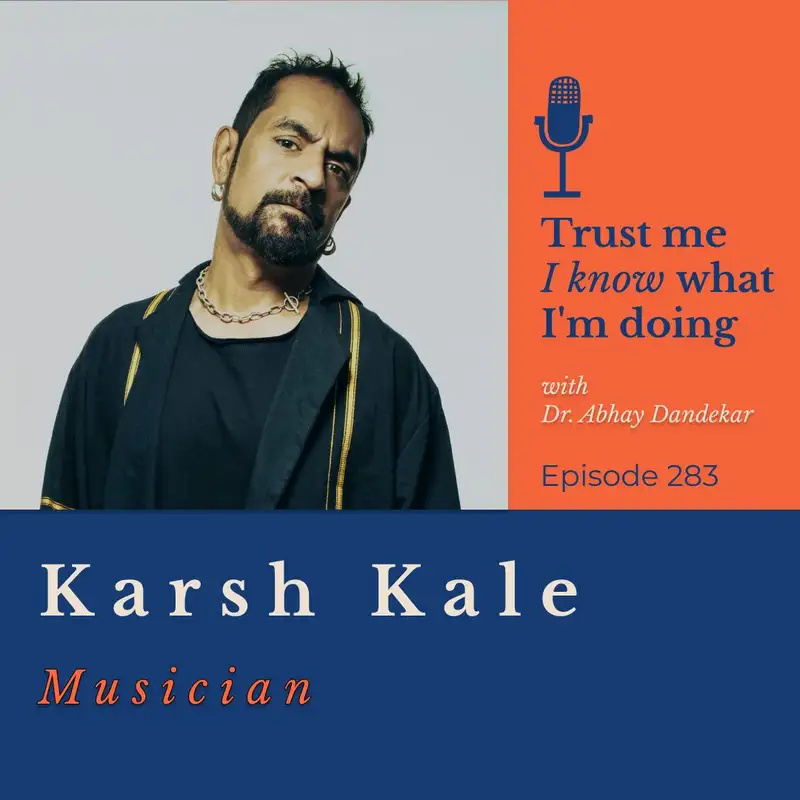
Karsh Kale on DUST and making music for his 10-year-old self
Download MP3Abhay (00:00)
thanks everyone for listening and watching, sharing with your family and friends, and don't forget to subscribe. TRUST ME I KNOW WHAT I'm DOING is brought to you by Travelopod.
For destinations like Africa, Japan, Antarctica, India, and the Northern Lights regions, start your journey with Travelopod. Visit vacation.travelopod.com.
Karsh (00:19)
if I go back to what I listened to when I was 10 years old,
All of it still holds And so I just realized that I just need to make a record for my 10 year old self. And that's what I did. And I accepted that, I was flying.
Abhay (00:32)
in order for you to make this album, did you actually have to unlearn about yourself? or for that matter, let go of
Karsh (00:38)
was a place where I was kind of returning know, with my honest there's nowhere else to put
can hold onto it or you can put it into something. You For me, it's always been I put it into the music. Every album that I've done has been kind of some sort of documentation of the end and the beginning of some era and everything that happened during that.
Hi, this is Karsh Kale. I am a musician, composer, producer from New York City. I have a new album coming out called Dust.
And this is, trust me, I know what I'm doing.
Abhay (01:40)
welcome everyone to this episode of Trust Me, I Know What I'm Doing. I think about this a lot, but I know that often in our quest for true expression,
and especially in times of very deep discovery, we find corners and pockets of ourselves that seemingly had been previously unknown or untapped. And at first glance, we may want to keep those newly unearthed parts of our persona very shielded, but sometimes we want to let the world in on our new secrets, especially when communicating new thoughts, sharing a new portrait, and ascending maybe to a new freedom. For award-winning
multi-genre artist, Karsh Kale who's been a true musical pioneer, framing much of the Asian underground music scene of the 90s to a prolific career as a musician, composer, songwriter, producer, and DJ. His latest expressions are part of a new album called Dust, featuring some terrific collaborations and some of his most personal work to date. I'm so thrilled to
welcome my friend actually welcome him back to Trust Me. I know what I'm doing and catch up for a chat. Karsh it's so great to have you here. Thanks again for joining.
Karsh (02:52)
Thank you so much brother for having me
Abhay (02:55)
You been a while since your last a long time since your first album. I'm just curious if the process after having done this for so long, if that process felt any different this time, was it a little more evolved, a little bit more mature or did it feel just as fresh as doing it the first time?
Karsh (03:16)
No, it was very, I mean, I stopped for a moment making music because I became very disillusioned with the process and with the industry and I'm kind of like coming out of the pandemic, I was lost. I didn't recognize anything that was kind of the world that we had before. Something had...
Abhay (03:29)
Hmm.
Karsh (03:45)
shifted and there were other powers that had taken over and I was having conversations with people in the industry and I continued to work. I was always, I was doing commercial work. I was performing with other artists on albums, collaborating, producing stuff. I just hadn't made, whenever I make my own album, it's a moment where I stop everything else and spend a few months saying something. But even that process started to get a little kind of formulaic.
And, you know, it's so easy now. Like, you know, if you just tell me, make a, you know, go make a Lavni bass album, I'll do it in three days. And only because all of that information, I'll just get some libraries and slap some stuff on and I know how to make a cool track. And so there you go. So I, you know, I kind of stopped just making music for a moment. And that's when I started painting.
Abhay (04:21)
Right. Yeah. Yeah.
Right. Yeah.
Karsh (04:38)
And painting for no one, not for any audience or for any reason. I didn't even know if they were going to be good. But then all of a sudden I found myself watching this childish curiosity come back. And that was the root of where I started making music as well and started imagining music and started to see music before it was ever on a screen.
Kind of once I realized that like that's where I have to start from, I started just, I went back to New York. All this painting was done while I was in Goa. And then I went back to New York for a few months and I just played piano. and while I was playing, just imagining all kinds of stuff, but not recording anything, just kind of keeping voice notes on my phone. And then finally decided, okay, now I have some frameworks of these stories.
that nobody else understood. mean, I was playing them for people and they were like, okay, dokey, you know, and then I like, don't you hear it? Then I finally, came to Delhi and Bombay, worked with some musicians, did some sessions and still things were quite abstract. I knew what I was trying to say. I didn't really have a, you know, because I still wasn't looking at a screen. wasn't, I wouldn't open my laptop and start.
Abhay (05:31)
Mm.
Yeah, right.
Mm.
Karsh (05:55)
building anything. wanted to just organically allow these stories to at least the thread of the stories to lay themselves out. Yeah, yeah. those raw versions will, I guess, come out at some point.
Abhay (06:03)
have sort of a raw version to begin with. Yeah.
Yeah.
Karsh (06:12)
But
I didn't really get into a studio until I came back to Goa after doing a bunch of sessions. And I came back to Goa and built a new studio and spent four months isolated in the monsoon season and just, you know, kind of finally put together all the things that I had imagined. And that process by the end, there's also a lot of chatter about who your audience is.
lot of people, especially in the industry, are talking about what's trending on TikTok and what sound is happening now and what producers are doing and all this stuff that makes sense to me on some level, but had nothing to do with what I was trying to say. And then I realized that besides the fact that I was a very curious and creative kid, I had a really good taste in music. And if I go back to what I listened to when I was 10 years old,
All of it still holds up. And so I just realized that I just need to make a record for my 10 year old self. And that's what I did. And when I accepted that, I was flying.
that was when the whole record just really just came together.
Abhay (07:19)
You know, getting to that point of like realizing that there's almost like a mission statement, right? Like, hey, I need to make music for my 10 year old self. Is there a luxury that you've built at this point of your career where you went through that cycle of being disillusioned, lost, as you mentioned, and then sort of like through the kind of raw organic process of playing music, listening to music.
being with other musicians and moving around, painting. then finally getting to that sort of point of saying, hey, there's a mission statement here that I have for this That's very different from, I'm guessing, when you first made an album and it was a kind of like, look, there's a blueprint for this, we're gonna follow the blueprint. And you had guides pushing you in various directions and stakeholders and whatnot. mean, is the process that you just went through
Karsh (08:06)
Yeah.
Abhay (08:11)
Is that is that one that you felt so good about that you want to just duplicate that every time now?
Karsh (08:16)
I mean, I don't know. mean, it also was kind of a life raft through some rough waters, you know. So I was kind of, reminding myself why I make music in the first place, besides all of the other reasons, you know. And that too, mean, nowadays, I think for younger artists, it's so hard to remember why you do this because...
Abhay (08:21)
Hmm. Yeah.
Karsh (08:37)
we get caught up in the dopamine cycle of like, hey, look at how many likes. And all of that stuff becomes the currency. and this time I think was the first time when I made a record where I realized that my most satisfying moment is going to be when I accept that this album was done before anybody else hears it. And that's it. This is why I make music. And it saves me there.
Abhay (08:59)
Mm. Yeah.
Karsh (09:04)
Now everything else is the business. Now let's put it out. let other people feel it, have their, you know, way with it and whatever. If things go viral and all of that is secondary to that moment that I had by myself after finishing the album. And that's not, I think that's something that comes with age, I think. I don't know if it's when you finally realize that none of the other stuff satisfies you. None of the other stuff is the reason. And you forget that.
And it takes you decades to get back to that, I guess.
Abhay (09:35)
I guess, and
plus it's kind of that circle of saying what brought you joy as a 10 year old. You know, it's the same sort of like naked feeling that brings you that same joy. Now, I think of your work and even this particular album and even the title just DUST right? I think of some symbolism there where there's, you know, what's left when you strip everything away. And also at the same time, the kind of
building blocks of something that needs to be layered and textured and bring a lot of the essence of maybe what's needed to build something very beautiful. Are they both parts of what you were trying to do here? Is that way off base? ⁓
Karsh (10:14)
Absolutely. No,
no, you're absolutely right on the money. you know, it was absolutely addressing the end of things, the finality of an era or, you know, a lot of things at that time while I was working on the album were ending and also acknowledging that, as you said, it's a, that's the birthplace for something to build, you know, like the Phoenix rises from the ashes, it's the DUST, it's, we all, you know,
you know, eventually become DUST in order to then become something else. And, you know, that's obviously, you know, for me, it was while working on these tracks, it was important to if lyrics were slightly darker, that there was that the hope came from the music and the story, you know, that the music was telling that, this feeling of finality, you know, is
a temporary feeling. It's just a moment before the rebirth of something else.
Abhay (11:15)
Yeah, you do a lot of singing on this album. And, you know, I was I was struck by a couple of the themes, there's a lot of reference to searching and discovery and really sort of like, you know, finding yourself, whether that's searching for more or the maze and even a line from night turns where you sing that you're looking for reasons, but you'll find them in the night sky. And in
Karsh (11:19)
Yeah.
Abhay (11:40)
building all of this and even stripping it away, right? Do you think the music creates a space for listeners to now experience that process that you were on and maybe kind of what you actually found?
Karsh (11:57)
Yeah, I don't know if it's what I found, but I know that the journey that the music takes you on or would take somebody on is analogous to their own story. And, you know, it's like I had a conversation with a very close friend of mine, Tarana Marwa, who's a fantastic singer, songwriter and producer. ⁓ She goes by the name Komorebi
Abhay (12:10)
Yeah. Yeah.
Karsh (12:22)
I was kind of in the middle of working on the album and I had a bunch of stuff, different pieces, and she had heard a bunch of it and she knew the stuff that I felt was quite personal you know, the stuff where I was like, I don't know if I really want to reveal this. it's not like there's anything specific in it, but it is quite vulnerable and personal at times. And she just reminded me that, you know, it's not about you.
Abhay (12:45)
Mmm.
Karsh (12:46)
It's not about you, it's about where it lands. And I mean, it's something that she kind of served back to me that I had said to her at some point. so I was like, okay, I can't say nothing about that. But no, but I understood what she meant, that it really isn't. So that moment that I had with my album was also a moment where I let it go. So now it becomes its own thing for people. Like whatever specific thing I was going through when writing the song Dust.
Abhay (12:54)
Right.
There you go.
Hmm.
Karsh (13:15)
has nothing to do with somebody else's experience with that song. I can paint a picture that is not so specific, but draws from my experience, creates more of a mirror for people to feel their own, then I feel like that's, that for me is the goal of why I would be so revealing in the music is not so that people.
he's been through this or he's gone through that. It's not nothing to do with that. It has to do with you. has to do with the listener.
Abhay (13:48)
And I wonder, mean, like connecting the dots, right? It always ends up being this loose association of, again, like me as a listener, when I experience the music, is it actually evoking something that might be parallel with what you're going through, but it doesn't always have to be. And that idea of it being a mirror for you and a window for me is one that hopefully the music really offers for anyone.
You've mentioned this a couple of times now that like this, album was deeply personal. It was really, really a personal experience, a personal journey, a personal discovery. I'm curious, like in order for you to make this album, in order for it to be completed, what did you actually have to unlearn about yourself? What did you maybe have to either unlearn or for that matter, let go of in order for this to come to fruition?
Karsh (14:40)
I I had to, there was a lot of letting go of.
of this avatar that constantly gets, there were moments where I would play stuff that, you know, at the time probably sounded like, it didn't sound like anything I had done before. very close friends of mine would be like, hey, remember you're KK. You're, you know, this is way out of your, you know, sphere of sound or, you know, nothing wrong with that. But, you know, so these kinds of things, like you have to ask yourself, like, do I want to be that anymore?
Am I that anymore? Am I coming something else? So yeah, there was a lot of just letting go of, know, at the same time, accepting, you know, like the the last track on DUST is very much a nod to where it all began. That drum and bass, Asian underground sound and, and and so that was kind of like this is there, too. But I'm also changing. I'm also.
Abhay (15:12)
Hmm. Yeah.
Karsh (15:38)
you know, changing maybe at a faster pace than the rest of the my environment or the rest of the world has accepted yet. And that's OK.
Abhay (16:22)
Do those labels, do they matter to you? know, hey, you know, when someone says like, well, wait, remember you're KK or, you know, this is what your music means or what it symbolizes or what it signifies and yet that's all, in a way that's old news. So for an artist, is it important to shed those? I mean, there's certainly the artistic value of something. There's also the commercial.
value of something and both of those like it or not are intertwined. mean, do you have to take those into account of not only it's just sort of recognizing who you are, who you've been, but you know, creating those new avatars and creating those new personas, if you will.
Karsh (17:04)
I think that, you know, there's also, I mean, I've, just turned, I mean, I'm 51 now and, I feel that I'm in a completely new era of my life. And, the era where I did need to, you know, wake up in the morning and remind myself that I just read an article last night that called me a pioneer and, all of these things that like, they're constantly being reminded every time you're introduced at a gig or every time you're
You know, you're constantly, you know, your resume is red and like all of that. It's just keeps following you around until you kind of ask like, you know, okay, that doesn't make me feel any different than what I'm experiencing right now. didn't wake up in the morning like, Hey, don't forget you're a pioneer. know, so this is armor, you know, this is just, and it falls off. melts off and.
Abhay (17:44)
Right.
That's right. You got to have that pioneer suit on, right? Yeah. Yeah.
Karsh (17:57)
You know, there's a very, very scary moment where you don't like, you're like, now what? Now what's going to protect me? And you realize how much it protected you for years, decades. For me, was, you know, it did. It was very important to me to, just in the beginning, see my name in places where I just only imagine it, and then just all of the stuff that follows that never ever satisfies your soul. It's just, it's just stuff.
it's accomplishment, it's fine, but like how many different, you know, suffixes are you gonna put on your name before it just sounds ridiculous? And then you just wanna be yourself again.
Abhay (18:31)
You know.
Yeah, and something that now, comparatively to the beginning of your career, to the middle of your career, and again, this is a career that's breathing, it's living, it's evolving, is that something that you've had to, in fact, come to terms with or be at peace with where it is still always about just satisfying yourself in the end?
In immaterial of what anybody else may think of your art, it's still your art.
Karsh (19:05)
Yeah, I mean, of course there's, you you want an audience to be able to react to it and you know, all of that is still there. But where's the, where's the juice from this whole experience? You know, I do always remind younger artists who, when I talk to them about this stuff, is that that moment when you're by yourself and you're like, yes, nailed it. This is it. you can't buy that. There's no, you know, that's, that's the magic right there.
You know, and then sharing it with people and all of that is still important. It's still part of the gig. And I want, you know, to get out there in front of crowds and have them sing the lyrics of my album back to me. And those things, they'll all exist, you know. But I put it in its place on the know, it's not like once that happens, I'm gonna be happy.
Abhay (19:44)
Right. Right.
Right.
Yeah, it's those milestones are very different. ⁓ But I like how you put that. Right. I mean, it's still the juice. It's still what what actually fuels you. It's still what accelerates, your your joy and optimism and and fire for creativity. You and I grew up listening to albums and albums were, you know, absolutely priceless in that they told a story. They were made up of songs.
Karsh (19:57)
Bye.
Abhay (20:21)
and a couple of those songs make it out as singles. And those kind of experiences, they capture, mean, this time in our lives, it's a little bit nostalgic, but it also is a real experience of going front to end of what an album actually means. Is that experience of listening to a full album, is that lost?
Is that a lost art, if you will, for the consuming public?
Karsh (20:48)
I think it's very difficult
to get people to listen to an album. mean, it's, that too, when I think about it, I'm like, people will listen to an album when they need the album experience. Now, make playlists, which is their own soundtrack, version of making an album. So you can make a playlist, get in your car and drive for an hour. You like every song. You're kind of curating an experience that is kind of keeping you in a particular mood.
Abhay (20:59)
Mm.
Sure, sure.
Karsh (21:16)
What an album does is takes you through a kind of a life journey, especially albums that we tend to keep going back to and listen through all the way through. There's something transformative that happens by the end. And you let those dark moments happen because you know that even though you're in a valley, there's a peak coming soon.
then you have that relationship we have with an It's not something that we get listening to singles and letting that fly by. mean, there's very much like a fast food analogy to music nowadays that it's great that we have so much access to all of that. But if you could go to a vending machine and get a quick little beef Wellington, what the hell is going on?
Abhay (22:02)
What the hell, right? But you
know what? mean, so does the industry obviously want the appetite for listeners, for subscribers, for consumers to be that a la carte menu and to be sound bites instead of albums.
Karsh (22:17)
Yeah.
Yeah. I mean, so I mean, I guess it's really up to the artist to I mean, I've made it a concerted effort to continue to let people know that when the album comes out, please take 57 minutes out of your life and listen from the beginning to the end, because you're not going to going to get a completely different story if you just listen to one track, because the album is a you know, it does have peaks and valleys and genres are all over the place. you need to listen to the whole thing to get it.
And so far, the people that have been, I did allow a preview to go out to a bunch of fans and across the board, it was all about the album. It was all about the album experience. So, as long as I keep reminding people to do that, I will hope that people take the album journey and not just pull it apart and throw it up on different playlists and stuff.
Abhay (23:10)
Right, right. And I mean, you that's a very different sort of like digestive experience, right? Where you take it, you experience the peaks and valleys and it means something to you. I have to tell you, so like, you know, out of all your work and I've really been able to enjoy and appreciate all of it, my favorite, my personal favorite album is the Liberation album and my personal favorite track is the Milan track because it does, it means something to me, the emotions that it brings and...
Karsh (23:36)
Mm.
Abhay (23:36)
you
know, knowing a little bit about the song and every time I listen to it, there's a little bit different twist to it. This album has so many different moods and so many different temperatures. especially when it comes to kind of what I can imagine was both the creative experience as a solo artist and the collaborative experience that you have with multiple people sort guessing on this.
Karsh (23:42)
Mm.
Abhay (24:01)
those different moods and temperatures for the album, does that also translate well when you're actually in the process of making that? Does that translate well to also your performances and your live shows and when you're actually even collaborating with some of these artists in a different setting? Is that the idea to try and replicate those moods and temperatures that you've created?
Karsh (24:23)
mean, some of them, the thing is that it does also represent ⁓ kind of the gamut of the different places that I perform. So, some of the tracks are straight DJ tracks that I would play in an Asian underground club setting anywhere that I would DJ these tracks would, the ones that are more electronic dance-based tracks would work.
And then some of them represent the world of, live improv world that, you know, I work with people like Max ZT and Alam Khan. You know, so there were a couple of tracks that kind of had a little bit more in that direction. How I would play it. I mean, the thing was that was important to me in addressing something that was always difficult before was that I would create these, these huge productions and then scratch my head as to how the hell am I supposed to do that live?
Abhay (25:12)
Right. How's that going to translate?
Karsh (25:13)
And then, now,
yeah. So, but what I did this time is I, you know, I can strip any of these tracks down to just me sitting on a piano, you know, or most of them, you know, and so I can rebuild them in the way they need to appear at that particular moment. You know, like I love to do a tiny desk version of this.
Abhay (25:34)
Yeah. Is that how you thought of, I mean, when you had to strip this back down and think of yourself as a 10 year old listening to music, is that how you were listening to music back then? That like, you're just listening to music in your head with this sort of like bare bones version of how you were experiencing it. Is that still the kind of common thread that brought you to this point?
Karsh (25:55)
Yeah, I mean, I remembered like how music, my imagination would just explode into the universe. Like I, it would go in so many different directions and so many things that I've done in my life came from what I had imagined, you know, at that time in my life, especially from like age 10 to 12. Like I had a very,
I mean, it was quite a moment for me to where I remember a lot of the things that I was thinking and I was listening to, you know, everything on the radio. was listening to the Police I was listening to Rush I listening to Led Zeppelin and I was listening to lots of Indian classical music and just getting, you know, blown. would I couldn't wait to get home, you know, off the school bus and run into my room and just blast. can, I was blasting the music. My parents must have thought I was insane, but.
I was in there just imagining the world kind of unfolding and becoming all of these other things, which a lot of it has come true.
Abhay (26:54)
I mean, that's sort of like this incredibly childlike joy that you get from both experiencing things for the first time, but then sort of reimagining it and repurposing it. You mentioned at the very beginning that there was a period of time where you were incredibly disillusioned and lost in the industry. So having made this album now, what makes you optimistic?
and perhaps, you know, rejuvenated about the independent music industry in India these days.
Karsh (27:28)
Well, I mean...
I'm not relying on this part of the process to, I know what it is and I've separated it from what I needed to get from this process of creating the album. So, no, what needs to happen now is, now it's the work I have to do to keep promoting my album without it becoming a source of anxiety or depression or all of the things that
it's done to so many different artists, including myself, over the years and like, figuring out like where to put it. that's so, you you there's, I'll still have to do all of the things that, that, kind of made me that repelled me from the whole process. I just, keep, reminding myself what the best part was.
Abhay (28:12)
it important for the industry to remind itself of, what's required to accelerate artists, to build trust with artists because that's the fuel of independent music and indie music across the world, but particularly in India, is there an ecosystem that needs to revive itself so that,
more and more artists won't go through this kind of stuff.
Karsh (28:37)
I think the ecosystem around the world needs to revive itself because now it's become this kind of factory space where people immediately start becoming masters of their own marketing before they've even figured out their own art. And that's just happening across the board. So it's just distracting the whole process.
we were no longer finding a, a diamond in the rough and then spending time developing that artist until, and if somebody is going to invest money in an artist, you know, they're going to invest in something that they see the potential in. Now it's just like, show me your numbers. Great. let's launch you and like, who are you? You're a 16 year old who just figured out how to make some tracks and your mastering sounds good and you make cool videos and you went viral.
and that is really all you need to do. And that competing in that world is, it's, it's quite ridiculous actually, But at the same time, you just kind of hope that like at some point something real cuts through, I don't know. Every time Bruce Springsteen comes up on my feed I stop, you know.
Abhay (29:44)
Yeah, right. There's the reminder. There's the anchor.
Karsh (29:47)
There you go. Yeah.
Abhay (30:19)
you and I, of course, share something with many others, of course, that we share this love and reverence for the music and life and legacy of Zakirji And the track, Tabla Beat Scientist, is such a wonderful tribute on the album. you know, thinking about how much inspiration was provided
and continues to be provided, does playing the role of guiding others, of mentoring others, perhaps even teaching others, they're students or artists or friends, is that something that at least taking away from Zakirji's legacy, is that something, somewhat of a responsibility that you at all feel?
Karsh (30:59)
I don't know. mean, I've never really seen myself as a teacher of any kind, just I see myself more as someone who's still exploring, you know, and figuring it out. And if someone asks me how, what's the proper way to do something, can just, I can only say, can show you a few ways to do something. I'm not going to tell you which one is proper because some people approach, you know, I was having a conversation about Derek Trucks the other day, incredible blues guitar player.
and how he spent the Ali Akbar Khan School learning sarod And I saw an interview where he was talking about how he was kind of frustrated that he didn't really get it. And at the same time, what he has created is the most unique sound in blues. And that experience, can't teach somebody that. That's just somebody's journey. I mean, that's even Zakirbaya for me.
Abhay (31:31)
Mm-hmm.
Karsh (31:55)
You know, I never sat in front of him and learned Kaidas and, I sat next to him and he watched me and he, and he saw who I am and what it is that I am carrying with me. And he, he just gave me permission to, to, to be that. And, you know, and guided me, of course, you know, but in a way where, you know, it was kind of like what he says in the track, you know, a teacher never teaches, a student learns.
Abhay (32:23)
Right, right.
Karsh (32:24)
and
you take what you, see something that someone has dropped on the floor, pick it up. And, I don't see myself right now as somebody who stand in a class and teach a, ⁓ I mean, at some point I will, but right now, you know, the teaching comes from sharing, I think, from it being available,
Abhay (32:47)
I think one thing that that definitely, gives me pause when I hear that is, like you said, him recognizing you and in a way sort of giving you agency to be yourself especially coming from, icon, this legend, this this this person of incredible stature. for those who might be up and coming now.
they may be getting the same exact sort of feeling when they are around you. And so, from their vantage point, you may be their rock star, you may be their sort of guide and even the nod of Is that something that you enjoy doing at all?
Karsh (33:29)
I mean, yeah, it's always, you know, it's great to see, especially when, you know, there are artists who have been, following and studying what I do for years and years. you know, kind of they're the first ones to, to react as soon as I drop a new piece of music or something like that. And those, those followers, always, you know, not two of them are alike. And that's, I wouldn't want to homogenize
the artistry of what these people are getting from what it is that I do, it's not a sound, it's not a technique, it's a state of mind. And if you have that, then you go on your own personal journey. That's the only thing I can teach. That's what Zakirbhai taught me, that you go on your own personal journey. He knew that I was like,
Abhay (34:17)
Hmm.
Karsh (34:21)
He's, you're never gonna be me. You know, and I stopped that pursuit as I sat next to him and played in Tabla Beat Science. And I was like, I will never ever be Zakir's hang. And that's what all of us were running towards. Like, you know, one day, one day we're gonna get there.
Abhay (34:34)
And right, yeah.
And I mean, I wonder if his message was like, you know, yes, and you don't have to be right. Like that permission.
Karsh (34:44)
I mean, to get
that kind of respect on stage and for him to push me, I could feel him without saying any words, pushing me in exactly the direction that I needed to go. And that was his brilliance. mean, he could speak to six people at the same time, but what he was saying to me, I felt it. And he has said it to me, you know, personally as well. But, has given great respect to.
Abhay (34:56)
Yeah. Yeah.
Karsh (35:10)
what it is that I do as an artist after, me just growing up being deathly afraid of what he might think, you know.
Abhay (35:17)
Right,
right. I've always wanted to ask you this, and I've asked this to other artists too, but especially for someone whose craft is constantly being sharpened and you're honing it both in the studio and as a performer, but do you know when a song is actually finished?
Karsh (35:34)
Hmm.
I think when it hits, you know, the last processes of what I do is more in the production arrangement stuff. And that's where, like, you know, this was my intention, but it's just not hitting yet. And all of that, when all of those pieces of the story hit and the punchline of the joke hits or whatever it is at the end, and you know that, ⁓ okay, that's it, now it's done. That's, me, that's the moment. Because there is, there's always a story arc.
there has to be some sort of payoff at the end. Maybe it's a fight scene, maybe it's a love scene, whatever it is, it's got to pay off at the end. And there's got to be that moment in the middle. And so I sit there and work on those details and that's when I know it's done. But a song is done sometimes right in one go. It's a beautiful song, but you want people to hear it the way you're hearing it in your head. So then you spend time dressing it up.
Abhay (36:09)
Right. Yeah.
Yeah, yeah.
We were talking before ⁓ about some of the doodling and the art. And of course, you know, knowing now that the art that you were creating painting wise became an inspiration. So I'm just curious, how has drawing or painting or creating on a canvas, again, for yourself,
Karsh (36:53)
Mm.
Abhay (36:54)
How's
that actually made you a better musician or composer or producer?
Karsh (36:59)
I think it's just analogous to what I do as a musician as well. mean, you start noodling first, you you start with a very rough idea and, you know, then you, you know, sometimes some of my doodles became, you know, pieces that I wanted to finish and that I would spend a couple of days on and then go in and fix the shading. And sometimes it's just something I do on the phone because I'm, you know, I 15 minutes to kill and some...
Abhay (37:23)
Right.
Karsh (37:24)
weird little doodle comes out, but that's how I treat music as well. mean, sometimes I pick up the guitar and some little cool little doodle comes out and I that's cool. And sometimes I sit there and I work something out and, take it to the end, and it's just, it just allows you to escape into, a place where sometimes you can just hover over what it is that you're experiencing as a, you know, as an artist, think a lot of composers, artists, writers,
They're right there in real time of what they're experiencing. because sometimes things are just too overwhelming to create an art piece about it. And sometimes you can stand right next to the fire and draw it.
Abhay (38:04)
Let me ask you, is music and I mean, maybe art to that degree, but is music an escape for you or is it a place for you to be found?
Karsh (38:14)
It's all of those things. It's very much an escape. mean, on a personal level, it's very much an escape. It's always been. But as it is for most people, think, I listen to music as a listener like anybody else listens to music. And I don't analyze it and think, how would I change it? When I listen to a Tom Petty track, it's the way it is. So I experience it as a listener.
And yes, I mean, it's also a place where, when I'm spending time, like I did, like like I did making this album, it was a place where I was kind of returning some, you know, with my honest truth and where there's nowhere else to put
You can hold onto it or you can put it into something. You can write it in a diary. For me, it's always been I put it into the music. Every album that I've done has been kind of some sort of documentation of the end and the beginning of some era and everything that happened during that.
even the album that I did with Underscout Breathing Underwater, all of that, mean, the content came from what we were experiencing.
Abhay (39:17)
Yeah, yeah. Let me get you out of here on this. mean, so many will be chronicling your work and, you know, with this new album, they'll be listening to old albums and both, you know, rediscovering some of your old work, but then, of course, really experiencing this newest and latest version. But for those who might be experiencing your music for the very first time.
whether that's at a performance, whether that's listening to DUST, how do you hope they feel? And maybe what do you hope they take away
Karsh (39:49)
I had a really great experience last year as I played at this very big conference in Bombay, which was a music conference, the All Music Conference. And did just a DJ set as like a showcase of some of the new stuff in front of a huge crowd of only young people. And the response was so awesome that, you know, it was the same response that
from back in the Realize days. And that response is that people feel it with their heart. That's, you know, when people come up and say, hey, that's a banger and all that kind of stuff that will happen everywhere in every, you know, venue or club. But when people feel it with their heart, in an environment where, you know, they're dancing or, and they come up and you can see it in their eyes that they felt it from that perspective. Then I know that that's,
It has the power to reach, you know, and I didn't really, you know, I didn't really think like I need to make a record for this generation or anything. I think good music is timeless. And I hope that people think it's good.
Abhay (40:55)
Well, I know that people are feeling it in their hearts and whether they're experiencing it for the first time or time and time again, they're appreciating it, enjoying it, and certainly looking for more. Karsh, what a treat to share some time and have this conversation. And I hope we can visit again in the future.
Karsh (41:09)
us.
Absolutely. Make it a regular thing. Always a pleasure. Always a pleasure.
Abhay (41:15)
This is TrustMe.
Abhay (41:18)
Hey, thanks again, Kush. And please check out the album Dust wherever you're getting your music. Shout outs to my guy, Yasharaj Akashi for connecting and building trust through the edge community. To Ishank Singh for becoming the youngest and fastest to ever swim the park straight between Sri Lanka and India. And to all of you for watching, listening, and sharing this with your friends. Don't forget to subscribe. And thanks so much for being kind to the planet. Till next time, I'm Abhay Dandekar