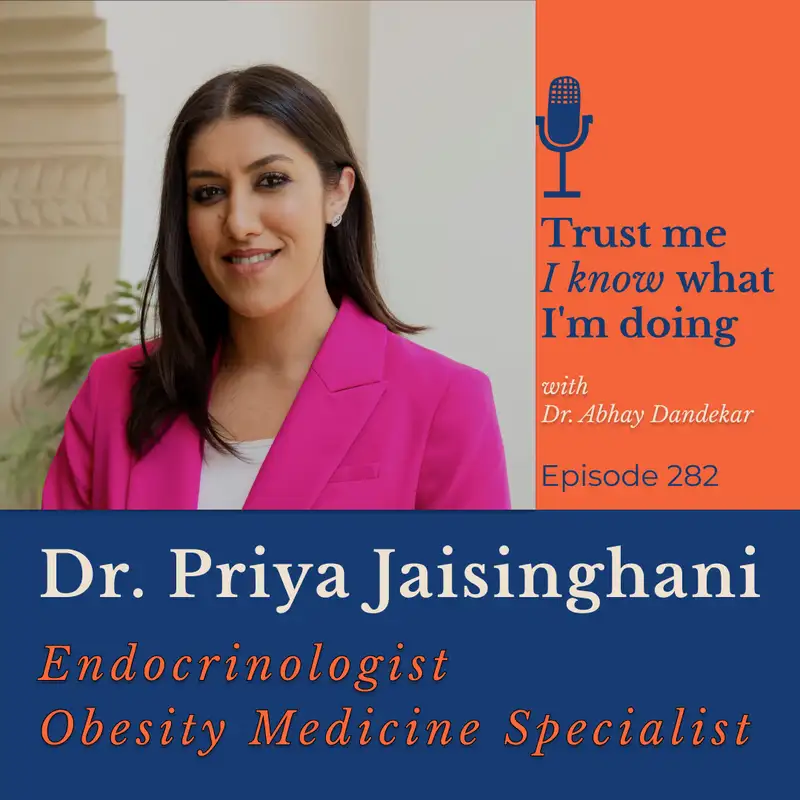
Dr. Priya Jaisinghani on How to Build a Metabolic Health Roadmap
Download MP3Abhay (00:00)
thanks everyone for listening and watching, sharing with your family and friends, and don't forget to subscribe. TRUST ME I KNOW WHAT I'm DOING is brought to you by Travelopod.
For destinations like Africa, Japan, Antarctica, India, and the Northern Lights regions, start your journey with Travelopod. Visit vacation.travelopod.com.
Abhay (00:19)
Hi, Abhay Dandekar here. And I know that all of you know this, but the content and conversation on Trust Me, I Know What I'm Doing is for informational and educational purposes only and not medical advice. So because each person is unique, always consult your own healthcare professional team for any medical questions.
Priya Jaisinghani (00:37)
When I talk about endocrine, people jump to hormones. When I talk about obesity medicine, people jump to weight.
But actually, that's not true. overall, the overarching theme is really metabolic It's how your honing in not only how you're functioning, the quality of how you're functioning. that's going to incorporate pretty much every body system your
muscle mass, your cardiovascular health, all your major organs, how they interact with each other, how your hormonal health is, how long you're living, what the quality of that life is like.
Abhay (01:06)
Because everything is just so interconnected and so related,
Where do you sort of help them start with this?
Priya Jaisinghani (01:12)
What's your sleep quality like? How much water do you drink in a day? Most people are like, no doctor ever asked me many steps are you walking? Do you even know how many steps you're walking? What about exercise? Do you know how to do strength and resistance training? Do you know what exercises fall under that? Do you much you should be exercising? are the types of conversations we have. But I think it's really important to meet people where they are.
Hi, I'm Dr. Priya Jaisinghani, an endocrinologist and obesity medicine specialist. And this is, Trust Me, I Know What I'm Doing.
Abhay (02:09)
welcome everyone to this episode of Trust Me, I Know What I'm Doing. You know, we live in a world where forces of consumerism and marketing and media and health are all intersecting in our daily lifestyle choices.
Now, sometimes these choices are at peace and sadly more often than not, there is a silent metabolic war that's being waged on and within our bodies. One that we are equally accelerating and rationalizing and addressing, but really very rarely actually harmonizing. Now for me as an Indian American who's not in my teens or twenties anymore, I find myself in a riskier place that definitely has to factor in my genetic and cultural heritage, my current lifestyle and career and my family.
as all this frames the dashboard of daily health choices that I face now and of course in the foreseeable future. And I'm not alone. These are questions about our metabolic and mental health that are present for every generation, whether you're young or old, Desi or in the diaspora. And so to help us all out, I am so, so pleased to welcome Dr. Priya Jaisinghani a triple board certified endocrinologist and obesity medicine specialist at NYU, who's been a true champion of bridging the gap between medical science and
understanding. She's an academic leader, a frequent national and local media contributor, and a true advocate for education and really actually helping to transform the way we approach metabolic health through safety, empathy, and empowerment. I am so excited to share a conversation with her. Priya, welcome to Trust Me, I Know What I'm Doing. It's so terrific to share some time with you and as we were just talking about, I'm pretty sure we're not only gonna overflow ⁓ with conversation,
but it's gonna be hard for us to sort of cut back I'm really just thrilled that you're here.
Priya Jaisinghani (03:53)
no, thank you so much, Abhay. I'm really, really happy to be here and have this conversation. So, so important. You have such a great platform and I think it's such a good representation of what we need to have daily conversations about. So, really excited to be here.
Abhay (04:07)
I think this is gonna be the most metabolically sound and safe episode we've ever done. absolutely. I was thinking about all of this and maybe just to frame this for everyone and given your area of expertise and especially in obesity medicine, which is a relatively newer out there. How do you define and describe metabolic health to most people, especially who are new to your practice?
Priya Jaisinghani (04:29)
Yeah, so metabolic health actually is encompassing the whole body, right? So as an endocrinologist and obesity medicine specialist, you might often hear a lot of times about hormones and what do you do as an endocrinologist or what do you do as an obesity medicine specialist? When I talk about endocrine, people jump to hormones. When I talk about obesity medicine, people jump to weight.
Abhay (04:44)
Right.
Priya Jaisinghani (04:49)
But actually, that's not true. think overall, the overarching theme is really metabolic health. And what that really encompasses is all of your major systems. It's really the juxtaposition between those two It's how your body is really honing in functioning on day to day, but not only how you're functioning, the quality of how you're functioning. And so that's going to incorporate pretty much every body system that we're talking about, whether that's even your
muscle mass, your cardiovascular health, so your heart health, right? And even all your major organs, how they interact with each other, how your hormonal health is, how long you're living, what the quality of that life is like. so metabolic health really encompasses all of your health.
Abhay (05:33)
Yeah. it's almost like the you're you're serving to the the general umbrella of everything that we do and all the decisions that we make,
First off, I'm just curious, when you walk into a room at a dinner party socially, and especially for people who know what you do, do they automatically sort of adjust what they're doing and clean their plates a little bit or start adjusting their drinks a little bit? I mean, that must be the kind of metabolic adjustment that they just need as soon as you walk in. Right.
Priya Jaisinghani (06:00)
Yeah, the nerves go up a little bit when I walk.
I tell everyone to just, you know, take it easy, calm down, do what you're doing and it's totally fine, you know? And I say the same for myself. You know, I'm also a human, right? Sometimes we get judged very critically, I'll have good days and bad days too, right? I'm also a human and sometimes people forget that. They're like, wait, aren't you a doctor? Why are you eating this? sometimes there's other factors that come into play, right? Maybe you're rushing somewhere or whatever it may be and you do the best you can every day.
So we're just all humans and I tell people it's totally fine. They don't have to change the way they are around me and kind of, you know, straighten up. So.
Abhay (06:34)
I know it's a, every, I have a cousin who is a very, very well-known yoga instructor. And I just find every time that I'm around her, my posture all of a sudden just completely changes a little bit too. You know, we think about lifestyle choices from so many different vantage points. You just mentioned that, you know, metabolic health is overarching and it governs everything that we do, everything that we choose.
everything from nutrition to activity to sleep, stress management, everything that we have to maybe help manage our metabolic state. When you are first faced with this question from either a new patient or someone who's having a conversation with you about this, where do you help them start? Because everything is just so interconnected and so related, but how do you focus and...
particularly drive someone to prioritize maybe and think about building step by step. Where do you sort of help them start with this?
Priya Jaisinghani (07:34)
Yeah, that's a great question. Because I think especially as someone who's the first physician in my family, I've seen my own family walk out of doctor's offices not knowing what happened, or even walking in not knowing what to ask. And I think sometimes people don't even know why they're at my office. They're like, I don't know, some doctor sent me here. And I forgot. It was so long ago. I don't even know why I'm here. So what I usually start with is asking if there are any particular goals that they want to address that day. I think that's really important.
Abhay (07:45)
Right, right.
Yeah.
Priya Jaisinghani (08:01)
if there's some specific health question that you have, it's really important to make sure you mention that to your doctor. The second thing I do is I actually get a baseline of their entire background, What are medical conditions that you've had? How are they doing? What's the progress like?
What are conditions that concern you? Where do you think your challenges are? Where do you think there's been growth? So those are really important things for me to know. And then also family and social history. I think family history is such an underrated piece of information. And I think it's something we also don't do a good enough job of passing down. How many times is it that we're sitting at home and we're actually talking about, hey, what health conditions do you have? What should I be on the lookout for as progressing through my life?
And I think that's something that we don't talk about enough. So I always ask patients about that. And sometimes I see the light bulb go off and they're like, wow, I don't know. I should go back and ask her, do you have a second doc? I'm just going to text somebody really quick. And I can see then people start thinking about how their genetics, their epigenetics, their environment, their family history start interacting and interplaying with their current state of health.
Abhay (09:05)
you get through that and you start asking those pieces of the puzzle and they start fitting in with each other, and then someone starts having that kind of aha moment of like, okay, wow, yes, there's quite a background to this. There's quite a baseline to this and a foundation to this. Next one you are building upon that now, and someone is saying, yeah, boy, I really know that I need changes to my lifestyle, to my diet, to my activity, to my sleep, et cetera.
Do you tell folks to try and target one over the other? Or again, is this kind of a blueprint that you have to personalize and customize that hits all of those things?
Priya Jaisinghani (09:41)
I think everything should be customized to a person and where they are. So in my mind, after I do an assessment, whether that's lab work, imaging, whatever that is, questionnaire, our first visit, I take that and then I kind of synthesize what I think about the landscape of their health. And then we also have alongside what their goals are and then what I think the could be based off of what I'm seeing. Then we work together.
Abhay (09:43)
Yeah. Yeah.
Priya Jaisinghani (10:08)
to see how we can kind of get somebody in a better place, with what they're trying to address. And I think that has to be very specific, So for example, I do a lot of lifestyle prescriptions for people. So a lot of what I talk about is what people don't usually talk about in a doctor's office. Like, how much are you sleeping?
Abhay (10:18)
Mm-hmm.
Priya Jaisinghani (10:26)
What's your sleep quality like? How much water do you drink in a day? Most people are like, no doctor ever asked me that. Or how many steps are you walking? Do you even know how many steps you're walking? What about exercise? Do you know how to do strength and resistance training? Do you know what exercises fall under that? Do you much you should be exercising? these are the types of conversations we have. But I think it's really important to meet people where they are.
Abhay (10:48)
Mm.
Priya Jaisinghani (10:48)
If
I told somebody, like for example, everyone knows about this 10,000 steps, if somebody is, let's say challenged with their mobility and they're walking maybe.
500 steps in their house. For me to tell somebody, you know what, I'm going to see you in three months and your goal is 10,000 steps, that is not surmountable, right? And it also defeats somebody internally. I think what should be done in certain cases is assessing what somebody can do and then kind of going from there and doing smart goals, right? So making them really specific, making them very measurable, making sure they're actionable, holding somebody accountable to it, and making
Abhay (11:10)
Yeah. Yeah.
Priya Jaisinghani (11:29)
really specific plan so by the time they come back I can check in and say how did that go so instead of me saying you know we're gonna go to 10,000 steps I'm say so when do you want to start working on your walking okay let's start next week how do you want to do this do you want to use an app do you want to use your phone do you want to use another device like a pedometer and carry that okay what's your target how much should we go up should we go up by 500 steps okay let's go up by 500 steps right which is maybe an additional 10-15 minutes of walking
Abhay (11:40)
Mm. Yeah.
Priya Jaisinghani (11:59)
You don't need to do it in one shot. It can be broken up maybe five minutes, three times a day. And then telling somebody, OK, we're going to add a five-minute walk post meals three times a day, and you're going to track your steps. And we're going to see where you meet your goal. And when we cycle back around, we're going to assess how that went.
Abhay (12:16)
Something so simple, right? mean, you know, and motivational more than anything else. It brings optimism. It definitely capitalizes on the things that they're already doing. When you are meeting with someone and they have that kind of aha moment of like, wow, no one's ever asked me that before. We haven't talked about basics like this. Does it become more and more clear as you're walking them through these elements of daily living?
but then you're also unearthing some common gaps in either their understanding or in the methods or even in the health issues that they're trying to address. What are probably the biggest first surprises that you note for most people when they're actually having this conversation with you? Maybe that's due to a nutritional gap or a sleep gap or a exercise or lifestyle gap, but what are some of those?
quick surprises that you notice that you're like, got to correct this like in whatever way we can, but we need to do that now.
Priya Jaisinghani (13:15)
Yeah, so I think one thing is there that a lot of people, feel like it's like a cathartic session for them because they're like, wow, I'm actually speaking to somebody and talking to somebody, And they're listening, We were talking about the power of listening before. I think a lot of people sometimes tend to get dismissed, right? With their symptoms, what they're concerned about. So that becomes one thing where I think individuals actually feel like they have a chance to talk, be listened to, and then address what they're actually concerned about, The second thing I notice is
Abhay (13:25)
Mm.
Priya Jaisinghani (13:43)
We live in the era of social media, right? There's a lot of myths, disinformation, misinformation, things that people have heard and maybe just acknowledged, not really fact-checked, Or been afraid to bring up to a doctor and say, hey, I saw this on TikTok. What do you think, And maybe they feel embarrassed to talk about it. I actually encourage it. I'm like, I would like to see the TikTok. Please show me, you know? Let's look at the video together.
Abhay (13:55)
Yeah.
Right.
That's
right.
Priya Jaisinghani (14:03)
Yeah, so I think we should meet our patients where they are, We should see what they're seeing, And because that's the truth, that's where a lot of people are getting their information. But also, you know, I think...
Another thing that people are surprised by is the fact that I am focusing on lifestyle changes. A lot of people think, because I'm a doctor, I'm going to push medicine. It's not that I don't use medicines. Of course, they're a part of our I'm a firm believer in really prevention, preventative medicine. So I like to address
health challenges before they become a And so my goal is really to prevent things. I prefer to be proactive rather than reactive. And so I like to address things from the forefront. But I use lifestyle, and then I also use medication therapy when needed. And we use surgical therapy when needed. And it just depends on the situation. So you know,
Abhay (14:48)
Yeah. Great.
Priya Jaisinghani (14:51)
I've noticed some of these things like when we have basic conversations even about, for example, fiber.
Abhay (14:56)
Mm-hmm.
Priya Jaisinghani (14:57)
And people will say, they'll stop me mid-sentence when I'm like, how are you doing with your fiber? Dr. J, don't worry, I'm eating salad. And I'm thinking in my head, uh-oh, salad. OK, so salad base, maybe lettuce. One cup of lettuce, less than one gram of fiber. You probably need, depending on your age, like 25 to 30 grams of fiber. I'm like, no. So I see a gap. So I'm like, OK, let's do an exercise together. And I do this not to be condescending in any way. I tell them, let's do it together. Let's look up.
How much fiber is in one cup of lettuce? And we actually sit down and do that in the office visit, right? And people are in shock usually. They're like, I thought this was gonna be my like, you know, big breakthrough of including more vegetables and eating salad and it's touted to be, you know, this health food. And I'm like, okay, so now we know, but do we know what our goal is? Right, let me go over what the goal is. So now you know what you're eating, what's your goal is, and how are you gonna bridge that gap?
Abhay (15:46)
Mm.
Priya Jaisinghani (15:52)
What's the best way to do that?
Abhay (15:54)
I love that. mean, in a way you're both doing the kind of exercise of hand holding and walking through that aha moment together and bridging an educational gap. But you know, that that shock that probably is there when someone's like, wow, I didn't even realize this. And, you know, I must have thought differently. And now you've hopefully helped them pivot a little bit for young people who are out there, particularly, most young adults. What are some
choices or patterns that they should look at and adhere to early on? We just talked about prevention so much, but what are some of those choices that they should adhere to early on so as to be successful middle age and older adults in the future? aha moments happening way, way sooner probably going to be that much more of a preventive upstream approach to things. So what are some of
big go-to's that people should be doing very, very early on. I know, right? Yeah. Yeah. Seriously.
Priya Jaisinghani (16:51)
Yeah, I wish we had a manual, right? Like we're in our 20s and they're like, make sure you do this before you end this decade.
I think I'm a firm believer in also initiating and keeping to simple things that, again, people think are very underrated, but they're so important, Plenty of patients, young patients that come in, you're not thinking about it in your 20s, how much water you're drinking if you're staying hydrated, right? You're like...
I have to go and do things. I'm running around. The less water I drink, probably better because I'm not going to the bathroom. I don't have time. And we were subjected to that in medical training. We were like, my gosh, no time for bathroom breaks. But I, again, recycle to the same thing. I'm really a firm believer in things that are actually underrated and very simple. So I think even for the youth that may be, it's cool to...
Abhay (17:25)
That's right. Yeah.
Priya Jaisinghani (17:40)
stay up and party and, you know, engage in things. And sure, we've all been through our college era and everything. But I think, again, focusing on health, bringing it back to the new standard of cool, right? What's that new standard, right? It's actually keeping yourself healthy, right? So making sure you're staying hydrated, getting the sleep you need, getting exercise, getting sunlight, right? Some grounding, some nature, you know, being invested in your relationships, friendships, your family, These are so important. Like people don't realize how important
mental health and metabolic health are related, In general, your health is related, to your relationships, your connections. Your mental health is so important. Your support system, your surroundings, your environment. So just focusing on some of the very basic tenets, right? I think alcohol, right, a big thing I see in practice every day, In Manhattan, it's very much common for people go to happy hour, drink three, four drinks, and they're going multiple times a week, and it's just become normal.
for them and to kind of reset and recheck and talk about And what impact that can have on your health having sedentary jobs, sitting in a chair all day, what that does to your body downstream, engaging in strength and resistance training. I feel like there's so much focus on cardio culture. And now we are on this protein rage, which is OK. But I think talking about that strength and resistance training, a lot of us didn't maybe have the opportunity to see our parents
Abhay (18:38)
Yeah.
Hmm.
Priya Jaisinghani (19:06)
going to the gym and lifting weights, that's not something we inherently learned. And so that's something that I tend to bring up with people that, you know, after age 30, you in our 20s, we all think we're invincible, right? After age 30, really, you know, you start seeing the, you know, losing muscle mass, things like that. And, you know, I tell people to get ahead of it in your 20s, right? Start embedding these tenets into your life, not so much to keep them as habits, but to make them
Abhay (19:17)
Right. Right.
Priya Jaisinghani (19:34)
regular part of your life so you don't even feel that it's something that's different.
Abhay (19:38)
Right. And not
to say that there's a general broad brush that we want to paint, people who are in their early 20s, early 30s even, and beyond for that matter, or younger, touching some grass, getting outside, limiting alcohol, getting plenty of ⁓ exercise and strength training, and not necessarily being sedentary. mean, how do you build this culture of cool?
and kind of shift the conversation more towards sort of healthier choices It's not that ⁓ you can't have fun. But is there a way that you see that you know this particular Lifestyle that you just described can in a way be mitigated
Priya Jaisinghani (20:18)
Yeah. So I mean, that's a common thing that we face often. People are used to going out to happy hour, like I said. let's restructure that. Let's go out to a walk in Central Park. Let's go walk in Chelsea Market. Let's go take a walk Let's go to a class. Let's do something we haven't done. Let's go do archery. Something that's different. And find a friend to do it with. I think restructuring, reframing what fun is, what a social activity is, is so important.
Abhay (20:25)
Yeah. Yeah.
Yeah, absolutely.
Priya Jaisinghani (20:45)
But I think the other thing that I really enjoy, truly makes my heart happy, is seeing my patients become advocates. Educating and empowering someone to empower others. I have patients that actually have done so well in their journeys that they've empowered hundreds, thousands of other people. I have patients that have actually created their own social media pages, documented their own journeys, created walking clubs.
Abhay (20:54)
Mm. Yeah.
Priya Jaisinghani (21:12)
national medalist for And so it's just incredible. And I tell my patients all the time, I'm like, you're going to become the expert through your own learning. My patients are so, so smart. They'll come in and they'll be like, you know what, Dr. J, I noticed the scale's not moving much, but I'm losing inches. My knee size is dropping. And I'm like,
Abhay (21:19)
Right, right. Yeah.
Yeah. Yeah.
Priya Jaisinghani (21:32)
They're like, don't think that's a problem though. And I was like, that's spot on. I love that for you. And let's talk about that. What that means when you have what we call visceral fat in the medical community, but really that abdominal fat pad that is a heart health risk. And why that's important for it to come down and why what we call as body recompositioning is important rather than just fat tissue dropping. But we want to preserve muscle, build
educating patients on that and them seeing that, you know what, the number on the scale, it kind of fizzles away, At some point, they're not even worried about it. They're not coming and telling me about it, Their focus has shifted because now they're focusing on the right things, And it's not something that I have to preface because my patients learn it
Abhay (22:18)
It's so nice to both the education and the expertise then get democratized. And so when you empower somebody, really does feel great that someone's not only just a micro influencer, but they're a macro influencer. And most importantly, right there, they're actually doing this for themselves. And it does create a nice community around them, which I think you're referring to
Vivek Murthy (23:12)
Hi, I'm Vivek Murthy. I'm the 21st Surgeon General of the United States. And you're listening to Trust Me, I Know What I'm Doing.
Abhay (23:19)
culturally,
for us, right, in our communities, we carry so many burdens, I mean, it is anything from the grandparent who wants a robust grandchild and wants to spoil them with snacks and sweets. I see this a lot for sure. Adults who face kind of a metabolic reality of having that normal rate but carrying a little bit more visceral fat and that obesity profile.
And then of course, traditional Indian and South Asian diets that just put us at such a different level of risk for cardiac and diabetic burdens. Is there a more Indian or South Asian approach that is critical for our community that you have really now in your study and academic rigor have grown to take as a much more tailored approach when it comes to our community?
Priya Jaisinghani (24:11)
Yeah, absolutely. mean, South Asian community needs attention, right? In metabolic health space, they absolutely do. And this is one of the main reasons why I actually joined the field of endocrinology. What I noticed was throughout my own family, my grandmother passed away when I was very young of a massive heart attack, And I saw that our communities were ravaged really with diabetes, obesity, a lot of chronic disease. And that's what kind of pivoted me to go into this field. I really wanted to be
involved in metabolic health, especially honing in on minority And what I've seen is that we are built a little bit So we have lower muscle mass to begin with. We have a predisposition to getting that belly fat that we were talking about, that abdominal fat. We also have things like
cultural acclimation, right? There's stress. And when you're in a different country and different food and this juxtaposition between trying to hang on to your roots, but also acclimating in a new environment, these things all add up, right? And I remember when I was in medical school, I was observing an interaction with registered dietitian and a Asian family. And the dietitian was talking about
Abhay (25:11)
it
Priya Jaisinghani (25:22)
high protein breakfast, but this Asian family was trying to explain that they eat congee. And the RD was like completely taken aback, didn't know what it was. And you just saw it miss, right? Someone's cultural food versus something that somebody is trying to tell them. And the points were just not meeting, right? And what I picked up from that interaction was, no, we need to tailor things to what the person sitting in front of us is actually going to do, right?
So for my South Asian patients, I think we have a whole episode just on this, right? But I would say the one thing is I always try to also, from the get-go, explain to my South Asian patients that, and in fact, any patient coming from another different ethnic background, there are different metrics for different ethnic backgrounds in terms of even your BMI, right, to that ratio that we have between height and weight, even in terms of your waist circumference cutoffs and where you have more metabolic risk. So for South Asians, the BMI is
Abhay (25:50)
I know.
Priya Jaisinghani (26:14)
at a lower cutoff for metabolic risk. The waist circumference is a lower cutoff for metabolic risk, but our medication approvals here are at a standard that's not for South Asians. So then we're fighting a battle where I'm like, listen, I agree with you. You're living with overweight or obesity according to South Asian standards, but medications are approved at a higher BMI cutoff or weight bracket. And then you're left with potentially patients paying out of pocket or things like that. That's still a movement that we're making.
Abhay (26:25)
Yeah.
Priya Jaisinghani (26:43)
I think tailoring things is really, really patients in terms of their food intake, their nutrition. What are they eating at home? And how do we restructure that? How do we put a little bit of emphasis more on protein and fiber within those traditional And also understanding maybe what are some of the things they grew up with? Like, no, you have to finish all the food on your plate. Or if you don't finish something that somebody gave you relatively, they're going to feel hurt.
Abhay (26:59)
Right.
There's.
Right. Right.
Priya Jaisinghani (27:11)
How do you deal with these things that we've all grown up with, right? While you're trying to address your health.
Abhay (27:16)
there is a ⁓ phenomenon in Marathi culture. I know this is the case in every, ⁓ you know, sub Indian culture for sure, but of like, you know, hey, well I'm done, but no, no, no, you could have some more. And then, no, I just finished the more part and no, no, you can have even more. It's called Agraha. And it's like, come on. mean, and it's right. It's a pathway of respect and like, you know, friendliness. And yet, you know, even beyond that, I would say, especially for South Asians and Indians,
Priya Jaisinghani (27:34)
Total word.
Right. Right.
Abhay (27:45)
both at home and in the diaspora, there's this sentiment that obesity and lifestyle mismanagement is a personal failure of willpower. And for an immigrant culture, for working high achieving professionals and those who might be in the home country, how do you kind of dismantle this bias to reframe this as no, this is a very biology driven condition and how do we get away from the sort of character flaw?
part of this to make it so that look, you know what, we need to take significant action on this so that we can actually manage this.
Priya Jaisinghani (28:20)
Yeah, this is really deep rooted, right? Weight bias and weight stigma, very, very deeply rooted. So that's, again, a long conversation that we have. And it really starts from the first visit when I talk to them about, what has been your prior experience with this? What have people told you? What is your goal? To kind of assess, again, what that information has kind of been like. But so many times when I do an assessment, there are so many different factors that can also be contributing to weight.
Whether that's medications that patients are on, whether that's maybe a hormonal transition that they're going through in life, whether that's stress, or insulin resistance, inflammation from other chronic disease processes that they may have. When we talk about what may be adding up to it, we also figure out how to address Sometimes that may be in addition to lifestyle changes and medication therapy. I explain to people and I really work with them. If they say,
Abhay (28:58)
Mm-hmm.
Priya Jaisinghani (29:13)
I want to work on lifestyle changes. I'm like, okay, that's fine. We're going to work on only lifestyle changes. How long do you want to work on this for until we revisit what we're doing and the plan? I think that's a really important question to ask, Because you can address and make a plan for a year, but is a year too long to wait? Right? You want to assess what someone's health risk is. You always want to make sure they're more on the benefit side than the risk side, So making sure that things are done within a timely manner.
having a plan to revisit a plan that was made and see if it's working or not, and then readdressing And then if we need to get to medication therapy, I'd tell somebody, it's not your fault. Part of that may be your genetic makeup, your epigenetics, what you're going through, what's around you, what medications you're on, what health conditions you have. These are not things that we ask for. are things that are happening to us. So I always tell people we try to do the best with the cards that we're dealt.
And that's what the goal really is. How can I optimize your health in the best way possible in the setting that we're in?
Abhay (30:18)
I wanted to ask you because in having some of those conversations, especially targeting follow-up, I've had some experiences in my pediatric practice with using weight as that measurement and not being the most effective way to in fact successfully monitor and especially with creating this incredible stigma and maybe even in some ways kind of being an accelerator for.
both the sort of early signs of eating disorders or even having Frank eating disorders. How can we build that kind of weight neutral approach to metabolic health, not just for teens, but that at any age, and is there a kind of formula to doing that so that we can sort of avoid the opposite parts and really get to many, unfortunately, too many of the mental health pieces there and of course the eating disorder.
phenomenon that we're really trying to combat.
Priya Jaisinghani (31:13)
Yeah, I think one thing I'll stress is, not all of your metabolic health is linked to the number on the scale. Like for South Asians, we started having a lot of metabolic risk before the number on the scale even changes. But we're living examples of that, I often, you know, what I think is one is really being respectful of people because, you know, most of the time when people are coming in, they honestly probably had a bad experience somewhere along the way.
Abhay (31:22)
Right. Right. Yes.
Priya Jaisinghani (31:39)
And so it's really important to be respectful of why they're coming in and addressing their questions and taking things, I think, very seriously. Even if someone is coming to me, I had a patient come in and tell me, and this is, again, not to go back to weight as a number, but I just want to lose three pounds. Some people would scoff that off. I took it very seriously. said, OK, what is bothering you about that? I want to know. And why? So this is, again, something that has to be delicately balanced according to the situation. Obviously, you want to screen for eating disorders, disordered eating, all of these things.
But I think it's very important to listen to patients, understand their concerns and why they're asking about these concerns. I think the second thing is making sure that everyone is respectful in terms of language with weight. Also, first person language, all of those things. We don't call people fat, things like that. We say living with overweight, living with obesity. I think the other thing is when we're shifting away from the real thing is I'm trying to address your health. I always ask people when they come in with a weight number, why that number?
Abhay (32:35)
Mm. Bright.
Priya Jaisinghani (32:35)
What's that based off of?
So why do you want to be at 130 pounds? Why? And they're like, I don't know. I just picked it. I'm like, well, let's actually come up with where we should be targeting. What's the best metric to actually target your health? Is it really weight? Probably let's look at some other metrics. Let's look at your waist circumference. Let's look at your labs. Let's look at your body composition. you know Behaviors. Let's take into consideration all of those factors and see.
Abhay (32:58)
Behaviors. Yeah.
Priya Jaisinghani (33:04)
what should actually be the health goal. And sometimes it's again about that education, the empowerment, the reframing that conversation about what needs to be done. I think we also need to do our due diligence with when individuals are coming into my office, if they're coming in for what we call a weight-related comorbidity or something related to weight, pre-diabetes, diabetes, high cholesterol, high blood pressure, there are over 200 conditions that are probably related to We have to screen for
Abhay (33:25)
Right. Right.
Priya Jaisinghani (33:29)
the weight-related conditions, if someone's coming in for weight, but we also have to screen the other way, right? So it's really about, it's very delicate balance because what we've come to is addressing weight as a disease. Sure. Do we want to be fixated just on that number? Probably not. Do we want to do consideration? Yes. But it has to be in context of everything. So it's again about that whole picture. You can't hone in on one thing, right?
So we're lucky we're in an era where we have effective tools to help treat things. But again, you'll see even in the weight management landscape, it's not just about weight. We have agents now that are protective for the heart. We have agents that are protective for the liver. We have agents that have data in kidney and diabetes. So it's just more than the number.
Abhay (34:15)
Yeah, I hope we can get to place where that's not the very, very first thing that everyone is focusing on and it sort of charges the medical visit. I know getting to that weight neutral approach is gonna take time, but hopefully we can make some quick pivots. I can't go ⁓ longer. I'm surprised we haven't completely identified it yet, but GLP-1 meds and both the information and the misinformation about them.
are getting more more ubiquitous worldwide, such a prevalence right now in the medical and community conversations around metabolic health. What's your message to those who are new to this about some of the potential benefits and pitfalls? And how do you sort of distill out the GLP-1 conversation from this just massive information that's out there?
Priya Jaisinghani (35:06)
Yeah. So what I would say is, you know, I actually hear GLP1's being referred to as weight loss meds all the time. For me, they are much more than weight loss meds. I think they should have been called metabolic therapeutics, right? Which is a fancy word, but really relating to metabolic health, because I think it addresses a lot more than just weight, Which is what we were talking about. think some of the things that should be highlighted with these medications are not highlighted, So we know that they're effective at treating weight.
But why are we not talking about some of the other markers that we see, like decreases in inflammation, decreases in blood pressure with some of these, decreases in cholesterol with some of these, decreases in what we used to call, or improvement, I should say, in what we used to call fatty liver disease, or MASH, Masal D. And even protection against heart health. I'm surprised that people don't talk about the protection against non-fatal stroke and heart attacks. So I'm always surprised by that. When people come in, I say,
Let's look into what else these medications also do, and then we can choose what's the right fit for you. I think the one area of caution I would really give people is sometimes there's a lot of buzz about things. There's a lot of hearsay about things on many social media platforms. There can also be the opposite where there's a lot of fear being produced. Whatever the conversation is, I implore people to go to a board certified provider and really ask all their questions, right?
Because sometimes there's a fear, and sometimes there's an over expectation. Again, whatever that question may be, it's really important to go to somebody who is well equipped with that knowledge. So even board certified in obesity medicine or an endocrinologist, or even now so many different specialties are prescribing, whether that's in pediatrics or in cardiology, GI, hepatology, the belly doctors. So
Just finding someone who's actually comfortable with these meds and having a very open-ended discussion with them about these medications and maybe what some of your concerns are.
Abhay (37:04)
when ⁓ I've had some conversations, especially because in pediatrics, we are not necessarily prescribing this as often, although that is changing a little bit. I always also start with practical things that can be GLP-1 receptor agonist foods or GLP-1 receptor agonist diets that can actually activate the same level of help with satiety and appetite. What are some of your go-tos when it comes to
to actually achieving that without the GLP-1 medication.
Priya Jaisinghani (37:35)
Yeah.
So actually, talk a lot about personalized protein and fiber goals with everyone. Protein and fiber, they're nutrient-dense. They're satiating as macronutrients. So I think it's really important to focus on that and then coupling that with also your water intake. And then you have timing, timing of meals, timing of when you're drinking water, And really customizing that protein intake and fiber intake according to your activity level, your diet looks like.
if you're someone who goes for more vegetarian protein options protein versus animal protein, whatever that may or your goals according to your activity, or your fiber goal according to your sex and age. And so these things all really matter. and just empowering people to actually know how to count their protein and their fiber and maybe using tools like apps also to help with that.
but just even giving them that inclination that, okay, let's go through what you ate yesterday. Let's go through how much protein and fiber you got. Let's see how much we should be getting and what is the gap, right? And how do we fill that gap? Right, so these simple conversations can actually be really, really powerful.
Abhay (38:39)
Yeah. Yeah.
Yeah, I love that. It speaks volumes as to how much more education from a nutrition and diet space that we all need for that matter. One quick one before we end that I wanted to I know that particularly to activate some of the things that we do require also a really, really high importance and priority for sleep. Maybe you can share a line or two about
why sleep is just so important in this entire metabolic conversation.
Priya Jaisinghani (39:13)
Yeah, so I'll just tie it in quickly to what we just spoke about, right? For example, hunger and satiety, right? So one thing that's there is, for example, if you're sleeping less, You will actually have an increase in your hunger hormones released the next day and a decrease in hormones that keep you full.
And so you might feel more hungry, have more cravings for things maybe which are not as healthy for you the next day if you're not sleeping well. I think the other thing you want to keep in mind, not just the quantity of sleep, the quality of sleep. Let's say you're waking up a lot at night. Well, why are you waking up? Is it because you're peeing a lot? Is it because maybe you need to get your sugars checked? Is it you're not breathing well and you're snoring and you're waking up? You're gasping for air? Do we need to screen you for sleep apnea, which is also metabolically related?
these are really important things to keep in mind. Again, quality and quantity of huge impact on your metabolic health.
Abhay (40:05)
Yeah. ⁓ let me get you out of here on this. I feel like we could have conversations for hours and hours about all of these and we certainly will. but you know, you're the first physician in your family and an Indian American, someone who's a medical leader in our field. and this particular topic and specialty has so many tentacles as we've taught, as we've learned about, and as we know here in our daily lives. So in a world where
Priya Jaisinghani (40:12)
all serious.
Abhay (40:32)
We are just absolutely overloaded with information and we're bombarded with things coming at us from all different directions. Like I mentioned at the beginning, how do you build trust when it comes to having this ongoing relationship building with your patients, with your friends, with your family? How is trust something that kind of exists at the core of all this for
Priya Jaisinghani (40:55)
I think again, I'm a firm believer in simple things. transparency, and education. They're really important. And I think that builds trust. think being open and receptive to dialogue, Not rushing into a room and rushing out in five minutes, right? Or even if you're sitting down at a family gathering and somebody approaches you with a question, taking the time to really address it as best as you To the best of your ability, right? So I really try to give my patients time.
I really do, because I've been there on the other end seeing someone zip in and zip out and just hand you three prescriptions and two referrals and you have no idea why.
keep that in mind every day, you know, to the best of my ability. When I'm with my patient, I'm there. I'm listening. trying to answer their questions, because I really want my patients to be involved in their health. I want them to be involved in their health care. I want them, I'm happy when they ask me questions. Right? Because it shows me that they're really thinking about what we're talking about.
I really want to educate and empower people. I think that's also a big reason why I'm involved in the media world. Because that's my way of engaging with the public in terms of sharing information and really giving back some of that expertise beyond my clinic office hours.
That's what I like to But I think trust is huge. I think when you trust an individual, and especially making sure it's from a credible source, think there's so much noise out there sometimes for a loss. I think as physicians, we're afraid most of the time to say, hey, I'm an expert in X, and Z, because we have so much to spent so many years working for that degree. We have so much to lose to protect that.
certificate in that white code, right? But there so many people online that will just say, I'm an expert without
Or say things and just spread misinformation or disinformation. It can really harm somebody, It can really, really harm somebody. I tell all my patients, you need to be your biggest advocate. Everyone may have an agenda, but you need to watch out for yourself, And so making sure you have a great team of experts, of credible individuals that you can ask questions to is key,
Abhay (43:03)
well, leaning into your expertise and certainly sharing your both credibility and advocacy and more importantly, empathy and empowerment. We are all so grateful for it. Priya, thank you so much for joining us on Trust Me, I Know What I'm Doing. I hope we can continue this conversation again down the line.
Priya Jaisinghani (43:19)
Absolutely, it's been such a pleasure. hope everyone listening learned a lot.
Abhay 2 (43:23)
Thanks so much, Priya, and a really grateful shout out to my friend, pediatric colleague, and adolescent medicine specialty guru, Dr. Lauren Hartman, whose latest book, Freeing Children and Young Adults from Shame, Scales, and Stigma, is available everywhere now. And I'll put the link in the show notes as well. Big shout out now to Anagha for her 50th, and great respect to the late photographer, Raghu Rai. Now it's time to go have more protein, fiber, water, sleep, and clarity. Remember to be safe, be smart, and be kind.
Till next time, I'm Abhay Dandekar.