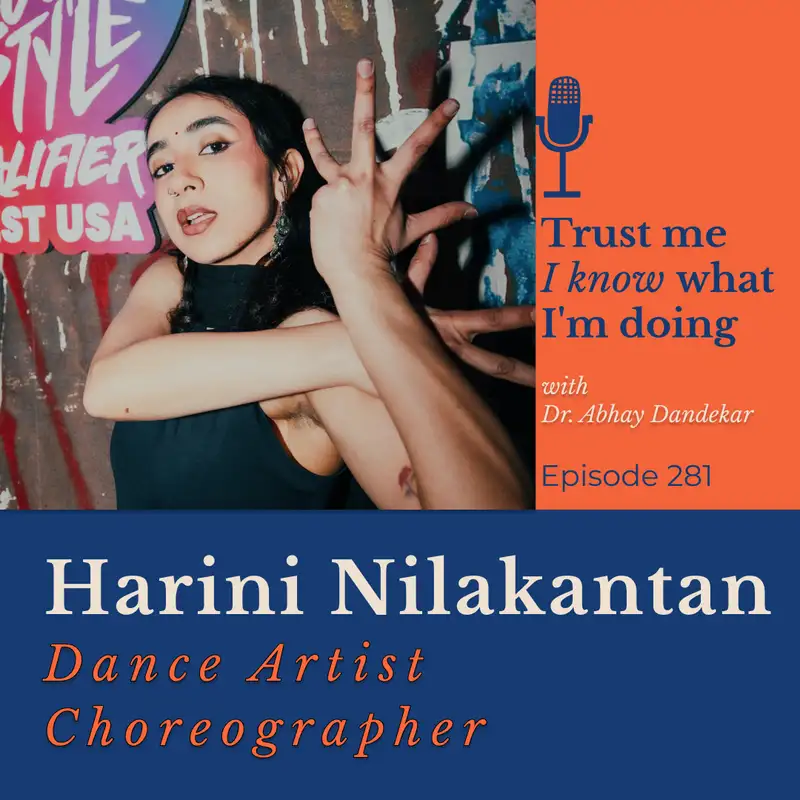
Harini Nilakantan on Dance Heritage in Modern Movement
Download MP3Abhay (00:00)
thanks everyone for listening and watching, sharing with your family and friends, and don't forget to subscribe. TRUST ME I KNOW WHAT I'm DOING is brought to you by Travelopod.
For destinations like Africa, Japan, Antarctica, India, and the Northern Lights regions, start your journey with Travelopod. Visit vacation.travelopod.com.
Harini (00:19)
So whenever I'm presenting myself, I'm not presenting just one homogenous identity. refracted through many different colored lenses. light you're seeing is going to look like a prism, a mosaic.
Abhay (00:33)
Do you ever feel like you are breaking something to build something new or is it just?
a lot more simple and natural than that. of repurposing it or retooling it or refining it?
Harini (00:46)
what could make this look still like inspired and derived from bharatnatyam
or what's a move set that I know in hip hop or house or something that looks similar to this. I blend them together? they talk to each other? Is there something that connects these worlds? practice is always going to be from the root.
build on, keep adding, keep adding, keep adding, keep adding and multiplying until you get a different product. But the root is the same.
Hi, I'm Harini. I'm a dancer, choreographer, movement artist, and this is Trust Me, I Know What I'm Doing.
Abhay (01:49)
welcome
to this edition of Trust Me, I Know What I'm Doing. I realized recently that while I have great reverence for tradition and I equally celebrate ideas and things that are new and vanguard, what I actually really crave and tend to enjoy are contemporary expressions of those very timeless traditions, especially when you know that they allow for those experiencing it to find new open spaces, to think differently.
and to find new avenues, particularly for access and equity. Now in the world of dance, I'm so drawn to the work of Harini Nilakantan a Chicago-based dancer and choreographer who is actually just so masterfully blending the rigors of Indian classical dance and the fluid expression of contemporary movement. Her work explores the intersection of heritage and innovation.
reimagining ancestral storytelling for a global modern stage. And what I like most is that she challenges the boundaries of discipline to make her audiences feel kind of like they're on a very deeply personal and transformative journey. It's such a treat to share some time with Harini. And thanks so much, Harini, for joining us on Trust Me, I Know What I'm Doing.
Harini (03:05)
Thank you. That was a very beautiful introduction. actually very touched. Thank you for having me.
Abhay (03:11)
always wondering whether these introductions match what my guests are actually feeling about themselves. So I'm so curious when you are usually introducing yourself to people who may or may not know you, how do you describe what you do and kind of who you are to them?
Harini (03:29)
I introduced myself and they ask, oh, what do you do? Or if they haven't already encountered something on just, hi, I'm Harni, I'm a dancer. And they're like, what kind of dance do you do? Then it goes, do Indian classical dance is my primary style. do Bharatanatyam. But overall, I would say I'm just a movement artist.
I don't occupy just one space in the dance community here, at least in the States, and back home. I'm still actively doing Baratanatyam and studying it and learning it, performances in that lexicon. At the same time, my five to nine is I'll be battling, I'm doing ciphers, shows like Urbanite with my collective, creating choreography that just has...
different type of movement vocabulary that comes together. So I would just say, yeah, I'm a dancer overall. And then when they get into the specifics, that's when I was like, okay, well, I'm a fusion artist. I'm a movement artist, but it's a lot of and, and, and semicolon, semicolon so far, so far. So I would say your introduction is a lot more concise than mine is.
Abhay (04:34)
Yeah. Well, and.
And as
people discover you and they ask about that and you even sort of like pause and reflect and think about the many ands and the many pluses and the ways in which your kind of work has evolved, does that an evolving perspective on how you even think about describing yourself inside your head?
Harini (05:02)
very much so. think you hit the nail on the head with I look at it this way. It's like two years ago when I first... No, that was four years ago when I first started doing actively pursuing fusion work or figuring out are the parallel movements that exist in different styles? What's the connection? What connects us?
⁓ I was a different dancer then. I didn't dance the same way as I dance now. I'm evolving constantly. I'm learning constantly. Things that I thought four or five years ago were being debunked constantly. I'm adding to this trove of knowledge that already exists. So I would do it a service to myself and the art form if I were to say that it's like stuck in can be immortal.
the movement itself can be immortal, but I don't think immortal means it's frozen. So the same way, like my perspective on myself, my perspective on my movement and where I'm going to take it is always going to evolve. So my answer, if we speak again in two years, might be completely different than what I'm giving you today. So.
Abhay (06:05)
Right. Yeah, yeah. No, I
mean, it's an evolving timeline. Things are always fluid and dynamic instead of being sort of static and time stamped. In that same vein, thinking the last two to four years of this evolution, but then also thinking the past and how you've gotten here. Do you actually remember some of your first dance?
episodes if you will, or encounters. mean, I'm just curious about maybe in your head right now, what are some of your very first dance memories? And do you have a sort of way to connect the dots back to those memories to how you actually, you know, function and express yourself now?
Harini (06:49)
So I've been dancing since I was four, active, fully dancing. My mother claims that it's been earlier than that. That as a baby, I used to bop to the rhythm. I used to rhythm and click kick inside her and all that stuff. But, you know, that's my mom. I'm not going to debunk anything a mother says. But I, no, no. mean, my earliest memories have always been in a dance class. I've always been moving around and dancing. I can't remember a time when I wasn't.
Abhay (07:05)
Never debunk what a mother says, right?
Harini (07:17)
dancing actually. the fondest memory I have I think is with my very first guru and I saw my cousin she was doing an Alaripu it's an item a piece in Bharatanatyam repertoire where it means blooming flower it's the first couple pieces that you learn in the repertoire and I saw her learning it. I wanted to learn it and I started copying.
her gestures and my guru then, she wasn't my teacher then. They put me under her tutelage after they saw the interest that I had. And I just remember feeling very happy. same happiness has always been there every time I touch a stage, every time I'm dancing for myself in the kitchen, dancing with my mom.
even when I had a love-hate relationship with dance, due to like college and everything and me being very kind of so out of touch pre-COVID, I would always try to move, try to dance in any capacity. it's not like there was a specific point in time where I said, you know, this is it, this is where I'm going to channel my energy. just always has been there. It's always been.
Well, I'm going to be a dancer and this, a dancer and that.
Abhay (08:32)
You know, do you sometimes, especially as you mentioned, like, you know, hey, there are sometimes you can be both excited dance or frustrated by dance and even sort of live in those universes and toggle back and forth between them. Do you have to sometimes remind yourself of those very, very fond memories or even kind of like the purpose and the elements that made that happiness, especially when you were watching your cousin or?
Harini (08:41)
You
Abhay (08:58)
or the touch points from some of those early dance experiences that say, hey, this is kind of what my why is.
Harini (09:05)
It doesn't leave me though, that's the thing. Even if it's frustrating, even if I have the worst days. There are days when I've just not felt good at all, but it feels wrong if I don't move my body. It feels like I'm betraying myself if I don't, at least a small little something. can be nothing remarkable. can just be me in the kitchen listening to any artist and I'm just...
spinning around in the kitchen, that'll work. very privileged to never forget my why because it feels different if I don't dance. If I go one day without dancing, it feels empty, incomplete. So I love it. I love it so much. never had to remind myself.
Abhay (09:34)
Right, right.
Hmm. Yeah.
Harini (09:54)
why I love dance. I've had to remind myself that it's okay for me to not be very good that day or it's okay for me to feel frustrated that day but never have I had the time where I need to remind myself that no remember how this made you feel no because it's like breathing it always is there for me.
Abhay (10:12)
Yeah.
And I think that transcends to anyone with their movement, right? That like there's those of us like myself who consider ourselves very kind of clunky or clumsy dancers, but there's a grace and an to anyone in the way they move. you have some days where in the moment you're like, boy, that was really a clumsy effort or today is a tough day, but then you look back and you're like, actually some art to that.
Harini (10:18)
Mm-hmm.
Yeah, I tend to watch my videos back sometimes because I like to study myself to see where I can take it or where I'm going. there have been times when I was like, ⁓ that did not feel very good or that wasn't my best or I feel like I was very trapped in my body or I didn't feel very connected with my body. And when I watch it back, it's always been like, wait,
I'm playing that was great. But there are times when I was like, okay, it's not like the best looking thing, but there's still some honesty to it. So I, yeah.
Abhay (11:13)
Yeah, yeah, that's a great way to put it.
I think, you know, being honest the expression allows for a lot of growth. I was talking with someone recently about re-imagining traditions and, you know, something we opened with to, especially when you re-imagine traditions to make new ones. Do you ever feel like you are breaking something to build something new or is it just?
a lot more simple and natural that. Is there not really an element of breaking something, rather, again, sort of repurposing it or retooling it or refining it?
Harini (11:52)
I see it a little bit like kintsugi, Japanese art of filling in the cracks with gold. There is an aspect where you feel like you're breaking something. What I'm doing is I'm not actively trying to reimagine Baratana-jima as a completely different form. That's not my goal here. My goal is to not amend or conserve or break down,
That's not my larger goal here. My goal is to create a bridge between different movement styles. It's to make a style that's uniquely mine. conversation, you must give it a name. A way where multiple people can speak our own languages and exist in the same space without it being one valued over the other. Some people are like, it's traditional, so therefore it has a little bit more value. Or...
That's traditional, it's ancient, it's lame, it doesn't have more value. I don't want that tipping up the scales. My larger goal is to have the lexicon of these different move sets come together and create a new dialogue, create a new language. I'm trying to expand on that vocabulary. That's one. Two, whenever... Okay. When I'm making...
strides in Bharatanatyam we could say a sequence called a Tattamettu it's like a rhythmic footwork it comes at the most in the most basic way I can explain it you have five Nadas right five different types of rhythms you got Tisra one two three you have Chaturasura one two three four Khanda one two three one two like that
Then you got Sankirtana, which is nine, one, two, three, four, one, two, three, four, five, and Mishra, which is three and seven. So these are just different rhythm sets. call them panchamere. And a tattamette usually is rhythmic footwork where we're keeping the metronome with our feet while our hands are languid and telling the story. So there's this happening and there's a polyrhythm happening with the hands and feet.
Fatimates can be performed straight towards the audience, moving forward. Can be performed moving side to side or diagonally or in a circle. I'm trying to find different ways I can perform this footwork. Can I dissect it, make a different movement pattern? The base of it is like a strike and a flexed foot, forced arch. So how do I do that? know these two basic elements are there. How can I cut them up and make them a different move set while staying in this ⁓
So when I'm doing that, I'm not necessarily breaking the art form, but I know the rules. So now to break the rules, I need to know them really well. So that's where I think an aspect of breaking can come in, where ⁓ something has been done like this for eons, decades maybe, and then you find a change, something that is challenging its inertia of that. So that's how I see it. I'm not necessarily trying to take a hammer to...
Abhay (14:37)
Hmm.
You what?
Harini (14:58)
of the tradition and then just be like, let's build it again. mean, there's a lot of unsavory aspects to any kind of form that evolves over such a long period of time with social economic influences, with classism, casteism, all of these conversations, right? That's a whole separate topic. While having all of those factors and my embodied practice, I've been doing this since I was four. I'm 27 now, 23 years of an embodied practice.
and the fact that I training and I'm just intrigued by dance as an expression. So when you take all of these factors and put it together, the dance form is not going to stay, like I said, frozen in time. we say timeless, we shouldn't just relegate it to one form. should say that it can span generations and it can move and change along with generations while keeping its core essence.
So whenever I'm experimenting only with Bharatanatyam, I don't like using the word pure. I feel like too problematic of a word to use because it can be very isolationist and it can cause a lot of like a power dynamic and a dichotomy. I'm not trying to do that. So when I'm only working with Bharatanatyam and focusing on it,
I'm trying to learn, study it, study the greats within and then expand on what I know and what I have learned and picked up in my 23 years with this form and try to add to it. so it can last in the upcoming years. I want it to stand the test of time. I don't want it to be a time capsule. I don't want to bury it and freeze it and pick it up later, you know.
Abhay (16:27)
Yeah.
I love
that. mean, you know, that there is such a, so much more nuance to it than just simply it being, a breakage or whether like, I like how you described that's, you know, the purity of something is just, you know, you don't necessarily need that as a confiner, a label or that rigidity to it as well. from what you just described, does it make you actually practice differently?
when you're preparing for a performance or when you're imagining a in a way, kind of separating away how you've practiced, whether it's in a Bharatanatyam tradition or in a hip hop tradition, does the practice also evolve? Does the preparation evolve?
Are those themes kind of intertwined, especially when you're now to prepare and practice?
Harini (17:25)
Yeah, I would say It's going to be a boring example, but it's like calculus. Like when you first learn. Yeah, but when it went or any kind of subject, really, I mean, when you OK, English is another example, right? English is a little bit more weird because maths, even though it's weird, there's still some logic in there when it comes to anything creative and any kind of art form. When you start.
Abhay (17:32)
It all comes back to math, right?
Yeah.
Harini (17:53)
learning and digging deeper and get comfortable with things, right? way you practice it and go back to the basics always gets effective because the basics are what's going to keep you foundationally strong. when I when I am practicing, I'm a lot more in tune with what is happening and what the basic is. So I can stay with the basic for long enough. And I'll just keep doing that one move or one one out of like a payout that you know, that the material
or even like a sadikal
I don't know what could make this look still like inspired and derived from bharatnatyam
But now it isn't because I'm trying to fuse it with something else or what's a move set that I know in hip hop or house or something that looks similar to this. Can I can I blend them together? Can they talk to each other? Is there something that connects these worlds? practice is always going to be start from the root.
Abhay (18:56)
Hmm.
Harini (19:17)
build on, keep adding, keep adding, keep adding, keep adding and multiplying until you get a different product. But the root is the same.
When you go back, the factors are the same, the factorials are the same. my practice has evolved. I would say I'm a lot more mindful, but I'm always constantly thinking about the basics when I'm practicing in any style. It can be whacking, can be house, it can be hip hop, but that's because that's how my brain works. I need to...
go back to the base. It can be the simplest thing. I like simple dance actually. When it's simple, it's earnest, it's honest, and it's easy to read. So I like something that's readable. So when I'm back in that simple space, then I build everything all around it. It's like a beatbox foundation, and then you build like everything around it and adding instruments to it.
Abhay (20:07)
it's a lot of layers. a journey that you've had to study, that you've had to find how do you fine tune and it's continuing to evolve and grow with you.
You've been doing this for 23 years now. When your audiences are just now getting to experience and learn some of this,
What do you think your audience is, either those who are truly familiar with classical Indian dance traditions or those who come to a world of dance type of scene or dancer style gatherings? What do you think your audiences actually have to unlearn about themselves and about their mindset when they watch you perform?
Harini (21:37)
Sheesh there's, there's a lot, right? We as we as a populism talking about Indians, we are, this is, this is like a trickle down effect from the nineties when we had to post colonization, find and reclaim our identity, bring it back. So the nationalist movement, the very Indian identity, you can trace it back to Aditya K. Kumar, Swami's restoration work.
here in the States, when you have a populace that is so attached to their identity and cultural identifiers, mind you, this is just one of the identifiers of many. They get they have a vision of what they think traditional dances in their heads, largely due to how but not him is evolved. Right. In the 30s, it looked a lot different the way but not him came to be.
We are now seeing a very contemporary version of Baratana. We're not seeing, I would argue that this is the more nascent version. The last 200 years, it's still very young, this version that you're seeing with the changes that happened due to post-colonial or trying to sanitize the form to make it a lot more acceptable, to make it less vulgar post-notch movement. And then you have the very
real issues with the casteist upheaval of the form and what that looks like versus what it was and how the hereditary families perform it and how, you know, all of these factors exist in tandem all at once. That influences a lay person and how they view the dance because how, what media they consume, which dancers they're watching.
if they're very in tune with the culture, if they're this close to it, or if they're watching it from afar, all affects the way someone is going to take in what Bharatanatyam is to them. So they're going to identify Bharatanatyam as X, Y, and Z based off of how they interact with it and all of these external factors. So they're bringing in all of these perspectives to a venue. Say this person who's
very intimately familiar and is a rasika or someone who likes classical dance. And they're used to subhawk culture. They're watching it in stages. And they come to a Red Bull dance event with this prior knowledge. But Red Bull Dance Your Style is dance your style. We don't know what music they're gonna play. We don't know who we're gonna get matched up with. Some people just like by one of the rounds was against
Vic, Vic White, amazing dancer. His style was freestyle. So freestyle can encompass so many different things, right? You don't know what he's going to pull out. My style was Indian fusion. I deliberately called it that because I know I'm going to pull from several Indian dance forms, several street style dance forms. I just don't know which one is going to hit at what time. So when they hear a track, popular culture track that they know, they hear poison and they're like, I know this track.
But they also, bear in mind, have that background of any classical dance, this person, this ex-person. Then they see me do some Addavus They're going to be like, I didn't expect this at all because dancer style isn't the same as at sabha. I'm not dressed in my finery. I'm not dressed in my Bharatanatyam traditional wear. I'm most certainly not storytelling. I'm using elements to enhance my performance and make the music visible. So when, what they have to learn,
is the fact that I'm only there as an amplifier for the music that exists. And I'm putting out my style. Music is coming through me and I'm showing what it feels like in my body to you. if there's like, tap, tap, tap, tap, tap, and I'm hitting that either with my feet or my hands is I'm responding in real time to the music. I am not here to showcase like this very traditional dance. I'm not here doing a Margam.
I'm not here to give you a tilana. I'm not here to give you a pushpanjali. You're not here to see Bharatanatyam. Right? I'm introducing that because I think that that style can be used in such a versatile manner to do so many different things. And we have the craziest polyrhythms. We have amazing athleticism, dexterity, all these stances, these sculptural beautiful aesthetic like poses, the karanas, the bhavas all of these can be used.
and can be used to amplify popular music, we don't have to be so fragmented. So I'm trying to break down a barrier that we have unknowingly put on. Like we don't have to keep them so separate. I mean, it can look like a mosaic. doesn't have to look like color within the lines. So when an audience member comes to me, I want them to unlearn that, you know, this belongs only here. This belongs only there. Only this person can do this dance. Only this kind of... Who do you sound like when you're starting to put these rules down?
We don't sound very accepting.
Abhay (26:34)
like how you mentioned that every single one of these things, they are not governed all the time by rules. And perhaps that's the one thing that as audience members, that people have to constantly rethink about ⁓ where sometimes there are no rules.
I wanted to ask you something because, there are so many elements of having many different lanes to get to different places, and yet there's also a very important personality to your expression, right? There are elements of Chicago, there's elements of Chennai there's elements of, your...
description of yourself and your pronouns. I'm just curious, in my opinion, at least art is meant to be agnostic. It's meant to be humbling. It's meant to be truthful. It's meant to be accessible. And of course it's still very, very personal. So when you take all of these kinds of identifiers here, geographic, artistic, pronoun based, why are those so important to you as a dance artist?
What does it mean for you when you're performing, when you're creating, when you're imagining your art?
Harini (27:41)
They're all parts of me. This is another part of me. I just gave them mine. Yeah. Yeah. He's very influential in my, in everything that I do. Yeah. But I would say where I'm from, where I live, who I train with, what music I listen to. Right. It's always been
I am an anomaly in the sense that I've had the most supportive family from the jump, from the start. They're very artistic. My extended family and my nuclear family, we have arts always infused in everything that we do. Whenever we meet, we have jam sessions that sometimes go until like one, two a.m. and we may not be, I'm not the best singer. Everyone else in my family sings. I chose the dance route.
And, but I have always been exposed to percussion music, music from different places, countries, language. None of that, that was never a barrier. My mom, think is the sole reason why I'm turned out to be like this because in the kitchen, whenever she was cooking everything from LL Cool J, Michael Jackson to Asha Bhosle to Janaki to SBB to A. R. Rahman and you know,
Carapiche Tiki Tak Tak that's from 1996. That was like this Brazilian, I'm going to say, I forget the genre, but there was a samba tracks. was also like Carlos Santana. She loved them - Prince We had everyone, everyone in our kitchen. In that kitchen, the barriers just broke. was everything and every sound that made us feel good.
Even my workout playlists right now or playlists that I'm curating and creating, they can go from K-pop to very niche indie pop to heavy metal to rock. I'm a big Dire Straits fan. I just, if this was my musical influence.
It was also the influence with my curiosity to learn different cultures. My mother is a polyglot. Again, everything comes from her. My dad is a multi-hyphenate. He can draw. He can definitely play. He plays the djembe. My brother plays the drums and the kahun and the tabla and the keyboard. Like we really love art. So with that supportive environment, I was also encouraged to constantly learn and be open.
learn about different dance styles, not just, you know, if it's Bartonati and Bartonati only, like it was never that. And I used to always try to find parallels. So, you know, if it was like watching something on TV and I'd be watching Hrithik Roshan and be like, he did that move. But that reminds me of something that I did here. And that was always always something we could discuss about connections. And that was a very big
reason why my identifiers are so vast, but they make up everything apart of me. So my pronouns, she, they, I do identify with that. Yes, I'm feminine in a very, very feminine sense, but sometimes I just identify a little bit more with my masculine side. And it's more comfortable for others to just call me they sometimes. I'm not, it's not harming anybody for me to have those sets of pronouns. It's just, I'm multifaceted. Pronouns are multifaceted.
Same way with my upbringing. I was born in Chennai, then we moved to Bangalore, then we moved to Pune, back to Chennai, back to Pune, back to Indianapolis, then to Chicago. And all of these places, everywhere I have experienced something, I have learned something. So I add that to my dance. I'm not taking from the place. I'm honoring where I've been. So, and Chicago, the city has adopted me so dearly.
And this community is very, special to me. So whenever I was in the choreography scene, I learned a lot. I learned how to move my body differently. The freestyle scene here is, I think, unmatched. There's so many talents. And when I'm learning and studying and baby stepping into Chicago footwork, I'm learning a lot about how this dance form is essential to the city and vice versa and what that means for the culture and what it means as a guest for the culture, right?
So whenever I'm presenting myself, I'm not presenting just one homogenous identity. You're seeing me refracted through many different colored lenses. So whatever light you're seeing is going to look like a prism, a mosaic.
Abhay (32:11)
I love how you put that these are all elements that you honor and that they build, they're all parts of an ongoing movie, if you will, that continues to build and add parts to it. I watch your work and for me, there are kind of two phases to my reactions.
The first is I realize equally that there is great power and lightness, even effortlessness in your dance. And it's appreciated. And then the second is I can also feel the collective excitement of an audience that has that same aha moment at the same time, which is kind of cool, right? As an audience member, as a participant in that conversation, you get these various phases and quantums that you experience when you're experiencing art.
For you as an artist, how do you therefore measure success of your performance, of your work, especially for yourself, beyond just the reactions of an individual or an audience? How does this kind of inform what your version of success may look like?
Harini (33:15)
so success, weird double-edged sword success. it looks different to different people, but to me, if I come out of any experience feeling like I did my best and I went out and said what I wanted to say, that's successful. There's, there's performances where I've
received nothing but love and praise. And people around me say that I did really well. But then when I look at them and I remember exactly how I felt and I felt, could I done, I could have done this, could I done that? I didn't go far enough. Or I used to, I used to measure my success with how, how many superlatives were attached to my name because I felt like if I didn't have that, then I was letting quite a lot of people down that, know, if I'm not,
winning all the time. Then I'm worthless. That was a bad, bad time mentally because I started, there was a period of time where it was just wins after wins after wins. And it was a very incredible period of time. And it was unique in the sense that right after the Red Bull win, I went on to start choreographing for the world of dance and prelude sets for movement of theses. And we'd taken the win for both.
And I'm part of another collective called Axis, A-X-I-S, it's the K-pop dance group. And then we had won the competition that we'd gone through and they were completely different genres. And I was just on a, my friend called it a generational run. And I was scared because it was very quick, very fast. And when you set that standard, you're your only competition if you don't
surpass that each time everyone's going to be like, you, you fell, you fell off. So I don't like measuring success like that anymore because it broke me it's not the same. Now I can count on one hand, how many people are doing this and I can name them. It's me, Hashna, Siva from the UK, Isha Tamili and,
Swetha Warrior, think, India, where we are doing any kind of... five, sorry. You have... She's the originator, Usha Jaya with Hybrid Bharatam, right? There's artists who are doing this. And I felt very alone in my own community, because I was the only one in battles pulling this style out. I was the only one. I wanted to showcase that,
I have all of these years of training. Your training doesn't stop at ballet. Training doesn't only mean ballet and jazz and Western styles. So I was on a mission and I did it out of like frustration that I didn't see many, they see professional dancers or they see sets that weren't just relegated to Bollywood fusion all the time. So when I say success now, it's just I did my best and I went to speak my truth and I feel good about what I put up there.
And there's many misses. I look back at some of my performances and I still feel like I could have done better, even if everybody loves that. But it was bad in the sense that I wanted to, I ended up putting that pressure on me to be only a winner. And if I didn't win, if I didn't get that gold, no matter how high I went, even if I placed like top eight in footwork frenzy, my first ever time competing in that battle.
I would view that as a loss. would view that as a failure because I didn't get the superlative. Because I didn't, I don't have a trophy in my hand.
Abhay (36:46)
Let me ask you something. With that perspective in mind, not necessarily looking at it at the lens of wins and losses, but of course of the total overall impact that it has on your growth and what you've now synthesized from it, has that made you become a more effective observer of dance, a more effective student of dance, and actually perhaps even influenced you as a teacher?
of dance.
Harini (37:15)
Definitely, definitely. feel like I'm still a student. I'm always a student. going to be. There's no stopping point. You're always studying and you should always be studying if you're pursuing something. Because there's always something new. Someone somewhere is always inventing something new or rethinking something that you never even
Abhay (37:22)
There's no end to that.
Harini (37:40)
thought to think of, right? So I'm still a student in any style. I'm always going to be a student of dance first, observer second, and teacher third, in that order. And it has made me a better teacher because I'm a better student. After seeing and experiencing and feeling, going back to the drawing board is actually my favorite thing to do. Even
Even after you've finished something, the next day I'm always thinking, okay, what's next? Let's go back. Let's revisit. I always want to make something new. I always want to keep things going. But in order to do that, I always need to go back to my roots and relearn, revisit, repolish. And when I'm observing dance, I don't stop myself at the styles that I'm doing. I'm always trying to find or observe things that are
that have nothing to do with me like the only common thing that we have is that we're both dancing. But what this other person that I'm seeing on social media or in real life is doing could not be more diametrically opposite to what I'm doing. But I like observing that. Yeah. Because then you see how they experience dance and what their story with dances. And then you, get reminded of their idea of success is not the same as yours.
Yeah. Yeah.
Abhay (39:00)
No, so with that in mind, and let me try and get you out of here on this one. In the end, right, all of this is a culmination or even in a beginning in some ways, not just a culmination, but a beginning in some ways of constantly developing new relationships, either relationships with ourselves, relationships with others, collaborators, audiences, et cetera. In the end for you, how do you build trust through your work?
does your work continue to be kind of an accelerator of trust with the art form perhaps?
Harini (39:35)
this goes back to me being a student still, right? again, I'm not here to bludgeon something and break it open. That's not my goal. I'm taking the parts that I know can be expanded on, improved on. If I have to take a bludgeon to something, it's the things that we should leave behind and shouldn't take forward. I want to make it accessible.
The way I'm going to build trust is I'm going to live my truth in the sense that I always want to make this dance form, my movement and my story with dance accessible. I want others to come learn, partake, understand with respect. And when I say learn, mean, learn everything. The good, the bad, the ugly, the boring, the exciting. So that is one is I'm always there.
with the intention of putting forth honest movement. My goal is to always make the music visible. Making the music visible is the greatest purpose for me as a dancer. And I would like to make something that can last the test of time, that can influence other generations to start thinking with connection in mind, with conversation in mind.
So how I built trust there would be that I'm trying here as someone who has this history with Indian dance forms. And it's not just Bharatanatyam. I do Bhangra as well. I do a little bit of Ras out there. do Ghumi. I do Kuttu. There's such a rich fabric of dance that India has. And I'm just trying to go to this exchange and be like, hey, look at what I have. Does this match what you have? Can it complement what you have?
does it contrast what you have? How does that look? And I want the exchange to happen again. We've gotten to gatekeepy, very hostile, very kind of vitriolic online. If, especially if someone doesn't like something or someone doesn't agree with something, agreeing to disagree or even like disagreeing with someone, but respecting them for their work is sadly dwindling. I, I, at least I know that my message is that
Even if you may not like my work, you know that you understand the respect, the discipline and the goal behind it and my honest intention behind it. So that's the only way we can maintain trust is if we don't lose that. Don't lose that connection. The idea of connecting with dance, not just alienating, isolating. Yes, we can preserve and we understand the pain that goes behind gatekeeping something. Got it.
That is completely separate. That's not what I'm talking about. Preservation, conservation, and innovation, they are three different things that work in tandem. What I'm trying to do is have a hand in all three different things. I'm not trying to conflate. I'm not trying to make a soup out of something. I'm not trying to cheapen or rub out the edges. No, none of that. None of that. I'm here to make a mosaic. I'm here to make a piece that people can add to. Yeah. Right.
So that's the only thing I want people to remember is I'm here to make something that people can add to something that can be expanded on so it can live beyond me, can live beyond us. It shouldn't die with one style. It's absurd to think that a dance can't evolve or people can't evolve. What you learned in the 80s through what we're learning now in 2026,
Yeah, there's a common thread there, but it has evolved. Like we have to be open to new perspectives each time.
Abhay (43:17)
continuing to evolve, making things that are enduring and constantly innovating. is something that's bringing a lot of harmony and cultivating trust for so many of your audiences. Harini, thank you so much for such a wonderful conversation. And I hope we can visit with you again down the road.
Harini (43:35)
⁓ Thank you for having me and for listening to me yap so much. Your patience is amazing.
Abhay (43:42)
Thanks again, Harini, and please check out more at harini-nilakantan.com. Shout outs this week to all dancers out there who are busting their moves to prime haapus and mango season, and to everyone keeping the planet healthy and clean. Remember to be safe, be smart, and be kind. Till next time, I'm Abhay Dandekar