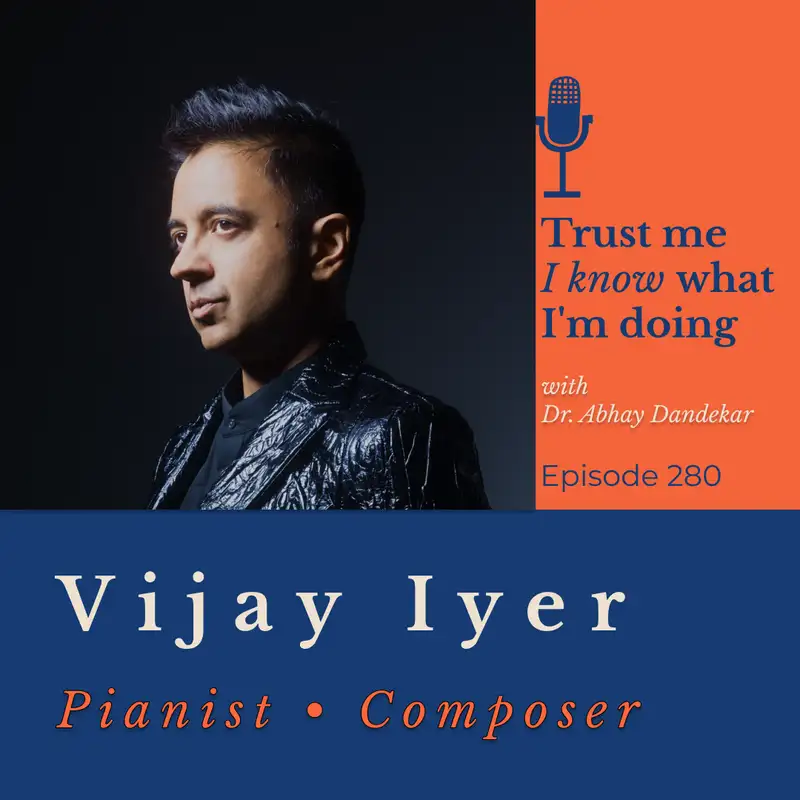
Vijay Iyer on Music as a Shared Space: Transcendant and Truthful
Download MP3Abhay (00:00)
thanks everyone for listening and watching, sharing with your family and friends, and don't forget to subscribe. TRUST ME I KNOW WHAT I'm DOING is brought to you by Travelopod.
For destinations like Africa, Japan, Antarctica, India, and the Northern Lights regions, start your journey with Travelopod. Visit vacation.travelopod.com.
Vijay Iyer (00:19)
I can say that I have ways of thinking about what I'm doing
ways of.
coming to grips with what's happening, you know, and a lot of that is informed by history of other people coming to grips with what's there's a history of ideas that's inside of what I do,
Abhay (00:36)
Is the reverence that you for that transductive experience, is that a personal proxy to kind of express both the sentiments of divergence and conflict and along with the harmony that eventually happens for people who say, yes, I want more
Vijay Iyer (00:54)
sometimes people say to me why do you do all these different things? And actually to me, it's all the same thing. I'm in this band one day and another band the next day, it feels like the same maybe the ingredients are different, but the methods.
and the human touch is the same.
Hello, this is Vijay Iyer. I'm a composer and pianist and this is Trust Me, I Know What I'm Doing.
Abhay (01:47)
everyone to this episode of Trust Me, I Know What I'm Doing. I've been reflecting a on how art in general has been simply such a magnificent expander and accelerator for me to think differently and to explore things with.
a lot of purpose with intention, with joy, with the beauty of all of life's imperfections, and with just simply a longing for more. And so with that in mind, I am definitely ready to welcome one of my favorite artists, award-winning musician, composer and piano artist, Vijay Iyer. He's been described by the New York Times as a social conscience, multimedia collaborator, system builder, rhapsodist.
historical thinker and multicultural gateway. His honors include a MacArthur Fellowship, a Doris Duke Performing Artist Award, United States Artist Fellowship and three Grammy nominations, not to mention being a Harvard professor and a mentor to so many aspiring musicians and artists. I am deeply, deeply thrilled and honored to welcome him to Trust Me, I Know What I'm Doing. Vijay, it's so great to have you here and to catch up with you.
Vijay Iyer (02:53)
Thanks so much. Happy to be a part of
Abhay (02:55)
You know, this time of year, we were just talking about the academic calendar and the semester being in full swing and that kind of thing.
you know, whether they are incremental improvements to ourself, to our health, to our body, find yourself that you have daily routines or rituals that really help, in fact, energize or restore the creative process or for that matter, just you as an artist? ⁓
you know, hey, I get up every morning and this is my routine or this is my practice ritual, et cetera.
Vijay Iyer (03:28)
I wish I could say there was an every morning type of thing, I think the nature of my...
My life has been such that every day is kind of different from the day before. And not just different in content, but different in structure. Like I end up in a different place and have to be in a different place at a different time and have to, so that, you know, and then in a different time zone and whatever else. And so everything, it's very hard to maintain any kind of continuity through all that.
So I think what I end up doing is...
Just trying to protect every bit of time that I have Even to allow myself time to not do anything, you know, I think that's the hardest ⁓ thing line to hold I would say because There's so many Ways that our time gets colonized ⁓
Abhay (04:11)
Yeah, yeah.
Yeah, no, that's a great, word to use there where it does our time does get And maybe I wonder for you is that ability to protect that space is that ability to embrace the differences of each day and is that itself kind of an important anchor for you?
Vijay Iyer (04:40)
So it's kind of like what can you hold on to that's constant through all those shifts?
And in a way just reminding myself of that, of my own
there's also, think like part of our time being colonized is our memory being colonized and kind of, there's a sort of like cycle of amnesia or erasure that happens partly because we're so flooded with information and we can't really hold on to much of it. And it's hard to.
make any information matter. So often just reminding myself of who and what I am. I think that, you know, probably because I'm a piano player, there's the piano over there, that a lot of the work I do is in my body. That's not just on a screen. It's not email. It's not just showing as a sort of office guy.
Abhay (05:29)
Right. Right.
Vijay Iyer (05:35)
It's like putting my body through some experience, you physical and emotional experience. And that requires a bit of attention and care, like I said, like trying to take better care of the body. And I find that, you know, just having space, particularly in the early part of the day to devote to that, even if it's a few minutes to lay my hands on it. ⁓
Abhay (05:58)
Mm-hmm.
Vijay Iyer (05:59)
Experience that communion with something outside myself and experience that Sensory bodily connection between what I'm doing and what I'm feeling and hearing That grounds me in something other than all these I don't know the cognitive violence of today
Abhay (06:19)
Yeah, boy, there's another great way to put
that, the cognitive violence of today. So true. I had the pleasure of watching you perform a few months ago now, and I was so struck by how humble and gentle your vibe was when I met you. And contrast that with how I felt, of course, after listening and listening to your performance and, of course, watching you perform.
And I was struck with how that gentle nature, that vibe that you exude, I was struck with how contrasting that was, at least how I felt, from how immensely powerful and driving your music was. At least again, to the relatively novice listener like me, I'm curious if this is something that has evolved at all over the years with
the intention of what you just mentioned a moment ago, is having that communion with the instrument, making sure that you're stepping both into it and away from it at the same time. And I'm curious if you've been very, very mindful of that evolution over time. Or by the way, if that's completely off base, let me know too.
Vijay Iyer (07:27)
Thank you for the very there's a very kind the very kind words within buried within that question
I think.
life is humbling, you know, and so whatever you're calling humility comes from just experiencing the sort of a broad spectrum of human experience and possibility and the highs and lows of living a life in the arts, being a parent, being a teacher, being, you know, being an artist on the road.
There's a some of it is squalor and some of it is is ecstatic grandeur, you know, so being able to.
Abhay (08:06)
Hmm.
Vijay Iyer (08:11)
hold all of that and hold on like what I was saying earlier about sort of holding on to some sense of myself across it all and through it all that consistency.
And I guess the other thing is I've just been around so many incredible artists, incredible musicians, people who are celebrated and people who aren't, know, but people who play circles around me, people who have taught me so much, younger people, younger than me, people decades older than me. And through that collaborative practice, you know, like through just being in the world among.
as an artist among other artists and then also through the experience of trying to make contact with audiences that you take nothing for granted, and you understand that you're just a small piece of it all, that you're not the answer to everything, you're not, you know.
I mean, I find that any sort of self aggrandizing idea can quickly get kind of put in check or kept in balance by something else that happens. And that, know, the same day usually like getting by some security guard or, you know, like, or, or being, you know, I think like we can
Abhay (09:31)
It's it.
Right?
Vijay Iyer (09:40)
We can easily get full of ourselves when we receive adulation and praise and awards. But, you know, life has usually offers a bit more perspective on what that might mean, you know. So, I mean, there's that. And then guess the other thing I want to say is that making music is partly about channeling.
Abhay (09:53)
Yeah.
Vijay Iyer (10:01)
all the impulses and...
everything that courses through you and focusing it into this very directed action, you know, this very like...
specific and kind of minute, like I'm just sitting at this instrument, you know, and moving my hands around. And why should that somehow result in somebody else across the room, feeling something, you know, it's a, or like, should someone who's blowing into a tube make you cry? Like what is, you know, this, this kind of ⁓ transduction that's happening, I think is the word
Abhay (10:33)
Right. Right.
Vijay Iyer (10:39)
you're harnessing something that's maybe very essential to you.
or maybe you're reaching for something, you but you're also trying to get it across. And so being able to explore the full range of that, express the full range of it, which means that there'll be moments that are tender and other moments that are brutal, you know, and that can be in the same few seconds, you know? And so like being able to traverse that kind of range is part of, it's part of the art.
Abhay (11:00)
Yeah, of course.
Vijay Iyer (11:11)
I think it's something that I listen for in others
Abhay (11:12)
Yeah.
you know, I'm thinking of that transduction, of course, that you have when you're actually doing this alone,
and you're having this kind of conversation with an instrument, with with the listeners. we were just sharing that you were performing solo and it's a little bit different expression as opposed to collaboration and the reverence that you have. I mean, you've worked with sort of a who's who of musicians and artists
reverence for collaboration and conversation. Is the reverence that you have for that transductive experience, is that a personal proxy to kind of express both the sentiments of divergence and conflict and like you said, of storminess with this, along with the harmony that eventually happens for people who say, yes, I want more of that. Is your
ability to flow between kind of the solo performance and the collaboration, is that something that you really appreciate? Is that something you crave for that matter?
Vijay Iyer (12:20)
Yeah, I mean, I think.
In every case, there is some kind of encounter happening. You know, a solo concert is not me sitting in a room by myself, right? It's me actually trying to...
make a room full of people feel something or help them arrive at some space of feeling. So it's a very communicative form. I'm trying to tell you something. I'm trying to carry you somewhere. I'm trying to be the vessel for all of us to feel something together. So a solo is never solo.
Abhay (12:57)
Yeah. Yeah.
Vijay Iyer (13:01)
You know, and that's, it's really like.
There's a...
You know, I'm just, I'm trying to tap into.
the feeling of the room, of the people in the room, you know, not to pander to them or something, but to really make sure that we're moving together. I'm not trying to leave someone behind. I'm not trying to show off for them. You know, I'm not trying to make myself look good.
Actually, I'm not trying to do that. That's not the point. I'm trying to accomplish something where we all feel something together and then that feel that space of shared feeling is the key to it all. know, it sort of maybe reveals that there's something more we can do together. I mean, collaborating with musicians is about
with other musicians is about imagining what it is that we can do together. And that essential question, that's a lifelong question for me, is both a practical question and a, well, it's many things, it's not just two things. It's a practical question. It's also a philosophical question and it's an emotional.
Abhay (14:12)
Yeah, it's quite layered.
Vijay Iyer (14:18)
question, a spiritual question, you know, it's because part of it, part of what's in there is the question of, who do we mean by we? Who are the we who are doing something together? And what does that we mean? Who's not in the mix? You know, who's not in the picture? Whom does this enterprise exclude and why, you know?
Abhay (14:38)
Has that sentiment or that question of like, who's the we, eliminating those boundaries among the people either on stage or in an audience or for that matter, who aren't even in that concert hall, is answering that question part of a lifelong artistic philosophy? Do you have a philosophy that's been shaped by answering that question?
Vijay Iyer (15:01)
I.
I'm hesitant to say yes only because I'd have to follow up with some explanation, but I would.
Abhay (15:08)
Right.
Vijay Iyer (15:10)
I'm not sure what philosophy is, to be honest. I'm not saying that facetiously. mean, as it was in the arts and humanities at Harvard and there's a philosophy department. I've read like the mean of my division is a philosopher. Like, I know what philosophy is, but when we say like, do you have a philosophy? I don't know. I can say that I have ways of thinking about what I'm doing or ways of understanding, I should say, not just think about in some mental sense like.
this dispassionate removed sense, but really ways of.
coming to grips with what's happening, you know, and a lot of that is informed by a history of other people coming to grips with what's happening. And so what I'd say is that there's a history of ideas that's inside of what I do,
that I'm not, I didn't come up with it by myself. I learned it from others who learned it from their forebears, you know? And so...
There is a certain...
For example,
Belief that anyone can make music together. Not a belief, it's a truth. I can prove it. I feel like I have. Many times over. So I believe that and I know it to be true and I've witnessed it happening. I've been a part of it happening. And what that means is that we don't actually know what music is. We don't know the extent of it because it keeps opening up.
Abhay (16:14)
Yeah. Yeah. Right. Right. ⁓
Hmm.
Vijay Iyer (16:35)
onto new vistas into new territories that keeps expanding as a category. So when we say music is whatever we can do together, for example, as a propagation, at least, or as a sort of offer, then.
then it keeps revealing more about itself.
Abhay (16:54)
When you think about that question of discovery and do we actually know what music is? Do we know what this relationship is? And you have this kind of ongoing conversation with yourself, collaborators, audiences, et When you think about your role as an educator, what perhaps have you had to unlearn about yourself in order to find success?
as a teacher, as an educator.
Vijay Iyer (17:20)
Well, I often go back to what elders have shared with me and taught me. ⁓ there was a composer and pianist named Richard Abrams, who I got to know fairly well in the last 20 years of his life. He passed in 2017. I got to interview him in maybe 2012 or so for, they didn't call them podcasts back then, but that's basically.
Abhay (17:44)
Right. Just call them chats.
I hope they did. I hope they still do.
Vijay Iyer (17:48)
You know archival interview something
Abhay (17:50)
Right, right.
Vijay Iyer (17:51)
You know, one thing he said was, you speak to five people after a concert, and every one of them says something different about what happened.
I said, yeah, that's right. And he said, the purpose of music is to excite all these different experiences.
Which means that there's no one way to hear something or to understand something. So what that has like, I think about that almost every day. I mean, it's been like 13, 14 years since he told me that, but I literally, I bring it up all the time. I was just, you know, last week I, I'm, I'm teaching this bunch of undergraduates, where I'm
holding a course where we just explore the work of different composer pianists. And I told them that like, I don't actually know everything there is to know here. And so we're gonna build knowledge together from what each of us experiences. We're gonna share it with each other and listen and learn from one another. That spirit of learning from one another and that I'm not.
master. You know, I'm I'm I remember Zakir Hussain saying something that his father said to him, which is that you can never be a master of something. You can only be an eternal student. So, that sensibility, I think is something I try to carry forward and and share with everyone else. I mean, I was just, you know, I've been listening to Thelonious Monk for 40 years.
And I just came from teaching or just sharing, know, holding this course, but I even am reluctant to use the word teaching as because what we're doing is learning together. And I said, like, you know, I listened again to this piece, this one piece that I've heard maybe thousands of times in 40 years. And I learned something new this morning about it.
Abhay (19:29)
Sure, sure.
Mmm.
Vijay Iyer (19:45)
class, you know, when I was preparing for class. So, there's, it's also that that this that every encounter with a piece of music is new.
Abhay (19:55)
love that. I mean, you know, those surprises, those aha moments, they can only come from having that sort of growth and learning mindset if you're just constantly a student. And it really does. I think that is something that we do continually grow into.
gonna, of course, I'm a huge fan. I love so much of your work. I have an actual favorite.
My favorite is your cover of Mystic Brew. And it's only because it captures so much contrast and motion and urgency with also so much peace and tranquility. And again, you're right, that's my takeaway from that. And I take something away every time I listen to it. And I noticed that this theme was present in many of your live performances as well of creating different moods.
and using speed and shapes of how your music resonates, all within the confines of a sort of governed composition. And is there an element of mathematics or puzzle solving or storytelling that you use with intention in your performances?
Vijay Iyer (22:09)
There's a kind of a...
If that ever is an element, it's always as you suggest.
In service to something else, more like you say storytelling or more of an emotional arc or a larger, larger shape, right? Is something more felt and counted. So sometimes it's that in the micro details of what's happening, like that piece being a good example, whether it's sort of like.
Abhay (22:18)
Hmm.
Vijay Iyer (22:41)
specific ideas taken through a few different transformations where the internal kind of mechanism of it shifts, but it still somehow feels the same. And so that's what I was interested in was that particular sensation of similarity or familiarity, but also that the inner workings might kind of come to life in a different way.
Abhay (22:45)
Mm-hmm.
Vijay Iyer (23:07)
might start spinning faster internally or something. So that's basically what's happening is these what I would call similarity relationships, which is not, it's a combination, I would say, of mathematics and feeling in the sense that, you know, what does similar mean? Similar doesn't mean anything mathematically. I mean, I suppose like you can, there's wavy lines and it means something geometrically.
Abhay (23:25)
Yeah. Yeah.
Vijay Iyer (23:32)
But when I say that this feels like that.
You can't quantify that, right? And say that, okay, there's a similar proportion, maybe, but not the same, right? It's not just like I'm multiplying.
Abhay (23:36)
Right. Right.
Vijay Iyer (23:48)
you know by one and a half and getting one and a half x like it's not it's something else that is you can describe using numbers but the numbers aren't doing it that the numbers aren't the reason for it the feeling is the reason for it and the numbers happen to be the means by which you get to that feeling but i as i often have to tell people like
You measure all kinds of stuff all the time, like when you mix a drink or bake a cake or build a doorway like you use, you are counting, you're measuring, you're creating like proportions. It's not a big deal, right? This is like a grade school arithmetic. Like you learned it when you were eight, how to do this step. So I'm not doing anything that's like super intellectual. I guess I'd put it that way.
I will also say that some of what I'm talking about comes from checking out what percussionists from South Asia do.
in different rhythmic traditions. mean, I mentioned Zakir Hussain I would also shout out, I don't know, Triti Shankaran and Umayyad Param Sivaraman and these different Carnatic percussionists. Then there's also folk drummers from Kerala. And like, and of course there's all this film music which works with similar elements. so,
Sometimes there's something in there that I find interesting that I want to engage with. So a lot of
I don't know, should I say the first 20 years of my recorded output? Now that there are more than 30 years. But a lot of it had this as an ingredient. ⁓
Abhay (25:22)
I think, yeah, and
maybe I postulated that feeling from just knowing that you spent some time in Berkeley and thinking about mathematics. And yet at the same time, you're so right. And I think about that a lot too, that like there is, it goes beyond the arithmetic or the algebraic way that we may form those constructs.
because you can't quantify feeling, as you mentioned.
Vijay Iyer (25:51)
Yeah,
and I would say that the math I was doing in college and grad school.
is not the math that's involved in making music for the most part. Like it's not, you know, not in this element, like this arithmetic stuff or like, well, turns out that eight is also three plus two plus three, know, like, this guy, you that's not like, that's not revelatory. And it's not college math. All right, it's just
Abhay (25:59)
Mm.
Vijay Iyer (26:22)
something that a child could do. And so that's the kind of math I might involve. The only element that sometimes uses anything like.
more sophisticated or more advanced is thinking about sound, which then you think about vibration, thinking about frequencies and frequency relationships. And that is involved in everything. Whether it's creating a chord or orchestrating a piece for an ensemble or mixing an album or mastering an album, you know,
or even just playing in an ensemble. You don't have to kind of think about sonic relationships in this way. And it's helpful to have some working understanding of that, of the physics. It's not that that's all I'm thinking about, but it's helpful. It gives me a kind of, I don't know, ⁓ just this morning I was, you know, it's a room full of Harvard students. So I'm like,
Abhay (27:05)
course.
Yeah, it gives you context. gives you, yeah, help set it up for sure.
Vijay Iyer (27:21)
Hey, let's talk about the harmonic series. It's actually gonna help us understand some of these chords. So I was showing them like, well, this is a prime number and that matters in the harmonic series for this reason. So stuff like that. I was able to tell them about that. So that's maybe like middle school math.
Abhay (27:36)
Mm. Yeah.
Yeah. Yeah.
Can't
escape those grades, right? ⁓ It's 2026, and we live in this, it is a very tumultuous place to organize art without being tied to the consciousness of the world right now. And many of your compositions feel so deeply tied to those social realities and that sort of.
Vijay Iyer (27:47)
Yeah.
Abhay (28:12)
zeitgeist in that consciousness. mean, how do you translate current events or emotions into a musical form without it being overly didactic? Or for that matter, is that something you don't worry about too much?
Vijay Iyer (28:26)
⁓ I.
is what, something I don't worry about the didactyplar or just.
Abhay (28:31)
Yeah,
yeah, do you? Okay, if it is didactic, so what?
Vijay Iyer (28:35)
Well, I think it's maybe more about what does.
How does politics function in music?
And, you know, I think I indicated earlier that the question of what is it that we can do together is a political question, right? It's a practical question in the sense of music making like, well, I know how to do this and you know how to do that. So what can we do that kind of compounds those two spheres of knowledge, let's say, or something? There's that.
Abhay (28:48)
Hmm.
Vijay Iyer (29:02)
The political larger political question of what can we do together? is the same question.
I know this and you know that, so what can we do together? And why? guess for whom? For what? To what end? Right?
⁓ so then like making a piece that's like has a certain title that maybe points to something outside of itself or like is kind of about says it says it's about something, right? Like what is it? How does instrumental music come to be about something? Because I said so. Is that do enough? I mean, I can say with sincerity that, for example, the
piece, Kite for Rafat Harir, was a Palestinian poet who was killed in Gaza in a targeted killing in December of 2023. That when I wrote that piece, I thought about him. Every time I played, I think about him. And so and not just think about him as a kind of topic. But I feel something about him.
I guess that's really what I mean. And so that space of feeling becomes a space that I want to share with other people. Do I need to tell them that that's what it is when I play it?
That's another kind of political work. If I wanna then stand on a stage in London or in Lisbon or in, I don't know, in New York or in Los Angeles, Minneapolis, and say, this is a piece that's dedicated to Riffat Al-Ariyar.
Abhay (30:23)
Minneapolis. Yeah.
Vijay Iyer (30:31)
Some people in the audience know who he is and others don't. And then if I then also say he was killed in Gaza Decembra of 2023.
then it's like okay so he not only said that and felt that but is putting himself on the line in a certain way.
Abhay (30:48)
Hmm. Yeah.
Vijay Iyer (30:50)
that then everyone has to deal with. So I have to make that choice beyond merely playing the song each time I play it, which is do I want to put everyone else in this position I'm putting myself in so that we all become kind of implicated.
That's a political question, right? So I guess what I'm saying is we can think not just about what a song does, but also of the political work that performance does in its moment. That piece I recorded with Wadada Leo Smith, who's a black man who's
Abhay (31:26)
Mm-hmm.
Vijay Iyer (31:32)
from Mississippi and he's 30 years older than I am. So he's 84. we recorded it...
was supportive of the idea and he sees that struggle as linked to the struggle of his own people. In fact, on the same album, there's a piece that's dedicated to Patrice Lumumba, who was killed in the Congo in the late 50s.
Abhay (31:46)
Mm-hmm.
Vijay Iyer (31:57)
And that was also a targeted killing.
So, you know, so there is this kind of idea of linked faiths and linked histories that this is all actually one story,
Abhay (32:04)
course.
there's such a larger discourse that's out there, but I think it takes a fair amount of bravery and courage and fearlessness to at the same time, you know, not only just put it out there, but for others then to say, yes, I'm here to learn. I'm here to share that experience. And and that's very appreciated in a way.
when you think about your own background as someone who grew up as Indian American, someone who has shared and performed and collaborated with other Indian Americans, other South Asian Americans, other South Asians globally, and also putting it into the context of being a global citizen, how have those layers of your identity sort of shaped your sense of belonging?
or for that matter even shape this whole idea of using your art and your voice as a platform for that political discourse or that resistance even within the jazz or music.
Vijay Iyer (33:06)
Yeah, I mean, thank you for putting it that way. And it's partly that it has evolved and changed for me, both in terms of what my position is in this complex world we're in. yeah, and also what these different affiliations might mean or how they might matter.
Abhay (33:14)
Mm-hmm.
to say the least,
Vijay Iyer (33:30)
For example, I don't
My parents left India in the early mid 60s, right? And my father was born before partition. He was born in the 30s, 33. So a good amount of his young life was spent in, I mean, under imperial rule, but in a broader
non-Hindu specific.
construction of India as a subcontinent you know, not as this nation with borders.
And so when people say India today, they mean something else than what he meant, you know, and that difference matters to me because my connection is more to the world, his world and to like modern Hindu nationalist India, you know, which is why I prefer to say South Asia and South Asian and South Asian American or South Asian work and stuff.
Abhay (34:32)
Sure, sure.
Vijay Iyer (34:33)
say Indian American. That is basically like, I didn't always think that way. I think in the 90s, when I was coming of age and all of us were sort of like finding our way into this world in the West, like figuring out how to be.
who we are in the West, particularly in North America, particularly in the US, that that was not an obvious thing to do. There wasn't really a template for us. And different people made different choices. But what happened to me is that in the early 90s, when I was 20, essentially,
started playing with elder black musicians, like people who were 50 years older than me. And through that world, that community and being embraced by that community and coming to understand.
their political reality and their social reality and the world as they experience it. The precarity, the lived precarity of the world is experienced. And that's humbling, first of all. And to be like learning from people who hadn't been conferred any of the privileges that I had. I mean, I was a PhD student at UC Berkeley.
Abhay (35:40)
Yeah.
Vijay Iyer (35:50)
learning from people who hadn't gone to college or even finished high school and some of whom had been in prison and you know and one of the ensembles I was in in those years that was led by an elder drummer named E.W. Wainwright our main gigs were in the California state prison system so most of what we used to play at places like San Quentin
Abhay (36:09)
Wow.
Vijay Iyer (36:14)
other places around California that were that, you know, including the maximum security wards where if you step over this line, a sniper up there will shoot you like that. That was humbling also, because I just I came to understand this, that a lot of people in there had done nothing and were
Abhay (36:27)
Right, right. Yeah.
Vijay Iyer (36:40)
what Wayne White called political prisoners. So then like, what am I in relation to all of this? You know, the construction person of color didn't really account for these differences in lived experience. I could say, well, I felt marginalized growing up Brown in the suburbs, et cetera. And I...
was the first, you know, Indian American jazz pianist. And so that made it hard to kind of define myself in my, you know, but I wasn't up against this kind of stuff that I'm talking. Then apprenticing with like Amiri Baraka, the poet and activist being in his band. And being in different groups with, you know, where
Abhay (37:15)
Hmm. Sure.
Vijay Iyer (37:29)
keeping my identity my identity. But first of all, like I was embraced because I came I had roots from outside the West and that was like something of interest, you know. And I was invited to just be myself. I didn't have to like conform or something.
Abhay (37:38)
Mm-hmm.
Vijay Iyer (37:46)
And so being part of this like embrace, being allowed to be myself and try to then figure out what that meant for myself. That became a lifelong pursuit, you know, and then like, well, what about finding people with whom I could find common cause, you know?
Abhay (37:55)
course.
Hmm.
Vijay Iyer (38:04)
Being an artist of color in the West and in North America, that's something like the fact that maybe I might have something in common with Teju Cole, for example, the Nigerian author, or that I might have something in common with Aruj Aftab, who is Pakistani American, or with Mr. Smith, whom I mentioned, who grew up in segregated Mississippi.
Or with Henry Threadgill, who grew up in Chicago in the aftermath of the Great Migration and was sort of like in a de facto segregated northern American city. You know, these different experiences where I'm finding that actually it's not simply about the sort of like facile notion of identity, but it's actually an endless set of
Abhay (38:49)
Hmm.
Vijay Iyer (38:55)
possibilities about how we build community, how we co-construct a future for ourselves and for each other, know, through art making. So that's kind of how it's really played out over all these years, all these like pretty extraordinary encounters. Sometimes I feel like, Gump of jazz.
Abhay (39:00)
Yeah.
I was going
Vijay Iyer (39:18)
Thank you.
Abhay (39:18)
Many dots to connect. And let me get
you out of here on this. given all of that, right? Given this global citizenship, this tapestry of experiences within the North American framework that you just mentioned, does your music help you or, and you for instance, because it is an experience of one in the end, your music help claim or create a sense of home?
for you ⁓ in that sort of context of identity and global citizenship.
Vijay Iyer (39:49)
It does. ⁓ it is that sense of continuity. You know, sometimes people say to me like, why do you do all these different things? And actually to me, it's all the same thing. That's, know, so the fact that I'm in this band one day and another band the next day, it feels like the same process to me. And I'm doing the same stuff in all of it, you know? So it's maybe the ingredients are different, but the methods.
and that the human touch is the same.
Whether that means global citizenship, I'm not sure about that phrase either. I'm not sure what that means, honestly. It sort of implies a kind of carte blanche. And I would say that it's not that simple because I think of this phrase from Saidiya Hartman, is that community
is not a given, it's an achievement.
So needs to be made, it needs to be earned, it needs to be built. It takes work, takes labor, takes sometimes conflict, it takes sometimes failure and rejection.
You don't experience pure mobility and pure freedom and pure agency. know, like sometimes things are hard. You gotta work through that. So I think global citizenship speaks of a certain kind of privilege and I'm not sure that that's simple.
Abhay (41:02)
Yeah.
Maybe ⁓ I like the phrase, the framework of community and working at that, but I guess what I was trying to think about was, it offer sanctuary? Does it offer home for people?
Vijay Iyer (41:20)
Yeah, I mean, I will
say that that is what I feel that music does it offers a space to join and feeling and space to kind of
tap in to some other level of reality. Maybe that's kind of one that's protective or one that accesses a different layer of experience that you're not generally allowed to access. So it is this special place.
I think of that, there's a katha from Thich Nhat Hanh's practice where he says, I have arrived, I am home in the here and the now. And that, that sensibility that actually what this, music does is it brings you directly into the present moment in a way that...
You know.
then we become accountable to one another in a different way, in a way that's...
vibrant and
very alive.
Abhay (42:20)
Well, building community, working at it hard, staying accountable, and feeling vibrant and alive. I think they're all at least personal descriptors of how I experience your music. Vijay, thank you so much for sharing some time with us, and I hope we can catch up with you again in the future.
Vijay Iyer (42:37)
For sure. Thank you, man. Thanks so much for making time.
Abhay (42:41)
Thanks so much again, Vijay. And thanks to all of you for listening and subscribing and sharing this with your family and friends. A big shout out this week to Gauri for turning 40, to the Artemis Crew and Amit Kshatriya for a mission accomplished and job well done. And to the artist Naresh Kumar Kumawat for his sculpted statue of Swami Vivekananda being unveiled in Seattle.
Lastly, our collective hearts will always be filled with the songs and music of Asha Bhosle. Remember everyone, be safe, be smart, and be kind. Till next time, I'm Abhay Dandekar