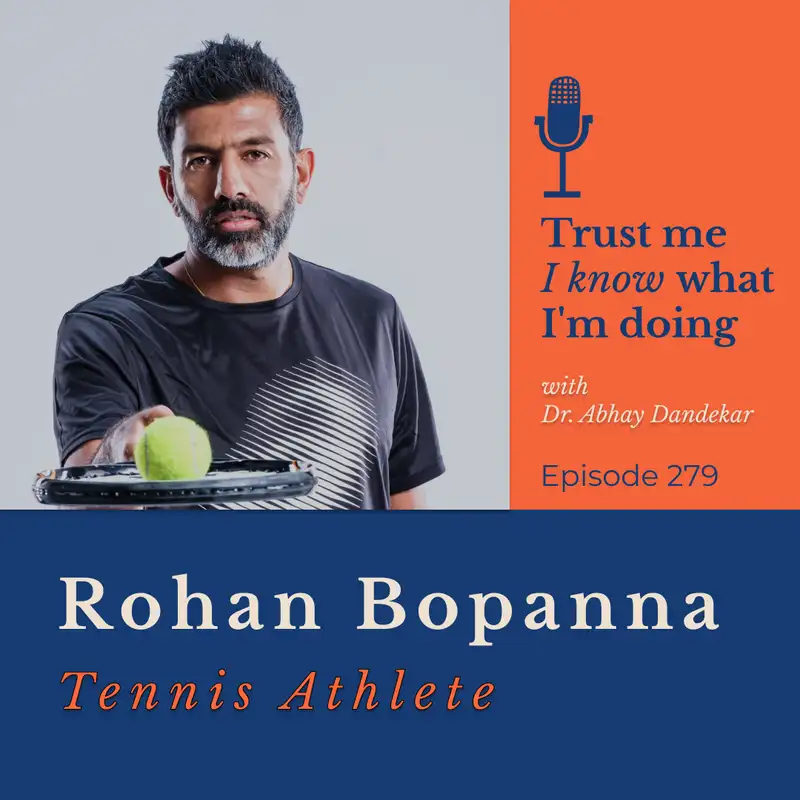
Rohan Bopanna on Tennis and the Art of Longevity
Download MP3Abhay (00:00)
thanks everyone for listening and watching, sharing with your family and friends, and don't forget to subscribe. TRUST ME I KNOW WHAT I'm DOING is brought to you by Travelopod.
For destinations like Africa, Japan, Antarctica, India, and the Northern Lights regions, start your journey with Travelopod. Visit vacation.travelopod.com.
Rohan (00:19)
I decided what was really important, what are the higher aspects and I felt were more important for my longevity and how it actually helped my game. I I may not have been the fittest athletes among there, but mentally I think I was
extremely strong to really push my game at the highest level.
Abhay (00:40)
Were there any things that were, you know, actually not so different from that first match to the last match?
Rohan (00:45)
soak it in, understand what somebody is saying and then look at it in a bigger picture, not just in one dimensional. And I think that is something I'm still adapting to learn and see how I can get and do better for, especially for Indian tennis.
Rohan (01:01)
I'm Rohan Bopanna from Bangalore, India, a retired tennis professional
And this is trust me, I know what I'm doing.
Abhay (01:37)
Welcome everybody to this episode of Trust Me, I Know What I'm Doing. So we've talked about it on the podcast a lot over the years, but I really think it deserves reminding that among the secrets of professional longevity are really, really healthy doses of rebuilding and reincarnation and rejuvenation and reinvention. And now as a tennis fan myself, I would imagine that the best of the best
have to actually do this with great intention within a single match or even a single point to simply analyze their own skills and performance and adjust therefore to leverage against their opponents or obstacles. Now professional Rohan Bopanna, this iterative process of growth has taken on a new meaning over the span of a storied multi-decade doubles tennis career that took him to two Grand Slam championships
Rohan (02:20)
Okay.
Abhay (02:31)
three Olympic games, India's Davis Cup team, and of course, the number one world ranking at age 43. He's a Padma Shri Award winner, a philanthropist, a mentor to so many young athletes. And I'm honestly just so pleased and honored to welcome the recently retired and of course,
evergreen Rohan Bopanna to the show. Thank you so much for joining. It's really a treat to have you on. Trust me, I know what I'm doing.
Rohan (02:57)
Thanks, Abhay, for that beautiful introduction. And really looking forward to having this chat with you. And of course, I've heard a lot of wonderful things about you. And my team always.
tries to find a way to connect with great people across the world. And I'm thankful that we are here today chatting together and look forward to having some great conversation.
Abhay (03:21)
I know ⁓ it's evening for me, morning for you. I'm hopefully catching you on a good morning. I'm guessing since you're from Coorg that you're a coffee guy and not a chaha person. Is that correct?
Rohan (03:33)
That's great. It's about 11 o'clock here in Bangalore and I'm already down to coffee. To South Indian filter coffee. So I'm ready. I'm ready.
Abhay (03:40)
boy, okay.
All right,
so, you know, poised and ready and, you know, ready for the next serve, I guess. Let me ⁓ start with this one. I mean, I've been thinking about your incredible career and your retirement recently. And I know that the retirement and sort of last matches are always fresh in mind, but I'm curious and I'm always so interested where the sort of origin stories are. So do you remember your first professional tennis match and kind of what that felt like? Maybe the
that day or even the day before that day. Do you have that memory strong, just as strong as perhaps the retirement memory?
Rohan (04:22)
To be honest, it's not as strong as I would say the first match to your last match. But yes, I do remember it. You know, playing ⁓ a junior tournament in Bangalore right at the Karnataka State Lawn Tennis Association. though I was living in Coorg, we had to always drive down for tournaments because there was never really tournaments in Coorg. It's where
I grew up, my family lives there, which is about 250 kilometers away from Bangalore in a beautiful place which grows coffee, is known for coffee plantation. Yeah, so I remember my parents bringing me to Bangalore and taking me to this national ranking tournament and unfortunately I barely won games. Yeah, but definitely remember that memory and...
Abhay (04:56)
Yeah, right.
Rohan (05:10)
always from a young age, I was very competitive. So when I went to the match and lost, I was not too happy about it. And I think that kind of stayed through and through my journey. just found a way to manage it much better over the years of traveling and learning so much.
Abhay (05:27)
I'm wondering, are there any constants there, right? That like, you know, hey, even though it was my first match, whether it's my last match, but there are some things that I always did the same. I was prepared the same or you had like a pre or post match ritual. Were there any things that were, you know, actually not so different from that first match to the last match?
Rohan (05:49)
I think how easily I got out of a loss and moved on to figure out what is the next step. I think that stayed very similar through and through from junior days. But in terms of preparation or post recovery, I would say miles apart because I didn't really know what kind of routine was there when I was growing up, what needed to be done, how much.
Abhay (06:07)
Right.
Mm.
Rohan (06:14)
exact work needs to be done before a match and after a match we just go there warm up with quick stretch straight get into the match after the match you know just sit in the car go straight home or you know or whatever it may be right you're not really thinking of all that aspect at all and plus most of the places where I played growing up never really had any warm-up gyms or recovery area per se so it was just
Abhay (06:39)
Mmm.
Rohan (06:41)
matches and and what kind of food to eat, there was no really nutritionist who was telling me what to do, so we just ate whatever it was available. So yeah, I would say those things completely changed over the years.
Abhay (06:54)
yeah,
different eras, different times. And I know ⁓ that when you were younger, your style of play certainly mirrored one of your heroes and Stefan Edberg and that pretty aggressive serve and volley style. Do you remember a pivot where you not just transitioned to doubles play and left the singles game but and
in a way kind of knew that that was what was destined for you. But do you remember when you actually fell in love with doubles tennis?
Rohan (07:26)
Yeah, I think right from the beginning, I mean, when I was playing juniors also, I loved, playing doubles, I felt that there was always somebody there to share the emotions and, you know, enjoy the moment and you always wanted to play with close friends so that made it much easier. And you always had company, especially when this tennis journey is pretty lonely, you know, from a very young age when you start traveling.
Abhay (07:42)
Right.
Rohan (07:49)
Of course, the Indian circuit was a lot of fun because you had tons of friends. When you started getting better and started traveling outside India, that's when it started becoming more lonely because obviously they're not the same group or, you know, travel to all these tournaments. So that started becoming much less in terms of ⁓ who your friends were and you started to make new friends. And as you were getting older, making new friends was not as easy as well. And yeah, but the transition.
I think from serving and volleying to going into the game that I served and stayed back, I think it started off when the court started becoming much slower. I saw a lot of the other doubles players kind of doing this and adapting it really well. So by just watching them, I was with Scott Davidoff, my coach, and we decided that, you know, let's start doing this. Not like every point, maybe, you know, slowly bring the transition and then ⁓
eventually got to a stage where I stopped serving and walling and also because of how my body was recovering and with lot of problems on my legs and everything. But yeah, I'm thankful to make the transition because I think that also kind of helped me sustain this journey for a longer period of time.
Abhay (08:58)
You mentioned how social, how socially important that camaraderie was, right? Like having a group of other peers and players, and of course playing tennis, there's doubles tennis, there is such a terrific camaraderie that's just shaped with your teammate. as doubles and even team play is so collaborative and it's much, much more orchestrated as a team. What were some of the maybe
accelerators of trust that helped you both individually and then of course with your playing partners. How did you cultivate that trust, either over time or quickly with your partner?
Rohan (09:38)
I think for me, the important part was who I surrounded myself with, having the right kind of people because you were spending 30, 35 weeks with this person and that was really important to find the right balance of who's kind of giving you advice off the court.
before you even choose a partner because it's not easy because everybody comes from different parts of the world, different cultures, a lot of egos involved. So, to understand that match right partnership, you also had to have a fantastic team who would make you understand why this journey is needed and how to handle different situations.
Abhay (09:56)
Mmm, yeah.
It's kind
of like professional dating, I would imagine. Yeah.
Rohan (10:21)
Absolutely, think it
is very much like that where you try to find the right balance in each partner and I'm extremely thankful. feel that my wife being a psychologist kind of made me understand partners better on how to maybe communicate with them in a different way and I think she read them really well compared to me just looking at it from a tennis angle.
There was a lot more to it when you actually spend so many hours outside the practice court or the matches. You spend a lot of time. Having Scott Davidoff also being on the tour with me for 15 years and I felt that keeping a coach and to understand your journey was more important than to every time you had a bad result trying to fire the coach and trying to bring somebody new.
And then I said, okay, it's time to figure out what best I can bring out to the partnership. And I look at it as like what I could do better in order to improve that partnership. And that I think really, know, made the difference in terms of a small example I could give you is that in case a partner with the volley I would start telling myself, okay, maybe the server's not good enough, hence he missed the volley. You know, so I looked at it in a very different perspective. And I think that really
Abhay (11:29)
Bright, bright.
Rohan (11:34)
made a massive difference.
Abhay (11:36)
everything you talk about there is with a growth mindset and particularly with this idea of lot of patience, Where you have to develop that patience instead of having rash reactions, let the decisions synthesize and marinate a little bit before you take action on them. that
Rohan (11:55)
But it's also a
catch-22 situation because when you started doing well is when you could afford to get more people around you. Otherwise, you're still playing doubles, you're traveling by yourself and you have to manage everything. there were situations where that does get tricky, I think initially. I'm glad the career went in a brighter side that I was able to afford traveling with a coach, physio, my partner.
Abhay (12:01)
Right. True.
Rohan (12:19)
My wife everybody, ⁓
Abhay (12:21)
Yeah,
yeah. You mentioned how, of course, that is a grind almost. I read that you shared recently how patience discipline and self-belief were so heavily integrated into your longevity. And I'm just wondering how did that translate on a day-to-day level, but particularly with daily tennis and touring and practice and
Rohan (13:11)
Yes, absolutely. I had to practice it in terms of
Abhay (12:49)
Travel and and even resting right? mean all of that can be such a such a grind not just physically but mentally How did all of those ideas of patience and discipline and self-belief? Factor in on a day-to-day level. Did you have to practice those things in order to really kind of shape that longevity piece?
Rohan (13:15)
In a way that I said, if I want to still continue playing this sport, traveling city to city, enjoying great tournaments and playing at the highest level, I have to really focus on what I need to do on recovery, find that right aspect and more so than playing tennis. I said, if I don't focus on that, playing tennis will not happen because you'll...
soon fade away. I decided what was really important, what are the higher aspects and I felt a very good warm up before practice and recovering after practice, after matches were more important and getting the right kind of sleep. These were more important for my longevity and how it actually helped my game. I I may not have been the fittest athletes among there, but mentally I think I was
extremely strong to really push my game at the highest level.
Doesn't matter who was across the net. I think I mentally believe that yes, this was what I could do and I can push with no matter who was there.
Abhay (14:17)
Yeah, I'm wondering, because of that kind of mental resilience and that real kind of strength and fortitude that you had to have, I imagine that as you mentioned at the very beginning, being able to have a very short memory for losses was something that you could translate to longevity and success. But I wanna dig a little deeper on that one.
what did you gain from those losses on the court? And because that didn't necessarily change from the beginning of your career to the end of your career, did the process change at all? Were there losses that, you know, we're all humans, so some losses may sting a little bit more than others, or some losses you actually learned from a little bit more than others, but did that process of being able to quickly analyze and...
you know, recuperate from those losses. Did the process evolve over time?
Rohan (15:15)
Yes, it did. I think you've all it.
you know, got into much more finer details of, know, speaking with the coach right away, understanding it is, understanding what happened in the match. Yes, of course, as you mentioned, some certain losses were much more harder to take, you know, especially at bigger events when you kind of not have achieved that, especially for me going to Grand Slam final, losing that back to back. mean, it was definitely harder. But at the same time, you know,
Enjoying that day of where you are, whether I was in New York City, I, yes, I ended up losing a final, but still I would go out, enjoy a meal together with the team for the great work which had happened those two weeks, appreciate where I am. And I think that really helped me, you know, for day to day and understand the loss better and move on from it much, much more quickly and then get back to
⁓ what I need to do in order to try and keep building on my own game. I think that is one thing which definitely helped me from a very young age and just able to let loose and enjoy the moment, wherever I was.
Abhay (16:22)
Yeah, we don't pay enough attention to that, right? Just being able to engage in the moment and just be present and celebrate exactly who you are and where you are right then and there before we're constantly living in a sort of futurist stage where, you know, onto the next match or onto the next practice.
Rohan (16:40)
And also
I think for me coming from Coorg, everything was always a beautiful journey, better journey coming from there. And it didn't feel like I was kind of going back in any way. felt wherever I was, I was always happy to be present at that time, at that moment. And I didn't take anything for granted. I enjoyed coming to different cities. I made like, I call it like a
Abhay (16:45)
Hmm.
Rohan (17:05)
once a year family who has to meet in every city. I had lot of these friends, I kept meeting for so many years and I enjoyed that aspect. I kept my priorities on, match days, not really staying out, you going for late dinners and they also understood that aspect. And then every time I was there, I would definitely find time to meet all of them.
because I didn't know whether I was going to come back the know the following year and so I think truly that is something which helped me ⁓ more than more than you know once and in many times over
Abhay (17:37)
I'm gonna call it a Coorg mindset right now, but where do you think that came from? mean, how did that help anchor you? Because for a lot of professional athletes, hitting the reset button to remind them of either some humility or some set functional understanding of how grateful they are in the moment, that doesn't come easy. was there a source for that? Is this something that...
⁓ you had to either remind yourself of or you had to sort of think back to why, Coorg was that mindset was so important to you.
Rohan (18:13)
I think it's my upbringing. It's my parents. You know, I remember an incident when I had gone to Egypt and I came back and my mom said, did you visit the pyramids? I said, no, I just saw it from a distance. And then she said, next time I was going there, she said, please visit the pyramids because people travel miles to just to see such a beautiful thing in that country. So you never know whether you're going to go back. So enjoy wherever you are.
I think so that from a young age kind of helped. And even my parents said, you don't punish yourself just because you don't have dinner or don't miss a meal just because it's not going to really help. It's like, yes, you feel bad about it. You talk about it. You call us or you call whoever you speak about it. But then when it comes to the right kind in order to how you'll improve the next day, don't sacrifice on that. And I think that is where
it kind of stayed and I'm extremely thankful for that advice coming at a very young age and coming from them who obviously were learning along with me in this journey. They were not somebody who had kind of understood what the journey is and my parents always said if they ever knew that it's going to cost them so much, they would have never really put me into tennis.
Abhay (19:27)
Right, right. Their burden was a little bit different than yours maybe.
I've heard athletes and executives talk about that mindset where you have to stay in the moment. And I've heard it mentioned in different ways, but the idea is the same, right? That you don't get seduced by the lows or the highs where, you you kind of try as best as possible.
not to get too down or not to get too up from a loss or a victory respectively. As you got further and further along in career and matured even more, was that just simply easier to do because you had that sort of experience and did the victories when you did have like grand success, right? At a major or a major tournament, were those also equally
uh challenging not to you know really get too high from those either
Rohan (21:00)
I always celebrated my victories from wherever I was. felt because I felt you have to appreciate what you have gone through. It's not like every week which comes. So when you do enjoy that moment.
It feels special to say that yes, you have put in that work. You get some friends, you get a team, everybody out there and you got to appreciate that week because I felt then you're ready to go on and ⁓ start the fresh week because if you just go on like a robot every week, just play, maybe win, get the trophy, go and then head out straight away. It doesn't feel right.
and you don't really then sit back and say okay this you don't have stories basically you know I feel this is what creates stories create memories and you know there's even you share with so many people you know close to you you know because you don't know whether that person is going to be in that journey along with you along the way and you also don't know where you're going know especially with
Abhay (21:59)
Absolutely.
Rohan (22:02)
any professional sport, an injury could set you back and you could be out the following day itself and you don't know what's in store. that is also something I along the way and I said, okay, this is what I'm going to do no matter where I am, whether it's a final, whether I lose a final or if I even win the final, I shall definitely go and...
celebrated for being an appreciate the week we have put in.
Abhay (22:28)
know, there's only a few pinnacle success players who can maintain that level of discipline that mindset over a long, long period of time. And of course it's not easy. But tennis is such a young athletes game and there's such a reality of turnover when it comes to professional athletes at that level. How did you find
aging gracefully over time, but then also seeing like know, a way, generations of athletes kind of go through the cycles. enough for you to be able to then, of course, achieve success, re-achieve success, get that number one ranking in 2024. Was there a formula to potentially aging gracefully? I mean, beyond what we've talked about here,
but also in the backdrop of those peers who you're playing with now are getting younger and younger relative to you.
Rohan (23:25)
I think biggest thing about there was that I, you know, when I got new people to try and do different kinds of, say for example, whether it was the new kind of mobility or new kind of recovery or yoga for example, when I got the people on board.
I let them in and I said, OK, I am going to really give it a try. I never really set with a closed mindset saying, you know what, this is what I know. This is how I'm going to do it. And I think that made a massive difference. mean, you whoever I tried to get on board, whichever little advice they gave, I took it and I said, OK, how can I adapt this? And let's see if it makes a difference. You know, I said, OK, I've achieved this.
Abhay (23:51)
Hmm.
Rohan (24:07)
Why not? Maybe there is a way to achieve more. Let's find a way. Let's give some other specialist out there a chance to maybe find a way to bring something new into me. And I think that is where it made a massive difference, especially I remember when in 2019 when I had no when I found out I had no cartilages on my knees and it had fully worn When I went to the doctor and everything, he said, yes, we can give you a couple of.
PRP injections, but after that the strengthening is the extremely key part. You know, and that's where I kind of found Iyengar Yoga. it challenged the teachers, I must say. Because for them I was a very different person coming into their practice and I said this is specifically why I'm trying to come in to work on is to build these small muscles before I big my.
build my bigger muscles on my quads and since I've lost all the muscles, have severe pain. I don't yet want to go to a surgery. I want to see if there's a way, you know, we can figure this out. And I think they were extremely adaptable to say, okay, let's give this a shot. And I went with an open book, their open mind. And I said, you know what, I'm going to give this a try. only did
Of course, the pain go away because all the muscles were built back again. also I felt that doing that yoga kind of helped my mind think clearly. I felt I didn't feel rushed. It was not like they were teaching me any breathing techniques or, you know, one particular day. It was more specific. Started off with my knee, then started aligning my back and slowly then enjoying the practice. You know, and I kept telling them.
I wish yoga is something which is taught for young kids. We always pick up kind of yoga when we are much older in the journey. Absolutely. And I think just being able to give that situation and going with an open mind, think is throughout my journey always helped, whether whoever came in, whether it was new physios coming in and giving me advice. I was open to...
Abhay (25:58)
Yeah, we wish we'd have done it a lot sooner.
Rohan (26:15)
take that feedback and try it and not be resilient to say this is the only way and this is my way or that nothing else matters. I think that helped the longevity and really made a change.
Abhay (26:28)
And I'm guessing that also, you know, that flexibility and that openness to new techniques or even just trying different things allowed you to sort of stay less rigid in your routine and your conditioning. And especially with lots of new players coming in, again, younger players coming in, I'm also guessing that that, fueled a lot of your motivation to stay competitive. So now that you're retired, ⁓ do you miss that competition particularly?
Rohan (26:55)
I don't miss the competition, I miss the cities, some of the cities which I've been travelling to. I'm missing going to Melbourne, missing my coffee spots which I've been going for many years.
Abhay (27:07)
Right,
the good social part.
Rohan (27:09)
Yeah, the good social part and you know, of course, like I said, that once a year family, which suddenly I'm not going to see only if I plan a trip there. Yeah, but I think apart from that, currently extremely happy to just leaving out of a cupboard than a suitcase.
Abhay (27:26)
Does that take also a little bit of an adjustment? I mean, I'm imagining that there is some adjustment to sitting back and again, being a spectator and watching from the periphery as opposed to being on the court, being part of that social environment, being part of the family atmosphere, whether it's in that city or at that tournament. I imagine that adjustment is still an adjustment, but for someone who's been
so flexible and adaptable to things that I'm imagining that that transition perhaps was maybe made a little bit easier.
Rohan (27:58)
No, one of the reasons I wanted to have my tennis academy already up and running is to maybe get to when I get the stage when I retire, at least have some kind of routine. I didn't want to come back to Bangalore and sit idle, do nothing because I mean, I've been doing having a routine for 30 plus years and then I didn't want to be there where I'm doing absolutely nothing. My academy is going to be 10 years old in March.
and we have about 160 kids there. you I feel also, helps me wake up and say, okay, what can we do here? And then the mind is still active. And that is where, I wanted to make sure I have that apart from all the other stuff, I'm doing, but I didn't want to be just sitting, you know, doing absolutely nothing, even if it was two hours of having a routine.
That is something I'm trying to still understand where that right fit is. currently waking up with no really such plan is amazing.
Abhay (28:56)
Yeah, I'm very curious about this one. Do you ever play with your wife or your daughter?
Rohan (29:02)
Tennis? Yeah, my wife doesn't really play tennis. My daughter now slowly has started once a week, goes to tennis class. But yeah, I let her go and learn with the coaches. I don't want to be involved there too much. Yeah.
Abhay (29:14)
Me, all right. Well, I mean, I'm
curious about that, right? Because there's this vacuum of people in your life and all of a sudden now you're rejuvenated with kind of getting to reacquaint yourself with some family members. And there's always this integration of, okay, well, how do I repatriate myself with both tennis and my family? And perhaps sometimes it's nice that your daughter is playing as well. very...
Rohan (29:38)
But for
my wife and daughter, think now it is more so that everywhere they turn, happen to see me around. So I don't know. For them as well, yeah, absolutely.
Abhay (29:44)
That right. It's more of an adjustment for them, right?
What if you had to maybe unlearn or even let go about yourself in order now to be a successful coach and a successful leader of your academy?
Rohan (30:03)
I think I need to be like you listening, listening to what the players and the coaches really have to say and then understand where they're coming from and then figure out what is really needed to go to the next step. Because you're so used to only thinking about yourself when you're playing this journey or being at this career. So this is, I would say, a big change of
really trying to soak it in, understand what somebody is saying and then look at it in a bigger picture, not just in one dimensional. And I think that is something I'm still adapting to learn and see how I can get and do better for, especially for Indian tennis.
Abhay (30:47)
So much of youth sports and ⁓ collective even community sports is foundational, right? So learning the skills, learning the fitness, understanding some of the mental techniques, and yet also in an era that is just dominated by technology, there's so much analytics involved too. So in someone who is not only just leading and mentoring and finding youth tennis to be a big part of their lives now and-
trying to activate that in the community. How do you balance the analytics part? How do you balance the data part, especially for those players who are looking to make that leap to the next level? you know, I'm as an amateur fan, I see that data is all around us and people and coaches are using that data to inform the athlete all the time. So how do you balance the sort of
fundamentals and instinct and talent part versus just the raw data analysis and how that factors in.
Rohan (31:45)
So at the Academy right now we've got
different experts actually specifically for this, you know, even for sports science where they go and test their entire physical ability. And then from there, the strength and conditioning takes that and then adapts and see, you know, what really works because back in the day when I was playing, we had none of this. And especially now with also cameras being installed on the court, we know exactly how they move.
Abhay (32:06)
Right.
Rohan (32:13)
watching their matches, data for stats for all their matches. And this is something we are incorporating into a day-to-day system because we want the players to get the best and then understand that and also getting psychologists involved. Because I think the mental part is such a major aspect there
Getting a holistic program around their tennis is what I'm trying to build. Even we got about 37 under-privileged kids all the way from Assam and from Jammu. They live with us. I provide boarding, lodging, education and tennis for them. And that's been amazing because we literally have taught them from day one and to see them in a year and a half on how they have progressed.
So there is a system if we are able to create a structure we set in place, it is possible to actually learn this sport and who knows, it's an individual sport, everybody can then take the advantage and never know where they end up or be at. We're just trying to say let's provide them with a good facility and see where it goes from.
Abhay (33:20)
Yeah, and I love the work that your foundation is doing and really just uplifting so many in the community with not just examples, but real opportunity there. Let me get you out of here on this one because when we're thinking about your career and your presence in ⁓ Indian tennis and for that matter, even not just nationally, but globally, it intersected with just so many past and present greats.
Rohan (33:32)
Thank you.
Abhay (33:48)
whether it's the Krishnans or the Amritrajs to Paes in Bhupati and of course Mirza and of course all your doubles partners globally, you know, throughout the years. given this like lineup of just terrific people around you and you know, from the past and even from just the recency of your retirement, as someone who is really now trying to infuse pride
Rohan (34:02)
Okay. Okay.
Abhay (34:13)
and talent and coaching and mentoring into the Indian tennis game. What do you hope your legacy and Indian tennis
will look like in five to 10 years?
Rohan (34:26)
I think I've learned so much from all these past players and players who been with me. For me, the biggest learning is communicating with all of them and actually understanding what can be done better. And that is how I feel is the growth for Indian tennis.
Rohan (34:43)
what I'm trying to build is like a domestic structure in place. And I really feel that Indian players need to compete against each other in order to see where their levels are before playing tournaments, ITFs or the challengers or the Grand Slams. There needs to be a pathway and that is where I feel we're still missing from a long period of time.
Though, yes, we run a few national tournaments in different parts of the city, different parts of the country, but I think a good structure having not only the players, the federation, the corporates backing all the sport needs to be found. And that is where we'll really make a difference before looking at where we will be in five or 10 years to really tell you exactly
Otherwise, the players who currently, who you mentioned and who have been there have all come out on their own, have done it on their own. So slowly we're trying to help a lot of the young players in order to help with coaches traveling with them or physios traveling with them. So at least it can enhance the journey where they already are spending so much of money on themselves. If we can make it easier.
by supporting coaches or physios, it will make a difference. And then constant communication with players, getting feedback also will make that difference.
Abhay (36:06)
Yeah, well, it's an ecosystem that we're hopefully excited to see. And on top of that, you're doing so much to lay the foundation for all of this in the future. thank you so much. Congratulations for everything. And I hope we can visit with you again down the road.
Rohan (36:24)
Thank you, Abhay, for ⁓ having me and congrats on all the great work you're doing.
Abhay (36:30)
Thanks so much Rohan and please, please everyone go to RohanBopannaTennis.com to learn so much more about Rohan's active tennis legacy and the incredible grassroots work that he and his team are doing, especially the Bhoomi program to address equity for children from rural and economically challenged areas with the broader goal of increasing India's representation and success in international tennis. I had a chance to personally visit and see it in action and it is absolutely transformative all around in so many different ways.
Once again, be kind, be safe, and be
Till next time, I'm Abhay Dandekar.