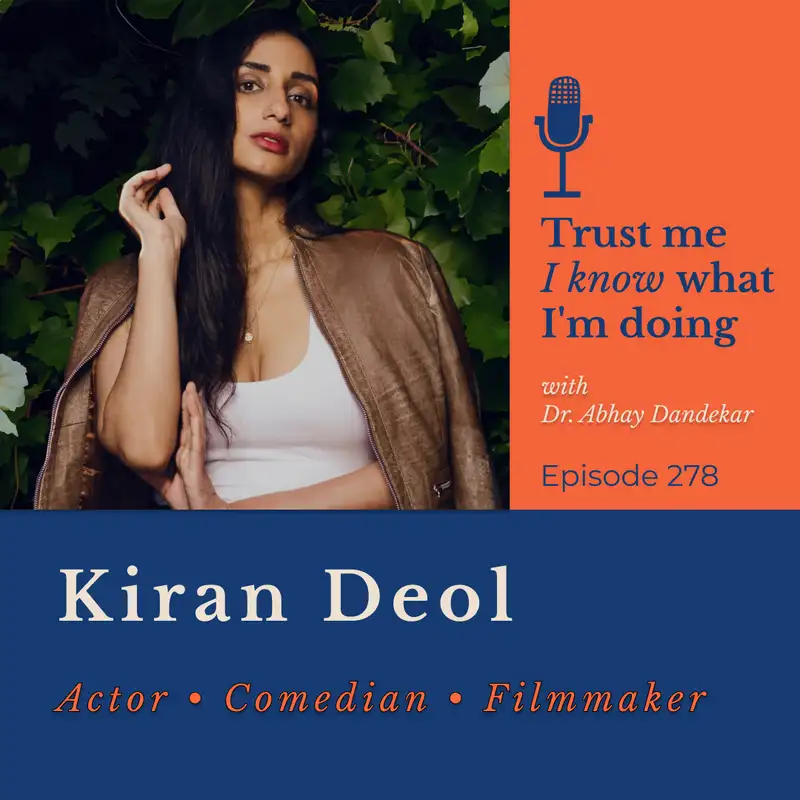
Kiran Deol on "Didn't Die": Owning Her Humor and Feeling Good
Download MP3Abhay (00:00)
thanks everyone for listening and watching, sharing with your family and friends, and don't forget to subscribe. TRUST ME I KNOW WHAT I'm DOING is brought to you by Travelopod.
For destinations like Africa, Japan, Antarctica, India, and the Northern Lights regions, start your journey with Travelopod. Visit vacation.travelopod.com.
Kiran (00:19)
As a performer and as a director, if you have trust with your filmmaker, you'll take risks, you'll fail, you'll look bad, you'll look stupid. But then you also have the trust that like, okay, we'll find something that feels organic and really works and isn't going to just make this character look like a strong point of view without being like an utter monster.
Abhay (00:39)
what is it about your personality or your motivations that tend to ground you as an artist, but then also tend to keep you afloat keep you energized, especially in a very challenging profession?
and the show business ecosystem that's out
Kiran (00:58)
I am aware a casting director sees my face or tape, I am absolutely still defined by what I look like first, but that gets stickier and a little bit more
Abhay (01:08)
Yeah.
Kiran (01:10)
potentially problematic when those categories are race and gender and how someone else who isn't you when there's a dearth of roles is writing what they think your face is supposed to look like and say.
Kiran (01:23)
Hi, my name is Kiran Deol I am the lead in the film, Didn't Die, which is currently in theaters right now. So you can go and check it out. And this is Trust Me, I Know What I'm Doing.
Abhay (02:03)
welcome everybody to this episode of Trust Me, I Know What I'm Doing. So I truly love it when we share time with people who can so smoothly express their truest of selves with a lot of flexibility and versatility. For an artist, getting to that spot definitely takes a lot of courage and open vulnerability. And it seems like they're mutually exclusive, but maybe perfecting the art of precision.
may actually allow for a range of personas to blossom. Now, especially if this can happen with terrific sense of humor, timing, and intelligence, then for anyone who's watching and experiencing the work of actor, writer, comedian, and filmmaker, Kiran Deol, getting to know her feels effortless as you can connect the dots among her many, credits. From her work on television and film with Sunnyside and Modern Family and Woman Rebel, to her ongoing podcast work with Hysteria and her terrific debut comedy special, JoySuck.
Kiran (02:55)
Yeah.
Abhay (02:57)
which is on Amazon Prime. She's been Emmy nominated and Oscar shortlisted, and her latest film work, Didn't Die, which was featured at Sundance last year and is currently playing in select US theaters now. please go and check it out. And we're so pleased to share some time with her. Kiran, thank you so much for joining Trust Me and Out On Doing. What a treat to have you on.
Kiran (03:04)
Thank
What a beautiful introduction. I'm gonna take this introduction, I'm just gonna clip it, and then I'll just play that as my new ASMR before I go to sleep.
Abhay (03:25)
Absolutely, right?
Just personal reaffirmation. Let me tell you, this was all human. There was no AI involved in helping generate that. So I'm very proud of that. I'm going to start label, just like everything's organic. I'm going to be just all human now. ⁓
Kiran (03:34)
Yeah.
I love that. It's a really
beautiful and I love that you said it's like the blossoming of different personalities was the thing that you had said, the art of something being perfect. I was talking to a friend of mine who's East Asian and I think we're in this South Asian culture. I'm sure you understand this, this idea of like excellence, this idea of being excellent, this idea of perfectionism like, you know, is a big part of our culture I think. And there's so much excellence that comes from that. This year, I think I've really wanted to make my focus about
having fun and following what feels good and understanding that that also makes your comedy more fun, it makes your work more fun, and it's just like a spirit of joyfulness that isn't necessarily, sometimes we can see them as opposite.
Abhay (04:22)
Yeah, no, no, no, totally. I've been thinking about Didn't Die and particularly because it's out right now and your role as Vinita gets you into so many intersections of grief and humor and hope and family and all in the backdrop, of course, of being a podcast host among biters, no So with that sort of zombie apocalypse as a backdrop,
I wanted to find out, as you mentioned, like, you know, one of your goals and aims this year is to have more fun, but what elements of yourself for this particular role needed stretching? What are some of the things that took you sort of out of your comfort zone? And you said, Hey, you know what? I need to explore. and we were talking a little bit earlier about like, you know, exploration and curiosity and what, what were some of the things that you had to stretch about yourself in order to make this film?
Kiran (05:11)
There were two things that really come to mind. One is it was built off of a 60 page scriptment with the director and her husband shot it. So it was a very friends and family effort. Like everyone in the movie was kind of a text message away, which was kind of how the film was made. It was really cool to be a part of the development process, but it is still exceptionally rare to get to, like, this is my first like true lead in a movie. And it's like,
The thing that's so exciting and also scary about the lead in a movie is you're playing a true arc over time. Like it's like the character starts one place and then they end in another place. And is that a journey through the performance, which you're shooting out of order with, you know, off of an outline, is that something that the audience can track? Right? And so the challenge of making sure that even with a project that had a lot of improv, is that a journey that they can track? And then...
Abhay (05:41)
Yeah.
Kiran (06:03)
You know, I always think of this film, it's described as a podcast host during, you know, the zombie apocalypse, who's kind of losing her family. But I think of it as a small independent drama that's wrapped inside of a zombie movie. It's shot in black and white. It's kind of this, you know, kind of play to a night of the living dead. You know, are these biters like a representation of COVID? Are they a representation of authoritarianism that might be from outside?
you're kind of exploring this like ensemble story about grief, really, which is quite a unique two-toned approach. You know what mean? It's not a kind of cookie cutter. It's a true independent film. And so in that, I remember like one of the things that Mira Menon and I talked about is like, she's a podcaster, she's sarcastic, she's a little bit glib, she's really focused on her career in the middle of a kind of apocalypse and...
Abhay (06:38)
Yeah.
Kiran (06:55)
I really was very concerned about, for better or worse, for the likeability of the character. You know, there's this thing with, as a woman, I don't want to be seen as like unlikable or selfish or shitty or mean. And I think she was incredibly reassuring that like, hey, you you'll get to watch cuts. you know, like feel free to kind of bring, like let it, let yourself, let yourself.
Abhay (07:00)
Hmm, yeah.
Kiran (07:20)
play as much as you want. And I think that comes from a trust between the filmmaking team. As a performer and as a director, if you have trust with your filmmaker, you'll take risks, you'll fail, you'll look bad, you'll look stupid. But then you also have the trust that like, okay, we'll find something that feels organic and really works and isn't going to just make this character look like a strong point of view without being like an utter monster.
Abhay (07:45)
Yeah. I mean, in that case for you, like those kinds of stretches and sort of becoming comfortable with that uncomfortability of is this character going to be super likable or not? Has that translated to, easy lessons outside of work also, being able to sort of roll and be able to say, be comfortable with like, oh, OK, there may be somebody out there who doesn't necessarily like this. Or, you know, I'm getting that more and more reassured that what I'm doing is true to myself and I am going to actually like, you know,
not worry so much about being likeable.
Kiran (08:17)
It's a great, this is a great question. I feel like, especially with the internet today, everyone is not going to like you. I'm sure you have a podcast. I put standup on the internet. If you get into the wrong algorithm, you know, if you get into, I have a joke about, about Britain and how they stole everything inside that museum. If that joke goes to Indian audiences and South Asian audiences, they're like, yeah, give us back our diamond. You know what I mean? If that gets into like the British MAGA crew.
Abhay (08:42)
Right, right.
Kiran (08:46)
Like, ooh, that comment section is like, that comment section looks like the entire world is like finders keepers. We hate you. Why are you ugly? Like whatever it is. Troll sandwiches, exactly. It teaches you, I think especially the internet teaches you, everyone does not have to like you. What you have to do is find your people. And so be willing. I think there's a thing now where it's a little bit more like be even more yourself.
Abhay (08:48)
Yeah.
Troll sandwiches. Yeah. Yeah.
Kiran (09:11)
try to be the most dis- don't you- because you cannot be for everyone. Like nobody is for everyone.
Abhay (09:15)
Well,
yeah, and you know, the anxieties and the worries and the like, you know, am I going to actually hit this particular wave on the right side of the algorithm or on the wrong side of the algorithm? I mean, when you navigate those worries and those anxieties, does humor serve as kind of a mask for some of that? I mean, is humor the easiest way to kind of navigate through that, whether it's the front facing part of a character, whether it's sort of like your go to mechanism for for coping.
Kiran (09:26)
Yeah.
Abhay (09:45)
Does that help you sort of process many of these constant ups and downs that you have to face as an artist?
Kiran (09:51)
I think that the character really, I think the character in Didn't Die is using humor and glib humor as a mask for grief. I think that Kiran in her personal life uses humor as kind of a weapon to like lighten the load. I know that if something like the latest show I'm doing right now is about current events and whatever, and I know that if...
Abhay (10:08)
Hmm. Yeah.
Kiran (10:15)
We can all take the latest clips, we just started putting them out like two days ago, but if the latest clips are like the Hillary deposition, whatever, and you have a room full of people really laughing about what is objectively a world that is on fire currently, the thing is, it's like the vibe and the energy of the room, just like you walk out feeling warm, you walk out feeling more capable, and I find if things make me really, and this is what the special was about too, I find if things make me really angry or really sad.
If I can find a way to joke about them, I'm finding a way to for my own brain and then experience that in a room with people and laughter. That's a way to heal. I think that's very different than putting content out on the internet, which is kind of its own beast that I think you develop a bit of a callous for. And you just understand that it's like, hopefully you find the right people and try not to take anything too
It's not one thing, it's gonna be a hundred things and you're gonna keep going.
Abhay (11:11)
you
First off, kudos for going third person. Always love that at any time. And One thing that Abhay talks about a lot on this show definitely about, know, sort of anchors and buoys. And I have no idea why there's a nautical theme to this, those things that tend to ground us and also tend to elevate us.
So I'm just curious for you, like, you you've done so many different types of roles and so many different genres or a variety of different types of media. what is it about your personality or your motivations that tend to ground you as an artist, but then also tend to keep you afloat or keep you energized, especially in a very, very challenging profession?
Kiran (11:39)
Yeah.
Abhay (11:59)
⁓ and the show business ecosystem that's out
Kiran (12:03)
So stand up is really great because it's yours, right? Like you can tour wherever you want on whatever level you own it. It's like a friend of mine said this, like I've sold a few shows to networks that unfortunately didn't end up going that I'm exceptionally proud of. And I think they made a mistake. You know what I'm saying? But like, I don't have control whether those are going to get picked up or not picked up. That's based on an executive in a market and what's going to happen in stand up. The beauty is we could come up with a joke that we laugh about right now. I could try it on stage tonight.
Abhay (12:05)
Hmm. You own it.
Yeah. Yep.
Kiran (12:30)
And a friend of mine who was a writer said that there's something so freeing about that medium that makes it yours no matter what. Maybe that's gonna be for 20 people, maybe that's gonna be for 2,500 people, maybe that's gonna be for 2 million people, but it's always yours. And that's a really beautiful thing, because it's a way to express yourself. I think that it doesn't matter what the medium is. I believe this. I had a friend who said he thinks the central question in an artist's life is always the same question.
But I would actually argue that the themes that you are interested in, the themes that I am personally interested in, reverberate across whatever I'm doing. Like whether that's about being South Asian, whether that's about being a woman, whether it's about class, it will always, and even having now staffed on some television shows, I was worried, you'll lose your voice if you're staffing on something. No, what's true is that I haven't developed enough perspective that it's like you actually bring that voice.
Abhay (13:05)
Mm-hmm. Yeah.
Mm.
Kiran (13:25)
into the work of what they do, which is like very exciting, you know? And so then it doesn't really become about the medium, it becomes about the clarification of your thinking and then how you apply it to a medium, right? So it's all kind of iteratively like the same gesture.
Abhay (13:38)
I love that.
Yeah, no, I love that. I mean, I like the idea that there is a central piece of ownership that you have, and then you have these various vehicles, whether they be you yourself or whether they be you in a different sort of incarnation, figuring out how to actually let those themes blossom up in various formats.
Kiran (13:50)
Yes.
Yes.
Abhay (14:47)
Speaking of the South Asian piece at least, your name, means a ray of sunlight, right? Look at that.
Kiran (14:50)
Yeah. Yeah, look at you knowing stuff.
Abhay (14:53)
Right. Well, we're going to do some Sanskrit So. This is let there let there be the first right. Let there be that light out You know, so in twenty twenty six is being a South Asian actor, writer, producer, you know, filmmaker. Is that something that's an important driver? Is it an asset or is it just simply an imp?
Kiran (14:56)
I don't think anyone's ever brought that up on a podcast before.
Yes.
Abhay (15:17)
important additive ingredient.
Kiran (15:20)
I think in Mira's movie, for instance, like one of the things I heard a lot of people say is that I think it's, listen, we are South Asian. Whether we talk about samosas or not, whether we make that the top line for somebody else, it's it's inherent to your identity. I think I started with something about, you know how our culture has something of a perfectionism in it. It's like, and you know exactly what I was talking about.
pieces, there's pieces that will always be there. I think it's a piece of an identity that's more integrated, but I will be clear that I also think that's a privilege that's based on the work of many, many artists and people and a generation that did a lot of legwork to make it so that, you know, to make it so that that could even be the case in any way, shape or form.
Abhay (16:05)
I asked that question because I've asked others in other professions or other areas and disciplines whether they consider themselves an Indian American blank or a South Asian American blank or a South Asian blank. And they're like, no, I really don't. I consider myself to be a politician or a leader or a CEO. And the rest of that identity just sort of happens to be the ingredients of who I am. obviously, we stand on the shoulders of people who came before us.
Kiran (16:27)
Mmm.
Abhay (16:32)
But for you at least, mean, is that part of who you are? And of course, the reverence to the work that's gone on before you, is that something that for you is constantly one that you're either integrating or balancing, or you just are at peace with that saying that like, hey, this is who I am and that's gonna be a part of every role that I have.
Kiran (16:54)
I think I think for me personally, it's definitely an integrated thing that I'm at peace with. I do still think that Hollywood very much. mean, this is for everybody, right? Is a place that very much like I was just talking to a friend of mine who was saying, you know, I feel very goofy like white guy. I feel very goofy on the outside. But when ever I get cast in something, it's a cop or like ⁓ I look like I'm a cop or I look like I'm a this and
I would love to get to a place where, you know, that typecasting kind of didn't happen to the same extent that it does. You know, we're seeing, we're seeing South Asian women and actors kind of come up, but a lot of those roles are doctors, you know, or like the one South, it's still very much defined by like the brown face. There isn't, there hasn't been, you know what I mean? There hasn't been maybe other than maybe Bridgerton would be an example of where she was.
Abhay (17:30)
⁓ Sure, sure.
Kiran (17:50)
And that's a Shonda show, is like, she's a set piece, kind of seminal showrunner that's known for breaking talent in that way, that is one person working. ⁓
Abhay (17:52)
Yeah. ⁓
Yeah, no, but a lot
of the Bridgerton types, the Hamilton types where we're seeing, you know, disruption to what those kind of typecast roles are and yeah.
Kiran (18:13)
Yeah, it's disruption to a status quo as opposed
to the status quo being different, you know? ⁓ And respect for like all of those actors. I'm just saying that if the question is, like I am aware that when a casting director sees my face or tape, I am absolutely still defined by what I look like first, as are most actors, but that gets stickier and a little bit more
Abhay (18:19)
Totally.
Mm-hmm. Yeah.
Kiran (18:41)
potentially problematic when those categories are race and gender and how someone else who isn't you when there's a dearth of roles is writing what they think your face is supposed to look like and say.
Abhay (18:53)
Yeah. And again, sort of like taking away some of the ownership part of that, which is part and parcel with, you know, kind of auditioning and then playing a role. yet, right? And yet there is sort of an understanding that you are actually giving away some of that licensure of who you are now to the role. ⁓
Kiran (19:02)
Yes, yes.
You
could say, yeah, you could say that's built into the contract. I would, my counter argument to that is like, if you look in theater, there's a lot more colorblind casting. There's a lot more like, anyone can be Hamlet. Anyone can be, you know what I mean? Like it's, there is a depth and a breadth to who gets to play what that we don't necessarily see in Hollywood that has a lot to do with, unfortunately, I think, you know, a level of systemic bias that,
you know, will fundamentally be dismantled as will all systemic bias in history, whether it's within our lifetimes or not.
Abhay (19:46)
Yeah. What did you maybe, and I love that, right. With her fist in the air. ⁓
Kiran (19:49)
She says defiantly.
Yeah, exactly.
With her with her beret on, she's like, if you excuse me, I have to go burn down a government building.
Abhay (19:59)
There you go,
right? Where is that flag? ⁓ I was gonna say, given that and given the idea of constantly trying to tear down that bias, mean, one is that hopefully we have more and more people who are gonna be in positions of power and influence and being able to make sure that we are structurally changing things. But on the other hand, individually for you, what did you maybe have to unlearn about yourself?
Kiran (20:02)
haha
Abhay (20:26)
who you are, how you were brought up, in order to, for that matter, again, find that peace and find success.
Kiran (20:32)
I think this I think that it's that old like what's his name? ⁓ John Lewis, it's John Lewis John Lewis. Yeah, sorry
Abhay (20:37)
John Lewis, there we go.
Kiran (20:40)
John Lewis, he had that thing about like get into like good trouble. I think it's about learning that. And I feel like that's a lesson. I feel like it's like have grace and patience with yourself and be iterative and trust that nobody's done, nobody's totally cooked. We're all like constantly evolving. We're constantly learning and changing. I think the thing I wanna get good at is leading with a sense of like fun and joy, making sure I'm enjoying process, making sure I'm enjoying, I can't.
Abhay (20:44)
Yeah.
Yeah. Yeah.
Kiran (21:09)
always determine outcome of anything that I do. like make sure that I'm really loving the people I'm working with, really loving the process, like being full of joy as I do it, only doing things that like to the extent that I can that feel good as I'm doing them, as in addition to like working hard and putting your best foot forward and not being afraid to get into some good trouble. I can remember very early
I can remember very early on meeting, like Hasan and I did a CBS diversity showcase together. And I remember during that showcase, there's a goat face video that they put out about when Aston Kutcher was doing brown face for Pop Chips. And he puts out this video that ends up going super viral. But I remember when he put it out, I was like, you know, why do you have to say something? Do you know what I mean? It's like, obviously we all know this is bad and stupid. You don't have to point out that this is like bad and stupid because like,
You know, obviously this is the kind of thing that will need to go away anyway. And I look back at that and I was like, he was right. Change happens when you point it out. Change does not happen because people just evolve. And I think that was really obtuse of me to expect that people are just going to be better when they aren't even aware that maybe what they're doing is super fucked up, even if it mirrors something else, you know? So I think it's.
important that he called that shit out. And it's like being a little bit more brave or a little bit more willing to be that kind of person, as opposed to a little bit more of like the, feeling like you're being the good being like the, I'll just put my head down and like do the thing, which is, get into the good school, et cetera. Yes.
Abhay (22:45)
It's active versus passive, right? I mean, it's
the idea of like, know, actively pursuing the bravery and the courage and being at the vortex of it, or are you gonna be on the periphery of it and watch it,
Kiran (22:56)
Yes.
Abhay (23:33)
wanted to ask you about JoySuck. And when I think about JoySuck and I think about ⁓ Hysteria there's such great accelerators for finding optimism through grim times.
Kiran (23:36)
Yeah.
Abhay (23:45)
And like, just, you know what I mean? Like just how do you get out of shittiness and, you know, understand the shittiness, but get through it with, you know, some fun and particularly, you know, getting those dicks off our backs, right?
Kiran (23:46)
Good, good.
Yeah,
get your dick off my back. Literally and metaphorically, we should, we need to put that one back on the internet. I was like, I love that joke. That's such a funny, that's one of those jokes that like worked immediately. then it was like, you had to do very little to no work on it. You know what I mean? Like it's such a perfect metaphor for like what the thing is. Guys, if you don't know what we're talking about, you can check it out. yeah, it's free. It's free now.
Abhay (24:03)
That on the internet, right.
Right. ⁓
Go check out JoySuck on Amazon Prime, right?
when you've actually had your family or your South Asian friends take a look at this and they've given shared feedback about their own experiences, do you think that those two items, right? Like of getting through grim and shitty things with comedy and humor and a way to sort of explain it and get through it, do you think that it's reframed for them?
How they get through shitty things themselves
Kiran (24:52)
I so. mean, I also do think that there's something like my family's Punjabi, you know what I mean? And it's like when people get together, I mean, like when people get together in my family and they all get together and they're like, and it's over dinner, it's over big meal. It's like they're laughing about things that happened in their childhood. They're laughing. and that is a big catharsis and a big release. So I also do feel like it's it's a little bit of whether it's named so perfectly or it's just done inherently within the family unit. I do feel like that's
Abhay (25:11)
Sure, sure.
Kiran (25:20)
very much part of how people cope, you know, and deal with deal with things that are grim because it is a reframe. Every time you're able to laugh at something, there is an act of like joy and hopefully defiance too.
Abhay (25:29)
Yeah, yeah.
Speaking of Punjabi and South Asian, mean, just to embody generations of general South Asian parental judgment, I I mentioned it earlier, but you're Emmy nominated and Oscar shortlisted. Does that squarely put you into the B plus category of all artistic things or, mean?
Kiran (25:51)
It's really interesting in my family. think I got very, I think I got very lucky because it's like on my mom's side, there's like one of the kids is a DJ, like her younger brother is an architect. There's a lot of like arty people, especially on that side of the family. I feel pretty lucky in that I didn't get that kind of like, why aren't you a doctor pushback? You know, like, mean, hilariously and ironically, it's like,
look, I'd love to play more Doctors on TV. think it'd be great. You know what mean? Like, it's like hilarious that like, yeah, it'd be great to be a series regular as a doctor, like doing what you do, but pretend what Sandra Oh did. But I don't think I've ever, I never really had that like, that sense of like you messed up, you know, from my family, which is, which is I think, which is very lucky. And even when I think back on what that is,
Um, for other people, maybe, you know, with grandparents or whatever, I really, I empathize with the fact that I think it comes from now being in this business and understanding how challenging it is on so many fronts and so many fronts you truly just don't have control over. think that that gesture comes from your parents or your family just wanting you to be safe and wanting you to be taken care of. and I think stepping into a business like this one is stepping into the unknown.
and just want to know that you're going to be good. And this is, know, a friend of mine's dad once said, your business is like the penthouse or the outhouse. He goes, there's just very little middle and that's just the game. so,
Abhay (27:20)
Yeah. Yeah.
Kiran (27:22)
They were just hoping that you, you know, you were comfortable, you know.
Abhay (27:26)
Yeah. No, no, no. It's funny because we've had a couple of guests on the show. Reshma Saujani just got named as one of the Time Magazine Women of the Year. And I think the responses from her parents, no big deal. Her parents were like, hey, how come you're not on the cover? And it looks like there's another Reshma on there. And then I had another guest who was a Pulitzer Prize winner. And I think she texted her dad about like, I just won the Pulitzer Prize. And I think the response back was like, that's very nice.
Kiran (27:35)
No, no big deal. No big deal. No big deal. Yeah.
Yeah, yeah,
Yeah, yeah, exactly. It's like, what about the, well, have you got the Oscar? And she's like, there are no Oscars for books. What are you talking about? Yeah, Yeah, exactly. Yeah, I've no, I've definitely had, you know, versions of that or like, you know, whatever it is. That's that's a I think one time.
Abhay (27:58)
What are you doing? Right.
Hopefully,
hopefully lots of positive reassurance though.
Kiran (28:10)
Yes, some positive reassurance. remember one time I was like, one time I did open for Hussein in South Florida. I remember like a family friend was like, so why are you opening for him as opposed to him opening for you? And I said, I believe the phrase you're looking for is thank you for the free tickets. You know, I think what you're looking for is thank you for the tickets, Kiran. There it is. Yeah.
Abhay (28:20)
Right, right.
Naturally.
Right, right. What you meant to say...
⁓
Kiran (28:36)
Yeah, yeah, exactly.
was like, let me, let me, I'm gonna, I'm gonna read the subtext of that comment, which is, you know, I think it partly comes from a curiosity and it partly comes from a, you know, there's something great about the excellence, but it's, it's, it's also, it's also, I don't think people realize that they can kind of be shackles then too.
Abhay (28:41)
Right. Right.
Yeah,
no, very true. Let me get you out of here on this one. You know, there's a line towards the end of JoySuck that I really enjoyed where you say you can't control everything that happens to you, but you can control the story. And so I'm curious now for you, what story are you telling going forward in 2026? is that story bringing you optimism, joy and peace?
Kiran (28:58)
Yeah.
The story I am actively working on telling myself is to really pay attention and follow what feels good. Pay attention to my gut, pay attention to when my heart feels full, pay attention to who makes me feel good. And then it's like, ⁓ more of that. collaborate on that. a show like this feels great. You know what I, so that you're really, I really like these new reps. You know, like these things. So that you're...
surrounding yourself with a positive, warm, supportive, nurturing experience, which is something I don't think we focus in. I I think we're seeing it a little bit at the Olympics this year with the girl who won, but understanding that that supportive communal environment can actually give you more optimism and more excitement to want to be more productive as opposed to feeling like...
Abhay (29:56)
Yeah. ⁓
Kiran (30:09)
you need to muscle through things and then using that joy as a weapon to get through a time when I think a lot of us are really obviously feeling a really, really dense and intense new cycle. so that you are, you are protecting yourself from, you know, everything that you don't have control over negative that might be coming at you, whether it's at the gas pump or whether it's, you know, like,
you know, whether it's inflation or in your town or whether it's when you turn on the news, you know.
Abhay (30:37)
Yeah,
yeah. Well, feeling good, having fun, being positive and supportive, making sure that your audiences are experiencing that Kiran, thank you so much for joining us today. And this was really a treat. I hope we up with you again down the road.
Kiran (30:42)
Yeah
Yeah, same. This was lovely. I love the way at the end you're like, I was like, feeling good, having fun. I was like, it sounds like a meme. It sounds like I just made a meme. It just sounds like I made a bunch of memes. hopefully it resonates. But that's, that is, that is truly what I, know, as somebody who has long been like a type A, get it right, make it perfect kind of, there's no room for error kind of, recovering perfectionist. I think that is the, that's the goal.
Abhay (31:19)
Yeah, no, the whole idea, right? The art of precision, but make sure that you are constantly just being yourself.
Kiran (31:26)
Yes,
and you're always gonna keep putting in the work. That goes without saying. So you always put in the work, you always trust that it's gonna be iterative, but just like making sure that you add this component. This component of fun always.
Abhay (31:37)
Hey, thanks so much Kiran and please check her out as the lead in Didn't Die playing at select theaters across the country. Thanks also to everyone for subscribing and sharing this with your family and friends. It's March, so shout out to Ishan Sharma and (Coach) Amit Tailor and all the College Hoops fans out there. Let the madness of those brackets begin.
to please be smart, be safe and be kind, especially to each other and to the planet. Till next time, I'm Abhay Dandekar