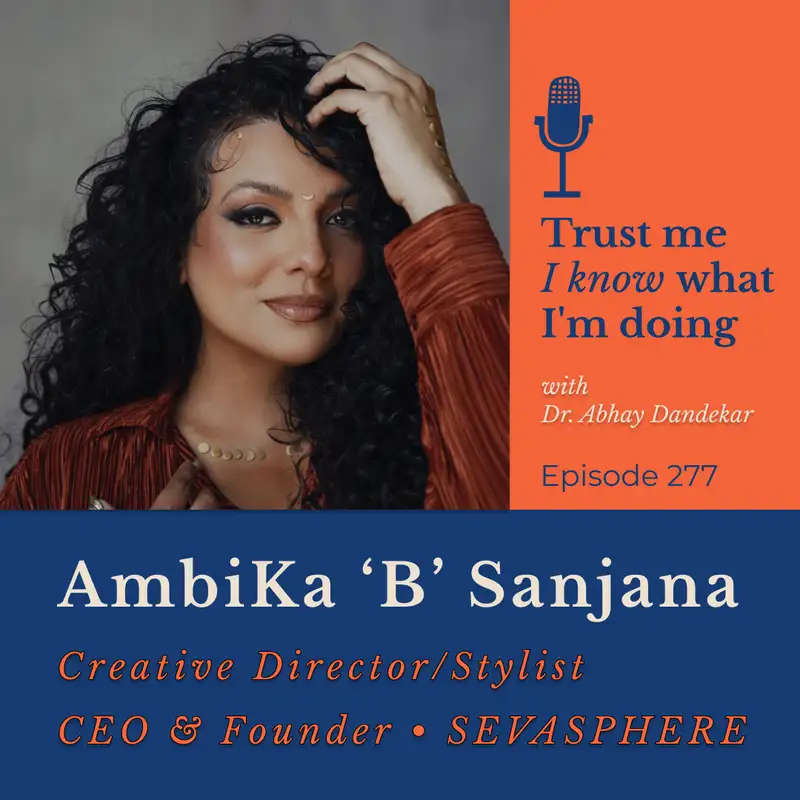
AmbiKa 'B' Sanjana on Style With Purpose: From Red Carpet to Skid Row
Download MP3Abhay (00:00)
thanks everyone for listening and watching, sharing with your family and friends, and don't forget to subscribe. TRUST ME I KNOW WHAT I'm DOING is brought to you by Travelopod.
For destinations like Africa, Japan, Antarctica, India, and the Northern Lights regions, start your journey with Travelopod. Visit vacation.travelopod.com.
AmbiKa "B" Sanjana (00:19)
barometers for success are based on fame and money. And I feel like I, as I got older or as I matured
started realizing that it's all fleeting
don't really value or taste level of complexity in your work
Abhay (00:37)
Does internal confidence need a style to be fully expressed?
AmbiKa "B" Sanjana (00:42)
inspire someone to be a better person, to want to dress better, to want to add color to their wardrobe, to celebrate being Indian
just think that if I can inspire anybody in any slight way, it's a blessing.
my name is Ambika Sanjana and I'm a stylist and creative director here in Los Angeles. I also am the CEO and founder of Savasphere, a nonprofit organization.
And this is Trust Me, I Know What I'm Doing.
Abhay (01:36)
Welcome everybody to this episode of Trust Me, I Know What I'm Doing. One of the important concepts of Trust Me, I Know What I'm Doing so far has been to serve as both a reflective mirror for and an open window into our evolving community and even beyond. Now, art and style and fashion can all be important expressions that help us anchor to the past and accelerate to brand new places. And so I'm truly pleased to chat with the very talented stylist
and artist Ambika Sanjana, who has been at the forefront of cutting edge fashion and style design for celebrities, events, and multimedia presentations, whether designing a fashion line or creating the newest look, and of course, going beyond creating the next iconic style idea, truly exemplifying the very best that our community has to offer in human kindness, she's also the founder and the driving force behind Sevasphere which is helping combat food and housing insecurity in Los Angeles very near and dear to my heart.
course. I'm so thrilled to welcome Ambika today. Ambika, thank you so much for joining us and for all you do.
AmbiKa "B" Sanjana (02:39)
Thank you so much for having me. It's such a pleasure.
Abhay (02:41)
You know, I was thinking a little bit about the whole concept of style and fashion. And I was looking at one of your social media posts and you share how fashion isn't really about arrival, but more about authorship. And I was wondering if you could maybe take a moment to sort of describe that feeling of authorship.
And, you know, does that work that you do feel very narrative for you in that way?
AmbiKa "B" Sanjana (03:09)
Yeah, actually I do believe that style is about authorship because everyone's individual style really tells a story about who they Choices that you make, cultural choices, visual imagery is pretty indicative of a lot of things actually if you're looking for the clues. The lifestyle you live, the socioeconomic status you're the cultural background you're from, some might be religious, you know, so I think a lot of
The way that you present your appearance has a lot to do with the authorship of who you are.
Abhay (03:39)
and I love how you use the word clues, right? That like everything about style and fashion and your external presentation and expression is giving a clue into who that person is, or even actually a clue into what that person is trying to discover perhaps too.
AmbiKa "B" Sanjana (03:55)
or what the person is trying to present. think a very classic example would be when you go to court and you want to dress business-y to go to court so you look more professional. I think that there's also that. There's people who dress the part, ⁓ dress for the job that you want to get. I think clues are, I don't know, I think with the train dye you can really tell a lot about someone by the way that they dress.
Abhay (04:14)
Hmm.
So when you're just people watching, do you sort of maybe flow a little bit differently?
AmbiKa "B" Sanjana (04:19)
my God, stories, stories.
I love it. It tells me so much. Like, I feel like there's such a huge part of my observing people that tells me everything I need to know just by the way they dress, the jewelry choices. I think it could be the same with anyone, right? Like, I'm sure you've interviewed enough people to know my personalities, like different things. Same with the chef, like by people's choices of what they pick to eat.
it's already gonna give them a flavor profile of like what the person likes. I think in each industry, whether you're a car salesman or a radio TV host, know, like the way that someone dresses or the way that they choose, the things that they choose will give you a lot of clues.
Abhay (04:55)
Does it make it easy to spot someone who's maybe faking it too much or trying too hard or for that matter just not being themselves?
AmbiKa "B" Sanjana (05:04)
I think, yeah, think I can tell for sure. A lot.
Abhay (05:08)
Yeah.
I'm curious then that like, with that whole sentiment, right? Of being able to offer authorship and telling a story about who you are. And then also, giving some great grace and clues to how you're feeling that day, what you're sort of emoting. And of course the trained eye being able to maybe check a little bit of that and understand what someone's style may be or what someone's going through for that moment. Are you someone who has a style
philosophy? Does the authorship piece maybe govern that and does that stay sort of foundational and allows you to kind of cater to any individual or client?
AmbiKa "B" Sanjana (05:47)
I would say so. I think that my philosophy personally as a stylist and as a human is like comfort. think that no matter what occasion day you're going to, whether it's the mandir or like a red carpet or a job interview or the court, know, whatever you're going to do that particular day, I think as long as you're comfortable in what you're wearing, you're able to sell it.
I have styled some people in the most gorgeous couture that was like fresh off the runway from Paris Fashion Week and they just weren't comfortable. It was in their style. They were trying to be like XYZ and it just, it just didn't work. And no matter how beautiful or exclusive or 3000 hours that the Cardi girls took to make the piece, they couldn't sell it because they weren't comfortable. They were insecure in their body, in the clothes, in the garments, the way that it was wrapping their body. And so I do believe that
If you're comfortable in what you're wearing, you could sell anything. It could be a t-shirt from the mall and you're just wearing it and you feel good and you feel confident. And then suddenly that ⁓ article of clothing or that fabric transforms you into something different because you feel good in it. So I do think comfort to me is like the baseline of selling a really good outfit.
Abhay (06:56)
Do you have to remind people of that often where it's like, it's not so much about the price of the item or the, you know, where it was made or located, but rather sort of like how it makes you feel.
AmbiKa "B" Sanjana (07:09)
I mean, I could preach about this all day, I do believe that unfortunately we live in a time where capitalism and, know, brands and everything, like, there's just so much weight attached to that that a certain demographic of people are only gonna care. And it doesn't matter. mean, I worked with, for very, very many years, worked with a very famous singer, songwriter, that should not be named. And she,
was very particular in her style and each fitting, even though I would have like a million options, would be very challenging because she was very particular with her style. And then I realized that it just, wasn't like the brands that she cared about. I just realized it was a certain kind of fit and it didn't matter what brand it was. She was looking for that fit, right? And I think after multiple times, just feeling defeated after the fitting, it's like, my God, like I just don't get it.
And her taste really wasn't elevated. It was just, she thought it was because she would just keep identifying with these brands. So one time we had a fitting and I got like 20 items from a popular, you know, street, like local brand, like Fashion Nova or something like that. And quite the, you know, polarity between a very couture line, right? And we took all the labels out. When I tell you, every single outfit that she picked was from that brand. And so it just goes to show that
If you remove a label out of something, people will choose quite differently, you know? And there's many times that I've seen items that are honestly not that great. mean, yeah, you there are houses of fashion that have been around forever and they're, I don't know, elegant and elevated or whatever, but there are also some things that are not that great. And just because you see a label on something doesn't mean it's immediately like approved because it's got a label on it. So that was kind of like an interesting social experiment for me to like, I told my sister and I'm like, watch, her taste is this.
Abhay (08:49)
I mean.
Yeah.
AmbiKa "B" Sanjana (08:55)
and she's a Fashion Nova girlie, but she wants to be like, I only wear Gucci, da. Okay, so we did a social experiment, took out the tags and I'm like, what'd tell you? And that was like quite a cool learning moment, teacher-student moment for my assistant and I where they were like, wow, the label matters a lot. I'm like, yeah. And the branding.
Abhay (09:13)
Did
you let your client know that? Yeah. This is going to the grave, right? Yeah. so it's a reminder, right, that there's so many different examples of that. You can't really judge a book by its cover. It has to be something that you feel inside. ⁓ that fashion and style, in a way, are completely, they should be agnostic to label, should be agnostic to cost. It should be sort of independent of all those things.
AmbiKa "B" Sanjana (09:17)
Absolutely not. This is going to the grave.
Yeah. Yeah. No.
I'll you.
Abhay (09:38)
And we see that by the way, yeah, I mean, just from a social dynamic, we see that in our country right now too, right? I mean, like whether you're an immigrant or whether you're someone who's here, like don't judge. There's so much that we can learn from that.
AmbiKa "B" Sanjana (09:39)
Theoretically, yes.
Yeah.
and some others.
Abhay (09:52)
Yeah, yeah.
AmbiKa "B" Sanjana (09:53)
Yeah.
Abhay (09:54)
I have to tell you very candidly, I mean, I'm someone who typically has no sense of style. I really tend to exist without that sense of style. And yet I feel pretty confident and I feel pretty comfortable with what, yeah, right? And you wanna know whether it's wearing a black t-shirt like I am right now or showing up someplace with a blazer, a tie and slacks and chappals I don't mind that because I do feel comfortable in my own skin with that. But does
AmbiKa "B" Sanjana (10:04)
It's not matters.
Yeah.
Abhay (10:19)
confidence? Like you've worked with so many different types of clients. Does internal confidence need a style to be fully expressed?
AmbiKa "B" Sanjana (10:31)
that they could be symbiotic in certain cases. I have seen instances where, like, for example, a singer was performing, had never been styled before, but I identified with this music and I knew that if you created the visual imagery to match the music, like it would really elevate the experience of the audience, right? And so I styled this individual in a certain type of way. And when she went on stage, the way that she walked,
It was like a transformed person because she felt she embodied the music. She really, you know, resonated with the clothes. And for some reason it was kind of like an avatar. She didn't ever dress like that. She was like a mousy girl, know, but she put this on and she was like royal and proud and majestic. And I was like, wow, okay. So I do feel like sometimes confidence is amplified by it, you know? And I also do feel that sometimes it could be the opposite, just the same.
Abhay (11:11)
Yeah.
Mm.
AmbiKa "B" Sanjana (11:26)
know, as polarity with everything in life, you know, sometimes it could be somebody who is just confident in just how, just regular, you know, and the second you put on all that stuff, it kind of takes away from their simplicity. So, I do think that it could go either way.
Abhay (11:39)
Yeah, yeah, no, that's so true. And I think like, I like that word amplify, right? Because in a way it's sort of like either gives that confidence a lot more power and takes it in a different avatar, as you said, or, you sometimes like if it's the style that doesn't actually offer you comfort, it might actually mute that sense of confidence. Yeah.
AmbiKa "B" Sanjana (11:59)
Because don't feel, you're not being authentically who you are, right? I
think as long as you stick to your core values, and pretty much things that make us feel uncomfortable are things that don't align with our core values. If your core value is confidence or whatever, like whatever that is. Yeah, I don't know. If you're dressing in a way that doesn't align with that, you're not gonna be comfortable and not feel good, so.
Abhay (12:17)
Yeah.
Do you have to, in a way, when you are first meeting with somebody or even you've developed a relationship with somebody over the years, do you have to constantly take stock of what those values are in order to style them appropriately?
AmbiKa "B" Sanjana (12:34)
So I think that also those values change a long time, you know I have clients that I've worked with for four or five years and we built and it was a beautiful journey of like evolving into different eras of clothing and expression and then it changed or you know, they were complicit in Political things that were happening and all of sudden like those things mattered or they just bit the you know, the
Abhay (12:54)
Yeah.
something changed in their life and yeah.
AmbiKa "B" Sanjana (13:02)
Yeah, they
just like suddenly now cared about things they didn't care about before and you're like, wait, you never ever like this is not you. But I think creatively, that's a beautiful part of like being on these journeys and experiencing different projects and people and artists and expressions and sometimes the journey ends and I feel like it is so idealistic to
want to hold on to one thing forever. mean, yes, there's great relationships that do last forever, but that is within itself, right? Like there's a stylist that I really look up to, Luxury Law, and he's worked with Zendaya since the conception of her career. But that, that in itself, that long term relationship has beauty that of its own where they've grown and gone through so many seasons together and evolved and like matured. And so there is a beauty in that too, but there's also beauty in one-off experiences as well.
Abhay (13:44)
Yeah.
AmbiKa "B" Sanjana (13:49)
You know, I've worked with women who when they started out, they were not married and then they got married. So like that whole era and then they had a really popular hit show and then now they have a baby and you know what I mean? So like the entire, like working with someone I will say through the seasons is so fulfilling in a way because you you get to experience someone's life and dress them for life, which I don't know. I think there's something cute about it.
Abhay (14:11)
No,
it's hugely cute, it's hugely beautiful, and it's so meaningful. And I've asked other professionals and leaders in fashion before about styling, not just for a particular occasion or an event, but sometimes even for mood, right? I mean, there's style that actually fits grief and sadness and how do you express yourself in that way too? And I think that that's great about cultivating that relationship, but then also,
the one-offs right that there's those can be surprises and and they can be so so rich yeah you know ⁓
AmbiKa "B" Sanjana (14:42)
Little glimmers. Yeah. I just recently
worked with a NBA All-Star basketball player who was 6'11", okay? Very large individual. And, you know, there were some funny moments where, you know, that was not a typical fitting for me. Like, it's not every day you work with someone who's six feet, seven feet tall and quite, you know, proportionately different than what you're... Even the taller everyday average man is like not taller than 6'4", you know?
Abhay (14:55)
Yeah.
AmbiKa "B" Sanjana (15:12)
A seven foot is kind of like out of my realm a little bit, it's not every day. Yeah. And the humor and he was just so lovely in the way that he handles certain situations of a pant being too short or, you know, the arm not quite hitting where it needs to because just, you just don't know, you know? And the grace and the humor in which that should happen was amazing. So I do feel like the one-offs where you're like, oh my God, it could go either way. The person could be like, you don't have anything that fits me. I'm like, sir, you're.
Abhay (15:14)
That's a one-off for sure, yeah.
Mm.
AmbiKa "B" Sanjana (15:41)
Your pant leg is length is 42. Like I.
I think that those little one-offs could be so interesting and add a little, you know, like a little humor to your like, just pretty patterned life. So, yeah.
Abhay (15:51)
No, totally, right? That it
adds so many different dimensions and also adds a lot to your own experience of like, if I've had this experience now once before, I can actually make sure that it now goes very differently the next time I have this or in a similar situation.
AmbiKa "B" Sanjana (16:06)
Yeah.
Utkarsh (16:43)
Hi, I'm Utkarsh Ambudkar
Geeta Gandbhir (16:50)
Hi, my name is Geeta Gandbhir and I'm a filmmaker and you're listening to Trust Me, I Know What I'm Doing.
Abhay (16:57)
I wanted to ask about one thing and that is a lot of times you either see.
people who exude that comfort and that confidence, whether they're celebrities or not. And it feels like their style or their fashion looks effortless. And yet you and I both know that there's a lot of rigor and a lot of work that goes behind all of this. And for that matter, a lot of experience and study that's been devoted to what style means or what fashion means. So, I mean, is one of your roles to help make that comfort
confidence seem like for the person wearing or exuding the style, make it seem like it's effortless, even though there's a lot of rigor and thought and care that's gone into that.
AmbiKa "B" Sanjana (17:42)
Again, I think that is also case by case because I don't think everyone, in fact, it's the opposite. Sometimes people don't want to look like they dress themselves. They want people to know that they got styled. So I feel like maybe my experience is slightly different because people who come to me are paying for a luxury service and they want to be recognized that they put effort into it. It's not effortless. So I think maybe.
Abhay (17:51)
Mm. Yeah.
Yeah.
AmbiKa "B" Sanjana (18:05)
My experience might be slightly different. People come to me to be styled and they want to look styled. So it's a little different, but I do think that the effortlessness that you refer to comes from people really authentically being in the realm of who they are. You know, I think that if you in your head, like you might, I might be from India, but I have lived in beach towns my entire life. I moved from India to Miami, to California, and I like to believe I'm a beach baby. You know what I mean? So.
Abhay (18:20)
Yeah. Yeah.
AmbiKa "B" Sanjana (18:34)
like that summer's, know, like beach vibe is synonymous with who I am. And it doesn't matter if I grew up in Bombay, I'm like Cali girl all the way. So I think it's possible to identify with a certain thing. And perhaps when your attire like exemplifies that belief of who you are, who you identify with, it doesn't seem like you're trying because you really, you're like, I'm a Cali girl. You know, I believe it. So I don't know that makes any sense, but yeah.
Abhay (18:58)
Yeah. It does, yeah. I think
what you're speaking to is that regardless of the work that goes into it, you it still has to be authentic in order for it to fit, so to speak, or have that comfort and confidence. I think...
AmbiKa "B" Sanjana (19:06)
Uh-huh.
Yeah.
If someone
is extra, like they love like gaudy, over the top, like ostentatious moments, and that's who you embody and you believe that, like even in their friends group, it doesn't matter if they're at home for like a luncheon at home, they'll show up fully to the tee, you know? ⁓ If that's who you identify with in your friends group, in your life, in your family, you, yeah. And so then if you were to dress that way to go out to a social event or red carpet, it's pretty believable, because it's like, this is who you are in real life, you know?
Abhay (19:20)
Yeah.
Yeah.
You gotta be you, right?
AmbiKa "B" Sanjana (19:42)
So I do feel like there is some synchronicity between that and like who you are. So it seems effortless if you really embody that emotion or that human.
Abhay (19:51)
Yeah, and then sometimes people, know, it's like Halloween or it's like, you know, they want to put on the, they don't necessarily want to be themselves either. Yeah.
AmbiKa "B" Sanjana (19:55)
Yeah! Yeah!
Yeah, possible.
Abhay (20:01)
I'm curious about one thing. mean, style and fashion aesthetics are just so subjective and they're so based, not based, but they definitely are subject to trends. And, you know, that can be even more fleeting as time goes forward with attention spans, you know, the way they are right now. You know, if they forget about today, but even compared to five years ago, how do you define success in a world
where those trends, that subjectivity can be so fleeting, can be such a moment-to-moment change.
AmbiKa "B" Sanjana (20:34)
How do I define success?
To me personally, think success is really how you make people feel. I think when you touch lives, when you enter spaces and brighten them up, when you leave spaces and leave a sparkle behind, whether it's creative or in a friend situation or in the world, just how you show up in the world, I feel like really all that matters when you pass or go on to the next life is how you make people feel, you know? And to me, success is
living fully and touching people's lives and engaging and living, you know, because that's really what matters at the end of the day, you know. Yes, Oscars, Emmys, all that's great. You know, I love that. I mean, I'd be lying if I say I don't think it's so cool that I'm the first woman in my whole family to work here in America, graduate college in America. Like it's, you know, it's like the first in the lineage to do something different, you know. ⁓ However, in the grand scheme of things, when you look back, like what I define as success would be how
Abhay (21:21)
Totally. Yeah.
AmbiKa "B" Sanjana (21:29)
I've made people feel along the journey, know, the friends that remember you, the invites that you get to people's weddings, the inclusion in societal events, so cultural events, know, when people miss you or think about you or see something like, my God, that has Ambika written all over it, or like, you know, champion for you. I feel like those measure success to me because, you know, you could have all the wealth in the world and be living in a house in Malibu, but most of those people that I know are miserable and alone and have nobody and trust nobody.
Abhay (21:31)
Yeah. Yeah.
Yeah.
AmbiKa "B" Sanjana (21:57)
I don't really measure success by a typical global way of measuring it. I think success is having your calendar booked out and full because so many people want to include you in their lives and big life moments. I think success is for me going into Skid Row every single Sunday and having people come up to me and give me hugs and kisses and tell me, my God, how's your mom and dad? And the fact that they know my dad because he's, you know what I mean? To me, that's success because, yeah.
Abhay (22:21)
Yeah, those kinds of things are, yeah,
that's immeasurable in that way. And is that something, what was yeah, no, absolutely. And is that something that for you has changed over time compared to when you first start out? And for that matter, are there things about yourself that you've had to unlearn in order to get to that point?
AmbiKa "B" Sanjana (22:27)
Yeah. Money can't buy that, you know? Yeah.
You know, that is a very poignant question that you just asked. then I absolutely can say that that's changed significantly over time. I think that growing up in Bombay and moving at a pretty, like I wasn't a kid when I moved here, I 17 when I moved to America, you know, and I experienced in college and life and lifestyle and complete like culture shock, as you would say.
And when I was trying to make it, you know, started out in the industry here, like there was no other Brown people, like one maybe, you know? So I do think that when I moved here and I wanted to be in LA, you know, I was a different girl, you know? And so much of success was weighted on or making it was about like, my God, I want to be on this set and I want to, like, I want to work the Oscars. I want all these like very...
exterior level things, you know, which are great and I've done them all. However, if I look back now, I would say that that's changed quite significantly because when you have done all those things that once seemed so far away and you looked and aspired to do these things that were like, you only saw it on TV and that was so cool because it was like you were famous. I think now that I've experienced over decade in the industry and I've been at all those things and I've done all those things, the thing that I take away from it most and I wish I knew this when I was younger.
Abhay (23:57)
Mm. Yeah.
AmbiKa "B" Sanjana (24:09)
is the experiences that I've shared with the people and the friendships that I've gained and the journeys that I've had and the growth that I have had as a human, as an artist, as a creative, the collaborations that I've shared, my God, over the years. I think that to me is like, it's a totally different thing than when I started out, I wanted to be famous, you know? And now I'm like, please, just don't even, like, you don't have to, I don't wanna be in the picture.
Abhay (24:31)
Right, just,
yeah.
AmbiKa "B" Sanjana (24:33)
It works about me. I've been a stylist for over decade in LA and I will not do a get ready with me video. It's just not me. And that's the most popular thing for everyone to do. But to me, it's not about that. It's not about the fame and the, my God, I have 1 million followers. I think it's a personal journey. But for me personally, I feel like that's changed so much because that girl who moved to LA was like, I don't want to do Bollywood. want go to Hollywood. And now...
Those things, yes, of course, I'm not taking away from any of the things that I've achieved. However, the more meaningful even than that is the journey and the people that have touched my life and the artists that I've worked with that have, you know, added to my skills or my palette, you know, of artistry. I think those are the things that I value so much more now.
Abhay (25:18)
touch on one of the things that I admire so much about your journey and of course the work that you're currently doing. Definitely the work that you do with Sevasphere and I'm so generally proud of like how that manifests and how much that expression of love and caring and compassion and humanity is so important for not just our community but for everyone.
How is that, how was that Sevasphere idea and execution born? And in fact, how does it fuel your work as a stylist?
AmbiKa "B" Sanjana (25:51)
so I've been doing work in the community since I was a child, you know, even growing up in Bombay, my parents were big advocates of like helping others or, you know, spreading the love. mean, as a kid, I remember going in Bombay to the spastic society and teaching the kids English or going to the old people's home and reading them books. You know, my parents were pretty big advocates of like giving back. and I've continued that work ever since I've been in America too. I think that was like, ⁓
I think there was a shock for me moving from a place like Bombay where you see the duality of like extreme wealth living synonymously with extreme poverty and it's almost like desensitization because you get so used to like, ⁓ this is, know, or like there's such a crazy system in where it's just normal, you know, to see that and it's okay. But I won't get into that. However, coming to LA and seeing that the same thing exists here where it's like,
your whole life you're like, America, it's the land of the dreams or whatever, you know, and you have this visual of Hollywood and glitz and glamour and Marilyn Monroe and whatever else, you know, and then you come here and you're like, my God, like actually Hollywood Boulevard has like homeless people and this is kind of like, maybe not on the scale of the Jopar patis in Bombay, like, it's quite like Skid Row is pretty much the same, just a lot more drugs here, but like, and guns, but it's the same. And so I think it was born out of like,
just wanting to do something. So I've just dedicated a lot of my free time to this work. And then after doing this work for about over a decade, I realized it's one thing to like provide, know, sustenance or resources to this community, but there's another thing to do it with dignity. And I do feel like so many of these orgs that I've worked with or volunteered with great work, not taking away from it. However,
It lacks like a certain sense of empathy and dignity because the people who are running it are so far removed and they do a great job in like fundraising and making this into a org. But the human connection is lost because they never go and engage with the community. And so once you remove that, there's a difference when you go and you hug somebody from there who's crying to you. This past Sunday in our group, there was a lady who came up to us and she was like, I just found out I have cancer. And she was like from the women's shelter.
that I provide meals for every week. And she just broke down and she's like, can you guys pray for me? And then all this, like had a college group that was volunteering and a family. We just all hurdled around her and we held hands and we prayed on her. And I put my hand on her back and we just prayed and everyone was crying. And it was just, I don't know. I'm getting goosebumps talking about it. It's just like the most amazing human experience where this lady is unhoused She lives in a women's shelter. We're providing a service to her. And she just was.
Abhay (28:18)
That was super powerful.
AmbiKa "B" Sanjana (28:27)
like vulnerable enough to break down to us and immediately and that group was all backgrounds, know, kids, adults, families, different, like everything was different, different religions even, but we all got together and prayed and it was the most moving thing ever. And so I think this work started from the feeling that there needs to be an org that provides, services with dignity, just because they're homeless doesn't mean they're not human.
We shouldn't be giving them Capri Suns and processed food and whatever's easy to give them, like processed cheese sandwiches and Costco pizza. Like I don't agree with that. So we make our food with organic veggies and ingredients. We garnish every single meal has like a Parmesan and a fresh basil garnish. And yes, is the cost more? Could I do that for cheaper? Of course. However, when you get a meal that's like a home cooked meal that you're like, man.
I'm craving that today. I even got a compliment this Sunday. was like, this is the best. I'm from New York, honey. And this is the best pasta I've tried that comes close to New York. To me, I was like, I'm winning. they know about me. you got that Indian spice pasta. They know, they understand. Of course, there's masala in my pasta. But it's like that yummy, you want to eat it. I do feel, so I created, I digress, sorry. I created this award from a need to
Abhay (29:28)
That's the wit, yeah.
Yeah.
AmbiKa "B" Sanjana (29:47)
want to give people dignity and services with dignity and what fuels me going through it and how it relates to my work. I've never been happier to be honest, you know, because I spent over a decade struggling and trying to make it. And there's always this feeling of like, it's never like, when is it ever enough? Right. Like someone asked me that the other day, like, when is it enough? And I'm like, that's a really good question, because I probably have superseded every goal I had when I was like, you know, fresh off the boat from India, like, my God.
This is so cool. And now I'm like, ⁓ I've done that like 10 times over and beyond broken every ceiling, right? And then you, it's never enough because that's the world we live in. It's always something bigger. It's always something better. and most of those things, honestly, are those barometers for success are based on fame and money. And I feel like I, as I got older or as I matured artistically,
started realizing that this new world that we live in, it's all fleeting and people don't really value like, skillset or taste or a level of complexity in your work as much as... Before it was like, oh, like someone spent 400 hours on doing this and you'd spend like, look at the brush stroke. And now it's like, oh, they made 10 million views on this and now it's a popular trendy thing. So I feel like there's a change in like...
the measure of what artistry is.
And if you get caught up in then trying to be popular and doing all the get ready with me videos so I can get the views and now I'm popular and on the shows, if that doesn't align with who you are, you're chasing something that's never gonna make you happy.
Abhay (31:21)
No, it's a great point, right? Because, it brings up this other concept here of, you just described this incredible moment a woman when you were actually doing community service with Sevasphere. And then I think often what are those things that we see either on social media or again, something that gets a million views or whatnot.
does art and fashion and style, and for that matter, anything that we do with community service, does it have to have any viewers at all for it to be beautiful?
AmbiKa "B" Sanjana (31:54)
not for it to be beautiful, for it in order for it to sustain or grow or scale. It does. Because if we didn't take videos, no one would know or see about us if we did not have connection to ask for resources. like, unless you're a multimillion dollar human funding it, like you need the resources. Like where making videos. Yeah, absolutely. So I think if you do it.
Abhay (31:59)
Yeah.
Hmm. There's still a practicality to this. Yeah.
AmbiKa "B" Sanjana (32:17)
within reason and you're not abusing that and you're not doing it solely for that purpose. Like there's so many rules that we have in place where we don't film kids. We're not trying to exploit what we're doing. We're trying to educate people that this need is there to help. And that is in turn, you know, translated into beautiful things where I've like had brands that I work with like on Valentine's Day, a brand, J'adore Le Fleur. I do all of their campaigns I have for many years and they're very fancy, beautiful company.
you know, Oprah orders from them and like they have like this very very luxury brand. However, I called her my friend who owns it and I was like, hey, I'm gonna need some roses for Valentine's Day. And she's like, busiest day of the year, girl drops everything to like cater to this request because she's like, I love it. I don't even think she fully realized what impact was gonna have, but she made it happen, of course, as good friends do. And I'm telling you.
Abhay (33:00)
Yeah.
Mm.
AmbiKa "B" Sanjana (33:10)
That service was so beautiful because now I've taken like what would have cost hundreds of dollars to procure, like red roses on Valentine's Day are, I assure you, very expensive. And getting all of those and taking them to Skid Row and giving one to each person for free. I had a gentleman tell me, he's like, a rose for an old man? I was like, yeah, for an old man. He goes, I've never gotten a flower before. And the magnitude of that statement right there
Abhay (33:19)
Yeah.
Yeah.
AmbiKa "B" Sanjana (33:33)
And the impact of that, that's just like a glimmer moment that might be pivotal in his life to feel, there was some like thug guys are, nah, I'm good. I'm like, why not? Why don't you want a flower? And he's like, you know what? He'll like walk away and then turn back. Sure, I'll take it. You know, but those moments where, and so now I'm bridging the world that I work in for work and for money and for whatever sustainence and taking the resources from there.
to be able to put into this, you know? And so I'm trying to find my own little balance. I don't know what I'm doing. You know, I've only had my work for a year and a half, but I know that the magic and the people that I've met and the sense of community that it's building and so many like South Asian families that have brought their kids that, you know, they struggled and they moved here and they worked hard and their parents did. And now they're reaping the benefits of that and they're very successful. But the flip side of that is their kids are growing up in...
Abhay (34:13)
Right, right.
AmbiKa "B" Sanjana (34:22)
very privileged environments and they have no connection with the struggles that we all experienced coming here. And so now by creating Save a Sphere, I'm creating a safe space for people to come and experience something bigger than themselves. And maybe here learn some life lessons that you wouldn't necessarily learn as a South Asian not growing up in Bombay, where you leave your house and you're seeing poverty, right? Over here, if you live in a very nice neighborhood, like you're never gonna experience that if you never cross those paths. And so I feel like...
Abhay (34:39)
Yeah.
Yeah.
AmbiKa "B" Sanjana (34:50)
It's brought the community together. I'm the happiest when I see like little kids, baby saver kids come out and like, you can see, and they love it. And their parents like, they didn't want to leave. They were like, mom, can we, you know, and it's changed the, like it's a core memory for families. And so I just love that. And I hope I can continue doing that a more.
Abhay (34:50)
Yeah.
Let me get to a couple of rapid fire ⁓ ones here. Real quick, how do you think AI is changing or impacting the world of style?
AmbiKa "B" Sanjana (35:45)
think it's impacting significantly the world of style because I constantly get decks and briefs of references that are AI generated. I'm like, this doesn't exist in the real world. Like, it's cool. I love it. However, it's not real. So I think that's been the most significant impact where directors and producers come up with unreasonable requests for articles of clothing that actually don't quite exist in the world.
Abhay (35:56)
Right.
Right, right. So it's sort of like this, hey, you you have to do the reality check now and again. ⁓ Right. Who's someone out there who you're hoping to style and work with that you haven't worked before? Missy Elliott. All right. then
AmbiKa "B" Sanjana (36:12)
Yeah, I'm like, this is not real.
Missy Elliott, top of my list.
Abhay (36:25)
What are you most proud of as a stylist? Who is of Indian origin?
AmbiKa "B" Sanjana (36:29)
most proud of the fact that I can showcase and highlight many South Asian brands and styles in a subtle way to a whole bunch of clients who are not Indian or not South Asian, but they are they normally are worried about cultural appropriation by trying our outfits and styles. And I feel like I'm most proud that I've been able to subtly integrate like brands or elements or little moments of South Asian excellence into mainstream
pieces of work and you would never know because you just have to repurpose, reimagine and now you're using South Asian design and style and like a very ancient form but just repurpose and reimagined. There was just a Bridgerton premiere and I styled ⁓ like a Western lady, know, she was African-American lady for the premiere and I put her in a Lenga and a full like shadi like
But we repurposed it in a way where it looked like it was like very Bridgerton-y, know, with the poofy sleeves and the, like, it was obviously a style that was like, doesn't look like a Lenga, but we like repurposed it. And now this lady in a very bridal outfit, but the way that we imagined it was very Bridgerton-y. So, I don't know, there's ways to like subtly sprinkle.
Abhay (37:42)
Yeah,
no, love it. And I mean, sprinkle aside, I mean, you're not someone who's a stranger to the red carpet. So let me ask you this. mean, does celebrity style make the red carpet or does the red carpet make celebrity style?
AmbiKa "B" Sanjana (37:58)
Hmm, that's a question.
lot of things make the red carpet more than celebrity style. And I think it is the energy of a red carpet, tenure of the red carpet, if it's a red carpet that's been around for a really long time. I think it is partially celebrities or partially red carpets, but I think mostly
Abhay (38:11)
Yeah.
AmbiKa "B" Sanjana (38:19)
You know, there's a feeling, I mean, after being on like pretty much all of them in the last 10 plus years, there's certain carpets that you just feel it. I mean, the buzz, the press, when you walk on the flashing, when certain people come on, it's like,
I'm getting goosebumps talking about it. It's so cool when you're just like, you feel that someone famous is on the carpet. Like there's just like a tremor, all the publicists, all like, it's almost like a, like it's like a volcano's about to erupt and you can just feel it. It's really cool. But those happen on bigger carpets. You know, if it's your first year doing an event, it's probably not going to have that buzz. But on like big ones, like the Oscars and the Grammys, there's definitely that like...
Abhay (38:45)
Yeah.
AmbiKa "B" Sanjana (38:58)
⁓ Beyonce's on the- all of a sudden it's like this ripple effect and like you feel it. You can just feel that excitement.
Abhay (39:04)
First off, I love that, right? That's a whole idea of legacy as well as, you know, freshness and, those things that are anchored with a lot of reverence for the past can have great energy that comes, you know, especially with new things. I want to get you out of here on this one, and that is when people are experiencing your work for the first time, let's say they've just met you at a Sevasphere event, or you are working with them.
and they're getting to know your work for the first time. How do you hope they feel afterwards?
AmbiKa "B" Sanjana (39:33)
inspired.
Yeah, inspired, I would say inspired.
Abhay (39:37)
Is there some part of the inspiration that you hope will also carry forward, especially in their own lives, independent of you for that matter?
AmbiKa "B" Sanjana (39:47)
just think that if I can inspire anybody in any slight way, it's a blessing.
And what they do with that inspiration is them. But if I am able to inspire someone to be a better person, to want to dress better, to want to add color to their wardrobe, to celebrate being Indian
by, like I literally wear a bindi every day, you know, like in whatever way I can inspire someone in any way, I think you can inspire someone in a tiny way. Like, ⁓ like maybe I should fold my clothes better anyway, you know.
Maybe I should be nicer. Maybe I should offer someone water, like whatever it is. If you can inspire someone by anything that you do, I think that's a huge Accomplishment
Abhay (40:21)
Well, inspiring and being nicer and making contributions in amazing ways for the community. We're all so grateful for it. Ambika, thank you so much for joining us today. This was really a treat and I hope we can visit with you again in the future.
AmbiKa "B" Sanjana (40:30)
Thank you.
Sounds good. Thank you for your time and so much for giving me this platform.
Abhay (40:39)
Thanks so much Ambika and please check out more about her and her work at styledbyambika.com and sevaspheer.org. Big shout outs this week to 2026 Oscar nominee and previous guest, Geeta Gandhabir for her film, The Perfect Neighbor, which is out on Netflix. Please go check it out. To T20 Cricket and Spring Training and to everyone who hopefully enjoyed a safe and happy holi Be safe, be smart and be kind. Till next time, I'm Abhay Darnika.