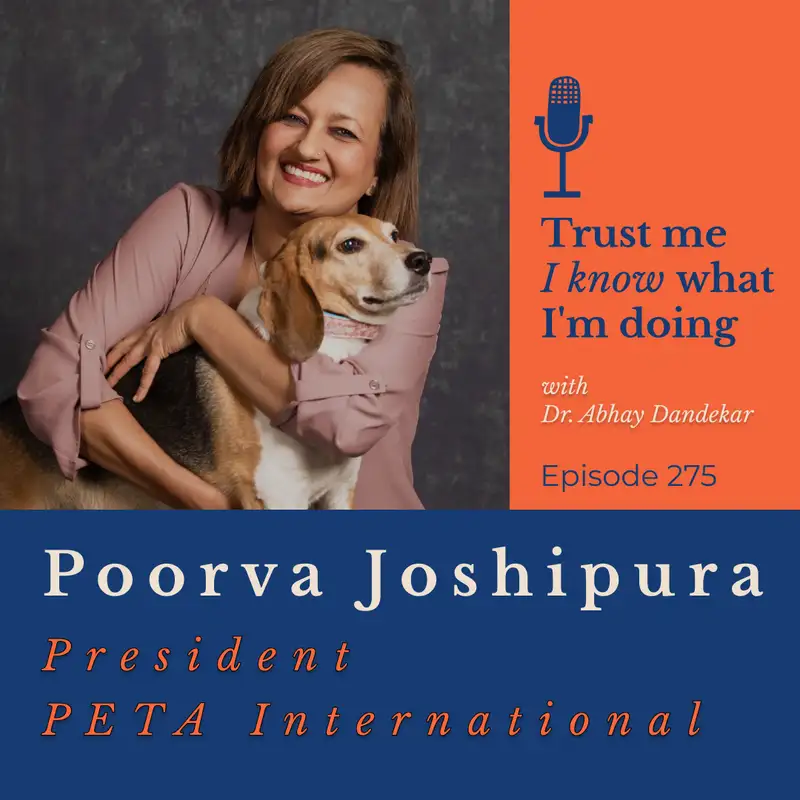
Poorva Joshipura on PETA International and the Threats of Animal Cruelty
Download MP3Abhay (00:00)
thanks everyone for listening and watching, sharing with your family and friends, and don't forget to subscribe. TRUST ME I KNOW WHAT I'm DOING is brought to you by Travelopod.
For destinations like Africa, Japan, Antarctica, India, and the Northern Lights regions, start your journey with Travelopod. Visit vacation.travelopod.com.
Poorva (00:19)
I love dogs. I love cats.
the animals that we tend to call friends. And I started thinking, well, what's the difference? What's the difference between a dog and a pig? They both want to who am I to rank one as worthy of life and rank the other is as mere, seconds of taste on my tongue?
Abhay (00:26)
Mm-hmm.
a lot of plant-based food and synthetic leather and cruelty-free testing and cosmetics. How do you see the compassion economy blossoming now
almost side by side in parallel with what PETA is doing
Poorva (00:53)
so if I stop eating meat, I can help animals. If stop consuming dairy, then I'm not contributing to calves being taken away from their mothers so that we can steal the milk that was meant for them. okay, so leather is a co-product.
of the slaughter industry. I can look on the PETA website and see which cosmetics are not tested on animals. And it really has been step by step like that, learning about the issues, learning about what more I can do,
Hi, I'm Porva Joshipura and I'm the president of PETA International and this is Trust Me and Know What I'm Doing.
Abhay (01:59)
everyone to this episode of trust me. I know what I'm doing
You know, it's a deep and important exercise, but I truly love thinking about our own place in the world and appreciate how some movements address human solutions that potentially help unlock so many other direct and even indirect problems that in a way we have actually created. And so I'm certainly excited to share a conversation with Poorva Joshipura Poorva is the president of People for the Ethical Treatment of Animals or PETA International.
steering campaigns across India, the UK, Middle East and Europe and the US with a staunch commitment to animal rights. She's the author of two books, For a Moment of Taste and Survival at Stake, Connecting Our Food Choices and Global Crises to Compassion for All Species. I'm so thrilled to share a conversation with her as we can all do better to meet all of today's urgent fights for animals, for our collective health and of course for the planet.
What about welcome to Trust Me, I Know What I'm Doing. Thanks so much for joining us.
Poorva (03:01)
Thanks so much for having me.
Abhay (03:03)
You know, this is the time of year when so many people, I hope, are sticking to some version of their resolutions, but I have to start off and find out, are you someone who Year's resolutions? Is that something that at all relates to you personally or even within the context of PETA?
Poorva (03:20)
I think it's so important to do that goal setting with oneself and to take stock ⁓ as to where we're at and where we need to be. We are working to address some of the most egregious cruelties that happen to animals on the planet for all sorts of things that we don't need, food.
clothing, for experimentation, entertainment. So we've come a long way, but there's a long way still to go. So we definitely have to do that exercise, not just in January, but all the time. And yes, personally speaking, I also think it's important for each one of us to do that.
And I like to try to remind people that it really doesn't have to be this huge big thing either. You know, there's so many easy ways that we can help animals, that we can incorporate being kinder to our everyday lives. I think it's more just about being conscientious of it and doing it deliberately. And sometimes it's really just the difference between
between that and not thinking about it where you can make a huge difference.
Abhay (04:30)
as we course hit that reset button sometimes and hopefully continually hit that, do you have to almost keep sort of practical guardrails and reminders for yourself about like, let's stay on track here? How do you stay kind of focused in that, especially when you find yourself perhaps...
you know, straying
Poorva (04:49)
Well, you know what keeps us on track at PETA is we have ⁓ undercover investigators who go and who get behind the walls of the slaughterhouse or laboratories or places that these industries don't want us to see. And we're constantly being reminded of what it is that we're working towards.
here in India, one of the campaigns that we're working on right now, we got footage from insiders in a laboratory. This is a facility that does contract research work for chemicals companies, drug companies, medical device companies, and so on. It's called Polymorph Biosciences. And we got footage of
beagles lying in pools of blood, pigs who have been poisoned so roughly that they bleed, and wild caught monkeys who are terrified and so on like that. And this is, that's just one place. We also just recently got footage of buffaloes being made to fight to the point that they're gashing and injuring each other.
And so that really, you know, we get those reminders all the time that.
Abhay (06:03)
I was going to say,
are reminders of plenty right there.
Poorva (06:06)
Yeah, that's right. And so we, we absolutely are reminded of our mission constantly and that we have to stay on track and it keeps us going. But it's not just us. I mean, I invite everybody, know, nowadays with social media, go check out the PETA website, go check out our social media. And it's a great way, really, it sounds, you know, like an awful thing to do to go and look at.
horrendous footage, if you want, if you need that extra boost they say by simply not eating animals and being vegan, we can save up to 200 animals a year simply by doing that. And a lot of times people need that extra motivation, extra boost.
Abhay (06:45)
Right. Yep.
Poorva (06:52)
You'll be right back on track.
Abhay (06:54)
You know, even in thinking about the reminders, but even for those people who may be, starting on some kind of self-reflection, or they're just getting into that space where they're like, boy, you know, either what can I do? How can I remind myself? And then they meet someone like you, right? So I'm curious, and I've asked other people this before, but how do you describe yourself and your work to someone who you've met at a party or at a meeting? And, you know,
Poorva (07:21)
Mm-hmm.
Abhay (07:21)
share with them kind of like, look, here's who I am and this is what I do.
Poorva (07:25)
You know, so I got involved with animal rights and animal protection a very long time ago as a teenager. And I used to eat meat. I used to wear leather. I bought any sort of cosmetics. I didn't really think about that at all. I just remind people that
I was the same as everybody else. I am the same as everybody else. It's just that somebody, had a friend of mine who, we were teenagers and we sat down at a mall food court and we'd gone on a school field trip, sat down and it was lunchtime and she went to go get something vegetarian from somewhere and I went to McDonald's to get a chicken burger.
And as we sat down together, she said, are you really going to eat that? And I thought, what? And she said, well, it's a chicken. And so it really just, I still ate the burger that day, but it took just her saying that to get me to start thinking about what I'm doing in a different way. I always regarded myself as somebody who loves animals. I love dogs. I love cats.
Abhay (08:23)
Mm.
Poorva (08:34)
you know, the animals that we tend to call friends. And I started thinking, well, what's the difference? What's the difference between a dog and a pig? They both want to who am I to rank one as worthy of life and rank the other is as mere, few seconds of taste on my tongue?
Abhay (08:39)
Mm-hmm.
Poorva (08:55)
So I started thinking of animals differently from there and it just kind of grew from there, grew gradually. I just learned, okay, so if I stop eating meat, I can help animals. If stop consuming dairy, then I'm not contributing to calves being taken away from their mothers so that we can steal the milk that was meant for them. okay, so leather is a co-product.
of the slaughter industry. I don't have to do that. I can choose not to. I can look on the PETA website and see which cosmetics are not tested on animals. And it really has been step by step like that, learning about the issues, learning about what more I can do,
looking at resources like the PETA website, talking to others, you know, because you will meet others who are like minded that
Abhay (09:37)
Hmm.
Poorva (09:46)
my commitment to animal protection grew and my understanding of what else I can do has grown. And I love to invite other people to
to that journey. And I also like to tell them that, look, it's not about purity. I think a lot of times people, they try to go vegan or something like that, and they have an ice cream, and then they think, I can't do it. And then they just go right the way back and just forget it entirely. No, forgive yourself for that little blip. Remind yourself of the fact that you are helping far more animals than you're hurting if you keep going.
and then, get right back on it. And soon enough, give yourself about a month, it'll just become second nature to you then. And it's not it's not going to always feel like a big effort.
But I'm not constantly burdened by the thoughts of what I can't do. Rather, it feels so much more like what I can do.
Abhay (10:51)
want on that one a little bit because I'm imagining, of course, this journey that you just shared with having a sequence of aha movements to building gradually towards in a leadership position within PETA.
Poorva (10:54)
Mm-hmm.
Abhay (11:06)
degree that whether it's at a party, whether it's at a professional meeting, whether it's at the kitchen table, at a restaurant, in a shop where you're actually buying clothes or merchandise, or for that matter, thinking about even medicines and pharmaceutical companies. At the end of the day, the storytelling is still also a part of the strategy, right? for the work that you're doing, are strategy, there's tactics, there's...
campaigns, investigations, like you mentioned as well, and even just kind of like person to person education or large scale education, now that you have gone from that, you know, person who you described to being in a leadership position, is there a priority to the method of tactic or, strategy in order to build this kind of movement that you've said, hey, you know what, yes, we have to do all of these, but
there some that take more of a priority than others?
Poorva (12:02)
First and foremost, I consider it very, important to remind ourselves that we too are animals. You know, we're also animals and I spend a lot of time establishing this basic fact in my book Survival at Stake. Because we focus sometimes too much on the differences between us and other animals. But in reality, the similarities between
us and other animals matters so much more. They may come in a different external package. Maybe they have scaly skin or they have feathers legs but if you look into their eyes you will see that there's another person there.
somebody else who has feelings and somebody else who wants to live. And so to start off with any campaign or anything we do, I think remembering that is so important.
And so I like to, establish the similarities between us and other animals to help people understand how cows and buffaloes are such fierce protective mothers, or how chickens are now regarded as intelligent as the dogs and cats who we share our homes with, or even comparable to primes.
primates or how pigs can also learn their names just like dogs and they like to play or fish like to play, fish have friends.
And also how the way that we treat them affects us in so many ways. For instance, meat production and it's linked to the climate catastrophe. Or how leather production is one of the most polluting ⁓ fashion industries in the world. And this sort of thing, it no longer becomes a surprise as to why, why there's a link between how
how we treat them and our own experience of the world.
Abhay (14:42)
I wonder if it somehow then becomes a matter of no matter which tactic or strategy is used to really forming that kind of connection of making that aha moment realized or actuated. in your book, Survival at Stake, it seems like there's a ⁓ really thoughtful effort to connect all those dots between so many touch points related back to speciesism and animal protection and how it's an accelerator maybe to combat
all those issues, right? I connecting all those dots. But in an era where it's just so hard to build trust, you know, particularly with everything that's out there, what's the hook? What's the maybe surprise that you found in that hook for newcomers to the world of animal protection and PETA?
Poorva (15:27)
Well, I think what's happening in the world, in the world of animal protection is that what we do to animals is so normalized in society. if you wake up in the morning, you may eat an animal, you may brush your teeth with
a toothpaste that was tested on an animal You may wear clothing, you may put on some shoes that are made of animal Later on, you may watch a movie where an animal actor was used or something like that. So it's so normalized that once we start helping people unlearn all of that,
in these industries, they work so very hard to try to hide what they do from the public. You know, it's not easy. can't just walk. You can walk onto an apple farm, but you can't just walk into a slaughterhouse. know, ⁓ and
Abhay (16:23)
Right, right. Yeah, so true.
Poorva (16:26)
We visited a Greyhound race the other day. there's an area where they're prepping the dogs. nearly impossible to get behind there to see what's actually going on. So there's so much hidden activity that that's why our investigators are so important. That's why it's so important for us to show people.
and the importance of social media where we can just put those videos up online and have people visit and see for themselves. And that's really what getting that real truth out there is helping people see and really opening people's eyes. And it's that that helps us.
look at everything that we might do in a different way. So every single one of those things I said, at every single moment, we have the choice to be cruel or to be kind. And so we start to think, well, now I when I wake up, I don't have to eat bacon made of a pig. Instead, maybe I can eat a vegan, vegan bacon, which also exists in the world, or I can wear
I can have shoes that look just as great, but they can be made of vegan leather instead, perhaps.
Abhay (17:38)
Are all of these touch points here and whether it's an investigative finding or even that kind of aha moment that you may have if you're eating the chicken sandwich, are those the kinds of unlearnings that even you had to go through and therefore leads to a general empathy, not only the empathy that it takes to really espouse and combat speciesism,
but also the empathy of what it's like to say, you know what? I've been in that spot where I'm not thinking about these things and I need to shine some light on this so that others more and more will start thinking about some of these things. Is empathy sort of like a real central driver here?
Poorva (18:11)
Thanks
It is, and I did have to myself learn those things. It wasn't an all at once realization, which nowadays, you know, the power of language, you we can say vegan and now people understand what it means. And so maybe they connect the dots sooner than what I did. But when I was a teenager,
I at least had not heard of what a vegan was. And so I started off with realizing, okay, chickens want to live and I shouldn't eat chickens because I care about their feelings. And so I started off with that, but it took me then some steps to realize, well, cows don't want to be turned, they have their skin turned into a jacket.
the cruelty to animals and the use of animals are so common around us that it takes us a minute to even recognize these as products of cruelty. And then to take that little extra step.
to change your habits so that you are no longer contributing to that cruelty. And it's often such small things. It's the difference between putting milk in your coffee and oat milk in your coffee. And quite honestly, you're gonna like oat milk better anyway. But it's really just a matter of sometimes those small things, but still those small things require us to recognize it and to...
consider what changes we can make. We have the resources that we didn't have when I was a teenager. People can now look on the PETA India website. it's easy to see, know, which cosmetics are not accessible to animals, shopping tips. Nowadays we have,
all sorts of vegan meats, vegan eggs, vegan ice creams, vegan cheeses. We don't have to sacrifice on anything. We don't have to sacrifice on taste, on fashion, on anything these days.
Abhay (20:14)
So I
want to put this in the context of me for a second, okay? Because I've been thinking about this for a little bit in kind of anticipation of our conversation. And like many, I'm a vegetarian. I gave up eating meat many, many years ago when I was taking call in the hospital and I was just having BLTs and burgers and things like that. for lack of a better way of putting it, I was just grossed out. And I probably had very much of the same kind of process that you went through.
Poorva (20:35)
Mm.
Abhay (20:42)
I typically don't eat eggs. don't buy leather or have any animal fashion products, but I do drink milk. mean, for someone like me and others out there who may be like me, right? I'm thinking, at least in hearing you, that like, you know, we have allyship here and there's a lot that I'm doing that I can always still be conscious of. And then I hear some of the things that you're just saying.
and I almost have to prevent myself from being so angry at like all the, you know, monstrosities and atrocities that are going on out there. What advice do you have for someone like me, who's in the state that I am, where I'm doing a lot, but then at the same time, like I really, really have to suppress this kind of anger and just really shame and even guilt of what goes on out there and at the same time live my life.
Poorva (21:33)
consider anger a healthy thing. Anger is what gets me going. You know, anger, really is. Well, it's a healthy anger, isn't it? I am angry about what we do to animals. I am upset about it. And it is wrong. And we should be horrified.
Abhay (21:40)
Anger is something I don't like, but sure, okay.
Poorva (21:57)
And it's about them taking those feelings and doing something about it. And it's so important to do that. again, it doesn't have to be these huge big things. mean, it can be incorporating these values into one's life. Perhaps someone listening is a teacher.
They can take lessons of kindness to animals in their classroom. Doctors can their patients about healthier ways of
you know making simple choices when when we go shopping. But it is that being upset about what's happening to animals and what's happening to animals on such a large scale. every year just for animals that we don't need to eat. There's some 92 billion animals land animals alone.
who lose their lives. And when we talk about fish, up to trillions of fish and every single one of them, and if you have a dog or a cat at home or an animal we know, there's really no difference in terms of the fear and the pain and the desire to live and the value that each one of those individual lives had considered for themselves and their desire to live.
Abhay (23:13)
Do
you almost need that anger, that shame, that guilt to have that transformative process?
Poorva (23:21)
I wouldn't say that I can profess to how everybody experiences this feeling, but I definitely believe that what drives us even in a positive direction is at least a recognition that there's something here that needs to change. ⁓
Abhay (23:42)
Mm, yeah.
Poorva (23:43)
What we don't want to do is get into feelings of numbness or indifference or what can I do or how is it going to make a difference or any of those things because we are making such huge differences and we can make such a huge difference individually. You know, as I mentioned before, simply by not eating animals, by going vegan, each one of us can save the lives of up to 200 animals a year a climate perspective.
By going vegan, we can reduce our individual carbon footprint from food by up to And collectively, we're making such huge changes in the world of animals today. You know, there was a time where all cosmetics around the world were tested on animals. Now there's thousands and thousands of companies that don't do that. There was a time.
that you can walk down the street in New York or wherever in London and you would see so much fur. People wore fur as if it was just nothing. Now it's so weird if you see somebody wearing a fur coat. ⁓
Abhay (24:52)
Yeah, the consciousness
and the ability for people to be quite aware of that, I think you're right, has made so much terrific change and yet still a lot of work to do there too. You're speaking to us from India and of just the cultural practices around the world, but certainly in India
Poorva (25:02)
Yes.
Abhay (25:13)
can involve animals in ways that are traditional yet suspect and controversial. So how do you, in a way, being of someone of Indian descent, how do you balance that idea of kind of harmonizing cultural heritage with also the responsibility and the ethics and the standards that you've outlined in PETA?
Poorva (25:20)
Mm-hmm.
I'll talk about our work here to get elephants out of temples because it's a great example Elephants who are used in temples in India, they are often stolen from the jungles, separated from their mothers when they're babies.
not just for temples but for any captive use of elephants beaten until they start obeying commands or until they stop losing hope and then oftentimes a temple will just have one elephant it's often a female elephant female elephants in nature would live in their family multi-generational herd but at temples they often spend their entire lives and they live decades changed to the floor
these elephants then start losing their minds. Many of them attack devotees or their own mahouts killing them. And yet, because of tradition, temples have sometimes felt even where they recognize the cruelty, that they have to do it almost, that they have to use these animals. And so we were
we were realizing that we needed to come up with something that allows for those traditions to continue thereby allows us to relieve these animals from suffering. And so we came up with a win-win solution of creating mechanical elephants. And these things are so realistic looking. I mean, if you saw one, you would not know that it's not a real elephant because
They move and their skin is the same as an elephant. And it took us a while to get the first temple to agree because it is still a novel concept. But now over 20 temples in India use mechanical elephants. We just launched one at ISKCON in Navi Mumbai. Hema Malini was there. She's a devotee of that temple. And it was such a
beautiful, beautiful ceremony. I feel it allows temples to regain or kind of get back to the root of the compassion that they're really trying to spread in the community.
But there's also been a ripple effect to us introducing the mechanical elephants in temples. Temples are where people go to understand how they should live their lives. And so by having these symbols of compassion for animals at the temples themselves.
Abhay (28:04)
Hmm.
Poorva (28:12)
and having the temple priests talk about why they're using a mechanical elephant instead of a real elephant, we're seeing this awareness growing in the local community about animals as a whole. And that's not something that we had really even thought about or anticipated, but it is something that is happening and it's very beautiful to see.
Abhay (28:34)
which is so terrific. I mean, because tethers of that are so far and wide reaching, the impact of that, obviously learning more about how this can translate to so many other aspects of everyone's lives.
And you mentioned that word compassion, right? I mean, there is compassion when it comes to having those aha moments in a cultural setting or in a religious setting or in a social setting, but then there's also the economic setting.
And I know that we've talked already about this with a lot of plant-based food and synthetic leather and cruelty-free testing and cosmetics. How do you see the compassion economy particularly blossoming now where, especially Indian and diaspora led brands and companies are really making ⁓ terrific contributions to this. mean, is there a role that the compassion economy plays
Therefore with and aligns almost side by side in parallel with what PETA is doing
Poorva (30:03)
Yes, yes, of you know, business and making money, this is not inherently a bad thing at all. businesses are increasingly
reacting to people's desire and demand to have products and to have services which ensure kindness to animals, protection of the planet, know, things, values that they care about. India is and can increasingly lead the way in this vegan economy, not just nationally but around the world.
There's so many edible plants, for example, in India. So many of the vegan meats and the vegan cheeses and so on are made from plants which grow in abundance in India. So many of the vegan fashions, there's a ⁓ vegan wool in India, which is made from a plant which grows ⁓ in abundance here.
I know that it has really, for instance, helped jackfruit farmers in Tamil Nadu and Kerala because jackfruit is considered a good option instead of meat in dishes and so on. there's so much that can be done.
Abhay (31:15)
I will vouch for being very tasty, yes.
Poorva (31:22)
so say for example McDonald's, we take a look at McDonald's in India or places like Burger King and KFC and so on. They realize that so many people in India want foods that are not made of animals. And so what have they done? They've responded to that demand. So businesses also will change their practices if they are told by enough people that that is what they want.
Abhay (31:48)
Yeah, it's the consumer that's always taking things to hopefully message back to those companies and therefore so much commercial appeal.
Poorva (31:48)
and
That's right. you know, words like profit and business and, corporations and all of those start taking a nasty turn only when they're contributing to something which is harmful and cruel. But it doesn't have to be that way.
Abhay (32:16)
I want to ask you about something that we're not all completely familiar with, and yet some in the business world and the tech world are becoming way too familiar with, and it's pervading into every aspect of our lives. But how do you think AI and tech are playing a role, particularly in advancing PETA's work?
Poorva (32:36)
Hugely, hugely. You know, we, think we're like everybody, we're still learning how we can increasingly use AI and tech to advance the animal rights movement. It is a major interest of mine personally. Some of the ways that we're already using AI and tech is through
spoke about our mechanical elephant initiative in temples. We also have a talking mechanical elephant robot who now goes into schools and her name is Ellie and she talks to children about her experience in the circus and how she was taken away from her mother and taken to a sanctuary and I see the difference between if a person
was telling the kids the same story, but when they see a robot that's the size of an elephant talking to them about this, it just has a completely different effect. So we're starting to use robotics, for example, in education, we have AI powered experiences that we take to colleges and universities. There's one right now that we're taking into
into universities where there is a, it sounds strange, but there's an alien and you're supposed to convince the alien that you're kind to animals and it's through your answers that you're able to get out of the clutches of the alien. So there's all sorts of, yeah.
Abhay (34:08)
of really putting it in our our basket right
Poorva (34:13)
Yeah, so there's all sorts of ways and I believe down the line, know, one of the things that I would love, you you always hear people say, you hear people call animals voiceless. They're not really. They're talking all the time and they're really telling us how they feel in the language that they're able to use. And it's just whether or not we're listening.
But down the line, I believe we will be able to take those sounds and that this kind of work is already starting to happen. Where we will know this is a distress call. This is this is the animal saying they're scared. This is the animal saying, get me out of here or whatever. So even though we we can still understand that an animal is scared of that.
You know, make things even clearer for us, I believe is one of the areas where we can benefit from AI and tech as this goes on.
Abhay (35:14)
Yeah,
I mean, certainly being accelerators of that and great sort of tools for us to use. And again, it goes back to building that empathy. I know that, you know, in hearing all of this and in even thinking about this myself, you know, as someone who definitely aligns so closely with all the things that you're saying, I know that many around you and PETA will probably also point to controversies or practices
that for them may not necessarily make a whole lot of sense. And whether that's like the campaign styles or sort of like the ability to share deeply disturbing kinds of images or for that matter, the kinds of even visual or in-person tactics that are shared to communicate some of these ideas or even some of the shelter practices where people will talk about euthanasia and things like that. While you distinguish
Poorva (36:00)
Yeah.
Abhay (36:08)
good faith sort of feedback, but also separate out what is just frank disinformation. Where do you think PETA can grow now in thinking about sort of like the responses of people who may have very, very good
intentions and want to listen more? Where do you think PETA can grow now based on some of that feedback? And maybe how does your leadership help to bridge some of those gaps where people might have
some of those misgivings about some of the things that PETA does.
Poorva (36:37)
Well, let me start by explaining why PETA does some of the things that we do. Because once people understand that, able to understand a lot better why PETA is the way that we are. So unlike the industries that PETA goes after for their cruelty to animals, we don't have a massive advertising budget.
a McDonald's will spend billions advertising. it is too dangerous for us to not be seen and not be noticed because then it's a difference between.
people learning about cruelty to animals and learning about what they can do and not learning about it at all. So that's why you'll see some of the colorful campaigns from PETA. That's why you'll see things like I'd rather go naked than wear fur. You know, it's not that people necessarily enjoy putting themselves into situations which are normally societally uncomfortable.
out on the street without any clothes on or something like that. But they know that, okay, if I do this, it's going to get attention on the minks that are, you know, running around. They've gone so crazy, they're running around in circles in a cage on a ⁓ mink farm. People learning about that versus not learning about that at all. So a lot of the controversial or the stunt-like work that PETA does
It's simply to get attention to issues which would otherwise go unnoticed and unheard of. And we cannot afford that when we're being spokespeople for animals. So that's really what it is. But it's well understood that not every form of messaging is for everybody. And that's why we also use things like, for instance, celebrity volunteers.
You know, maybe if Joaquin Phoenix says something, maybe that'll appeal to somebody. Of course it will. So a lot of people. And so we do try to use different tactics, both in your face, as well as those that are a lot more softer. We use humor. We've even created, you know, video games, you know, where people can can play and be kind to animals that may appeal to a certain population.
And increasingly, I believe people are coming to an understanding of why we use the tactics we use. And we see so many other campaigning organizations and advocacy groups now starting to adopt those tactics too.
Abhay (39:16)
ask you sort of a side question to that. mean, should euthanized animals be used for medical research?
Poorva (39:23)
Well, when you say euthanized animals, you mean if they've been euthanized for, I suppose it depends on what you mean. Not euthanized for the purpose of, yeah.
Abhay (39:31)
Euthanized animals who've been in, no, euthanized animals
who've been in a shelter, been, they're now helping to kind of control animal population in a safe and effective a humane way. Should those animals be should their contributions as animal species make their way towards scientific research?
Poorva (39:40)
Hmm.
So there's two things. So there's something, for example, with vet schools. It's called the World Body Program, and where they use animals who have been humanely obtained to teach vet procedures on animals. how those animals are sourced is very important to determine whether it's a humane source or whether it's not a humane source.
definitely don't want animals who've been deliberately killed for the purpose or have been killed because of some other reason that is unethical. And so that sourcing has to be really managed. And as long as it is a humane source, for example, if animals who have been euthanized by a veterinarian because they were sick and that they were at the end of their life and they needed to be euthanized,
That's a very different source than say an animal from a slaughterhouse. so there are programs where it is managed and ensured that the animals comes from a good source. When you talk about euthanasia, however, animal shelters, I would rather we get to a point in society where that is not happening.
Because the reason why it's happening is because dogs and cats are sold. sold by breeders. They're still sold by pet stores. This is happening all over the world. They're sold to anyone willing to buy them. doesn't matter if that person has thought about whether they're going to be able to commit to this animal for the next 15 or 20 years, whether they've thought of the responsibilities that come with having
a dog or cat at home. so oftentimes what happens is that these people, they haven't thought about it. They bring in this animal as if the animal is a toy or a status symbol or something else. And then those animals are abandoned by the millions at animal shelters. It's not the animal shelters fault that, they then have to decide.
how to deal with such an influx of really millions and millions of dogs and cats, I'd rather get back to the source and address the sale of those animals, the breeding of those animals, and ensure that there's a growing awareness in society as to what it means if you're going to welcome a dog or cat into your home, what that entails and to make sure that you're ready for that responsibility.
And if you are ready to go to an animal shelter and rescue a dog or cat in need instead of contributing to the population of the animals who end up at shelters.
Abhay (42:36)
You know, I hear all of this and I think about even the beginning of this conversation of incremental change and the way that you can find solutions back at the tech level or with AI. And by the way, I do believe that AI and tech can create great animal models to contribute to scientific research so that, you know, perhaps, yeah, so hopefully that's not a thing of the past.
Poorva (42:56)
They already do. They already do.
Abhay (43:01)
But when you think about the activism that's involved here, I mean, it's so energizing, but I know it can also be a very lonely and kind of emotionally draining place because again, you're sort of steeped with unearthing. You're trying to motivate and actualize such important empathy and get to a place where we can hopefully live in a animal cruelty-free world. And yet you also are steeped in
a reality where there is cruelty going on and that can be so draining. And so when you're constantly sort of with tug of so many different emotions, how do you stay optimistic with all of this? What keeps you kind of energized and keeping that sort of optimism lens on things, not only just for, of course, yourself, but really for your teams?
Poorva (43:53)
feel so much worse if I knew this cruelty was going on and I was doing absolutely nothing to stop it. What keeps me going is knowing how much of a difference we're making. we talked about fur and how, once upon a time fur was all over the streets and now hardly anyone wears it, but nowadays hundreds of fashion companies have stopped selling Angora
Angora wool, instance, is fur which is ripped off of a rabbit's body while they're alive. While they're kicking and screaming, this fur is ripped off of their bodies. There's been hundreds of fashion companies that have stopped selling cashmere, which is hair that's ripped off of a goat. So,
the awareness it's not just once upon a time people knew fur was bad now people understand about leather they understand about cashmere they understand about wool they understand feathers and so on the the consciousness is is growing in society we're doing better and better there's a lot to go but we're doing better and better around the world
countries, including countries that were traditionally where bullfighting was performed and so on. You have countries around the world which are banning those types of spectacles, banning the use of animals and circuses. There's so much progress that has been made and it's very important for us to remember that and to take stock of that because that is really the reminder of that is what's going to keep us going.
and what's going to keep us going to make more and more progress for animals. So I would find it far more lonely and horrible if I just sat with all of this knowledge and just kept it and didn't do anything about it.
Abhay (45:38)
Well, we're all so grateful that not only you are doing something about it, but you're activating and organizing and inspiring so many others to do the same. Poorva thank you so much for joining us today. It was really a treat to catch up with you and I hope we can catch up again down the road.
Poorva (45:55)
That would be wonderful. Thanks for having me again.
Abhay (45:58)
Thanks so much and I encourage you to go to peta.org and petaindia.com to learn more. Big shout out this week to previous guest, Neal Katyal for always bringing his constitutional A game, to Paul McCartney for being one of my favorite vegans of all time and for starting Meat Free Mondays and to Kashi, the inspiration behind RuffRest by Timber Dog. Don't forget to subscribe and share this with your family and friends and please be safe, be smart and be kind. Till next time, I'm Abhay Dandekar