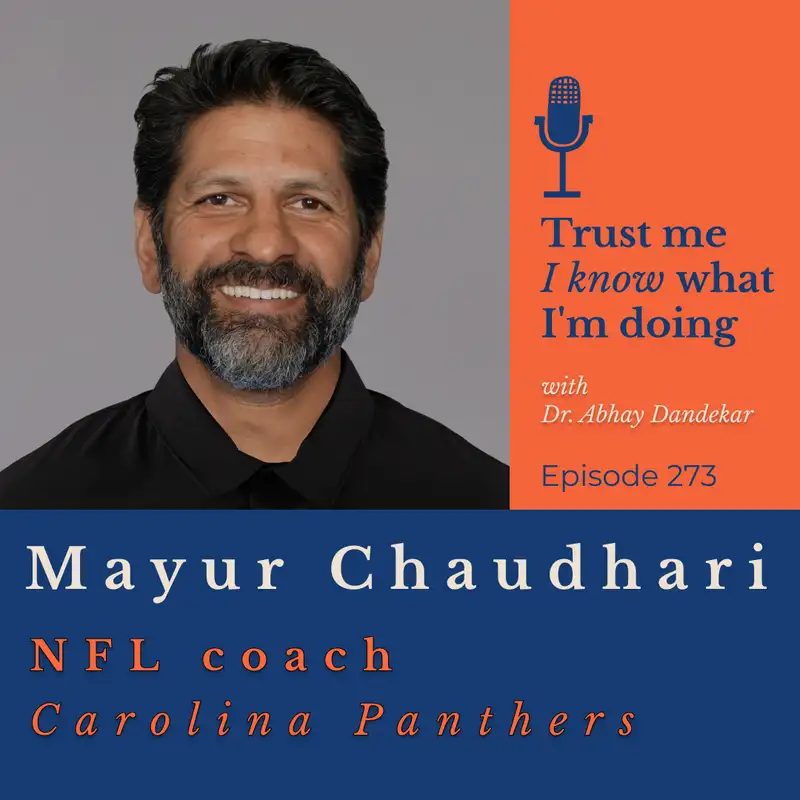
Mayur Chaudhari on coaching in the NFL
Download MP3Mayur (00:24)
it's a very high performance industry, your shelf life as a player is short, a coach, it can be short too. 40 % of the workforce in the NFL is turning over right now.
Abhay (00:34)
Do you ask that question of, should I be here? Can I do this differently because you're an Indian American?
Mayur (00:41)
mean, a lot of people, mean, they don't even know that I'm Indian until it comes up some way organically somehow,
you're trying to help (the players) solve the problem and if you do your job really well during the entire week. Then they don't they shouldn't need you on game day you know you're there to support them
Hi, this is Mayur Chaudhari Assistant Football Coach with the Carolina Panthers, and this is Trust Me, I Know What I'm Doing.
Abhay (01:29)
Well, welcome everybody to this episode of trust me. I know what I'm doing I think it's safe to say that if you do what you love and you love what you do that sort of peaceful success in life is bound to happen and especially over time It hopefully translates to longevity in any career now in collegiate in professional football
Coaching itself is an everyday sport involving everything from perfecting technique to tactical strategy and film study, to mentoring athletes through both the physical and mental challenges that drive performance on the field. And I guess the pinnacle of that ecosystem, at least in football exists in the NFL. just so thrilled to share some time with Mayur Chaudhuri
after a several decades long career at the college level and experiences with a few NFL teams is now the assistant linebackers coach for the Carolina Panthers. Mayur thanks so much. And it's honestly so good to welcome a fellow Californian and a fellow Marathi guy to TRUST ME I KNOW WHAT I'm DOING I've been looking forward to this for a long time. So it's great to have you on.
Mayur (02:34)
Yeah, thank you so much for having me. I really appreciate it. I've been looking forward to it as well.
Abhay (02:39)
You know, so I have to admit that on a day like now where I'm clearly obviously not over my Rams losing and for a lot of, guess for you growing up as a Ram fan as well, you know, the season's over for the Panthers, but I know that for fans at least, it always feels like it's so abrupt.
Mayur (02:46)
Yeah.
Abhay (03:00)
And like you're yearning for something more. You're honestly looking forward to the next season, but, you know, as a sort of year round cycle of this, is there a process to how you've dealt with the closure of a season ending and maybe kind of the grind of that year round pace? Is there
method to trying to deal with how you then move on to the next sort of chapter.
Mayur (03:28)
it really starts, that whole process starts before you think about the end of the season. we kind of always, I take the approach of the players all the time that like, you must play this play and then it's over. And then you play the next play and then that one's over. And I think even in wins and losses, is a very emotional game.
Like, as a coach, as a player, as a staff member, everything. and within the game, it's highs and lows. You can be up 17 points and then you're down three and you kick the winning field goal or you, you tie it or whatever it is. But through that whole game, you got to stay even, you know, and know that it will end at some point. And so I think.
If you can remind yourself of that on a daily basis, this will end at some point and something new will begin. Then you come to grips with the loss of a playoff game like we went through, right? Where you just throw all your emotion and effort into it. And then you're onto the next challenge. Okay, next year, let's go. And I just think that's an important piece to remind yourself all the time. I don't think there's, I guess that's learned over time.
Abhay (04:30)
Mm-hmm.
Mayur (04:38)
And also, you're confident. I expect to be here again. I expect to be there again. if you have that in your mindset, then you get over it faster, you know, and you move on to trying to prove it.
Abhay (04:42)
Yeah. Right.
And,
and you know, ⁓ it's, you mentioned that, that like, you know, look, you have a sort of short-term memory of what just happened. You have to just like, keep going and, know, erase the, you know, the high or the low of the last play. And it's onto the next one when the season ends though, it's just sort of like, okay, this is, you have to sort of process a little bit. And like you said, you're, confident that you're going to go to that pinnacle again and hopefully reach another height. Do you also.
at some point say, look, I also need to step away for a little bit. you know, do you ever, like even right now, do you get sick of like saying, hey, yeah, you know, I need to like unprocess football for a little bit and just be me.
Mayur (05:26)
absolutely.
Yeah, yeah, absolutely. I mean, absolutely you have to. would love to still be playing, obviously. I think the Panthers would love to still be playing right now. But you do also appreciate the time that you get before you go back into the office officially. A lot of us are working on our projects and also you get a chance to kind of be a dad.
and re enter your own home. You know, my wife loves to say like, Hey, wait a minute. You haven't been here for seven months. So like, they'll start coaching at home now, you know, like this is where we put the cups and this is where we put the spoons. Yeah, exactly. ⁓ but, no, I think, I think you do. And I think that actually the, ⁓ one of the things that's helped me over the years probably, and the NFL has done a much better job of this, of like, just,
Abhay (06:00)
Hmm.
Right. That's right.
It's like a reentry process, right? Yeah.
Mayur (06:26)
mental health and all of it. like even being able to step away in the week of the game for however many minutes it is, right? So whether it's like physical activity, exercise, or like, I mean, I meditate on the way to work or I meditate at work for the first five minutes of my day, every day now, you know what I mean? I didn't do that when I was younger and it all spills in. So I think the more you can incorporate that,
Abhay (06:28)
Mm-hmm.
Yeah. Yep. Right.
Mayur (06:54)
mode of being able to just step away even during the week, you process it better. It's funny though, you say that.
Almost every year of my coaching career, when the season ends, I get sick. I get the flu or something. But it happens like the day after the season. And it's just like two days where you're like, I'm not, you know, and so your body just says, okay, go ahead. Let's let it all, let it hit you now. You know, you got time. And so it's.
Abhay (07:15)
Bright. Bright.
Let it all in, right? Yeah, yeah. Well, I mean,
your natural defenses are, you've been on this kind of like high for seven months and a lot of that cortisol is pumping and all of a sudden now you're just sort of, it's a release to some degree. You ritual part of it and that you meditate every day, which is really, really important, right? To stay grounded and of course maintain that
sort of levelheadedness and that mindset throughout your week, throughout your game time, and for that matter, throughout the season. I feel like everyone to some degree is anchored to some kind of ⁓ ritual. Do you have a particular game day ritual or a particular routine that does keep you focused that goes beyond the meditation part or maybe sort of starts with the meditation part? And then do you also have some kind of
you know, a way non-negotiable guardrails that sort of help you stay grounded, whether that's meditation or otherwise, like, look, I don't care what's happening, film or not, eight o'clock, I need to like, you know, get back for dinner, whatever that might be.
Mayur (08:28)
Yeah, yeah, no, think for me, I love to step away after the game. So after the game, now because of technology, you get the game on your iPad when you're on the bus. So I know after the game, the first thing I do is after I shower and all that stuff, I call my wife.
Abhay (08:36)
Hmm.
Right. Right.
Mayur (08:51)
And I debrief, it's important for me to debrief with her because I think she's my I mean, she's my everything, right? She's she's so smart in her own career. She now understands leadership and and she's been around this game too in a different way. And so I just love hearing her what her opinions are. Or she just allows me to vent sometimes, you know, or share something great that happened. And then I don't watch the game.
Abhay (09:11)
Mm-hmm.
Yeah.
Mayur (09:15)
I don't watch the game on the plane right now. Sometimes I'll do a few things maybe for the next opponent, but I don't watch our game until I get back home. And then the other thing I do, I've learned, it took me a long time. I don't sleep at the office anymore. just won't. Yeah. yeah. Many times, many times. I just don't. then, I mean, now if I'm, I'll
Abhay (09:23)
Right.
Hmm. Did you used to?
Mayur (09:39)
come home if it's for two hours, then I'll sleep at home for two hours, then I'll get up and go back. just don't do that anymore. And I learned that from a guy that I worked with who was, he had coached at Pittsburgh and a couple of other places, old vet, and he just said that I won't do that, you And so that's a non-negotiable for me now.
Abhay (10:01)
Mm.
Mayur (10:01)
Unless we get in at four and we're meeting at six a.m. You know what I mean? Then that's like something different where we got a bit of stuff done. But if I have a chance to go home and sleep two hours, I do that. Yeah. Yeah.
Abhay (10:09)
Yeah, yeah, no,
and I appreciate that because again, those non-negotiables, that's the, in a way, the fuel for constantly keeping yourself ⁓ active and that longevity for sure. ⁓ You're someone who's built a career with, I mean, defense and special teams, I can't say were strong points for my Rams this year, but you're someone who...
Mayur (10:21)
Yeah.
Yeah
Abhay (10:36)
has really kept that as an area of great focus and detail. that's been sort of a seemingly a link throughout all your coaching stops through the years. Is there something about those two phases of football that have always attracted you to perfect as a coach particularly, but especially since offense has been something that has been driven and kind of catered to a lot more?
Are there elements of defense in special teams that for you have just been that much more compelling?
Mayur (11:07)
⁓ yeah, I think I grew up playing defense. I wasn't any good, but I grew up playing it and like, always enjoyed it. but I, my first like eight, nine years of coaching were on offense. ⁓ and that was where like my biggest mentors were offensive coaches, you know? ⁓
Abhay (11:21)
Hmm.
Sure.
Mayur (11:29)
how that manifested into special teams was nobody wants to coach special teams. They all want to be the defensive coordinator. so for me being Indian and wanting responsibility and not being an ex player in college or not having a career and not having like, family or anything in it, I saw an opportunity to have a leadership role,
so I said, I'll do that. want to do that. And the thing I loved about it is you touched every player on the team with special teams. You you got a chance to coach the lineman because of field goal, lineman, field goal blocks, then our punt return. Like you're coaching the star receiver might be your punt returner. You know, it's just, you just get a chance to coach everybody. you know, even sometimes the holder in college, the holder is a quarterback.
you know, sometimes just how it worked out. So I just really enjoyed that part of it. ⁓ and then that obviously I always did that and defense when I was at university to Hawaii, the job was special teams and tight ends, was great because I enjoyed it. And then I could give the tight ends a bunch of defensive knowledge. Well, that's not really what that guy's trying to do. You know, I know they,
Abhay (12:20)
Mm-hmm. Yeah.
Mayur (12:46)
All these offensive coaches are telling you that, but this is what the defensive guy is trying to do to you. So I just, holistically, I love the whole game. Anyway, I can be a part of any of them. But no, think, but there is a level of reaction that's required on defense and special teams that I really enjoy. And then the chance to, I've always worked with the...
Abhay (12:50)
Right? Right.
Mayur (13:11)
especially in the when you do special teams, you're working with the back end of the roster, all the guys that are undrafted that are trying to make it. And I love those guys, man. They're just like hungry and they're trying to figure out their careers. And I used to tell them like, listen up, I want have the five year contract and receiver and get paid, but let me help you stay in the league by doing this on special teams. And they always appreciated that, know, so.
Abhay (13:16)
Mm. Yeah.
Mm.
Yeah.
mean, such a, such an incredible amount of, behind the scenes work and mentoring that goes into, again, sort of like, you know, making a real impact, not just on the field, but for, you know, so many players as, know, professional existence in their lives.
Mayur (13:46)
Yeah.
Abhay (14:30)
you've been coaching for, you know, over 25 years, whether it's at Davis or Stanford, which I won't go too much into, ⁓ Hawaii.
Mayur (14:37)
Yeah.
Abhay (14:39)
Right, the Falcons, the Chargers, and of course, now with Carolina. Have there been particularly any signature moments for you that have made you kind of realize that, I can do this at the highest level. I have that capacity to coach and be an accelerator and a mentor and a leader with the best of.
Mayur (15:00)
Yeah, no, I think.
I never set out to coach in the NFL. That wasn't like a dream of mine. I started coaching because I mean, I went to India and I was supposed to play my junior high school and I lost like 30 pounds and I weighed 95 pounds and I was going to play varsity football. And by the way, my parents were like, what? We're not leaving India early for you to get back to summer camp. Like, yeah. So I'd shut up two weeks late.
Abhay (15:25)
Right, Forget about that.
Yeah.
Mayur (15:29)
So, my first coaching job was to, helped the, was whatever 17 and I was coaching the JV team that I used to be on. And I was, my job was to take the guys that were ineligible and mentor and tutor them in sixth period, and then take them out to practice and like help them make grades and play again, you know? And so there was something I enjoyed about the holistic
like helping the whole person, right? I enjoy that. I don't know how that has taken me to the NFL. Like, I, I, I'm like, I've been really fortunate. I've been ambitious and I want to like leadership roles and things like that. But I think, like I remember in UC Davis, like, you know, coaching, one of the players and
Abhay (15:59)
Mm-hmm.
Mayur (16:17)
teaching him something and then he shows up in a game. You know, like, you you're just talking to him about a technique and shows up in the game and you're like, wow, that was like, I'm in the box and that guy's in the field and he just did what I talked about. And that was like such a like energetic feeling for me. And that's when you realize, okay, I can do this. I can be an Indian guy and relate to a black guy or white guy or Samoan guy or
or Tongan guy or whatever. And if I can just connect with them first and they know that I'm interested in helping the whole person, then I can get this guy to do what he needs to do to be perform at a high level. like there's been stops at every school like that where I've experienced moments like that or you've reached someone not all gone on to be NFL players, but then you just realize like, I can, I can connect with people and I can help.
Abhay (16:53)
Mm-hmm.
⁓ I mean, yeah, it doesn't stop on the field. It doesn't stop with that game or that season.
Mayur (17:12)
and I can help them for the rest of their life, you know, so.
No,
no. like, and truthfully, honestly, when you get to NFL, you're like, what am I doing here? I mean, I remember the first time I saw Julio Jones in Atlanta, and I was just like, my God, that's Julio Jones. And I was such like a dork and a nerd trying to like introduce myself. And then, you know, three years later, we're talking on the sideline, you know, and just like
Abhay (17:41)
Yeah. Yeah.
Mayur (17:43)
you know, just shoot the breeze and like, you know, stuff like that or, so there's always a moment of like,
Should I be here? Can I do this? But I think that also is necessary for you to remind yourself that you are lucky to have this opportunity to do it.
Abhay (18:00)
Do you ask that question of, should I be here? Can I do this differently because you're an Indian American?
I mean, in your head, do you think of yourself that like, yeah, I belong here inherently because I've got the experience, I have the knowledge, I can think holistically, I can be a tactician, I have the skill set to do this, or is there an element, I mean, I wouldn't say or, but and is there an element that,
I don't necessarily have a strong family history. There are not a ton of Indian American coaches in football doing this. I is there some kind of creative tension there that you have to constantly struggle with?
Mayur (18:37)
⁓ yeah, always. I think like, because I think that
It is normal. There's not a lot of Indian players. Right. And so like it's normal for people to, to just, it's just human nature. Like how is this person going to connect with that person? You know, like what do they have in common? the truth is we have a lot in common. mean, tons. and so I think there's always a moment of where I go, okay, how am I going to get this guy to open up to me?
Abhay (18:46)
Yeah. Yeah.
Mmm.
Mayur (19:07)
And then I realized, okay, I gotta open up to him. And then if I open my door and like, then it's vulnerability. You gotta show some vulnerability. You'll be like, yeah man, I'm an Indian guy and I'm coaching you. What are you gonna do about it? I got a chance to help you. And then they're like, okay, yeah, it's fine. Yeah, you're right. Actually, you know what you're doing. So there's always a moment of that all the time, you know? And I think.
Abhay (19:22)
Yeah, right.
Mayur (19:32)
We did a presentation, the head coach I work for is awesome. And he has us all do a presentation of the entire team. so like, everyone has a walk-up song. So I did the Punjabi DJ and like Jay-Z, right? And so I walked up there and the guys loved it, right? They're like, whoa, what? And...
Abhay (19:54)
Coach C doing
his thing.
Mayur (19:55)
Yeah, yeah. And so then and then you're talking about communication or connection or whatever it is. ⁓ But I remember one of the linebackers now that that song is older now. So people don't. Jay-Z isn't pumping out the blueprint albums anymore. Right. So as a linebacker and he was like. Who was that? Who was why did you choose that song? Like who's who's famous on that song? And I was like, I mean, Jay-Z and the guy was like, Jay-Z, get out of here. He's not rapping with the Indian guy.
Abhay (20:08)
Right.
Get out of here, right?
That's right.
Mayur (20:23)
And so
the next day I like educated him. sent him a bunch of articles and when it got big. And so I see it as an opportunity to open a door for them to be like, yo, there's a world out there, man. You grew up in South Georgia. There is a whole entire world. And so I think that's like, that's fun for me. That's a fun part of like the Indian thing. I don't shy away from it, you know.
Abhay (20:39)
Yeah.
You know, you mentioned communication style and being someone who, has grown into this and you take a lot of iterative steps over the years to, grow as a leader, as a coach, and you're constantly learning in this. And I imagine that they, takes practice. I'm so curious about one thing. If you were miked up on the sideline for an entire game, what would likely surprise people most about how you communicate?
Because we have this perception that there are some people who just like they're just so close and right. They've got everything close up here and they're constantly talking. And then there's others who are just like, wow, they're yelling and screaming and they're getting in guys' faces. For you,
what would we be probably most surprised by when it comes to your particular style?
Mayur (21:37)
No, think my particular style is like I try to get to a place of collaboration with the players, especially at this level, right? Because I just think that like...
They know what they're supposed to do. And for some reason, they didn't do it well enough or they forgot to do it. And they're not doing it on purpose. And they know the ramifications of what has happened when they didn't do what they were supposed to do. So my job is not to be like, know, hey, you're supposed to tackle that guy. I mean, he knows that. But.
Abhay (22:11)
Right.
Mayur (22:12)
wear your eyes and so to me it's like you're trying to help (the players) solve the problem and if you do your job really well during the entire week. Then they don't they shouldn't need you on game day you know you're there to support them
and so because of that like. It's all it's I'm pretty calm you know I probably wasn't always like that when I was younger ⁓ but I think. I wasn't like.
Abhay (22:30)
Hmm.
Mayur (22:33)
I wasn't ever really super crazy on the sideline. My wife would always be like, you're not passionate. I don't see you like jumping around. And I'm like, I mean, what do you want me to do? I'm not a fan, you know? I'm like, I'm coaching them. I'm watching what they're doing. And so she would laugh all the time. Especially when you do a special teams, you got like a big binder of all the what ifs and you got like all the depth charts and you got all these charts and you're hanging there you're watching. And I used to carry a little mini whiteboard to draw stuff up and.
Abhay (22:44)
Yeah, yeah.
Right. Yeah.
Yeah.
Right.
Mayur (23:02)
But I just think that like what would be surprised what they people think a football coach is is screaming and yelling and a lot of that stuff, which I think there's definitely moments of that because it is an emotionally intense game. But what they need.
Abhay (23:14)
Mm-hmm.
And there's
so many other ways to sort of like get your message across, right?
Mayur (23:19)
Right,
if you're a surgeon and someone is screaming at you while you're trying to perform surgery, like, you're not gonna perform any better, you know? Now, if you're in class and you are made the same mistake 27 times and your attention is all over the place, and we've already worked on it, talked about it, at some point sometimes you're like, hey man.
Abhay (23:23)
Right. Yeah. Yeah. Yeah. Yeah.
Mayur (23:43)
Like you might have to get in someone's face a little bit and it's out of love though, but that you're, you're allowed to do that with maybe a more aggressive or like a tone because you've established a real connection with them before that. And you know where it's coming from. Yeah. It's trust, man. Like they, they trust that you have their best interest in mind no matter what, you know.
Abhay (23:45)
Mm.
Yeah, that's about relationship development. Yeah. Yeah.
When it comes to being someone who didn't grow up playing football, didn't have a football background, probably was not in the kind of space where the entire community is like, yeah, Mayur, coaching, that's where you belong. Whether it's as someone who is ⁓ Indian American, a Marathi American, a Hindu American, all of those things put together, how do you think that upbringing, that culture, that background
has in fact made you a more effective leader.
Mayur (24:35)
Yeah, I think.
is different than what players have seen and known. So even they're curious, right? I mean, a lot of people, mean, don't even, they don't even know that I'm Indian until it comes up some way organically somehow, you know?
Abhay (24:40)
Mm-hmm.
Mayur (24:50)
And oftentimes, I mean, I can't tell you the number of times that people have gone, yeah, what tribe? And you're like, no, man, like India, India, you know? And then,
Abhay (24:58)
Yeah.
Mayur (25:01)
But I think it's different for them. And so for me, it's been like an asset because it has just allowed them to see me in a different light. they know that like, they automatically know, man, you probably had like a different path than everybody else. And I didn't do analytics. I never worked in a front office or anything like that. I mean, it's been on the grass.
Abhay (25:19)
Yeah.
Mayur (25:28)
for me, you know? And that's what I want to do and where I enjoy it the most. so I think it's been a true, like I said, an asset and just like a different way to connect with them that is totally different than the other coaches and people they meet. And I see it that way, you know? So I don't shy away from it.
Abhay (25:46)
Yeah,
brings a very, very unique style and background and upbringing. And I love how you mentioned that it just sparks curiosity, particularly with the people that you work with. I ask this question a lot, but I'm always fascinated by how people share the things that they've had to go through. But what if you perhaps had to either unlearn or let go of in order to actually find success, particularly in the NFL?
Mayur (26:12)
Yeah, I think the.
This is a very, it's a very high performance industry, you know, and your shelf life as a player is short, but as a coach, it can be short too. mean, 40 % of the workforce in the NFL is turning over right now. You know what mean? Six to eight teams are fired every year and that's all staffs.
Abhay (26:28)
Mm-hmm. Yeah.
Mayur (26:34)
Um, college is the same way. so, what I've learned though, is that like oftentimes you are
And now the money is a lot different. It wasn't that way when I was starting up, but now it's very different. So guys that were entry level roles that I was in 20 years ago are making good money, have health insurance, all that stuff. So then they see, oh man, if I can get to this level and I'm like that much money and I'm gonna be at this level and that, and they're like, the ambition is like crazy to get to titles and.
Abhay (27:03)
Yeah.
Mayur (27:08)
the SEC and then the NFL. But you can't control any of that. You cannot. And so what I've learned, think over the years is like as, as much as I may have wanted to work at that school or as much as I may have wanted to like have that title, be a defensive coordinator, a special teams coordinator, it happens for you when it's supposed to happen for you. And so nothing has taught me more about that than my daughter, right? Like,
Abhay (27:10)
Mm-hmm, right.
Mayur (27:37)
But so you just have to be where your feet are all the time and do and totally invest yourself and totally be other focused where you are. And then that's where like your career takes care of itself, you know? So the probably the way I guess the way to put that in of quick phrases, you gotta let go.
Abhay (27:38)
Right.
Mm-hmm.
Hmm.
Mayur (28:03)
You gotta let go what everyone expects you to be. I my dad is awesome. I love my dad. I mean, he's great. And he has been as hard on me as anyone else in my life, only because he wants the best. But there was a time where he was like, mean, how come you're not a coordinator in the NFL? And so you're like, oh man, I'm in the NFL. What are you talking about?
Abhay (28:22)
Yeah.
Yeah,
it well, you know, it goes back to the like, well, hey, you know what? I got a 95 on my test. Well, how come you didn't get 100? You know, what's going on? Yeah.
Mayur (28:34)
Right. Yeah, exactly. I grew,
I remember explaining that to, was coaching, I was coaching DBs once and I was like, I was coaching, this was the Gunners. I was coached special teams and they were mad about the grading system that the special teams coordinator was giving. And I told the story about my dad and I'm like, you know, man, like my dad would come home and I'd be like, yeah, I got a 97 pretty good. And he's like, wasn't a hundred. And so, but, in your mind, you were like,
Abhay (28:54)
Right. Yeah. Yeah. There's three questions you didn't get right.
Mayur (29:01)
You have to remind yourself, I got a 97 and that was pretty good and that's hard to do. And so I had the guys grade themselves. I told that story and I was like, don't worry about the grade. Look at the clip. Is it good enough to get what you needed to get done? like, so you have to do a lot of self-talk too, you know? But I guess my point is like, I can't adopt my dad's ambition.
Abhay (29:24)
Mm-hmm.
Mayur (29:30)
He just wants me to be successful. And that's it. There's nothing more than that. But you can't listen to all the outside voices of where you should be in your career, what you should be doing. And also, I know that my coaching career may end at some point. In fact, it will. We have to be really comfortable with that. And so there is another version of my life that exists after coaching football, whenever it happens.
Abhay (29:46)
Yeah.
No, that's
incredible wisdom, right? Of like being able to say that you have this peace and this comfort with who you are in the moment, what you're doing right now, it is spelling success for you. Does that also mean that you have to place ambition and aspiration
aside in the moment and let that blossom in other ways. How do you maybe grapple with that part of it, which is at some point I do have ambition, I do have aspirations, I do have the motivation to now get to grow in my career and in my profession.
Mayur (30:40)
No, I think you're right. like, and it's an interesting profession that I work in where there's so much set on like, I mean, what are your goals? Like you do your exit interview, like what are your goals? You know, like everyone expects you to want to be a, and almost, you're almost like shunned or, you know, looked as if you don't, not ambitious. You don't care if you don't say, I want to be a head coach someday, you know? And so.
Abhay (31:06)
Mmm.
Mayur (31:07)
I think you have to remind yourself that acceptance of where you are is not resignation of who you can become. And so you're all kind of always reminding yourself that, but there are moments for sure. You have to be like, okay, what, how do, what, in which way do I want to affect people? And is it by being a specialty coordinator? Is it being, by being a defensive coordinator?
Abhay (31:14)
Wow, yeah.
Mayur (31:32)
Don't want to be the best linebacker coach I can be and help these guys. so, yeah, you do have to temper yourself sometimes. It's really just the outside voices. It's your inside that is usually right. You can listen to it.
Abhay (31:44)
Right. Yeah. And that's
probably true for so many different people. mean, and if you were sharing this, like, let's say we were having this conversation in an audience full of Indian American youth who are, you know, finding themselves saying, hey, we love sports, we love athletics, we may love coaching, we may love participating in this endeavor. If some of them wanted to coach in the NFL,
or in college or even at the high school level, but they're clearly not seeing themselves in some of those coaches, some of those athletes, some of those other professionals. What would you tell them would be like concrete steps to engage in so they can actually both do exactly what you just mentioned, which is find the comfort in what they are doing in the moment, but also...
keeping the ambition and the aspiration in mind.
Mayur (32:38)
Yeah, I think the number one thing is you have to understand why you're doing it. Like I said, those high school guys that I was helping with, that is the real root of why I enjoy doing it. so if you don't know that or you forget that, it will get hard. I mean, I've slept on couches.
Abhay (32:51)
Mm-hmm.
Mayur (33:01)
things I've had to do to keep this thing going have been difficult and challenging, but all worth it because that's the journey. But you always have to remind yourself, why am I doing this? ⁓ it's because Ivan Millikan, you know, or it's because of Kyle Dugger, or it's because of, you know, Mefi Kola-Mutongi. Like it's because of those guys. And then once you can find your real, like, I love football. I love it.
Abhay (33:21)
Mm-hmm.
Mayur (33:27)
Like I love the X's and O's. I love the physicality of it. I mean, you got to have an elite processor because it's happening so fast. And then you got to be able to make calls and communicate. mean, it's the ultimate sport to me. And it is like bigger, stronger, faster people, just finding a way to be as physical with each other, but also very technical.
And so it's, I totally enjoy the game, but it would be not, it would not be fun for me if there wasn't a human aspect to it with Claire. And so for any of those guys, any of those men or women, if I was speaking to about, know, chasing any dream or passion or whatever it is, like you really got to know why you're enjoying it. Because the glitz and the glamour.
Abhay (34:21)
Mm.
Mayur (34:23)
of it all will fade quickly. Yeah. Yeah.
Abhay (34:26)
Yeah, yeah. And I mean,
you know, Indian American or not, having at least that very grounding question to ask is critical, I imagine. And I like how you said earlier that like at some point you have to keep listening to that inner voice and filter out, you know, what's out there.
Mayur (34:43)
Yeah.
Abhay (35:16)
I kind of want to hit you with some rapid fire stuff because...
Mayur (35:19)
Yeah,
go.
Abhay (35:20)
at the very end of this, right? It's always still about, you know, who you are as a person and kind of paying attention to what drives you. But tell me a little bit about some of your either coaching or football heroes growing up. Maybe list a couple of those for us.
Mayur (35:36)
Wow, that's a good one. I mean, I grew up.
I'm trying to think of like, you know, players that I loved or, you know, things like that. You know, I have a couple coaching heroes that I really like appreciate over time. there's one guy's name is Lou Bronzen. He was the defensive coordinator at UC Davis when I was there. And he was just a huge influence on me. I didn't even coach on defense. He just was like a teacher.
Abhay (35:49)
Mm-hmm.
Mayur (36:03)
You know what mean? And such a humble guy. So he was a big, influence. My very first football coach in Frosh-Soph football, the assistant coach was an Indian guy named David Uppal. And so I just remember they had cut like 10 guys or they said, you you 10 guys go over there and then out of the 10 he chose two and it was me and another guy. And he's like, yeah, man, I can't I can't cut the Indian guy. You're in.
Abhay (36:03)
Yeah, yep.
Nice.
Mayur (36:30)
You know, and it
Abhay (36:30)
That's right.
Mayur (36:31)
was huge because I remember the year I went to go coach that I got hurt. I went to go coach where we just went to go watch the varsity play. We're just hanging out me and him and he looked at me he goes, so you want to do this like someday? I'm like, yeah, I do. Like, yeah, I do. I think it's cool. And then that was like, ⁓ you know, what a cool model for me, you know, he's not coaching anymore and we haven't talked in years and years and years, but like, but what a cool.
Abhay (36:48)
That's awesome. Yeah.
Mayur (36:58)
thing to see when you're 16, 15. So those are two good things. And then obviously my father-in-law, who I coached for after, I coached for before I met my wife, his name is Dick Tomey. He's like, yeah, he was a huge influence on me man. He was a connection person at heart.
Abhay (37:19)
Mm,
yeah. And you know, these are titans, right, in your head of like, know, wow, these are like milestone markers of like what behaviors are like, and you know, how do you model yourself? And they're these like, visual and kind of iconic reminders of like, you know, hey, well, how would this person behave in this situation? And you know, just fuel so much motivation.
Mayur (37:24)
Yeah.
Yes.
There's a number of players I can mention, I mean every place. So tons of players that have just, I I could not stop talking about them, you so.
Abhay (37:45)
Yeah.
I wanted to ask you, what's the hardest defensive position to coach and what's the hardest defense, what's the hardest position to play you think?
Mayur (37:56)
you
Whoa. Yeah, you know, that's they're all different, man. They're all different. If I had to pinpoint it down one, I think the the hardest one and I didn't I've never coached it is a quarterback. I mean, I just think that like the processor you have to have and you get hit and you got to keep getting up.
Abhay (38:07)
Yeah, yeah.
Okay.
Mayur (38:25)
and I just think there's a reason that if you don't have a good quarterback, you don't have a good team, you know? And if you got a average one, then you got a shot if you've got a good defense, you know? ⁓ I just think that those, those positions are hard, but like, then you look at, ⁓ they're all unique in their own way. And I've been lucky because I've coached a lot of different positions over my career. So I have such like a.
Abhay (38:46)
Yeah.
Mayur (38:51)
respect for all of them in different ways. Some are more technical than the others, some are more mental, but they all have a physicality to
Abhay (38:58)
Because offense and defense has to mirror itself and sort of get that back and forth going, is there a sort of a defensive equivalent of whether that's the guy who's listening to the play call on the defensive side or someone in general who's sort of like leading and kind of orchestrating or coordinating stuff? Yeah, yeah.
Mayur (39:16)
Yeah. yeah. The linebacker. Yeah. The middle linebacker. Yeah. Yeah. That's
why I enjoy coaching that position right now. Cause like, you're just in the thick of it all. You're in the middle of it. You know, you're part of the front guys, the defense lineman, you're part of the secondary and all the past game stuff. ⁓ you're the Mike. So any, you know, it's, it's, it's not just about saying, Hey, we're running, you know, Sarge fire zone. It's Hey, until so and so do this, like this, lot of information they get in that.
Abhay (39:30)
Hmm.
yeah.
Mayur (39:44)
get set in that few seconds they have to listen and down in distance you're just like you got to be a processor and then you got to go do it and I just think like those guys I've been fortunate to be around some real like just elite guys and yeah it's that to me that's the equivalent of the the quarterback.
Abhay (40:05)
What's the, you know, I've thought about this. Like I've thought about weird relationships that people have either on the field or off the field in the NFL and sort of like quirks, right? So I'm just curious, like, what do you learn from referees? Are there like, you know, stadium nuances? Do you have a favorite stadium?
I mean, like there just must be such like a quirky culture sometimes to coaching in the NFL that I'm just curious if you have a couple of nuggets that you'd love to share.
Mayur (40:35)
No, yeah, it's kind of funny. We do like on Saturday, we kind of do a preview of what crew we're going to get, you know, and the NFL we do, right? And in college, I used to do it. I got interested in it because I just thought, you know, so many things are, they determine so much of it, right? So how do I communicate with this guy? So you really learn quickly, like, all right, this guy is going to, don't talk to him.
Abhay (40:56)
yeah.
Mayur (41:02)
Don't talk to this ref, you know, no matter what, just don't talk to them and you're not going to call your way and don't. Uh, but also I realized like they're, they're their own person. always tried to communicate and have a good relationship with them and stuff like that. And then, um, there's some that you're like, you know, you know, you have, you know, you can laugh and well, why'd you call that man? And then they're like, got you. Yeah, leave me alone. And then you get a, you know, you're to make a call later. Um,
Abhay (41:04)
Right, right, stay away.
Right, right.
Mayur (41:31)
Yeah, so they're always interesting. The stadiums, okay, so there's two stadiums. One, Aloha Stadium in Hawaii is like the most electric atmosphere you can be around. Like it is awesome. And it's old and it's rusty and they've condemned it now and no one plays there. And I just remember sitting in the tunnel when I was coaching on the opposite team and just hearing a roar.
Abhay (41:46)
Mm-hmm.
Mayur (41:55)
there and I was just like, this is a cool place, man. This is cool. And then we were in
We're in the we're playing a Pittsburgh. I was in Atlanta. We're playing in Pittsburgh and and there's something special about those old stadiums where there's not like there's no club level seats where you're going to the bar. They're just they're just sitting in their seat and they're drinking beer the whole game and they're not there. They're just there and it is like a ruckus man. Like it is loud and you're like wow, this is.
Abhay (42:15)
Alright, no frills.
Yeah. Yeah. Right.
Mayur (42:31)
crazy. So that was that was another really cool one. And then I think like playoff football is amazing. I've only experienced it one time in the NFL and I just feeling the change in that stadium when those and then you know like our our last three seasons here have been you know the last two or whatever have been tough right like it's getting to where we are now. So just
Abhay (42:40)
yeah. Yeah.
Hmm. Yeah.
Mayur (42:57)
You just realize what an impact you have on fans and the community and all of it. And so that was really fun to be in that atmosphere. But there are quirks, especially when you're in the, when I used to coach in the kicking game, you're like, the wind goes that way. You can only kick off that way. this or yeah, it's like, it's like kind of like a, you know, baseball diamonds. They're all a little different. I get it. It's 120 yards and took three and third. Like I get that, but like where the wind comes in, all that stuff.
Abhay (43:11)
Right. Right. This part of the field, that part of the field and yeah. Yeah. Yep.
Right, right.
Yeah, and this is one that affects every single element of everything we're in right now, but I'm just curious, like how much has AI and data and analytics affected or actually integrated into your professional coaching life when at the outset of this and throughout this whole conversation, we've been talking about just, hey, human relationships and how do you connect with players and...
and how does instinct and kind of your experiences and wisdom matter in a world where data and analytics and predictability is just constantly guiding us.
Mayur (44:03)
Yeah, I think...
It's a huge part of it nowadays, right? Because they, they like they have invested in trying to find stats and, and things that reoccur all the time. And so it's, it's a big, it's a big driving force, but it's also what I remind people, cause you in the scouting department too, like you're, can look at all these measureables of guys, but every once in a you're like,
Abhay (44:16)
Mm-hmm. Yeah.
Mayur (44:30)
just watch the tape, Just watch the tape, you know? Yeah, right? And I think I remember like, you know, happened a lot in when we recruiting in college and you're like, everyone has the recruits from their area and you're bringing them to the table and you watch them as a staff and, you know, and everybody's kind of bartering for their guy to get the scholarship and know my guy's better, stuff like that. And I was never like that. I just wanted the best guy. oftentimes like,
Abhay (44:31)
Yeah, yeah, just the eye test.
Mayur (45:00)
I would just feel like I don't have any guy from my area, but that guy's, his guy's the best one. And you you just be like, I mean, just watch it. You gotta watch it, because it's still organic, it's still human, you know? ⁓ But I think you cannot shy away from how data analytics can help you narrow down where you put your focus, you know?
Abhay (45:02)
Hmm. Yeah. Yep.
Mm-hmm.
Yeah.
Mayur (45:27)
And
Abhay (45:27)
Yep.
Mayur (45:27)
I think it's a tool for players, for coaches, for GMs, for recruiters. Yeah, you can't, yeah, it's everywhere in the world. And if you don't learn how to use it to your advantage and also understand that there's some pitfalls to it, then you're gonna fall behind the wayside, you know?
Abhay (45:33)
Yeah, the entire ecosystem.
You know, after all of this, right? Everything is based upon your own barometer of your performance and also like it or not, the sort of external barometers of that performance. So let me get you out of here on this one. know, in the end, right? Your success as a coach is so dependent on how your team performs and how your players
are performing on the field and how they execute your messages and your strategy into the plays that enact out there every Sunday, which sometimes can seem unfair, but it can also be exhilarating at the same time. aside from wins and losses, how do you measure your own success?
Mayur (46:34)
When I have connection with a player long after he's done playing for me or you know, been on the same team Like to me, that's that's it. You help them in their life, you know, and so for it like I Was out of football for a year was in I was in between the Chargers and And a time that I spent at Denver, so I was like out for a little bit and I
Abhay (46:42)
Mm.
Mayur (47:03)
I remember that was a moment where I was like, what am I, what do I love about this game? Okay. I defense, special teams, this X's and O's still watch games on my, you know, even though I wasn't going to the office and I thought, you know, what I love more than anything is the connection with the guys and the coaches and everybody in the building. I mean, the person that fixes your breakfast every morning, you know, just saying hello to them. So I just started calling players that were out,
and guys that I had coached, guys that were done playing, retired. And so when you feel like, they pick up the phone and you're reminiscing or you're talking about your kids or you're talking about what it's like to be a dad, you're like, all right, I made an impact. And they impacted me too. that's to me, you can't take money with you. You could win a Super Bowl. That trophy's not going with you to the next life.
talk about Hinduism and reincarnation, all that stuff, there's nothing going with you, you know? My soul is leaving to somewhere else. And so to me, that is what I always measure it by. what will people say about me? That guy was in it for me, you know? Meaning like I was in it for them and that's what I want, you know? So that's...
Abhay (48:14)
Yeah. Yeah.
Mayur (48:19)
that sometimes that's hard because there's no monetary value to it or anything like that. But it also gets you through those moments when you are looking for a job or you are working for someone that's just crazy, you know, or that is not focused on the way you want or doesn't have the culture you want, but that's the job you're in. So it just keeps you grounded.
Abhay (48:39)
Well, staying grounded, making impact both on the field, off the field, in football, out of football, and of course in life. Mayur, what an absolute treat to share a conversation with you. And I hope we can check in with you down the road. Best of success now and always.
Mayur (48:56)
Thank you so much for having me. I really appreciate it.
Abhay (48:58)
This is Trust Me, I know what I'm doing. Stay tuned.
Abhay (49:02)
Hey, thanks so much, Mayur, and hope everyone enjoyed a great NFL season this year. A huge shout out to one of the first Ram fans I ever knew, in Deepa McPherson, who along with her husband, Bob, helps make and deliver free custom homemade birthday cakes to at-risk and underserved youth. This is through Cake for Kids, and you can go to cake4kids.org to learn more, and I'll put a link in the show notes also.
You know what? It's always a good time to practice some random acts of kindness. So please be kind to each other and to our planet. Don't forget to subscribe and share this with your family and friends. Until next time, I'm Abhay Dandekar.