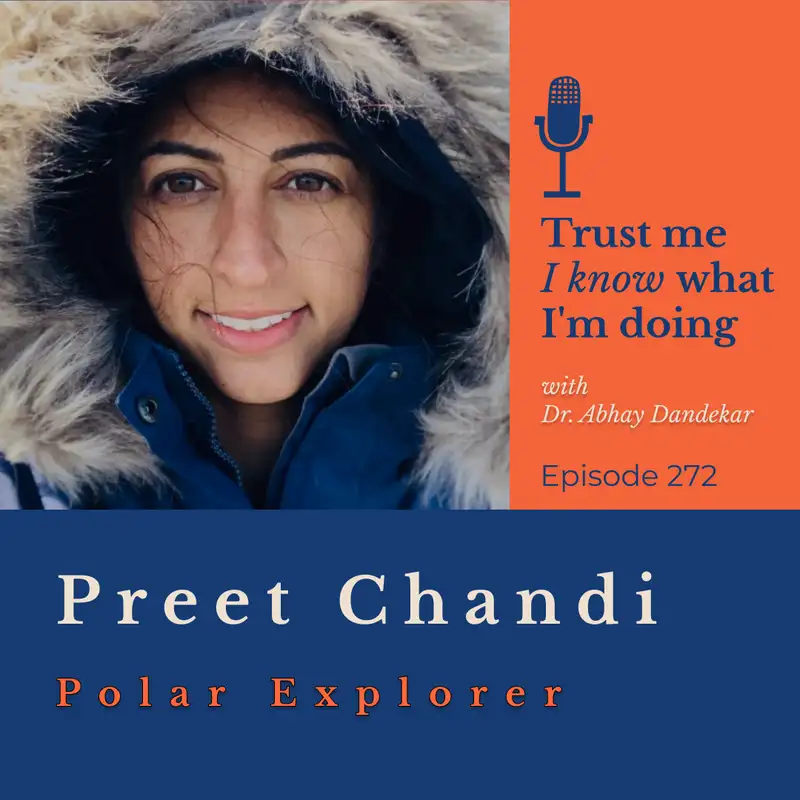
Preet Chandi on Polar Exploration
Download MP3Abhay (00:00.718)
Trust me, I know what I'm doing is brought to you by Travelopod. If you love travel and destinations like Africa, Japan, Antarctica, India, and the Northern Lights regions, then start your next journey with Travelopod. Visit vacation.travelopod.com and explore the wonders of the world.
Hi, my name is Preet Jandi. I am an adventurer. I've done a few solo expeditions to Antarctica and now I'm hoping to go to the North Pole to become the first woman to ski solo and unsupported to the North and South Poles. And this is Trust Me, I Know What I'm Doing.
My name is Abhay Dharndekar and I share conversations with talented and interesting individuals linked to the global Indian and South Asian community. It's informal and informative, adding insights to our evolving cultural expressions, where each person can proudly say, trust me, I know what I'm doing.
Hi everyone, on this episode of Trust Me I Know What I'm Doing, we share a conversation with polar explorer, Preet Chandi. Stay tuned.
Abhay (01:10.83)
I would say with some confidence that I pride myself on having a wandering spirit and a craving for some adventure and some exploration. know, certainly in our DNA as humans, we've crossed across the millennia, sought to scale and traverse and venture far beyond the horizons. And for me, that might mean a nice long hike and the occasional mountain trek.
But for Preet Chandi, her operating framework is on a different level and quite extraordinary. She's a British officer, a physiotherapist, and a record-breaking polar explorer who became the first woman of color to complete a solo expedition to the South Pole. She has since gone on to break multiple Guinness World Records for solo unsupported Antarctic ski expeditions and is using her journeys to challenge perceived norms about
who belongs in the extreme adventure environment and to inspire so many others to push those boundaries and push themselves and seek some of our deepest answers to those questions that we've had internally. I'm so thrilled to welcome Preet Chandi, who is also known as Polar Preet for our conversation today. It's just so great to have you here on Trust Me, I Know What I'm Doing. Thanks so much for joining, Preet.
Well, thank you very much for having me. It's a pleasure to be able to share the story on your platform.
You know, I have to ask you first off, like, so even on a day like today where you're not out there in an extremely challenging environment, do you have any sort of adventurous rituals or routines that might seem mundane to others, but to you actually still fit into the kind of adventuring theme?
Preet (02:53.162)
For me, it's not motivation, it's the discipline. So, you know, here at home, it's comfortable, right? I'm in my comfort zone. I've got my gumball, I've got my blanket that I love to sit with and a cup of tea. And I'm like, I have to train. And it's not nice outside, but getting out of the door is the hardest step. So I will do something every single day because I have to. I've got something very, very big coming up. That's not motivation. That's discipline. It's not because I want to. It's not because it's
pleasant or fun, but I have to get outside and do the training that I need to do.
Are you an internally competitive person, at least even just within yourself or within those day-to-day confines? mean, like you said, getting out the door, doing something, whether that's training or even just keeping yourself motivated. Do you have that kind of internal competitive spirit?
I believe I do. Not with everything, but growing up it was me my two older brothers and I definitely wanted to beat them at everything.
There it is. I think we've just discovered it. Okay.
Preet (03:57.986)
So, yes, I believe I do have that. And, you know, I've had some very, very big goals and it doesn't matter if I don't reach that huge goal. It's still worth going in that direction because, you know, maybe I won't reach this massive goal, but I'll still get so much from the journey on the way. And that's probably one of the biggest things I've learned.
I wanted to, you know, for those people who don't necessarily have that competitive spirit, but they actually just sort of flow with the universe. And there's absolutely an importance to that too. But, know, do you on a day-to-day basis kind of crave those experiences, especially if they help kind of manufacture some adventure out of even the most mundane things. Like, I mean, I struggle to get motivated to fold laundry sometimes, but I mean, you know, for you, do you have to, do you not have to really search too far to find that motivation to
get that sort of competitive spirit or that adventure spirit. And yes, you can probably thank your brothers for that a little bit.
Definitely. I still sometimes do have to search. I think you often crave, you know, where you're not. So I could be on the ice having like a horrific time and I'm craving just being at home in my blanket. And I'm thinking about what my mum is doing or my brothers are doing and, you know, wishing that I was there in the comfort. And I think it's often I'll say to people, don't think about this huge, huge thing. It doesn't have to be. My mum was walking on the pavements in Derby.
while I was on my expedition, you know, and that was her, like, she's like, you know, freaks out there. can walk every day. Great. That is her coming out of her comfort zone a little bit. It could be absolutely anything. And it's not just, it doesn't have to be adventure. could be, it's good for your mental health. It's good to just get outside some fresh air and try, just try this, try not to have anything else on, try not to listen to music. You know, if you can get away from the cars, do, don't worry if you can't and just, you know,
Preet (05:52.938)
whether it's listening to the silence, to the wind, whether there's any animals, to the grass rustling. Even that, I cannot tell you how good that is for you. And it's not very often that we sit with our own thoughts, but I can tell you it's very powerful to be in that position and try and be comfortable with that.
You know, thinking of that, that important internal voice and being comfortable with silence, being comfortable being alone. And I know that's a big part of, of the journey, especially when you're out there in this vast expanse. And yet is it really motivating also to know that peers or loved ones are out there kind of doing their journey on the way and saying that like, yes, we're kind of doing this together. My mom's out there walking the pavement or my friends are doing something that is
motivating them and does that also kind of fuel things when you know that there's community in a way that's either rooting you on or doing their own adventures too?
100 % yes. know, this is and I'm pretty honest, I think there's always the selfish reasons that you want to do stuff. Am I a competitive person? Do I like to push my own boundaries? 100 % I do. But it has always been bigger than me. You know, I'm alone on the ice, but I'm also not alone. I'm carrying my culture, my heritage. I carry it all with me. In Antarctica, I would listen to audiobooks from South Asian authors and I've got their voices with me. My sled was named Simran after my niece.
I wondered if anybody else has had an Indian name for any of their gear on the continent, nephews, sorry, my skis after my nephews. So I have, I feel like it's not just me. feel like they're kind of almost invisible pushing me to go forward because it's not my victory or my win, it's ours.
Abhay (07:40.482)
Yeah, I mean, and that's something that I think spreads not only to just, you know, your loved ones, but of course, entire community with you. When you train or you're preparing for a journey, I think so many people see the headline and the tagline of, you know, someone who's made a record or this like incredible milestone, but they don't always see the kind of quiet, arduous, even very unglamorous preparation that goes behind all that.
What would you say are some of those kind of unseen habits or even surprising habits or disciplines in your training or your mindset that in a way you've kind of had to grow into and have been able to sort of make a difference for for all of these things?
I think with a lot of successors, we see that image, that video, and sometimes you think, it was probably easy for them. They were born into it. I was in the British army and they don't necessarily see the other side. Now, when I joined the British army, I didn't tell anybody in my family because it wasn't the thing that you're supposed to do. They weren't happy with it. I joined as a private soldier. Eventually I became an officer, which was a huge deal. And we did stuff outside, but I didn't know anything about the adventure community. And then I just had this...
crazy idea. I knew absolutely nothing about Antarctica, but you know, went right out there and was like, I'm going to try and do these big expeditions in Antarctica. And I felt like, you know, I didn't know anything about it. So I go on Google, I type in, how do you get to Antarctica? I am trying to ask people for funding. I mean, from our community, people just, you know, had no idea what I was trying to do at all. And it just seemed like, know, preach just trying to do another thing that
We don't understand. I struggled for people to take me seriously. I really struggled for anybody to take me seriously. And I remember people asking me if I was inspired by Shackleton, Arminson and Scott, their big polar names, but I didn't know who they were because I didn't grow up reading them. I wasn't inspired by them. I didn't know their stories. It just wasn't, you know, that background, but I felt like I had to come from that background. So then I said, yes, I was inspired by them. And then I, you know, I went back and changed that.
Preet (09:51.316)
narrative and was like, actually, I didn't know anything about them. But for me, it was wanting to show that it doesn't matter where you're from, does not matter if you don't have the experience. And that's a big one for me. You can get the experience.
do go from the, I want to look up how to get to Antarctica to the way I have to really prepare now to get to Antarctica. And I have to do some things that I've never done before. Even though you've gone through the rigors of being a British army officer, you've marched through some really, really arduous tasks and scenarios. And yet this was something completely different. I mean, when it comes back to making your narrative and really building those blocks and now like actually like putting
know, one foot, you know, after the other and getting there, when it comes to the preparation and the training that now goes from searching on how to get to Antarctica to actually preparing, were there some things that were just pure surprises along the way that you were like, boy, I didn't expect that at all.
So many things, I mean, where do you start? Like you said, I am starting online. I was so nervous to put it out there. You know, so I created Polarpreet, a social media pages website, and you're putting this huge goal out there. You're hoping people, you know, take you seriously, which a lot didn't. You know, who is this person? What's she talking about? It is very, very vulnerable and it scary. But you know, that's why it's out of your comfort zone. There's growth there.
vulnerable place to be,
Preet (11:20.66)
Every time you step out, it's scary. I still get scared and nervous. Like so many things I do. It's not that I'm less scared or less nervous. I'm just used to that feeling. I've been there before. I have been scared before. I've been nervous before. I've been in this position before. And I know it's okay to have those emotions. So getting money was really, really hard. I'm trying to get people to, because it's expensive. Training is expensive. The gear that you need to survive.
in these locations, the sled that I need to drag, there's so much detail. So I was asking anybody and everyone that had anything Antarctica that was on their socials, anything, would you be happy to speak to me? And asking a lot of the wrong questions, because how do you know? You don't know what you don't know. So yes, it's a very vulnerable position, but I really wanted to...
push boundaries. wanted to show that somebody like me, somebody from our community can go and do this thing, huge thing, and show that we belong in every space because I have been in so many spaces where I felt like I didn't belong. I joined the army, you know, and then I became an officer in the British army. And then I wanted to do stuff in the outdoors and then I wanted to go to Antarctica. And the thing is, we do belong in those spaces.
A lot of the time it's just from, you it was my feeling or do I belong in this space? You feel nervous because maybe you haven't seen anybody, you know, from the community do it before and that's okay. You know, you go and you start.
You're listening to Trust Me, I Know What I'm Doing. After a quick break, let's come back to our conversation with polar explorer, Breet Chandi. Stay tuned.
Abhay (13:04.514)
Hi friends, you may have visited Italy and seen the highlights, but exploring Europe or Asia for a more immersive vacation is where the details truly matter. That's why so many trust Travelopod for personalized custom experiences. From small group travel to complex planning for any destination, the pros at Travelopod can help make your trip seamless, affordable, and unforgettable. With thousands of five-star ratings and stress-free booking and support, Travelopod is your trusted partner for unforgettable experiences around the world.
visit vacation.travelapod.com.
Abhay (13:40.11)
Hi, I'm Sanjeev Bhaskar
I'm an actor and a writer and a work in progress
You're listening to Trust me I know what I'm Doing
Preet (13:55.342)
Bye guys, I'm Indra Nooyi.
Hi, I'm Vivek Murthy. I'm the 21st Surgeon General of United States. Hi, my name is.
Hi, I'm Lilly Singh and you're listening to Trust Me, I know what I'm doing.
Abhay (14:11.682)
Welcome back to Trust Me, I Know What I'm Doing. Let's rejoin our conversation now with Preet Chandi. I was just going to ask, what were some of the wrong questions that you may have asked from the beginning? Everyone's like, okay, well, I did all these things, right? And it fell together. But I mean, there must have been some of those wrong questions that you're like, boy, that was a real off base, know, thankfully, I never went in that direction.
Well, just, so I didn't want to go on skis. So I tried skiing before and I was like, I'll probably just run like the distance. It'll be fine to do that, which you know, it's, 700 miles with all your gear and everything in a sled. I just, I didn't know, you know, I didn't know, I didn't know there were no polar bears. That's probably the one that I was embarrassed about at the start. So I didn't know there were no polar bears in Antarctica. and one of the first things I learned was the word Arctic.
comes from the Greek word arctus. That word means bear. is where the North Pole is. So Antarctica itself means no bears. And I think that's one of the things to me. It's just remembering that everybody has a different baseline knowledge and you have the capacity to learn at any age and any time because I had to learn a lot of baseline stuff for this continent. I know literally nothing about it at all. So that was what I learned.
completely clean slate. You mentioned this kind of idea of still getting scared. And, you know, for someone who has had immense amount of training in the army, and like you mentioned, you became an officer and now you've traversed and had these incredible milestones and accomplishments. But I'm just curious in pushing those boundaries in doing these kinds of great achievements.
The basic question for me is like, how has your relationship with fear maybe changed in these experiences? Does the exposure sort of dampen the fear? Do you harken back to some of your army training? Does that resolve take a lot of patience and maybe some practice as to how to dampen those fears?
Preet (16:18.414)
100 % time helps. And the thing with the military is I had other people around me. So when I was in situations, I'm part of that team. And when I've done these expeditions and even though I know people are supporting me back home physically, I'm, I'm alone and that's scary. That's it's, you know, even the lead up to the trip is scary. You're caught. feel like you're constantly on. I will wake up in the middle of the night and write something in the notes of my phone because I don't want to forget that.
to that, you know, and it becomes quite overwhelming and quite stressful. And then the fear, I think you get used to feeling that emotion. So I, you know, so maybe that does dampen it. It's still there. I still have the fear, but it's not going to stop me from doing something. And it's not that I go into stuff just thinking, I just want to do that. You know, I've served in the military for a long time. I will do risk assessments for everything.
I want to know what the risk is. want to know how I can mitigate that risk. You know, what am I going to do if that does happen? So there's so much planning and preparation that isn't just, I want to go and do this adventure. And you know, there's, dangers involved as well. it's, it's, yeah, it's important to remember all that. And it's just repetition over and over again. I am, I did some training not that long ago, actually, to try and acclimatize to fear in the Arctic because there are polar bears in the Arctic, which
It was not something I had to deal with in Antarctica. that was scary. It was really, really scary. And I thought, okay, how can I just acclimatize, but not make it too dangerous? So I would do like two days out and then back in, two days out and back in. And I took a dog with me as well. So yeah.
I mean, you know, in that way, when you're in the army or when you're going through these simulations, there's always this kind of backup there, right? That like, there's somebody else who I can bounce this off of. But yet your, your expeditions are solo and you're out there alone. So in that idea of coping with these things, it's always so much more comfort when you have someone with you. yet when you're alone, there are particular ways that you were able to combat that.
Abhay (18:30.988)
lack of companionship or even just the human aspect of being bored, that stagnancy that sometimes that sets in and yet you always have to stay alert and always have to stay sort of mindful of things. How did you grow, I guess, more comfortable with?
So in Antarctica, I sometimes, I'd listen to audio books and I tried to really immerse myself in that story and these voices that I had with me. And then, you know, I didn't always listen to things. Sometimes I would do things just like count genuinely to a hundred over and over again. So with every step that I took forward, it'd be one, two, I'd have finding, I'd have, sorry, Dory in my head from finding Nemo saying, just keep going instead of just keep swimming.
I'd sometimes say, could you, why could you keep it there over and over again? Because it's something, you know, I'm known from as a child. I think just to give me that, you know, whenever I've been afraid, I've always used it since I was a kid. Um, so I, there's so many different strategies. It's often not big picture. If I'm scared, you know, I think I break it right down. I, or I think of a happy memory, you know, what I'll think about something at home of a happy memory to try and, you know,
and make me feel better. In the Arctic, it's a little bit more challenging because you have to remain very, very vigilant. The ground is changing around you. I'm basically on sea ice, so it's shifting, it's dynamic. There are bears. So you're exhausted in a very different way. And that's hard. How do you prepare yourself for the hardest thing you've ever attempted? So that's where I'm at right now. So I try to go back to the most
difficult times I ever had mentally. I go back to that time, I remind myself of it and I think, you you got through those times. And if I can do that, then, you know, I can get through more mentally tough times.
Abhay (20:25.536)
One would think that perhaps in the Arctic with more motion involved that there will be some Bangra music somewhere in there. You've described yourself and I mean, even just hearing that, right? That just sort of like the simple things are the things that keep you going. And you've described yourself as someone who, you know, very, in a matter of fact, a way has that simplicity of just being a Punjabi girl from Darby. And then then on top of that, you build these complexities of being a seasoned British army officer and now
the first woman to do a solo Antarctica expedition on the continent. How do you balance that idea of pride of being somebody who's had some humble beginnings and the hunger of that ambition and sort of explore that ambitious exploration? How do you balance that sort of ambitious exploration with the humility and the growth that constantly has to be there as you embark on some of these new challenges and especially ones that are just like you said, completely unknown.
The humility is so, important. And I think just of the background, me and my brothers in our entire family were the first people that had the opportunity to play a sport. So to be given, and yes, I'm not saying I had boundaries, but what were they compared to what my mum and my grandma had? So the opportunities I have, so there is no way I can take that for granted.
Yeah, I'm so, so proud of my background, my community that, know, and I will go in, you know, when I'm there, I'm alone. And even I get to the South Pole, there's maybe one, two people to meet me there. And it's a small community. And I come back and I do interviews and I go into a room and do a talk where there's our community. And there are some things I just don't have to say because they know, you know, they understand what this actually means.
Because people would say, what does it matter? You know, you're a person. Why does it matter as a woman of color? Why does it matter as somebody who's Punjabi? But they know in that room and they feel it just as I feel it, you know, and I don't have to explain it. I don't have to talk about the boundaries. I don't have to talk about how hard it was to even get to the start line and how, you know, to move forward through that. So it is incredibly powerful. I might, you know, of course I'm still ambitious and it's not the
Preet (22:54.464)
because somebody asked me before, do I care about the world records? And, you know, I'll be honest, some of those records came and they stayed in their boxes for months. I didn't open them and put them on my wall, which is silly really. I didn't want to, I wouldn't want to be too showy. And it's funny because it's my own home, you know, so I can be if I want to be. But also it's, I think it gave me the platform that I wanted to say what I wanted. so that part of it was important to me because the best thing I've
ever seen is a young girl dressing up as me for World Book Day. And whether that young girl wants to be an explorer or not, the fact that she believes she can be is huge for me. I didn't know what an adventure and explorer was growing up. You know, I just want to make noise and I want to make it with my actions so loud. That's what I want to do.
No, amazing. And I mean, if you think about sort of the amount of inspiration that's out there, and like you said, some of it is just absolutely an unspoken, quiet, you know, connection, because those in the community who can actually relate and this all resonates with and yet it's important to call out, right? I mean, you are an adventure athlete of color. You are a Punjabi woman. You are a Sikh.
woman, you have a South Asian background and all those things are so important. In that same vein, I'm just so curious if you've been able to reflect a little bit on this piece, which is what if you actually had to unlearn about yourself or even let go of to achieve that success and even for that matter, be comfortable with that success.
Yeah. So that I would say growing up. So I feel like we've always been told to be a bit quiet, to be respectful and you can still be respectful, but have a voice, not be showy. And I realized that as I didn't want to put my own Guinness world record certificates up in the house, why would I not want to do that? And that's from growing up. And even now, some of the things I'm like,
Preet (24:53.198)
On my Instagram bio up until two months ago, it just said breaking boundaries. I was like, oh, don't want to put the records up because I don't want to be too showy. I'm like, what? I've achieved this. So that is something. It's okay. And that's not me. I'm not arrogant. I can be confident and not arrogant and that's okay. I can have a voice. don't, having answering back isn't being disrespectful. And I can still be humble. can still say,
Those are things that I had to unlearn.
It's so interesting. First off, that's such a lovely sentiment, right? I mean, like it's important to have that self-confidence and be able to express that. And where I think that is a huge challenge for those. And I feel somewhat of the same way where I don't want to be showy or I don't want necessarily the attention on me. yet.
In a way, I have to actually have that attention sometimes, especially for purposes where we were just talking about before we started this in things like that are realities like fundraising. so as you are now, you know, going on your next exploration and experience trying to reach the North Pole and perhaps the first and critical part of this always comes from being able to pay for these kinds of trips and raise the funds. Maybe you can explain a little bit of what's involved.
in finding sponsors, fundraising, and the costs actually that are involved for both training and completing these excursions as an adventure athlete. And again, right, it goes back to this whole idea of like, well, boy, I don't necessarily want to be showy and, you know, express that confidence. And yet that's part of this entire experience too.
Preet (26:38.432)
Yeah, a hundred percent. So I, start with, I was just sending emails blind to anyone I could think of, any company going into their website on their inquiry pages. And I still do, to be honest. So anybody that could be interested, anybody I speak to giving them cards, know, giving them a pitch because, know, fair enough, people say, okay, how does this benefit us? What can, what can I give in return? Which is a completely fair question. You know, it's not just people funding my goals and my dreams.
How can I relate that to businesses and you know, that planning, preparation, that going into risk, but mitigating the risk as well. Having these big goals, but having these tiny little goals on the way. And if you do fail, because I failed one of my trips in Antarctica, which hit me quite hard. What do you learn from fail? How to fail? Do companies support failure? Which man, that failure hit me really hard because I don't think I've ever been told in my life that it's okay to fail.
I tell you what, I learned more from that failure than I did any of my successes. And because of that trip in Antarctica, the one I failed, I then went and got another record, which I don't think I would have been able to do without it. And because of that failure, I'm going to do something which is insanely hard. Nobody has done from Canada in 11 years. No woman has ever been solo to the North Pole. Only two men have done it solo and unsupported. So it's so, so hard, but I'm not as scared of failing.
So, you can't fail unless you try. So might as well try. So for me, fundraising is so many avenues. I have a GoFundMe page. I speak to companies regularly, you know, and then a lot of chasing people, a lot of, spend a lot of time on my laptop trying to chase people and the figures it's well into six figures. It is very expensive. We're talking about the remotest places on earth. You know, we're talking about the edges of the earth, literally.
Trying to get to my start point. Nobody lives there like this far in Northern Canada on Ellesmere Island. And then trying to get support on the sea ice. So Antarctica is on land and during my expeditions, I have 24 hours of daylight. There's logistics companies that have supported my expedition there. In the Arctic, I'm on the sea. So I'm moving on sea ice. That is shifting and moving. So I literally have to climb over big blocks of ice.
Preet (29:02.624)
And then there's open water. So I will have to get an immersion suit on, get into the water, swim to the other side, drag my sleds over and they're a polar bear. So I have to carry a fire on with me. And I will start with some hours of darkness. It will be about minus 50 still at the start. And because I'm literally on top of the sea, that adds to the coldness and the humidity. it is everything. Like the first two weeks of this trip, I think will be harder than anything I've ever done in my life.
You're listening to Trust Me, I Know What I'm Doing. After a quick break, let's come back to our conversation with polar explorer, Breet Chandi. Stay tuned.
Abhay (29:43.854)
Hi, I'm Abhay Dandekar and if you have an animal in your life that you love, then I want to introduce you to the Timber Dog Rough Rest, the only dog bed you'll ever need. The patented Rough Rest is compact and light with over 14 travel features, comes in three sizes, and has everything from essential storage to even a built-in sleeping bag. The New York Times Wirecutter calls it a versatile, portable dog bed with lots of extras for traveling or camping. Go to TimberDog.com to explore Rough Rest
The only dog bed you'll ever need.
Abhay (30:19.586)
Hi, I'm Krish Ashok, author of Masala Lab, the science of Indian cooking and you're listening to Trust Me, I'm Know what I’m DOING
I know what I'm doing.
Abhay (30:33.624)
Hi, this is Farhan Akhtar
Hi guys, I'm Ananya Panday. I'm Kani Kusruti. This is Vidya Balan.
Hi, is Madhuri Dixit and you are listening to Trust Me I Know What I'm Doing with Abhay Dandekar.
Hey there, I'm Abhay Dandekar and you're listening to Trust Me, I Know What I'm Doing. Let's rejoin our conversation now with polar explorer, Breet Chandi. You mentioned the arduous kind of barriers, right? It seems like this obviously the most arduous and really death-defying obstacle course that there could be here. And yet all those things...
they do amount to being able to just keep going, right? That whole kind of Dory mantra that's out there. Is this something that you've grown into and matured with as far as like being able to like get back up and go beyond the sort of like day-to-day failures? And of course, knowing that the risk of some of these failures actually could mean the difference between life and death sometimes. And what's your approach been, especially as you've grown as an adventure athlete, as...
Abhay (31:43.596)
an explorer, you know, have you been able to maybe think about your own fragility in a way as you go about doing some of these things?
So I always learn from my mistakes, first of all. So I've made mistakes and I write them down immediately in a pencil or paper that I have with me or on my phone so that I can take accountability. There is no space for me in that environment to say, but it was all these external factors. Of course they are there. You cannot change them. What can I change internally? What mistakes did I make? In every trip, there's something. It could be very, very small, but I can't afford to make
those mistakes going north. It's just, it's too much. Like you said, it's much, much more dangerous if I'm honest with you. So it's also, I go into these knowing that I'm not the only person that can pull me out. There's another person that can pull me out. And it's so important to have that because my head, when I'm on a trip is solely on that trip. I struggle to concentrate on anything else outside of that. is incredibly challenging.
On the trip that I failed in Antarctica, that was 70 days, solo and supported. I finished losing 20 kilograms of fat and muscle. That was about 40 pounds. And I was so frail. I had run out of pain relief. I was running out of food. I was not in a good way. So at that point, as a logistics company, said you need to stop. I don't know if I would have made the decision. I hope so. But it's made for you because it needs to be. So I think there's so many things in the preparation.
it can't just be on me. That's too dangerous. And it's a dangerous trip.
Abhay (33:24.69)
Is that a vulnerability or at least an acceptance of that vulnerability that took a little bit of, I didn't even know what the right word is, but it took some time maybe or some patience for you to have to get there.
Yes, so my first trip I did 700 miles to the South Pole. My second trip I wanted to be the first woman to cross the landmass. And I'll be honest with you, I had done the training. I'd been to Antarctica before. I'd done a big part of that distance. I thought I could make it. And there was no part of me that didn't think I wouldn't make it at all. Not because I thought I was being arrogant. I've done the right preparation and not making it absolutely broke me. That put me in a very vulnerable place. And it took me the year to recover from that.
you know, accepting failure and how that made me feel. And, you know, if I'd go back again, and, and it was hard, it was a hard place to sit in. It's not fun. I don't think it can be accelerated, but I also think it's good to sit in that. And I felt empty for, for quite a while actually. And then I decided to go back and get, a speed record, which
I learned from those mistakes and the vulnerability as well. And it's not, I'm not the most patient person, especially with myself. I'll give advice to others that I wouldn't take necessarily. And I had to have surgery on my leg, like I was injured as well. And I remember like buying a coloring book for myself. I didn't touch it once. Like I just wanted something to make me feel better. I'd binge watch things on Netflix. And normally I would exercise or walk to make myself feel better, but I could walk
two minutes and then I'd feel exhausted out of breath and nobody really understood that I don't want to see people because I've just come back from a big trip. So I'm at my mum's house and she'll say, you know, Auntie just wants to come and see you. I'm mum, don't want to see anybody. And then she was like, no, she just wants to see me. I'm like, no mum, they want to see me. And I'm telling you, I don't want to see anybody, but you know, of course they don't understand boundaries. So then people would come and I just.
Preet (35:34.138)
And nobody could, well, I say nobody could see it. I didn't look great, but mentally I was in a dark place. and I just couldn't cope with it. So I'd often then just remove myself from the room and go upstairs and, know, and, and I don't think many people understood why after being alone for 70 days, I wouldn't want to be around people. And everybody wants a piece of you at that point as well. but that was hard and that was a very vulnerable space for me.
But then looking back, you know, it wasn't fun at all. It was horrible. Looking back, I go to it for strength. I look back at that time and I draw strength from it.
Do you, especially this story that you just told of the setbacks, the idea that even after this long time away and whether you've actually succeeded or not, that you actually need some either time or space to just reset? Does the word adventure mean something different to you after a trip like that? Does it mean something different to you now compared to...
when you were a child or when you were trained to be a physiotherapist or even in the army. mean, has that word, perhaps the meaning of that word changed at all throughout your life?
It has. So I'm going to change it slightly to exploring because people will say to me, you know, exploring is going to a place where nobody's been. So you're not exploring. And I think actually exploring is going to a place where you have never been. We tell kids to explore all the time. So, you know, I'm exploring in places I never thought I would ever go. I didn't dream about as a kid because I didn't know anything about it. An adventure to me, you know, as a kid.
Preet (37:17.322)
would probably just be doing something new, doing something different. So it's just grown, know, they're just doing something different. It's just much, much bigger. And I don't think 10 years ago, if you told me that I was doing these things, I don't think I'd possibly believe you. mean, I went from university to working in the National Health Service to joining the army. you know, all, and because, you know, I thought this is what I need for financial stability.
and leaving the army, that was hard. You know, I'm suddenly going into something that's very different from anything I knew.
Yeah, completely different dimensions of exploring for sure. Let me get you out of here on this in the way that you're pushing boundaries and those accolades that you've collected in a way are now the motivation to even go for your next exploration, if you will. I wanted to figure this one out or at least query you about this one. When people meet you for the first time,
or even learn about your work for the first time, what do you hope they take away, but particularly learn about themselves after meeting with you or hearing about your work?
I would want them to just take away that I'm another normal person. And if I could do something so huge that they could go and try whatever it is they've been thinking about, or that's at the back of their mind, and no matter how overwhelming their own goal is, just take the first step. And that first step could be tiny. That is okay. It could be, you know, typing it onto Google, on your whiteboard, writing it down, telling a friend. That's what I hope.
Abhay (39:00.29)
Well, I'm sure whiteboards across the world are going to be a little bit different hearing about your explorations and all your achievements, but I know that the inspiration is always there. Preet, thank you so much for joining us. We wish you absolutely the very best and we hope we can visit with you again down the road.
I hope so, thank you very much for having me.
Thanks so much, Preet, and we are wishing you all the best for your training and the Arctic journey up ahead. Please check out all of Preet's work at polarpreet.com and the GoFundMe link in the show notes as she attempts to become the first woman to travel solo to the North Pole. Remember to be kind to each other and to the planet, and thanks again for listening and sharing this with all your friends. Till next time, I'm Abhay Dandekar.