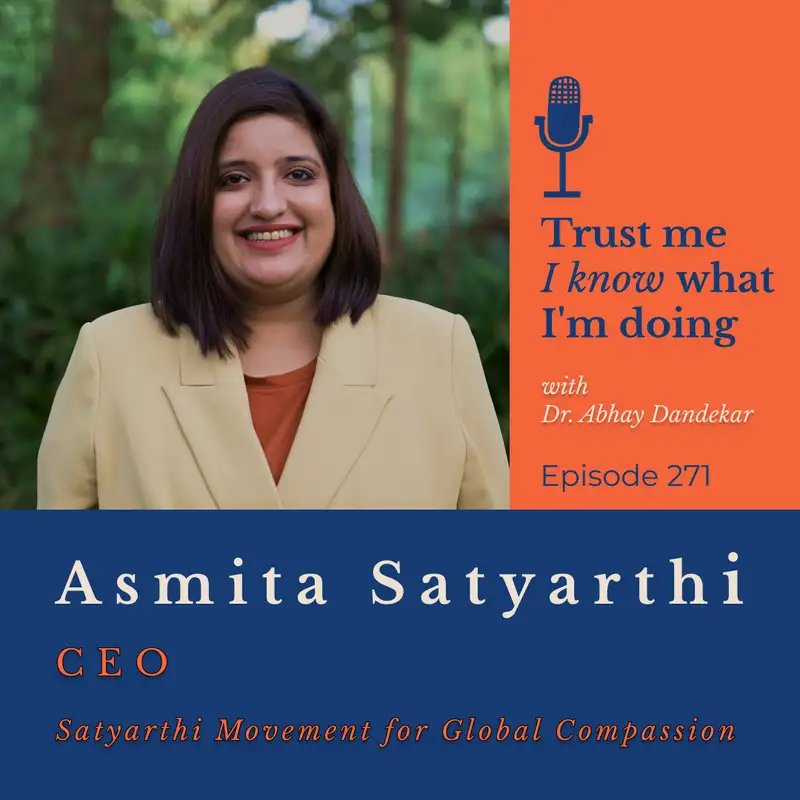
Asmita Satyarthi on Compassion, Everyday Leadership, and Global Justice
Download MP3speaker-0 (00:00.566)
This episode of Trust Me I Know What I'm Doing is brought to you by Travelopod, with personalized travel support to help you explore the wonders of the world. Start your next journey at Travelopod.com.
Hi, I'm Asmita Satyarthi and I'm the CEO of Satyarthi Movement for Global Compassion. And this is Trust Me, I Know What I'm Doing.
My name is Abhay Dhandekar and I share conversations with talented and interesting individuals linked to the global Indian and South Asian community. It's informal and informative, adding insights to our evolving cultural expressions, where each person can proudly say, trust me, I know what I'm doing.
Hi everyone, on this episode of Trust Me, I Know What I'm Doing, a conversation with Asmita Satyarthi, the CEO of the Satyarthi Movement for Global Compassion. Stay tuned.
speaker-0 (01:00.15)
It's 2026, and even with a new year, we're reminded of age-old challenges where we're constantly faced across the globe with conflict, inequality, and indifference. And I'm always awestruck by leaders and change makers who can actually move us forward through vision, power, money, technology, and political will. And of course, it's time for more of us to think about the ultimate transformative tool in our human arsenal.
And that of course is compassion. It softens the edges of every difference that we have, and it makes even the coldest moments and events bloom, of course, with hope and kindness. And most importantly, it teaches a very weary world that we live in to choose love and act with the very best that our heart and soul has to offer. And keeping with that focal point, especially in this conversation, I'm so pleased to be joined by Asmita Sethiarty, the CEO of the Sethiarty Movement for Global
passion, of course, inspired by her father, Nobel laureate Kailash Sattarthi. Smita has led numerous movements to drive change in areas of equality, justice, peace, and sustainability with deep, deep experiences at the grassroots and institutional levels, whether it's training the next generation of leaders and teams to impacting communities across India by confronting child labor and exploitation, poverty, health and education and gender inequities.
Asmita has had a absolute front row seat to the tremendous value of compassion as an accelerator for everyone. After all that, I am absolutely so pleased to welcome you Asmita and thank you so much for joining us on Trust Me, I Know What I'm Doing.
Thank you so much, Abhay. It's an absolute pleasure to be here.
speaker-0 (02:46.126)
You know, I know for a fact you've had a front row seat to this entire movement for a long, time, but I wanted to reflect back for a second and ask you as someone who has had a seat at the table at many conversations in so many different places about this, but I wonder for you how this idea of compassion truly connects everyone every day at the most basic of levels. What's the kitchen table conversation about compassion?
What does that look like for you?
So, you know, we absolutely believe, very aligned to what you said in the introduction, that the world is burning. You know, we're at a stage where we've never been as rich as we are today, as technologically advanced as we are today.
powerful as we are today. But at the same time, know, look around us, you know, on one level, there's wars, conflicts everywhere. We are dividing ourselves at every level. Inequalities, injustices are all pervasive and extremely systemic in nature. And we don't seem to be getting anywhere. You know, over 470 million children live in conflict affected areas. Global warming is getting worse at every, every level. Right?
So, and at the same time, when we talk about individuals, isolation is very much an epidemic, know, loneliness, attention spans are getting shorter, our connection with fellow human beings is disappearing. So at this stage, we truly believe in the innate power of compassion. We believe that we, all of us are actually born with compassion, but, you know, along the way layers get formed.
speaker-1 (04:31.584)
and we lose our ability. In fact, at the Satyarthi Movement for Global Compassion, we are redefining the word compassion to mean mindful problem solving. We're saying that compassion is when you feel that somebody else's suffering or problem is actually your own. So in essence, you form the deepest connection you can with a problem or a suffering. And that connection is so powerful that it compels you.
to take action to solve the problem. There's a force that emanates from that connection and you can't sit still. You have to find a solution and you do it in a mindful way and pragmatic way. So you look at the entire ecosystem in which the problem exists and then you solve it in a way that is both systemic as well as sustainable in nature because that's what the world needs today.
You know, it's a completely I wouldn't say it's a different framework because of course it's innate in all of us. And yet we're not forced to think that way on a day to day basis. We don't find ourselves in situations all the time where we are constantly pausing and we're thinking, can this actually be my modus operandi to think always? So, you know, when you've worked at the intersection, particularly at big levels of policy and activism and grassroots change,
Is there a moment that you've had that stands out to you where compassion has tangibly shifted the outcome of a difficult situation? Just like you just described to, you know, so elegantly that this is the kind of conversation we should have at the kitchen table. Have there been some moments that have stood out that said, yeah, even at the very, very large macro levels, compassion has been the actual like changemaking device that has actually shifted a difficult situation.
Yes, yes. So, you know, there are many such examples. In fact, you know, we believe that all great religions of the world, all great social movements of the world were born out of the spark of compassion where, you know, somebody felt that, hey, you know, these are my people, this is my suffering and I have to stand up to take action, whether it's Ram, whether it's Krishna, whether it's Jesus, whether it's Mohammed, you know, everybody felt, you know, this innate need.
speaker-1 (06:52.504)
to solve the problem of others as their own problem. So at the largest level, feel that compassion has driven the basis, the foundation of religious movements or social movements that impact change. At a personal level, there are several movements from our 40-year-old journey. Essentially, when my father, Mr. Kailash Satyarthi, started the work, I actually grew up in a household where rescuing children was a way of life.
right? And every time a child was rescued, a lot of times people would ask both my parents, you why are you doing this? You know, you could be you're an engineer, you could be making money, you could be going abroad, you could be doing a lot of different things. Why are you doing this? And he would just look at them and say, what if this was my child? What do you know, if my child was trafficked and abused and exploited?
Yeah.
speaker-1 (07:47.52)
and raped and all kinds of horrible exploitation was happening to my child, what would I do? Would I sit still? Would I talk about it? Or would I stand up and take action?
And that idea of, you know, at the ultimate historical and, you know, religious level to, of course, the ethos that you grew up with. Not everyone thinks at either of those edges. Right. And, you know, especially at the corporate level or the policy level, these are difficult conversations for people to actually engage with because they seem so abstract and they seem so intangible.
And yet what you just said, right, like, you know, that idea that something is so deeply personal, do you have to train people to think that way of like, okay, well, what was, what if this was happening at your, at your family level or to you personally? Like, how would you react or respond? Is that a shift in thinking for especially corporate or institutional leaders that you help?
So you'd be surprised Abhay, so you know when we launched the movement, we launched it last year in March 2024. Since then we've been socializing the idea across different sectors, right? And we actually started to target two sectors which we felt were vital for any kind of real transformation, but at the same time might be difficult for us to get our point across. One was judiciary and the other is corporates.
And I mean, honestly, I was as surprised as anyone when we saw the receptivity and the beauty of how quickly people resonated with the idea. We did a round table with 15 Supreme Court justices in India, some current Supreme Court justices, some former. And it was such a beautiful conversation, the idea of compassionate justice.
speaker-1 (09:41.474)
which essentially means fast, fair and equitable justice delivery, resonated so deeply and it's so practical in a country where millions of cases are pending, people have to fight for justice every day of their lives. The idea that we could have a victim-centric approach where the justice system acts in a compassionate manner, not to absolve criminals of their crimes or anything like that, but...
to actually hold them accountable and solve the problem in a way that works not just for the individual, but for society at large and for the justice system ultimately. So that was a really beautiful idea. And we are working with, you know, Chief Justice of India, Justice Surya Kanji, as well as Nal Sahib to launch a large-scale training for judges across the country. And we're also creating a bench book for judges. And this is obviously an idea we want to take to the world.
So we're also partnering with an organization in the US to work on this idea of restorative justice. And it's in very nascent stages, but we're truly excited about it. The second is corporates. So, you know, of course our movement has a history of partnering very closely with a business. So, you know, Mr. Satyarthi, launched the Raghma.
which was the world's first social monitoring label, you know, to signify carpets made free from child labor. And at that time, you know, he actually in the nineties, when he came across the pervasive issue of child exploitation, child trafficking, severe child labor in the rug making industry, he flew to Germany and he appealed to the innate compassion of the rug manufacturers, right? And then they came together and found the solution, again, the solution centric.
Compassion is solution. Compassion is problem solving. Which was super successful.
speaker-0 (11:33.432)
When you talk to corporate leaders, judicial leaders about this, how do you help them see this without practically losing their competitive edge sometimes or the accountability that they have? Of course, in the initial reactions, everyone is aghast to hear that these things happen. And yet is it kind of surprising to them that it's actually happening under their own watch?
Sometimes yes, yes and no, you know, it depends really, but I think what we're really trying to do is shift the conversation. are saying that absolutely profitability is, you know, what businesses exist for, but at the same time, you know, profitability can coexist with accountability, with responsibility, and not just for supply chains and exploitation within the supply chains, but also for their own people. You know, what kind of leadership.
Are we propagating as an organization and the idea of compassionate leadership where, know, whether it's the CXOs, the board or senior management, middle management of the organization behaves in a compassionate manner for all involved seems to be resonating very well. In fact, I have traveled to the US, you know, given a talk at Aveda for
all of their leadership and their salon owners and it resonated beautifully and we're in talks with them to actually develop an experiential learning experience for their senior leadership. We're doing that actually with a number of corporates here in India and outside because it's so important and we definitely believe that compassion can be enhanced. So to that end, we are developing something called the Satyarthi Compassion Potion.
which actually outlines the journey from awareness to action. So, you know, first you become aware of the problem, then you connect with the problem, then you start to feel, and then that feeling beautifully, you know, results in a force that moves you towards a pragmatic solution, finding a pragmatic solution to the problem and take action essentially. So we worked very closely with McKinsey.
speaker-1 (13:36.878)
create an entire strategy for this. And because, we really do want to partner with institutions that exist, right, across sectors. the idea that this can actually be percolated across corporates and other institutions. The idea of compassionate healthcare is another one, you you know better than me, the issues that exist, right? I mean, we came across a study, even for critical care, where if I think it was John Hopkins,
where if a doctor spent even you know five extra seconds with a patient hold their hand and say you know I'm with you in this the impact is tremendous so the idea that yes of course you need to practically you know solve the problem you cannot get empathy fatigued and here is what the difference is between empathy and compassion because with empathy you feel for the problem but with compassion you know you not only feel but after the feeling stage comes the stage where you create a healthy distance
between yourself problem. So you are connected very deeply but you give yourself that space to take action.
You're listening to Trust Me, I Know What I'm Doing. After a quick break, let's come back to our conversation with the CEO of the Satyarthi Movement for Global Compassion, Asmita Satyarthi. Stay tuned.
speaker-0 (14:58.008)
Hi friends, you may have visited Italy and seen the highlights, but exploring Europe or Asia for a more immersive vacation is where the details truly matter. That's why so many trust Travelopod for personalized custom experiences. From small group travel to complex planning for any destination, the pros at Travelopod can help make your trip seamless, affordable, and unforgettable. With thousands of five-star ratings and stress-free booking and support, Travelopod is your trusted partner for unforgettable experiences around the world.
visit vacation.travelapod.com.
speaker-0 (15:34.84)
Hi, I'm Vivek Murthy. I'm the 21st Surgeon General of the United States. And you're listening to Trust Me, I Know What I'm Doing.
speaker-1 (15:50.606)
Hi guys, I'm Indran Nooyi. Hi everyone, this is Shafiq Askhanna. Hi guys, this is Amit Khandan. Hello everyone, namaste. I'm music composer Ricky Cage, Grammy Award winner and United Nations Goodwill Ambassador. And you're listening to Trust Me, I Know What I'm Doing.
Welcome back to Trust Me, I Know What I'm Doing. Let's rejoin our conversation now with Asmita Satyarthi. Let me ask you this. At the heart of all of this is it is thinking deeply about others. It is sort of like moving to problem solve and find those solutions in that era where there is just an absolute universe of stakeholders, right? Involved in every single step of the way, whether it is in the judicial system, in the corporate world, at the healthcare field.
You name it. And the idea of where capital and power and knowledge is placed is in seemingly in the hands of so few when those who are actually really needing it and the equity of that knowledge and power and capital needs to be shared so widely. How can people in leadership and otherwise, how can they practice exactly what you just said, whether it's thinking about a compassion quotient,
or whether it's thinking just more deeply or even for the first time thinking about compassion, how do you hope that that equity can coexist a little bit differently in some of these institutions?
So, you know, like everything else for real transformation to happen, the approach has to be top down and bottom up. And ultimately it has to lead to compassionate policy making. It has to lead to compassionate policies within institutions, know, compassionate practice, compassionate action at every level. And, you know, we are really trying to do this in a very practical way. You know, I keep coming back to the word because I feel that, you know, a lot of people talk about these things.
speaker-1 (17:45.922)
But when it comes to real action, sometimes we take a little bit of a backseat because everyone loves the sound of such things. really are focused on getting it done. And our inspiration actually comes from the grassroots communities of India.
So, you know, we have compassionate communities or Bal Mitra Grams. So the program started in 2001 as Child-Friendly Villages, which became this super impactful award-winning model for resilient communities. And essentially the idea is how does a community emerge as a problem solver through the power of children, to the power of youth, to the power of women.
So, you know, the three most important stakeholders for transformation that we've identified are children, youth and women. And they make these democratically elected councils where they sit down and they identify their problems and they actually solve the problem. And I'm very excited to report, you know, recently we did this impact evaluation, which shows very clearly the impact that we've had on culture change or behavioral change in a very deep manner. So even communities where we've pulled out 15 years ago.
20 years ago, the impact is still there to be seen. And here's where we are drawing our lessons from, know, from these brilliant, brilliant young people and women who have been at the forefront of driving transformation to create a community, you know, which protects its children, which is focused on fighting, you know, systemic discrimination. So, you know, that's the kind of learning or lesson that we want to now bring to institutions around the world.
And we've begun our journey, you know, in Bhutan, we launched a curriculum, a college curriculum at the Jigme Singhe Wanjok University last year as a pilot, which was a great success. We also did a summer school, Satyathi Summer School, the first ever, where we brought in 25 young people from 11 countries around the world. And they spent a month with us, you know, seeing our grassroots communities.
speaker-1 (19:45.806)
spending time at Balashram, which was the country's first long-term rehabilitation center and what we call the Laboratory of Compassion. And, you know, they've gone back and they're doing all these incredible things.
Yeah. You know, I hear all of these wonderful items when leaders hear this or when they see this in practice and they see the models that are out there at the grassroots communities, you know, whether it's at a badass or even a village or a community that you've left in the past. Are they practicing this? Meaning that like, does it actually require some iterations to get to a point where you feel very, very comfortable doing this? Because
in a corporate environment or even elsewhere, these are not the systems that people work with on an everyday basis. So it can be quite a dramatic shift away from the way that they usually govern things.
Absolutely. So, know, what we normally see is that human beings are all the same at the core. So, you know, when these corporate leaders who've probably never even been in such communities or, you know, even other world leaders from different walks of life come and spend time with a child that has been rescued from slavery, but has now, you know, risen up to become a really powerful champion for change.
or is going to Harvard, for example, or is becoming a doctor and doing research, trying to work, save humanity in a different manner using medical science. They see the power of the human spirit. They see the courage and the conviction that can come, and they see the power of compassion firsthand, which we've seen can be really inspirational for so many. And what is beautiful is,
speaker-1 (21:34.584)
how they go back and try to implement some of this in their own environments. Obviously, their sphere of influence is very different, right? So it's about what we are hoping for, honestly, is that everybody finds this compassionate leader or compassionate human being within themselves, right? And whether it is their families or their social circles or their institution, they are able to stand up and take compassionate action.
in a very organic and natural way. So, you know, what we're looking for is not something that comes from the outside, it really has to come from within and also applies to the self, which can be really powerful. So, you know, we have defined compassion in four forms. One is self compassion, social compassion, in compassion and transformative compassion. So these four different types of compassion can be, you know, innate and manifest themselves in beautiful ways.
So, you know, can prevent burnouts for leaders, for example. You know, how are you connected with yourself? In fact, sometimes self-compassion becomes the most difficult to practice. You know, I've been experimenting with it. Yeah. And it's fascinating to see how can I, you know, almost dispassionately see myself as another and then identify and work towards solving my own problem.
Yeah, yeah, no, I mean, there's there's so much to be to be explored and experimented with. And it does require daily practice. I know that leaders when they see impact and value and ultimately see how it changes their bottom lines, whether it's internally in their own corporations or their own ecosystems or in the people that they they deal with. But I love how you use the word beauty and inspiration there, because at the end.
All of these are innate human qualities and they do exist in a sort of very beautiful way and they inspire us. You're no person who's a stranger to that. You grew up around very powerful ideas of justice and equality through your parents. And I'm so curious, how did your own understanding of compassion evolve from your childhood to the work that you do today?
speaker-1 (23:45.102)
That's a great question. I think, you know, absolutely I grew up seeing all of this firsthand and it became deeply embedded, you know, when we would spend time with children rescued from exploitation. At the age of 10, I got this beautiful opportunity to go to the U.S. and, you know, testify at a congressional hearing.
and then also speak out at the Canadian Labour Congress with a gathering of over 50,000 people. In fact, one thing led to another and they came in and they supported the creation of Balashram, which is why Balashram is also very deeply personal to me as a 10-year-old. And then at the age of 13, I actually participated in the global march against child labour. This is a march where the entire world...
more than 7 million people. So 7 million directly and then up to 15 million otherwise march together from three corners of the world to meet in Geneva where the ILO Convention 182 against the worst forms of child labor was created and then testified. On a personal level, so my parents are actually crazy. So they taught us to question everything very...
well upbringing for you know from Indian parents. I wasn't even given a last name so on my passport it still only says Asmita because they wanted to make a statement against the caste system and then later for logistical reasons and stuff I started using Satyarthi because you know US airports were not very kind to somebody.
Yeah.
speaker-0 (25:17.4)
With a single name, right? Yeah. Right. You know, your lens and your dashboard of the common things that most children and teenagers go through, say, on a global level, your lens and your dashboard had a much different vantage point where you got to see some of these things get transformed, both from the
What are you trying to be Madonna?
speaker-0 (25:46.286)
what's the realities of what a child's life might be like out there and to the impact of what it could be like when some of these transformations happen. When you think about how your daily vocabulary has changed over the years, right? When you now think about the Satyarthi compassion quotient, when you now think about the transformative language that leaders are using, that corporations are using, that judicial, that judges are using.
How do you think that those experiences in marching and those experiences that you're currently trying to evangelize, how can they be applicable for anyone on a very daily personal level? What should we be thinking about on an everyday level to make it so that we have that same kind of vantage point as well?
Yes, that's a really great question. So I believe that it's very important for all of us to stop introspect, you know, take a pause, especially in the world today, which is actually very different from the world of 1998. You know, we are so distracted and, know, it's a world colored by filters and social media and profiles and views and likes and all of those crazy things.
Crazy things, right.
Yeah, there are practical realities though that we all have to live with. Like I keep trying to go offline and it never works because I know that I have to speak, I have to be on LinkedIn for the movement. I also like being connected to people. So it's about, I think, finding a middle path where we don't lose our sense of self and our authenticity and just honesty.
speaker-1 (27:25.902)
You know, are we being our real self or are we letting all these externalities cover our existence? You know, I think that is the fundamental question we need to be asking. And are we really connected with ourselves or are we really connected to, you know, the people around us? And if not, I think we need to take a hard look and say that these are where my priorities lies, you know, because as a human being, it's extremely important first and foremost to be connected with myself.
So, you I've started to do no cell phone weekends and they're beautiful. You know, my husband and I were able to truly spend time together, be present because we realized, you know, we were so passionate with our work that we were so caught up and we weren't really, I mean, we were together, but we were really, our minds were elsewhere, checking emails or whatever. So, you know, taking that active, active decision to...
you know, go offline and really focus on the real world. you know, that exercise where you just look at five things and you count them and you know, be truly present. I think that can be a great practical first step for us. And especially our young people, know, our young people really, really need to exist outside of the digital world. And the more I see and work with them, the more I realize the need for
And what you just said is so critical, right? It's for any generation to remind ourselves of our connectivity that we have as humans. And every single time that we ask that question, right? Like, what is it? What am I doing? What is it that's important to me? What's important to others? Then I feel like it's the passport for us to start thinking a little bit about that compassion quotient. And in a way, kind of gives us license and agency to start saying, well, what can I do more of?
without also losing who I am and my identity, right? You're listening to Trust Me, I Know What I'm Doing. After a quick break, we'll rejoin our conversation with Asmita Setiarti. Stay tuned.
speaker-0 (29:27.714)
Hi, I'm Abhay Dandekar and if you have an animal in your life that you love, then I want to introduce you to the Timber Dog Rough Rest, the only dog bed you'll ever need. The patented Rough Rest is compact and light with over 14 travel features, comes in three sizes, and has everything from essential storage to even a built-in sleeping bag. The New York Times Wirecutter calls it a versatile, portable dog bed with lots of extras for traveling or camping. Go to TimberDog.com to explore Rough Rest, the only dog bed you'll ever need.
speaker-0 (30:01.976)
Hi, I'm Krish Shashok, author of Masala Lab, the Science of Indian Cooking and you're listening to Trust Me, I Know What I'm Doing.
speaker-0 (30:15.874)
Hi, this is Farhan Akhtar.
Hi guys, I'm Ananya Pandey. Hi, I'm Kani Khusruthi. Hi, this is Vidya Balan. Hi, this is Madhuri Dixit and you're listening to Trust Me, I Know What I'm Doing with Abhay Dandekar.
Hi there, I'm Abhay Dandekar and you're listening to Trust Me, I Know What I'm Doing. Let's rejoin our conversation now with Asmita Satyarthi.
You talked about this briefly earlier too. You so many leaders, so many people, particularly young people, but I would say those of any age, they feel when they hear these stories, when they think about like what their purpose is, they feel both deeply compassionate and they have great empathy and they want to participate in this. And yet they also feel deeply exhausted. They feel.
like they are spent for all of the energy that is required to actually invest in the compassion quotient or participate in that. So what do you say to someone who wants to care for the world and really transform and change and participate, but also doesn't want to burn out?
speaker-1 (31:32.3)
Right, so you know here's how we distinguish between sympathy, empathy and compassion. So what we're saying is that sympathy is you know when you feel bad for somebody and then you move on with your lives. You know you definitely feel for them, you may not feel with them. Empathy is when you truly feel with somebody you know you're able to put them in your put yourself in their shoes and you know really kind of live out their experience. But then this can be especially exhausting because you know how much pain am I really going to carry in my heart?
So I'll give you an example. I traveled in my earlier role as CEO of the Global Sustainability Network based out of London and Dubai. I traveled to Ukraine because we were working very hard for the SDGs, for the Sustainable Development Goals, with a focus on aid and 8.7. So we traveled to the Ukraine border and I firsthand saw the plight of these women crossing over with their children, toys in one hand, baby in another.
you know, really, really horrifying and vulnerable to all kinds of abuse and exploitation. And I, I was shaken, you know, I have to tell you, I mean, this is, know, before we began thinking about SMGC and then, you know, I was completely, and and COVID happened around the same time and I was feeling very overwhelmed with the state of affairs of the world. And then my husband and I and our golden achiever, we spent time in Balashram and that's where I reconnected with Balashram as an adult.
And then, you my father at that time was thinking about institutionalizing compassion because 11 years ago during the Nobel acceptance speech, he gave a call for the globalization of compassion. You know, he said that we have globalized markets, data, et cetera. Now it's time for us to globalize compassion. And I was always fascinated by the idea, but then I deeply, deeply connected with it because I felt that this is a practical way for me to take action.
And you know, do something actually do something about the issues I care about whether it's fighting discrimination or divisiveness or war or know, hatred. So, you know, that gave me so much energy and as my personal journey I've seen that compassion just because you stand up and do something about it actually in turn gives you a lot of inner power and energy and strengthens your connection with
speaker-1 (33:49.79)
people around you and the world at large. So suddenly, you you don't feel alone. So the second you start to feel connected with others, and you know that you're actively taking action, you know, believing their problem or suffering to be your own. It's a game changer. It's an absolute game changer, I'm telling you.
And it can prevent that burnout capacity and the erosion. Yeah, it's really it's really something that helps accelerate that feeling, you know, and is restorative in a way.
Yeah, you know, we also feel that the apathy that you mentioned at the beginning, right? That is what is missing in the world. Like our leaders are the people in positions of power who can actually solve all of these problems. But there is the little bit, sense of will or the fact that, you know, they're distracted by a lot going on. I mean, we honestly are, if you're honest with ourselves, we are very much a power and profit driven society. We just start thinking about people and planet and we feel that compassion is the missing link.
Yeah. You know, thinking about that which links us every day more and more so, whether we like it or not, you mentioned the word data earlier and certainly the call for making sure that data exists when it comes to linking compassion to transformative change. I'm curious what you think about this piece, which is can AI and technology play an important role in increasing our individual and collective
compassion quotient.
speaker-1 (35:24.608)
Absolutely. You know, the reality of the world today is that more and more people are actually turning to AI for even support, you know, to ask fundamental questions or really honestly even replace, you know, their loved ones. There have been shocking incidents of people being influenced by AI and, you know, resorting to violent action or even killing themselves, you know, committing suicides, unfortunately.
So, you know, at this point, I do feel very importantly that AI is incredible and it's, you know, it will change the world. But at the same time, we must look at artificial intelligence itself to be compassionate intelligence. You know, must augment artificial intelligence with compassionate intelligence. So it's very much about, you know, solving problems for the people, you know, the
Roach has to be very, very much like that. And then at the same time, do feel that technology and AI can play a massive role in propagating the movement. yes, yes, absolutely. One of our major priorities for this year is to work with AI experts and folks in technology who can actually come with us and brainstorm, because this is our approach. In fact, the biggest program that we're launching in 2026 is called the Satyarthi Fellowship.
helping the scale.
speaker-1 (36:43.278)
So we're truly excited. We want to work with leaders from different sectors, where we look at identifying specific problems that they can solve. And this is in different sectors. So it's going to be the first of its kind multi-sectoral global fellowship. And this is for young leaders from the ages of 25 to 40 who can actually practically get their hands dirty and solve problems.
So one of the projects that we're thinking about is very much about how to leverage AI and technology to spread compassion in the world.
Yeah, so much more to come. And again, I love how it hopefully integrates more and more of the human solution building when it comes to how we leverage AI and how we integrate it well. You mentioned that this fellowship, of course, is going to tap into young leaders and cultivate young leaders for sure. But for you, for me, for anyone who's of a certain age, I wonder, especially as again, someone who's had a front row seat to this,
What has age and perhaps the wisdom of your parents, the wisdom of the children that you've been around, what have those conversations taught you about the lessons of activism across generations that sort of transcend generations, whether you're young or old?
Yeah, honestly, age is just a number. And just yesterday we were thinking about expanding the age for the fellowship. So I agree with you there. But we are definitely coming up with a lot of learning and leadership programs for schools, for universities, for professionals, et cetera. Ultimately, it's really about being authentic, being honest, and then having the courage and the conviction to stand up and take action. What is activism but compassionate action? Because ultimately,
speaker-1 (38:31.534)
activists overall, generally, are doing what they're doing because they don't know what else to do. And we believe that this courage and conviction actually comes from the deep sense of urgency you feel because, again, compassion, you feel that somebody's problem is your own. You have to stand up and take action because you don't know any other way to live. And that is true activism.
Yeah, and at the end of the day, that activism does not have to be limited to anybody of any age, right? We have so many lessons to learn from children, from our grandparents, know, animals, our peers, right? I mean, there's a there's a lesson to be learned just about everywhere.
You know, we have a dog that actually, you know, so we have a lot of animals at Balashram and, this is beautiful story of this, literally saw this firsthand, you know, there was a lot of rain and some flooding happened in Balashram and, you know, our dog Rani, she actually carried little baby ducks in her mouth and like swam to safety. She didn't have to do that. Like, why would she do that if it weren't for her compassion that, you know, I have to save them.
Yeah, again, there's so many lessons around us in every single variety. Let me help finish with this one. When people may be learning about your work and the work of SMGC and thinking of both their own issues and of course these profound challenges that face humanity for the first time, or even after hearing this conversation, what's a small, concrete, compassionate action to complete for someone in the next 24 hours?
What's something that you would want someone who's new to this conversation to experiment with, especially like right away?
speaker-1 (40:19.372)
I think it'll be great to start on a journey of awareness. know, think about, notice the people around you, notice what's going on inside you. Try to identify one problem and connect with it so deeply that you take action. It really could be anything and it could be anything that you're passionate about.
You know, it could be the environment, it could be volunteering, it could be something that you can do with your own kids or your own parents, you know, something that they've been going through for a while and you've just not noticed it. So in our journey of compassion, the first step really is awareness to become more aware of what's going on inside you and what's happening to the world. And then, you know, figure out, become more connected with it, learn about how you'll solve that problem. And we are very, very excited actually. So, you know, our book.
Karuna, the power of compassion gets launched this year, which Mr. Kailash Satyarthi has written. And it's literally, you know, our guiding force. And we're truly excited. It's being launched at the Jaipur Lit Fest. So it talks a lot about in depth about a lot of things that we spoke about. But one idea that came from this book is the formation of Karuna circles.
So we've already started to do this in our communities about forming a community circle which sits down, identifies problems and solves them. Watch out the space, we are very excited and we are creating an entire toolkit and way for people to form these Karuna circles in their communities and their social setting to practice compassionate action in their daily lives.
whether it's building awareness for yourself and looking in the mirror very closely or sharing a circle of ideas to enact change and create solutions in a group. I know that people are excited about the book, excited about the work that SMGC is doing, and of course, excited about all the things that you have on your portfolio and are working on so deeply and so passionately. Asmita, thank you so much for joining us on Trust Me, I Know What I'm Doing. I hope we'll be able to...
speaker-0 (42:19.34)
have you come back again and keep us updated.
Absolutely, was a true pleasure and I loved the conversation. Thank you so much.
Thank you so much again, Asmita, and please visit satyarthi-movement.org to learn more about her work and for more info on the book Garuna, The Power of Compassion, visit thegarunabook.com. It's National Human Trafficking Prevention Month in the US, and if you or someone you know is a victim or need help, please call 888-373-7888. And I've listed some additional national and global resources in the show notes as well. In the great words of Dr. Martin Luther King Jr., the time is always right,
to do what's right. Till next time, I'm Abhay Dandekar.