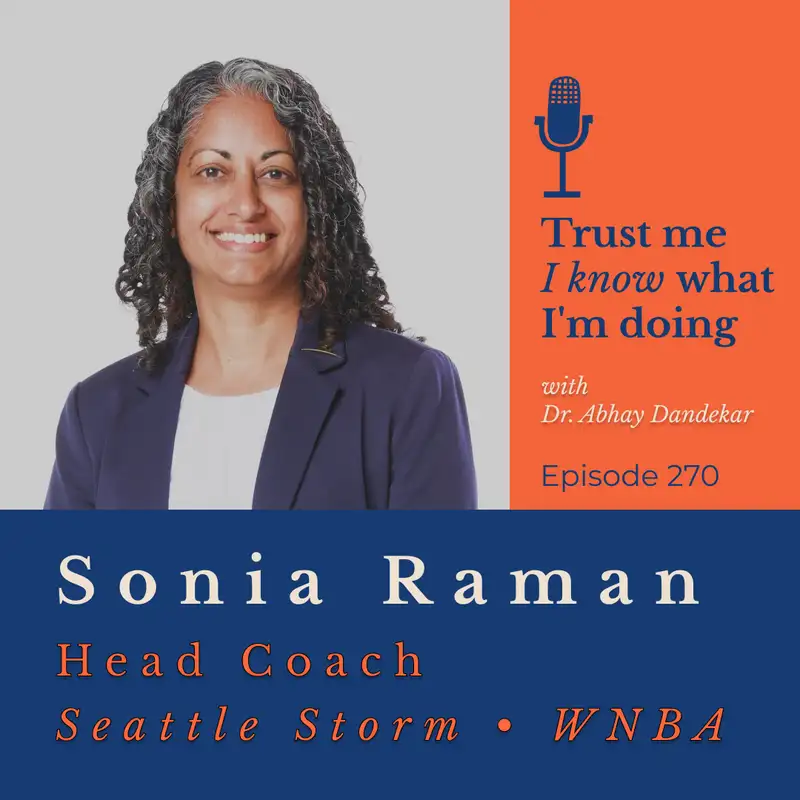
Sonia Raman on Being WNBA Head Coach of the Seattle Storm
Download MP3ABHAY (00:00.578)
This episode of Trust Me I Know What I'm Doing is brought to you by Travelopod, with personalized travel support to help you explore the wonders of the world. Start your next journey at Travelopod.com.
Hi, this is Sonia Raman, head coach of the Seattle Storm. And this is Trust Me, I Know What I'm Doing.
My name is Abhay Dandekar and I share conversations with talented and interesting individuals linked to the global Indian and South Asian community. It's informal and informative, adding insights to our evolving cultural expressions, where each person can proudly say, trust me, I know what I'm doing.
Hi everyone, on this episode of Trust Me I Know What I'm Doing, a conversation with WNBA coach Sonia Raman. Stay tuned.
ABHAY (00:56.226)
Maybe among the toughest and more complex roles to play in life and in society is that of a coach. And in professional sports, particularly, it means mentoring and guiding while also managing a universe of stakeholders and ultimately being judged by outcomes that need to end with wins and championships. And for Sonia Raman, connecting the dots as a basketball player from Framingham,
a lifelong student of the game, a lawyer, and a winning coach has translated to some incredible milestones in college, NBA, and the WNBA, and now is the new head coach of the Seattle Storm. And while I'm not completely sure how I feel as a Laker for life, having an avid Celtics fan on the show, I am actually absolutely grateful that she's got some time to join us today on Trust Me, I Know What I'm Doing. Sonia, thank you so much for being here today. It's really a treat.
Abhay, thank you so much. I'm really looking forward to our conversation.
Yeah, and you know, I mentioned sort of in jest about being a fan and sort of the rivalries that those, you know, produce sometimes. But I am curious about the role of being a coach and perhaps also at the end of this, this is a pastime, it's entertainment for so many people. How does being a fan or even the empathy that it takes as a coach for fans, how does that all factor in at all into being a successful coach for you?
I think it's the passion that probably comes through. Like if you start off as a fan and maybe as a former player, you've put in a lot of hours into the craft, you know, as a player and as a fan, you sometimes put in a lot of painful hours, but you know, dealing with losses is part of it as well. So I think that passion really ignites and that's sort of where it happens for a lot of people. It's where it happened for me early on, you know, being a fan of the game, a fan of the Celtics, as you mentioned.
SONIA RAMAN (02:57.462)
You you choose a profession like coaching and the hours are really long and it's so finite with like a win and a loss. And I think that if you don't have that passion, if you don't really love the game and all of the components to it, especially the people that you get to be around, then it's probably not the right profession for you. So I think that fandom and that passion are what really helps to drive in those moments.
You mentioned the twists and the turns and sort of like the celebrating of wins and losses and how maybe that's how so many of us start when it comes to sports. And then that translates to playing and coaching and again, being a part of that sort of sporting universe. Do you watch or observe basketball differently in that evolution of being sort of a casual observer to now a not just a student, but someone who is
at the vortex of that universe, does it become harder to watch and or even be a fan, especially when you're constantly analyzing and thinking about the game?
I think it's more different than harder. You just watch with a different lens, different perspective. I mean, I love basketball. I think it's just incredible to watch. so having a higher level of knowledge now of what I'm looking at and being able to pick the game apart a little bit, I think it's a fun thing to be able to lean into, but I still can watch as a fan as well. Sometimes it's just a really good basketball game that you're tuning in to watch. The other night I tuned into an NBA game and it was just an incredible game to watch.
I would say, you I was watching much more with my fan hat on at that point. I wasn't a fan necessarily with your team, but at the same time, I'm kind of taking mental notes of what each team is doing and why they are performing at the level that they're performing at. I'm always kind of analyzing, thinking of things that I might want to borrow from a team or a moment in time, you know, what to do, sometimes what not to do. But yeah, I mean, I can watch endless amounts of basketball.
ABHAY (04:59.372)
Yeah, I imagine that the way that you dissect out, say a timeout and when it gets called is very different than, you know, perhaps the observer like me.
Yeah, but I think I still enjoy it. So yes, I can put my professional coach hat on, but I can still turn the TV on on a random night, pull up a random game and enjoy watching it. So it doesn't feel like work, if that makes sense.
You're not walking around with your clipboard every game, right? Yeah, okay, good. You know, I'm sure you likely remember your first game coaching, but do you remember a moment or maybe even a series of moments that made it very apparent of how you fell in love with coaching?
That's a good question. You know, I don't know if I've gotten that one before. I remember my first moments coaching kind of came at the youth level. So I coached my high school team in a summer league. That was the summer after I finished high school and was going to college. like coaching as a profession just wasn't on my radar. I continued to do that in the summers while I was in college, I was working at camps and I had, you have your own team and you coach that team through camp and
I think I just always connected to coaching is something that brought me a lot of joy, trying to help the players that I coach, like find ways to get to the highest levels that they can get to perform, succeed, know, teach them to play the game in a higher level way than what they were doing before. So I think I just always connected with coaching that way. And it took a while before I really realized like this was something that I wanted to do as my profession, but it was.
SONIA RAMAN (06:42.656)
It was just kind of always there, you know, as something that brought me a lot of joy.
You know, people always equate the love and passion that they have for something that they do with success. does it equally, does it equally prove that you love something so much when you have the same amount of passion and joy for it when you lose?
You know, I think so. mean, so that's a tricky one, because I think in sports, I'm not sure if every coach or athlete would use the word joy after a loss. True. But I think that when you I think when you zoom out, you realize what a privilege it is to be able to do this every night. you you know that you're trying to win every night, but you're also trying to get better. And sometimes the losses provide the greatest lessons and opportunities for that growth in a way that.
is just more real than what happens after a win. So I think that sometimes as coaches, do welcome those opportunities. But yeah, I I think that if it's not for you on a loss, it's, again, it's probably not the right thing, but we're all trying to avoid losses as much as possible at the same time.
Does that take practice, To like, you again, like as you falling in love with the game, you almost have to like reignite that love for the game. You know, how you manage a loss or how you deal with losses, does that also take some practice and iteration, especially, you know, to make sure that you're constantly in a growth mindset?
SONIA RAMAN (08:10.734)
Yeah, so you took the two things that I was going to say right out of my mouth. So the iterative process and having a growth mindset. I think it starts with that. I was first a head coach at MIT. And so I'm coaching a group of women that are taking a STEM course of studies. And they're coming straight from lab and onto the practice core. so kind of leaning into the iterations, right, was not very hard to do. And it was very easy to get the players to buy into that process.
the growth mindset, the problem solving. I think that, like I said, you can learn a lot from failure, but also how you handle it, how you handle emotion in those moments, and how quickly you can be able to bounce back. Like, what is your resilience? Until the very last game of the season, you know you always get another shot. You have that next game, you have that next opportunity to iterate and to continue to find ways to grow.
I think that excites me just as much and sometimes even more is how do you come back from those situations, know, learn from our mistakes and try not to repeat the same ones and find ways to, if you're in that situation again, how do you tackle that same problem?
Yeah, almost not getting too seduced by the super highs and not getting too down with the lows. Your superpower has been in player development and skill sharpening and scouting. And so I'm curious how these important sort of at least from the periphery and from the casual observer that these are sort of backdrop roles that are also kind of drenched with developing strong human relationships. How have those?
roles as a scout, as a player development leader, or a player development expert. How have those made you a better overall leader?
SONIA RAMAN (10:02.23)
I'm not sure if I would call myself an expert, but I appreciate that term from you. I do really enjoy player development. I think that it kind of goes hand in hand with this whole iterative process. And it really leans into the part that I really love about basketball and coaching, which is the relationship piece. So, you know, from that high school team that I coached early on and was trying to help those high school players, you know, get to the levels that they wanted to get to through college and then all the way to the pros. think that
it's really important to have those relationships to be able to lean into them and kind of meet them where they are. They're all different ages and different stages of their development. You're coaching a first year in college versus a senior. It's going to look different. You're coaching a rookie in the NBA or in the WNBA or a player that's kind of on the fringe on a roster versus the player who kind of has a lot on their shoulders every night with the cameras right on them. So all of those
look different, you know, and that's part of these unique challenges. No two days are the same in coaching and no two player development programs are going to be the same with two different players. So getting to know each player, figuring out what motivates them, where their obstacles might be, where they're kind of vulnerable as well, and how to build their confidence in the areas that they need, how to push them and hold them accountable in the areas where they need to push. But each person's different, right? So you have to find
these ways to reach them. It's the same with scouting. Every game plan is probably gonna look a little different from the last, not markedly different in some cases, but it's still that challenge of you have to know that team really well to know what it's going to take to beat them.
I would say I use that word expert for you, you know, pretty solidly when hearing that. And then of course, you get people who are on Sports Talk Radio or every fan out there, know, we're the experts in the room always when we talk about this kind of stuff.
ABHAY (12:01.474)
You're listening to Trust Me, I Know What I'm Doing. After a quick break, let's come back to our conversation with WNBA coach Sonia Raman. Stay tuned.
ABHAY (12:15.288)
Hi, I'm Abhay Dandekar and if you have an animal in your life that you love, then I want to introduce you to the Timber Dog Rough Rest, the only dog bed you'll ever need. The patented Rough Rest is compact and light with over 14 travel features, comes in three sizes, and has everything from essential storage to even a built-in sleeping bag. The New York Times Wirecutter calls it a versatile, portable dog bed with lots of extras for traveling or camping. Go to TimberDog.com to explore Rough Rest, the only dog bed you'll ever need.
ABHAY (12:50.958)
Hey there, I'm Parag Marathe, President of and EVP Football Operations, and you're listening to Trust Me.
at 49ers Enterprises.
SONIA RAMAN (12:57.71)
I know what I'm doing.
ABHAY (13:04.728)
Hi, I'm Kevin Negandhi Sports Center. Hi, this is Farhan Zaidi
anchor. This is Arjun Nimmala professional baseball player. there, this is Aditi Kinkhabwala an NFL sideline reporter for CBS. This is Trust Me, I Know What I'm Doing.
Toronto Blue Jays. Hey I'm Saurabh Netrawalkar here, athlete from the US.
ABHAY (13:28.184)
Welcome back to Trust Me, I Know What I'm Doing. Let's rejoin our conversation now with WNBA coach Sonia Raman. You've undergone and you've been a witness, had a front row seat to the sort of microscopic level of detail that this has in the NBA. You of course served as an assistant coach for the Grizzlies for four years. I'm so curious, what were some of the things that you learned about yourself?
that maybe were specific to the MBA experience.
You know, I think one of the things that was probably the most challenging was I had been coaching for 20 years, right, at the college level. I had been a head coach for 12 years and previously an assistant coach at a different school for six years. And so you combine that to 18, it was all in the same conference. So I bring that up just to say that I knew those teams in our conference inside and out. You know, doesn't mean I'm beating them every night or we're beating them every night, but I knew those teams.
If I never got to watch film on one of my opponents for some reason, if you just blindfolded me and said, me about this team, I could give you some sort of a basic level of how this team probably likes to play.
Yeah. You're a Miwack guru, so to speak.
SONIA RAMAN (14:43.822)
I mean, I knew like New England Division III basketball inside now. And I knew obviously the terminology that we used, it was my terminology. So, I was very familiar with that. I understood the cadence of what we're doing, the schedule, what planning goes into things, how we're going to pivot, where the adjustment points might be. And now I'm new to the Grizzlies. It's 2020, so I'm wearing a mask and so is everybody else.
I can't really even be around my peers and my colleagues and see their faces and go out for coffee because we were very restricted as to spending time outside of work during that quasi global type of period. So it was a challenge to build relationships right out of the gate in the way that I'm used to. And it was a challenge to overcome that learning curve as quickly as possible. I think the team and the organization and my colleagues were really
great about knowing that I'm coming from college and it's going to take time, but I wasn't great about that. I wanted to know everything the way I just did five minutes ago on my last job, really accelerate that learning curve, know the terminology. I called something different at MIT that they call it in Memphis, so I just needed to learn that translation, get the dictionary, and figure it out. Not that there is a literal dictionary, but if there was, I probably would have helped.
Well, it's almost like being a tourist, right? mean, like you're sort of unfamiliar and once you get to learn the language and vocabulary and nuances and customs, you sort of start fitting in.
So, I think like to answer your question of what I learned about myself, I learned that it was good for me to get out of my comfort zone because I hadn't done that in a long time. And also that I don't like not knowing things. So I will forever kind of work to overcome learning curves and accelerate those areas. And I'm fairly new to the WNBA right now. I've got one season under my belt as an assistant. So, know, learning a new team, a new league.
SONIA RAMAN (16:46.176)
so to speak, fortunately not brand new since I was in the league last year. But I mean, that's something that going into this new situation and having been through it not that long ago with Memphis, I think I do know myself a little bit better and know what I wanna do right out of the gate.
I know that this certainly is transcendent to any field, but once you do know that vocabulary and you do start getting familiar and the language seems a little bit more easy on a day-to-day basis, then of course your aspirations and your ambitions change a little bit. At any point, did you ever entertain aspirations of becoming an NBA head coach?
You know, I didn't really think about that. I really was there trying to, know, as cliche as it sounds, be as good as I could be as an assistant coach there. I was there for four years and I felt like I was still learning exponentially every year, right? It's like the first year is the terminology, the players, the relationships, and then you move into trying to get next level with your game plans, with your schemes. You're thinking about playoffs and
how you build a regular season team that's going to be battle tested and bulletproof for playoffs. You're thinking about who the best teams in the league are and what the trends are. So I'm thinking about things in a more detailed way each year, right? But I'm not necessarily like thinking I'm trying to build towards a head coach in the NBA. And the reality is that there's a lot of, I mean, it hasn't been done before. So I think that without that representation, it probably doesn't occur to me that that's something to even.
kind of think about or consider.
ABHAY (18:32.514)
Yeah. I want to think about sort of like the journey in a way. When you connect the dots for yourself from law school to Wellesley to MIT to Memphis and New York and now, of course, to Seattle, the evolution of what it is like to feel like a college player and transit into the professional space. mean, that evolution for a player.
has evolved so dramatically in the last 10 to 15 years, especially with things like the NIL and other kind of external forces. How do things like the NIL and now of course contracts and off the court things for a player, how does that impact cultivating trust and developing players on the court? How do you stay focused with the skill piece and in a way kind of create space so that that can be the primary
area of concentration when there's just so many of these other external things that players have to deal with in their evolution.
Yeah, I I think that as coaches, we have to keep evolving. You the landscape is never going to stay the same. I know that for college coaches, this is a major evolution for what they have to deal with. I mean, between NIL and a transfer portal. But I think it's also important that players have opportunities, you know, and that they they can seek out opportunities that are best for them without overly restrictive rules that probably don't really make sense and are good that we've moved on from those. And so
With that, they're learning the business of sports a lot earlier and they're hopefully at the college level having good teams around them, know, their personal teams to help them in those areas and their coaches and assistant coaches are getting more more equipped to help them in those areas as well. But they're so much more savvy now coming in, for having this type of exposure and experience at the college level. They kind of understand things and they understand the landscape a lot better. And I think as coaches,
SONIA RAMAN (20:33.388)
we have to make sure that we're evolving and we're keeping up and we're meeting them where they are, we're supporting them in their outside endeavors. They might have a podcast, they might be really into fashion and be finding ways to lean into that in their spare time. mean, think that I really, what I loved about coaching and the college level was there were student athletes, right? So they poured themselves into basketball.
but they had these other things that they had to balance with their lives. And I think that it actually made them appreciate the time that they set foot on the court so much more. And I think that for pros, it's similar, know, that if they have these, some healthy balance, if they have other things that they're interested in, you know, whether it's outside endeavors or it's family or it's travel or it's trying new restaurants, you know, I think having these interests or business interests, I think are great, you know, and we need to lean into that and we need to make sure that we
We support that as opposed to kind of bumping up against it, right?
Yeah, I mean, it it reminds us that the boundaries between just simply being player in person are just so constantly blurred. And I imagine that a lot of your former players probably connect with you for advice on all kinds of things and and get your opinion on everything from basketball matters, you know, to to, course, life matters as well. And that's probably part of the fun of of having those relationships as they as they develop.
Yeah, no, it's kind of part of the job, I think, and it's one of the most rewarding parts of it.
ABHAY (22:06.338)
Yeah. You know, you're someone who has used the levers of data and game tactics as a coach to be someone who uses technique and precision. And then as you mentioned a couple of times now loops back and makes that an iterative process and a constant sort of learning and growth opportunity. With that amount of information, where does instinct and gut feel?
and the things that aren't always teachable or coachable. How does that factor into both the performance and to some degree your own coaching philosophy?
I think that's number one. I think that we have as coaches, we have to be able to read the game, see what's happening in the moment. I think that in some areas, it's much slower. Like if it's a player development session, we have time, we can stop, we can think, we can talk, we can collaborate. We can sometimes even check our tech that we have to see if there's something there that might inform the session. But in a game, it's a split second decision, right? So that's gotta be the first thing.
But I think that for me, I'm doing that preparation beforehand. So I know more about the data before we play the game. I have sort of an idea of each situation and where I might want to go with it. I'm talking about that with my staff. I'm talking about that with our analytics person. I mentioned earlier, I really enjoy just watching random games, but I'm also keeping a running list of in a situation, how would I handle that particular situation if I'm in the exact same one?
you just over time, you just kind of keep building this like mental database of what you would do in those situations. For sure, you've seen like football coaches will have like a play card or a laminated thing and they might have these situations ready to go for the end of game or the end of the quarter. So, you know, it's very similar in that way. Like you're doing everything you can to have the discussions with your staff to contemplate these situations before they happen to understand what the data says about.
SONIA RAMAN (24:09.87)
a decision you might make going one way or the other, but then in the moment you have to be prepared to act. And sometimes it might be a little bit different than what you thought you were going to do as you're preparing more in a vacuum.
And I imagine that, I mean, this is like many other things, it's just pattern recognition and trying to prepare yourself for the expected algorithm. And yet at the end, right, there's going to always be that surprise situation. You're like, OK, I don't think anybody's ever dealt with this before. I haven't prepared for this. And I imagine that that's kind of where the gut and the instinct come in of experience and even just like sometimes just raw talent to be able to to handle that. How do you iterate on things like that?
You know, I think that like, have to really know your team and have a really good pulse before you can make those types of decisions. So to give you kind of like a nerdy, real, like a basketball example, you know, some coaches. Yeah. like, you know, there's a, there's the standard example at the end of a game is like, if you're up three late in the game, do you foul intentionally so that they can only get two free throws? Or do you just try to get a stop knowing that they might attempt a three?
It's about, by the way.
SONIA RAMAN (25:21.43)
which might tie the game, right? So that's kind of the age old and you might have one feeling or the other, if you might be in the camp of foul up three, that might be like the data says to do it, you can study how many teams have done this and which way it's gone and you can study that forever. But you might also have a team that is not the best at rebounding on the free throw line. And you know that on that second free throw, they're probably gonna miss because they can't mathematically catch up with one point when they're down by two. So they miss that free throw, they tap it out.
someone gets it they shoot a three. And so how much weight do you want to put in this like kind of crazy hypothetical or is it not so crazy because throughout the season you've seen that your team has maybe struggled at rebounding on the free throw line. So like those are the types of things where the data might tell you something, but you your feel, your gut, knowing your team and what they're best at, your team might have defended the three point line well all year. So you're going to give them a chance to defend the three point line and you're not going to foul.
or you might have some of the best rebounders in the game, you fell and you know you're gonna come up with that rebound and you're gonna go home with the win. So I think really having a pulse, again, I mentioned like with the staff, I think collaborating on that and certain players are gonna work with certain coaches and have that relationship that goes even deeper. And so when I ask a question about what we should do at the end of a game, coaches might have a really good opinion on that from working with those players individually, but it comes down to that pulse.
but I think it's also data informed and the best coaches can kind of roll those two together in a really special
Just a reminder that free throws and rebounds are equates or rings, I'm imagining.
SONIA RAMAN (27:02.606)
Absolutely.
You're listening to Trust Me, I Know What I'm Doing. After a quick break, let's come back to our conversation with WNBA coach Sonia Raman. Stay tuned.
ABHAY (27:18.616)
Conversation. It's the antidote to apathy and the catalyst for relationships. I'm Abhay Dandekar and I share conversations with global Indians and South Asians so everyone can say, trust me, I know what I'm doing. New episodes weekly wherever you listen to your podcasts.
ABHAY (27:41.134)
Hi, I'm Vivek Murthy. I'm the 21st Surgeon General of the United States. And you're listening to Trust Me, I Know What I'm Doing.
you
SONIA RAMAN (27:58.158)
Hi guys, I'm Indra Nooyi. Hello everyone, my is name is Tan France I'm from Hi everyone, this is Chef Vikas Khanna I'm This is Vidya Balan. Hi, this is Madhuri Dixit. And you're listening to Trust Me, I Know What I'm Doing with Abhay Dandekar
My name is Tom. Hi.
ABHAY (28:09.432)
Good.
ABHAY (28:17.932)
Hi there, I'm Abhay Dandekar and you're listening to Trust Me, I Know What I'm Doing. Let's rejoin our conversation now with WNBA coach Sonia Raman.
speaking of sort of insights, not only into your team, but also into yourself, you're obviously no stranger to setting new benchmarks, certainly as the first Indian American woman to coach in the NBA, and of course now the first to be a head coach in any professional setting. And the hope is that you won't be the last and that doors are gonna be now open for others. And I've often asked people this, that like aside from our names, what is it that actually
you know, makes us Indian American on a day-to-day basis. But do you think of yourself as an Indian American coach? I mean, how does the identity piece factor in for you professionally? But again, more on a day-to-day basis.
You know, my identity is so important to me. So of course I do. You know, I think of myself as a basketball coach, but that is also Indian American, also a woman. So I think that identity is important. As I've gone through this time, you know, early on like coaching at MIT and actually recruiting players of South Asian descent, talking to their parents in the recruiting process and starting to see this next generation and what they've been doing.
It was really exciting. And then getting to the pros and kind of, guess, getting a little bit more media attention, right, with these firsts, which also then the neat thing about that was it brought in more people who hadn't realized that this was happening or wouldn't have realized otherwise, maybe weren't following basketball very closely or weren't following the Grizzlies specifically. And, you know, they would reach out, they would talk to me about their daughters, their sons.
SONIA RAMAN (30:08.468)
who are of South Asian descent and playing basketball and maybe sometimes ask for tips and all different kinds of ways that that conversation goes. But I've really enjoyed that. I didn't see other Indians growing up playing basketball and would have probably really enjoyed seeing that. So I love that this next generation is kind of pursuing all professions and playing all the different youth sports and coming up that way.
and playing it at higher and higher levels. I want to be able to help in any way I can and keep that door open.
Can I put a pitch in to rename the triangle offense as the Samosa offense?
Oh my gosh, yes. I love it. Too many syllables though, you in basketball you gotta have like, even triangle has meant too many, but yeah.
ABHAY (30:57.998)
There go. You know, we both share something in common actually in that both of our wives have strong ties to Snohomish County. No way. Yeah. No, my wife is from Mill Creek and she went to high school there. How much does community and city matter to being a successful head coach for a franchise in a professional league? I I know the obvious answer is yes, of course it does. But are there tethers and...
you know, anchors that actually translates to culture building and, you know, success on the court beyond just what it means sort of off the court.
Yeah, I think that the community is a huge competitive advantage to an organization. it's like Seattle, for example, you know, the fan base there is incredible. They're really supportive of the team and they have been for a long time. I mean, I was a fan once before I became, you know, the coach and it's a team that has been able to win championships over time, know, like over the decades, over different eras.
It's a team with like an ownership group and a front office that's really committed and knows what it takes. So I think that there's been a really good synergy over this time period with the city of Seattle, with the community, with the people who just love the storm, you know? And so how does that translate into winning? I think it creates this environment. First of all, Climate Pledge is full. You know, the fan base is eager. They're loud. They're cheering.
dying to connect with the players. And so the players feel that. When they're in town, when they're going to get a cup of coffee, whatever they're doing, they feel that love. It's a really great basketball city and a really, really high level women's sports town with professional ice hockey, professional soccer. So it's got this community and this feel that the storm are it. They're not just kind of like one of...
SONIA RAMAN (33:01.238)
one of these teams and maybe we'll go catch a game and it's a novelty. Like this is a part of like the ethos of being a Seattle sports fan.
Yeah, I love it. mean, there's nothing like a vibe that you get. You can't quite explain it, but it just feels like the temperature out in the city is one that's constantly checking and feeling like it feels like home to players and fans and coaches alike. I got a couple of rapid fire ones for you. This one probably hits.
at sort of coaching heroes for you. But if you had three coaches or players for that matter, past or present, that you could get to one of your favorite restaurants and have a conversation, who would those three people be?
Gosh, that's a great question. mean, there's just been like so many great coaches over time that I've enjoyed, you know, following so many great players as well. You know, I really struggle with those like pick one or pick two or pick three. You can pick. You know, as you know, I grew up a Celtics fan, so I would probably throw like Larry Bird in there. Oh, boy.
more.
ABHAY (34:09.038)
I'm gonna have to do some heavy editing on this episode.
And I would say like we, the other thing we have in common is like my wife is a Lakers fan as well. So, you know, it's always, it's a constant battle. You know, I think that I'm fortunate that like being in this profession, I've actually been able to talk to a lot of the coaches that I've had a lot of respect for and that I've been able to, you know, to really follow and to pick their brains and do those types of things. You know, you go back to.
some of the greats and like the beginning of the W like Teaspoon, Teresa Weatherspoon, and players like that of that era. I would love to kind of bring that group together, the founders of the W, right? And like talk to them about like what they thought they were getting into, where they thought this league was going and kind of thank them for where this league is now because nobody knew back in 1997 that this was going to be what it was, know, these.
the coverage that it gets, the media exposure, the fan bases, the merchandise that's being sold, the tickets that are being sold. I think it's really special where our league is. And I think that that group, I can't even single out an individual person. I think that would be like a really neat thing to sit down with them.
Yeah, just a gratitude for the heritage that they've created now. Do you have a pretty typical sort of post-game routine?
SONIA RAMAN (35:32.906)
Yeah, I mean, I think it varies a little bit by each place I've been with the cadence of what we do. But my typical one, I'm going to talk to the staff right after the game, and then I'm going back and I'm rewatching the game. So I'm going to run it back. I'm going to pull things that I think are important in terms of clips that I think we might need to watch as a team. And then I'll probably put that away and then revisit it in the morning and try to narrow it down.
I really think that less is more sometimes and we might overdo it with film as coaches. So I wanna make sure that I go right to the most important things and right after the game, everything is the most important thing. So in the morning is my cleanup and then we kind of have our meeting from there. But it's a process usually where we don't spend too much time right after the game because I think you need a little time to get away from it and then revisit it in the morning.
Now that you're in the Pacific Northwest, do you have a favorite rainy day activity?
So I love the way it rains in Seattle. You can still get outside. So when you say rainy day activity, I think my old self would have just gone right to board games and you're inside. I still really enjoy putting on some sort of waterproof stuff and getting out for a walk and getting outside every day whenever I can. If it's pouring rain and I have the time for it, getting out to a movie is always a fun thing to do.
There you go. I'll get you out of here on this. You you're the face in a way, one of the faces of a franchise and certainly leading a group of women on the court, but then also leading in the community. For those folks who are coming to a Seattle Storm game for the first time or for having for that matter, learning about you and learning about your coaching for the first time, what do you hope they take away?
ABHAY (37:29.752)
from those experiences, especially for those first timers who are coming to a game or just getting to know you and learn about your work.
Yeah, that's a great question. I would say if they're at the game and they're watching it live, I hope that they leave and they say something like, wow, they play so hard. They compete for 40 minutes or what have you, right? And they play so hard. And the other thing that I hope they say is they look like they really like each other. Those players, they're great teammates to each other. They look like they really love each other. I love how they celebrate each other's successes.
and how unselfish they are and how competitive they are. So if that's the brand of basketball that they're seeing, hardworking, gritty, unselfish team that plays with a lot of joy, then I think we're in good shape.
Well, it's all about building a culture, mirroring a culture, representing the culture. And I know fans and admirers are really, really grateful for it. Sonia, thank you so much for joining us. What a treat to spend some time with you and I hope we can visit with you again down the road.
Thanks so much for having me.
ABHAY (38:40.6)
Thanks so much again Sonja, and a big thank you to all the youth coaches out there who are playing an uplifting role in the lives of so many. A quick reminder to please share this with all your friends and family and subscribe to the YouTube channel. Grateful to everyone for listening, watching, reviewing and rating, being kind to each other and to the planet. Till next time, I'm Abhay Dandekar.