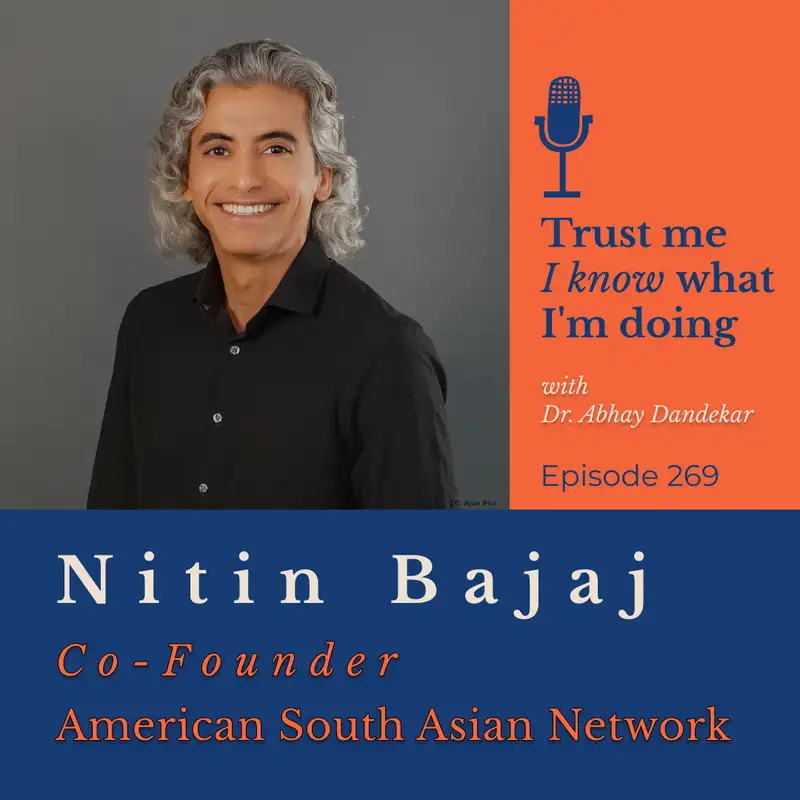
Nitin Bajaj ... on the American South Asian Network (ASAN)
Download MP3Abhay (00:00.13)
Hey friends, this is Abhay Dandekar. Before we get started, don't forget to subscribe to Trust Me, I Know What I'm Doing on YouTube, Amazon, Spotify, Apple, or wherever you listen or watch. That way you never miss our show celebrating the vibrant Indian and South Asian global experience. Thanks.
Hey everyone, this is Nitin Bajaj. I am the host of the industry show and the co-founder of the American South Asian Network. And this is Trust Me, I Know What I'm Doing.
My name is Abhay Dandekar and I share conversations with talented and interesting individuals linked to the global Indian and South Asian community. It's informal and informative, adding insights to our evolving cultural expressions, where each person can proudly say, trust me, I know what I'm doing.
Hi everyone. On this episode of Trust Me, I Know What I'm Doing, we share a conversation with the co-founder of the American South Asian Network, Nitin Bajaj. Stay tuned.
Abhay (01:11.225)
You know, sometimes I'm simply amazed how synchronized the world actually is. And let's take the premise of this show, which is to find ways for conversation to be the antidote to apathy and also to serve as both a mirror and a window for the global Indian and South Asian community. So to highlight this and to actually prove how strong that synchrony is, my guest today is someone who's been passionately blending entrepreneurship, storytelling, community building, philanthropy.
to really create opportunities across the entire diaspora for all walks of life. Nitin Bajaj is an operator, keen strategist, a tech innovator, an entrepreneur, an investor, a philanthropist, an academic thinker, and of course a community builder, namely through his long running The Industry Show. And as a co-founder of the American South Asian Network, or ASAN,
spotlight and support South Asian changemakers here in the US and around the world. I am really, really grateful to call him a friend. And of course, so thankful for Nitin to be able to join us today on a Saturday, no less. I can't help but be just thrilled that you're here right now. Nitin, thank you so much for joining. Trust me, I know what I'm doing. Thank you so much. And as you were reading that long introduction, I was wondering who is this guy?
Well, I promise you we'll get to that. I have to tell you, knowing a little bit about you, you know, of course, on a Saturday where things are always busy, but yet, hopefully not stressful and peaceful. And because I know it's part of your daily DNA, did you already get in some standup paddle boarding time today? It's a critical piece for us to get out of the way, right? Yes, I did. I wouldn't miss it, put a thing. Does the standup paddle boarding for you because it's again, ingrained in your daily DNA?
Do you feel sort of incomplete or absent when you haven't done that on a day-to-day basis? That's something I guess I've never thought about. I look at it as, I still look at it as a privilege. I consider that as something that I'm blessed to be able to do. So I don't take it for granted. And when I have the opportunity, I don't think twice and think twice comes from
Abhay (03:31.779)
Am I feeling lazy? Am I feeling slow? Am I feeling any of those adjectives? I have the opportunity. I'm here. I'm going to go. Last night, it was pretty foggy and we were supposed to go as a group. And a few people backed off because it was dangerous. And I was like, I'm here. I'm going to go. And whether it's fog or time or laziness, I mean, there's always a million barriers, but after you've completed a session like this, and this is true for anybody who has some kind of daily ritual or something that they feel very
either passionate about, or they get into sort of like a zone when they're done or when they're actually doing the activity. But, you know, for you, do those barriers, the more and more you do this and the more and more it becomes baked into your daily life, do those barriers just tend to dissipate and get less arduous for that matter? I think some of it comes from the habit forming process. Some of it comes from your perspective to life. I have looked at barriers as
coming from a place of strength. Cause I know most people will see barriers and pause or stop or think twice or look at different ways. And for me, it just comes as a, barriers. Awesome. Let's go for it. So you embrace it. I have a, reason I stand a paddle board is because water is the only thing I love and I'm scared of. And yeah, stand up paddle boarding and sailing is my way of getting back at my fears. So there is.
a bit of an irony in there that the whole act of standard paddle boarding is to overcome a barrier that I have in my head about the water. You know, thinking of barriers and all of the barriers that many, many have overcome and also are continuing to embrace and both be celebrating and as you mentioned, fear for love, love at the same time.
When I first met you, shared with me one of our first conversations you were sharing about how you had completed a doctoral thesis on South Asian immigrant entrepreneurs. And I promise it's somehow linked to stand up paddle boarding, you know, reflecting on the learnings that you had in doing that work to now with the current climate here in the U S as we head into 2026, what do you think immigrant entrepreneurship feels like and, and what perhaps needs to be prioritized?
Abhay (05:55.715)
as we enter this kind of new 2026 era where there are lots of barriers and lots of fog and, you know, sometimes instability. So what do you think that feels like now compared to when you were studying this actively for your doctoral thesis? It's a great question. And I'm going to disappoint with my observations and analysis. A lot has changed and has stayed the same, the same time. When I was doing my research,
I remember going from reading a lot of literature that talked about how it was extremely difficult for a person of color, an immigrant, to become an entrepreneur. And that's where a lot of organizations came into existence to help make that dream come true. But towards the later part of my research, I started getting insights and peeks into language that had started to come up wasn't
wasn't instilled, wasn't set in stone at that point, but you were starting to see those highlights of hope that how being a South Asian or being an Indian immigrant in the US was an advantage for you going into entrepreneurship. 15 years in, we confidently speak about, if you want your startup to get funded, make sure there is a South Asian or Indian co-founder on the list. That transition took
a very relatively, really short time. But now we're starting to look at almost a backlash or a revisiting of that thesis to say, when you come into this country, do you really have an advantage? have people, perceptions are starting to question that again. But, you know, I look at this similar to mortgage rates. Over the past 15, 20 years, we've gotten so used to the two and three percent.
If I forget for the majority of time, they have remained in two digits. So that's why I said, I'm going to disappoint you with my analysis and the opportunity remains the same. The reasons why we have been successful remain the same. And I continue to feel extremely bullish going into the new year, but also looking at the near to long term that we will continue to.
Abhay (08:22.0)
have an outsized impact on this economy. Yeah. And with the primary intention of our journey being capitalized on the lessons learned. And I want to think about this from your own personal lens. Like you said, you know, the perspective of doing the doctoral thesis of thinking about what it's like to be from an academic lens, a South Asian immigrant and an entrepreneur and
being not very different and having evolved and changed and also states so similar. What do you think you personally have had to in fact let go of or unlearn about yourself in order to succeed as an immigrant entrepreneur in the US? This will be a little controversial, but for the sake of transparency, when I moved here, a lot of people asked me, did you experience some kind of a culture shock? And obviously the answer was no, I felt at home when I moved to LA.
Yeah. The piece I realized a few months in was I've essentially lost my superpower. When I was back home and this is the India of yesterday, you could essentially depending on who you knew and what were you willing to part with to get things done? Anything was possible. Yeah.
What year did you come here by the way, 2007, so 2007. Okay. Just to put it in context for us. Yeah. And, now almost 20 years in, know, things have changed in India. coming into the U S I lost that super power. I one did not know many people or anybody for that matter. And I didn't have the resources to unlock those doors that remained closed for the fair majority in India.
I knew what the keys were and I was able to use them. So that is something I had to let go of that I now was on the same level playing field. But on the flip side, those things that needed those keys and needed those doors to be open were extremely open here. I could set up a business in less than a day. I could be off the ground, set up a bank account, do all of those things.
Abhay (10:41.799)
in a matter of minutes or days that back in those days in India would take weeks, months or years. So I didn't need some of those superpowers, but the fact that I had lost them was a little unnerving to begin with. You're listening to Trust Me, I Know What I'm Doing. After a quick break, let's come back to our conversation with the co-founder of the American South Asian Network, Nitin Bajaj. Stay tuned.
Abhay (11:16.798)
Every story told is a lesson learned and every lesson learned is a story waiting to be told. I'm Abhay Dandekar and I share conversations with global Indians and South Asians so everyone can say, trust me, I know what I'm doing. New episodes weekly wherever you listen to your podcasts.
Abhay (11:39.157)
Hi, I'm Krish Ashok, author of Masala Lab, the science of Indian cooking and you're listening to Trust Me, I Know What I'm Doing.
Abhay (11:53.047)
Hi, this is Farhan Akhtar. Hi guys, I'm Ananya Panday. Hi, I'm Kani Kusruti. Hi, this is Vidya Balan. Hi, this is Madhuri Dixit and you're listening to Trust Me, I Know What I'm Doing with Abhay Dandekar.
Welcome back to Trust Me, I Know What I'm Doing. Let's rejoin our conversation now with Nitin Bajaj. Thinking about how you then regain those superpowers and how everything is in a way kind of connected, right? mean, you're someone who is constantly, I think, reimagining and reinventing and thinking about how to redesign your approach on things. And I imagine that that exact same story of
you know, recognizing that the superpowers are not there and having to now reinvent how you develop those superpowers. You originally, if I'm not mistaken, wanted to be a pilot, but your journey took you through tech and innovation into exploring generationally transforming work now with your thesis and now Assan. I wonder if you can maybe connect the dots between that pilot mentality and the dashboard of work that you now know and that you, know, on a day-to-day basis accomplish.
So that's a two part question. I'll move away the part that I cannot answer, which is connecting the dots. I say I've come to believe that for most people connecting the dots looking backwards is possible and feasible and makes sense. In my case, it doesn't. I cannot explain to you as a two time college dropout having a doctor degree now or being afraid of water and enjoying snorkeling and
paddle boarding and sailing and hate is a strong word. I'll qualify that. But someone who grew up hating geography and maps, going out and designing industry first products in that. So I cannot explain how the dots connect, but I'll do my best to talk about what the paradigm looks like moving from one to the next. So what has helped me is the hustle that Bombay is.
Abhay (14:06.621)
And growing up in that spirit, growing up in that environment of not knowing what to expect and that essentially shaping the conduct, the street smartness that came with it. But more importantly, and increasingly as I started to get on that journey of maturity, understanding that it's all about people and I have to come to adopt.
adapt and realize that when I was in the corporate world, I was looking to optimize for job titles, salaries, perks and what have you. Soon enough, realized that it's all about optimizing for people that you love, that you can learn from, that you want to spend most of your time with and through and with those people doing things. And if those things fail, at least you were with the right people and had a great time.
Now, is that, can you find a way to somehow link that back to a pilot's mentality? I imagine that, you at the core of being a pilot, you know, it is still about the people, but there's a knowledge base involved. There's a keen sense of direction and a keen sense of vision. But in the end, if all else fails, you do, I hope, plan on being with the right people in your stead. You know, not the most, you know, celebrating of thoughts, but still, is there a way that
Do you still think like a pilot? you still dream of? So I didn't become one, but I still plan to. And, my 16 year old self that wanted to become the pilot had very specific goals. I wanted to travel the world and I wanted somebody else to pay for it. And so the core function there wasn't about having that vision, having that finesse or even understanding the dashboard and all of the equipment.
In fact, that scared me. was like, that's too many things, too many choices, too many options. I'm going to get easily distracted. So it wasn't coming from being able to technically excel at those things. It was a very vested selfish interest of being able to travel around the world, have the best view of every place possible and not having to pay for it. That hustle has stayed.
Abhay (16:32.791)
taken on positions. I used to joke, said, you know, I've grown themes around the world purely so I could meet different people from different cultures, enjoy meeting them, enjoying those culturally diverse dialogues that we can have. So that's where it has stayed. That also honestly brought me to LA. My initial thought was I should go to Europe and every weekend I can go to a different country and
my immediate next thought was, wait, I'm a lazy person. Why am I going to do all the bouncing around? Let me just go to a place where people are already there. My ultimate goal is to imbibe the different cultures, be around people that have that diversity. So that's how I ended up here. Yeah. Well, there's a social capacity to that. Maybe the, you you're the social pilot, the cultural pilot that we all
gravitate towards. I want to think about that a little bit. I sense a little bit of a theme here of being in a way very good at things that you also have some innate fear for. I'm a big fan of the industry show, as are so many, particularly how you highlight our communities, entrepreneurs and leaders. Are there examples that you really tend to look at of how these enriching conversations have in a way sort of changed your day-to-day thinking?
I know it's an ongoing trip on how you can see the best places and do this all for free, but have these conversations made a difference in your own life? In a huge way. I say, you know, the show, as much as it shares the journeys and stories of our community, they're a very selfish initiative. These conversations that allow me to have a first audience,
with people that have accomplished some really cool and amazing things, not just commercial successes, but also social entrepreneurs and in all levels and kinds of accomplishments, you get to see and learn a lot from and through them. And a couple of people that have touched me to a point where they have essentially changed me for the better. Manusha who has been this quintessential entrepreneur and I
Abhay (18:57.677)
blame him but also give him all the credit for pretty much everything I've done over the past 15 years. He was the inspiration for me to start thinking about my dissertation thesis being about South Asian immigrant entrepreneurs in the US. He was the first person I spoke to when I said, hey, I'm enjoying doing this. I think this should become some kind of a show. And his literal response was, I'm in.
let's record next week. I'm like, I haven't even processed the thought, let alone not having the equipment. What do you mean record next week? Well, now did that, that, that push by someone who said, you know, why not now? And you know, absolutely. Was that a change for you? Did you not expect that? I was ready for it in terms of the execution, but I wasn't ready for that response, that acceptance, that belief. I'm just here thinking aloud.
And this person has taken that in, accepted it, and given me a date to perform. Right. Breathe some life into it. Yes, that was unexpected. Once I internalized that, okay, this is happening. Then the hustle mode kicked in and made it happen. But the fact that someone that respectable that accomplished believes in you to the extent of saying, yep, let's do it next week.
was unexpected and unreal. Yeah. I was going to ask what have been like, you know, were there surprises along the way? And I imagine that, you know, that itself, that acceleration of an idea to actuation itself being such a nice sweet surprise that's yielded so much. Has that made a difference in how you view the mentoring opportunities, the numerous mentoring opportunities that you may have in that actuating things are important?
for people to hear that acceptance and that, especially when you're synchronized with an idea, to hear your belief in the idea and to, in a way, of validate it? Yes, in many ways. And especially coming in here as an immigrant with no family, no connections, know, come to believe and realize that we build our family. There's one that you get as part of your
Abhay (21:24.163)
blood relationships but the one that stays with you and really helps you flourish is the one that you build and create and I came here with nothing and no one and the family, the community that I've built has been in and of itself a big positive surprise and has helped me give back and do the things that I do and the one thing I've realized in this journey
going back to the previous point that we were touching on is in many ways, it's all about the access. How do we as a community build that ecosystem, build that infrastructure to continue to provide that access so each person, each generation is not starting from scratch? And I'll kind of leave it at that, but that's essentially the foundation and the reason why we started ASAN. We'll park that for a little bit.
Yeah, no, and I want to build on that actually, because we've chatted about this before and you mentioned it now, but I'm so impressed and so enthusiastic about the work you've done in co-founding Asan, which is the American South Asian Network. And this is done with your co-founder Mohini Torghari. I wanted to find out if you could share a bit about how that idea originated, what maybe sparked that whole notion of
making it so that no one has to necessarily be without access, without a seat at the table. And currently in the thinking, what gap it fills in our greater American cultural and social conversation that we're all having right now. Big question. I'll try and do justice to it in a couple of minutes. Which I know you will, by the way. Assan started about 18 months ago, but was laid on a foundation of the last 18 years of my life here.
I came here as a student was essentially starting from scratch. I was much older than most other students. was 29 when I moved here and pretty much came here in 2007, graduated in 2008, which was one of the worst times to graduate, let alone as an international student looking for a visa. Got extremely lucky despite the hustle and everything else. And I was
Abhay (23:43.007)
one of the very few international students that got to stay back in this country. Many things were happening, lack of jobs and whole ecosystem change around visas and what have you. And almost 20 years in when I talk to students now, nothing has changed. They are still coming in and starting from scratch have no ecosystem to use that term again that they can tap into.
no hands, they can reach out to get help and support. And this transpired not just through the students, but also through a lot of the discussions, conversations I had, given my other involvement in the community through nonprofits that I'm a volunteer on and I serve on the boards of. And the third thing that came through was looking at it through the lens of my own children and some of the discussions we had through
couple of the nonprofits where we were thinking about how do we engage and ensure the next generation that is not as attached to our home countries will continue to give to those causes. My deeper concern as a selfish person was where is the community for my children and also how do we not just be cognizant but also be respectful of the fact that
My identity and ethnicity is South Asian. My children's identity for sure is not. They may have an ethnicity that is shared and the same, but their identity clearly is not. And how do we address that in a way that is respectful of them and their realities? So a lot of these questions, thoughts, concerns went into what do we do about
As entrepreneurs, it's always about there's so many things that can be done. What's the one that appeals to you the most where you have somewhat of an unfair advantage going in and that is what led to the ideation behind ASAN.
Abhay (25:56.043)
You're listening to Trust Me, I Know What I'm Doing. After a quick break, we'll come back to our conversation with the co-founder of the American South Asian Network, Nitin Bajaj. Stay tuned.
Abhay (26:14.253)
Conversation. It's the antidote to apathy and the catalyst for relationships. I'm Abhay Dandekar and I share conversations with global Indians and South Asians so everyone can say, trust me, I know what I'm doing. New episodes weekly wherever you listen to your podcasts.
Abhay (26:33.657)
you
Hi, I'm Vivek Murthy. I'm the 21st Surgeon General of the United States, and you're listening to Trust Me, I Know What I'm Doing.
Abhay (26:53.709)
Hi guys, I'm Indra Nooyi. Hello everyone, my name is Tan France. Hi everyone, this is Chef Vikas Khanna. Hi guys, this is Amit Tandon. Hi, my name is Richa Moorjani and you're listening to Trust Me, I Know What I'm Doing with Abhay Dandekar.
Abhay (27:13.315)
Hi there. I'm Abhay Dandekar and you're listening to Trust Me, I Know What I'm Doing. Let's rejoin our conversation now with the co-founder of the American South Asian Network, Nitin Bajaj. I've been to a few ASAN discussions, have attended an event, and we've had conversations about this. know, beyond the incredibly powerful social construct and the incredible relationships you develop,
in meetings or discussions like this and kind of finding community, but laying the groundwork for others to help find their communities. As you develop and grow this very, very diverse, pan-generational South Asian community, if you will, how do you balance celebrating the relationship building and the culture part of it with also driving, in fact, measurable outcomes like entrepreneurship, mentorship?
capital. Do you need to balance that by the way? Or do you even want to balance that? Is there a expectation or a goal that you find yourself seeking in the next three to five years with us on? Again, very deep question. And I credit you for thinking that I can process all of that and do justice to it. Once again, I'm confident in that capacity. So I probably wouldn't have asked otherwise. But you know, it's also an evolving and
ongoing discussion. So I figure you'll do your best. So, you know, the way I think of this is you're right. You, know me well enough by now to say that there is some method to the madness. So when you bring a community together, when you bring good people together, magic happens and you don't want to be in the way. So in terms of the structural aspect, the way we are thinking of this is there is the build, launch, amplify and sustain.
We want to help people build, get started, help make those transitions happen that people that want to go from nine to five careers to becoming entrepreneurs. How do we enable those in the build section? The second is helping launch early careers, providing the stepping stones for students to come in to the workforce. What can we do to guide, to mentor, to help increase the opportunities for internships and jobs?
Abhay (29:42.071)
Yeah. The third is amplify. One of the founding principles for Assan was there is no need to reinvent the wheel. There are people and organizations that are doing some amazing work. They found their passion, purpose. Let's become the loud speaker for them. Let's help amplify the impact of the work they're doing and do that through partnerships that are meaningful that help the community. Because at the end of the day, that's why we exist. You want to help people that
are part of our community and help uplift the community so we are stronger together. The fourth leg is sustain. How do we help sustain not just the businesses and the entrepreneurial ventures but also our health? How do we talk about longevity on the commercial but also at the individual level? So those are the four structural domains.
And that also helps us meaningfully measure the outcomes around those, bring in partners that have a key stake and interest in each of these areas. And then we and I get out of the way and let that magic happen. The role that I want to take on is that of a tweaker that steps in and makes sure, going back to the sailing analogy, that we are headed in the right direction. We are keeping our eyes to the North Star.
but not really come in the way of speeding there. What gives you as someone who is steering and tweaking and adjusting and fine tuning the ongoing operations and even just the ongoing celebrations of Assan, what brings you the most optimism in this journey so far? Because again, the
You know, as we, as we talked about at the beginning, know, barriers are things that you celebrate and ones that you enjoy, that, you know, optimism is an important component of all this. So, so what brings you the most optimism, not just in sharing these four pillars that you can measure, but you know, perhaps even in the intangible things that come from Asan. So on one end, we are the most affluent and one of the fastest growing communities in the country.
Abhay (32:05.529)
talked about this, we have an outsized impact on the economy of this country. We 2 % of the population own and operate 60 % of hospitality, 20 % of physicians, 20 % of unicorn founders, 20 % of truckers, 10 % of all patrons are granted to South Asians, $11 trillion in economic impact. But at the same time, we are very divisive. We traditionally have never been there in the true sense for each other.
The optimism is we, I believe, are at that transition point, that tipping point where the older generation is handing the baton over to the younger generation. And there are key mindset differences between the two generations. The older generation was successful because of its scarcity mindset. And this is not a judgment on them. It's to
be mindful of where they came from, what they had to do to be successful, and that's what made them successful. The younger generation categorically is coming from a mindset of abundance. And to me, that's an extreme sign of being able to bring us together and be able to truly create that unified community that we have lacked. And when that happens,
it gives us the ability to unlock those individual successes and build that infrastructure that can continue to persist that success. Yeah. I like the fact that there's people who are looking at, fact, the same idea and the same structure and the same community through many, different lenses, through many different vantage points. And at the end of the day, sharing
that and building that community is what the ultimate goal is. Let me get you out of here on this. I'm a huge believer in reverse engineering. And very importantly, I'm going to try and ask you something that you ask a lot. But as we've woven through this entire conversation, I'm ultimately led to ask you this question, which is who is Nitin Bajaj? Wow. I've asked this question over 500 times, I think. Good.
Abhay (34:27.701)
The one person I haven't asked this to, obviously, is me. We touched upon a few of these things. I'm a hustler in the good sense. think in this country, that word is not necessarily... doesn't come with positive connotations, but I'll use the Hindi word for it, jugal. That has driven my sensibilities, again, because I came from nothing. had to be extremely resourceful.
That's really what that word means to build that foundation. I believe in people and relationships. I've always played the long game and I know that I came into this world with nothing and I'm going to leave with nothing. And so the only thing that I believe in is my word and what I'm able to build and create as a conduit. That's, I believe, all I am. And I don't take myself seriously.
and I continue to be an outstanding student, primarily because I get kicked out of places and I truly enjoy that. Well, as someone who celebrates you getting kicked out of places, and that just means that I have more time with you. It also is a joy to talk to someone who's being a conduit to so many other people for so many good things.
Nitin, what a treat to talk with you. One of our last conversations on Trust Me, I Know What I'm Doing for this year. I hope we can visit with you again down the road. Looking forward to it, Abhay. And I really, truly appreciate everything you do for our community, but also the community at large by serving children, serving families, and bringing these stories to life. So thank you. Thanks so much, Nitin.
Please check out Nitin's work at nitinsbajaj.com and check out more about ASAN at americansouthasiannetwork.com. Please don't forget to subscribe on YouTube, Spotify, Apple, Amazon, or wherever you get your podcasts. And I hope everyone enjoys a safe, healthy, and peaceful end of the year. Till next time, I'm Abhay Dandekar.