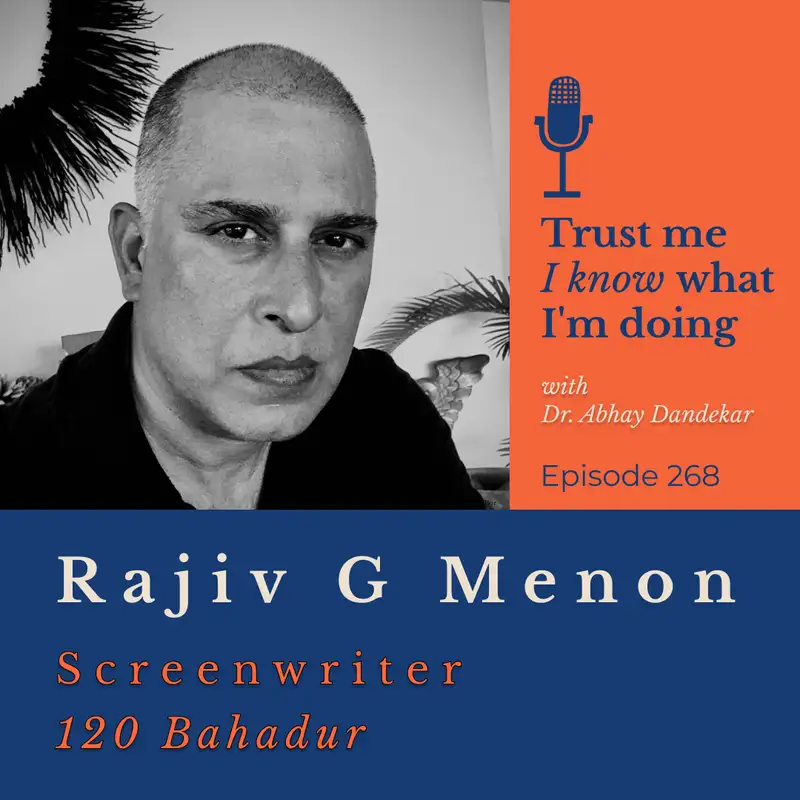
Rajiv G Menon ... on 120 Bahadur and the journey of a screenwriter
Download MP3Abhay (00:00.111)
Hey friends, this is Abhay Dandekar. Before we get started, don't forget to subscribe to Trust Me, I Know What I'm Doing on YouTube, Amazon, Spotify, Apple, or wherever you listen or watch. That way you never miss our show celebrating the vibrant Indian and South Asian global experience. Thanks. Hi, I'm Rajiv Jumennan. I'm an author and screenwriter. I've written a movie, which is right now in the theater. called Ekstav Bish Bahadur. And this is Trust Me, I Know What I'm Doing.
My name is Abhay Dandekar and I share conversations with talented and interesting individuals linked to the global Indian and South Asian community. It's informal and informative, adding insights to our evolving cultural expressions, where each person can proudly say, trust me, I know what I'm doing.
Hi everyone, on this episode of Trust Me I Know What I'm Doing, a conversation with author and screenwriter, Rajiv G. Menon. Stay tuned.
Abhay (01:10.819)
You know, we live in an age where everyone wants to build on the origin story and the kind of endless kernels of exploration that pique our curiosities about history and their applications to both today and tomorrow. But for my next guest, author and screenwriter, Rajiv G. Menon, this is something that he's just simply super familiar with and has had success now in writing that ranges from mythology and fiction.
to Hindi filmmaking. His latest work includes the screenplay for the film, 120 Bahadur, which recently released in theaters in India and is a fabulous and important story to talk about. And so we're so grateful that he is able to join us on Trust Me, I Know What I'm Doing. Rajiv, thanks so much for joining us this morning. Well, thank you for that really, really kind introduction. Yeah, I'm really looking forward to doing this.
You know, I'm so curious from your perspective, just like musicians perhaps listen differently to music and athletes observe their games and their sports a little bit differently when they're not playing. I'm curious if you watch movies differently as a screenwriter. You know, it happens now very often because of the fact that you're writing that I rarely get time to really
sit down and enjoy watching a movie, really have to cut off because it becomes like work, know, and you end up watching a lot, especially with the kind of stuff I write about. I end up watching a lot of documentaries, listening to a lot of historians now on podcasts. And so when I actually sit down to watching a movie, I have to really, really be able to shut myself off completely. Otherwise, I'm quite consumed when I'm working.
So, you know, there's always something going on at the back of the mind. So it's difficult to sometimes watch a film objectively. So what I like to do is I like to go to the theaters on the weekend. And that's where like you're a captive audience and then you've got your, you've got it's you and the movies. Yeah. But at home and I can see why even for normal people, it's getting difficult to be able to really zone in and watch a movie. Yeah. Well, I mean, at least going to the theater allows you to be a fan.
Abhay (03:34.638)
and you could really watch it from a very kind of naked perspective. Whereas I imagine that as a screenwriter, especially when you're watching something or you're learning something that you're constantly dissecting and, you know, kind of thinking all the time, as opposed to just letting the experience come to you. Yeah. See, like I've got a list of films sometimes that I end up watching over and over again. So, you know, if I feel blocked or if I feel this thing, there are some go-to films I really like to watch.
So I end up doing that a lot. And then I gather enough research material to like, if I'm working on something that these are the kind of films I need to watch. So everything becomes like kind of work associated as opposed to like recreational. Right, which at the end of the day, right? Like, I mean, most of this is about entertainment and time and like, know, passive learning. But sometimes you're right that it's hard to separate the two.
Does each of these films that you have on your list, is it a sort of connect the dots experience where everything that you're watching is kind of additive and it's iterative, it's building so that your next project can get informed better? Yeah, it's also sometimes just the craft, know, like just figuring out how great stories are told. And there is no right way or wrong way to tell a story.
I've realized with films, it's getting more and more difficult to engage a modern audience, which is used to Instagram reels, which is, you know, like a slow setup becomes hard for them to follow or pay attention. Still when an audience goes into a theater, you have them, you have them for that one and a half, two or maybe two and a half hours, they're there. Okay, you have an interval, but after that, they come back in. But generally they are in there for the long haul.
which is getting very difficult when when an audience are watching our devices and streaming platforms. It's this reason and this need to engage them constantly is even altering our style of storytelling. I feel like everybody wants everything upfront. There's no movie wants to sit down, breathe and wait for events to happen. It's funny you mentioned that, like, I mean, the idea of sitting and waiting and being patient.
Abhay (06:00.59)
It's almost that the piece that is longer than a minute all of a sudden becomes an epic. that evolution has happened maybe over the last 10 to 15 years. I want to ask you about the particular story of Ixobis Bahadur. And I'm wondering if you can tell us a little bit about how that screenplay concept
came about in sharing the battle of Rezang La and that story, especially with Major Shaitan Singh as the protagonist, was there a spark that perhaps ignited this? there some, again, connect the dots that happened from understanding more about the story and then bringing that to life? Yes, I was very fortunate actually to come across the story because the director, Razi,
Razneesh Ghai, he had the story. mean, his brother was from the same regiment. He's a serving general in the army now. So, you know, he had the story, which he was really, really keen to tell. And I consider myself fortunate that I was there in the right place at the right time, you know, to be able to help him tell it because he had tried to get it written elsewhere and he wasn't very happy with the thing. And what I loved was there was a survival story, like a 20 minute interview with one of the survivors.
which I thought for me was perfect. I mean, that's all the material you needed. After that, when you try to put, especially with screenwriting, you have to be careful that there is the truth and there is the story, how it needs to be told on screen, the truth sometimes isn't always as interesting and you need to make it cinematic.
So the thing was that the challenge was that at the same time to keep it real, to keep it, there were families of survivors to make sure that they were not in any way offended or felt shortchanged about how we treated the story. But it was a story that told itself. when I came across it, I said, man, you just have to make sure that you just tell it decently, because it's a great story as it is.
Abhay (08:21.005)
Yeah, no. And in listening to this, and you mentioned that Razy had this story and it was kind of the soil and the ingredients were there, but perhaps it didn't actually have the breath that brought it to life. You know, what was it that you brought perhaps to that, that, you know, made that story whole or made it more complete and allowed you now to take concept and a historical piece, but, know, again, put some life into it and
create some architecture around it so that it's something that viewers could enjoy without losing the sanctity of it or the importance of it, especially to survivors, their families, and being respectful of the story itself. So when I came across the Survivor account, I was still trying to figure out how I want to tell the story. And I grew up reading a lot of the classics.
So one of my favorite stories was Moby Dick. And that's a story which is again a survivor's tale, you know? And I love the way it starts off, I am Ishmael and you know, this young rookie, wailing boy going in to join a group of wailers. So yeah, so that was the kind of format I decided to follow in the beginning. then, yeah. I think the narrative style was what was my first contribution to the.
to the story, how it was gonna unfold. You know, is there a, for historical pieces, and again, making sure that you both respect the story itself and the actual humans that that have played a role in that story, with also the balance of captivating audiences and making it somewhat entertaining, especially in a movie format.
But is there almost an anatomy of how to do that? I mean, you mentioned bringing the narrative voice in the very beginning. Are there components that you have to pay attention to in especially a story like this? Yeah, so the first thing as a screenwriter you have to understand is you are the cog in the wheel that sets that whole thing up, you you give the director as much information as he needs to actually pick the right cast. Right. And one of the things about this movie was
Abhay (10:43.512)
Razy was very clear that we were going to be actually shooting on actual location, which was also great, you know. So the pacing of the thing could be done according to that. Ladakh is a huge expanse, big skies. the story, you have to give the story a little time to breathe, like take in everything, you know, like, so it was nice to say it from this point of view, this rookie radio operator was seeing all this for the first time. Because I spent a lot of time tracking in the Himalayas and for me every time
you go there, the first thing you do is takes your breath away, know, just that expands and you realize how small you are. Do you need to have that, almost that cinematic filmmaking vantage point as a mirror in order to write, to make screenwriting effective so that it matches in a way the kind of vision and the voice of the director perhaps?
Yeah, I think screenplay is a craft in itself. I've done both now. I've written screenplays and I've written novels. Novels give a writer more chance to, you know, like, you can be a little more extravagant with your words and with screenplay, it's all about brevity and, know, just like making sure your dialogue has to be really effective. You can't meander too much, especially with today's audience. You've got to make sure, you know, everything is like concise, precise and visually you try and tell as much as you can.
and try to, like, I prefer, like, telling a story visually on cinema as opposed to giving too much dialogue or, you know, too much exposition, which is okay in a novel, you know, even in a television series, long format, it's fine. But for movies, I believe, yeah, gravity and screenplay is a craft that, yeah, you have to practice, you have to get in there and, like, yeah, you have to watch movies. You're listening to Trust Me, I Know What I'm Doing. After a short break,
Let's come back to our conversation with Rajiv G. Menon, whose latest work, 120 Bahadur, is out in theaters now. Stay tuned.
Abhay (12:50.281)
Every story told is a lesson learned and every lesson learned is a story waiting to be told. I'm Abhay Dandekar and I share conversations with global Indians and South Asians so everyone can say, me, I know what I'm doing. New episodes weekly wherever you listen to your podcasts.
Abhay (13:12.629)
Hi, I'm Krish Shashok, author of Masala Lab, the science of Indian cooking and you're listening to Trust Me, I Know What I'm Doing.
Abhay (13:26.517)
Hi, this is Farhan Akshar. Hi guys, I'm Ananya Pandey. Hi, I'm Kani Kusrudhi. Hi, this is Vidya Balan. Hi, this is Madhuri Dixit and you're listening to Trust Me, I Know What I'm Doing with Abhay Dandekar.
Abhay (13:46.719)
Welcome back to Trust Me, I Know What I'm Doing. Let's rejoin our conversation now with Rajiv G. Menon.
Abhay (13:55.53)
Why was this story so important to tell now? See, I think it's a story that's timeless. The now only happened because I think as an audience, people are looking for, know, our history has been quite contorted and we had a colonial past and a lot of the history was controlled by the British. A lot of the history that came to us to our schools and our teaching was from that place. So a lot of things were left behind. And this is modern history.
And I've been a student of history for a while, but even I didn't know about this story, you know, because it was too modern. I studied military history. You've studied like kings and conquerors across timelines. But this story, even I didn't know about because the 62 war was not really spoken about, you know. It's not discussed as much as the India Pakistan conflict is, for example.
So there's always, yeah, this happened, we lost and that's it. There was nothing. So for me, this story and sometimes the best stories are when the best battles are sometimes fought for a losing cause. There's also a very strong this thing of the futility of war, which appears in these kinds of stories and which I think is also important. Because today you find everybody sitting behind keyboards that say, yeah, we should go to war, we should do this.
cost is something everybody considers. When we don't really celebrate this idea of futility, right? Like, it's not necessarily one that we concentrate on as to like, what is it that we're actually gaining out of this? We certainly see valor and courage and bravery and all those are celebrated, but the expense and futility and wonder that we have about that is not always something we think about. When you were thinking about this and researching and
and finding more about character development and learning about the historical maybe texture of this. As you were unearthing some of those findings, were there surprises or even aha moments that you had that you felt, wow, this is something that I never knew about before. It's so powerful and therefore became anchors in the script? The aha moments were actually
Abhay (16:16.007)
some of them had to be constructed because a lot of it was, you know, we had a survivor account, but the battle took place across three different phases because the ridgeline that these guys were defending was three kilometers. So you had placement of troops across three, four places. So a lot of the moments had to be created. One survivor, probably as a radio operator, Mr. Ramchandra Yadav was most qualified to be able to tell you the story. And he survived. maybe we got a large chunk of
the story from him. But still a lot of the moments had to be constructed. You had to kind of figure out putting these people there, the kind of weapons and ordinance they had, the skill sets they had, and then you work out and create those moments. Yeah, which is a skill unto itself and being able to craft that in such a way that is compelling, certainly that's where the art and the skill come together. I'm wondering, is there a blueprint or a secret
that makes historical period stories come alive. And as you mentioned, they have to, in a way, resonate for modern audiences. Are there some ingredients that are essential or sort of constructs here that are very critical to make sure that, again, audiences that are more and more used to short form storytelling are now going to be compelled to link all those dots together and make a full, more complete story out of this.
Yeah, see, if you follow the history of historical period pieces in cinema, you had some really good ones and you had some really ordinary ones. Some of them kind of get stuck in this whole repetition. And also, think one of the things people keep talking about now, you the first half is very slow and the second half is great. But in a story, the first half of it's slow is probably the reason why the second half becomes great because you set up the story a lot.
along the way. Yeah. So, yeah, so I think there are great, great historical, there's literature, there's as well as cinema, you know, that depicts historical period events very, very well. So, yeah, that's a good place to start. Like for me, for me, the Mahabharata and Ramayana, although my problem is we've never gone beyond that because our mythology is far, far more richer than that. But those are great pieces, you know, which have everything.
Abhay (18:43.09)
I wanted to ask you about that. In writing Vedic mythology books like Raksasas and Thunder God, how did those experiences maybe accelerate your work as a screenwriter, maybe add to that work as a screenwriter? As you said, being able to take historical pieces and make them come alive for a modern audience. I think just compiling those two books, took
took many years, but I think it just gave me a kind of confidence and the other thing is every day when you sit and write, that's the only way you your craft. So I think it made me a competent actor just because I managed to achieve that, you know, and I learned a lot of things. First of all, I learned this whole concept of India that we have is a very British concept. It's not even 70 years old. Somebody drew a line and said, this is India. But if you look at during the Vedic period,
Indian influence was all the way up to Antalya and Turkey, you know. Because the Mitanni Aryans, were worshipping these Vedic gods. And all across Iran and this thing, in Iran, some of our Vedic gods were demons. And their gods were our asuras, you know. So, see that influence everywhere. Like in my book, I talk about Susa, which is a city in ancient Iran. And if you study the...
DNA and the distinct patterns of the people there. There were people of Dravidian influence who ruled that place. you know, from the south of India, it went everywhere. And I think for me, the main thing was that this trans-Juvans, what they call pastoral nomadic cultures that have appeared throughout, they came and started conquering. And there is this thing about the Aryan invasion theory, which colonial history tells us these guys came on horseback, they conquered us and they taught us everything.
But that's not what really happened. you look at it, yes, they came on horseback. They managed to conquer us because they were in a warlike culture. But the point was they learned a lot here. They came here, there were cities there. There were cities with water supply, plumbing, technology these guys had never seen because they were adapted technology built for war. They had horses, had bows and arrows which were designed for cavalry. They had like those kind of advantages and they were very strong against a sedentary farming population.
Abhay (21:00.841)
So, but it was not like, you know, they came and taught us everything. And so my book deals with a lot of that, you know, how the Vedic culture began. And my second book is about Ravan's great-great-grandfather and how the Rakshasas, the race started. Yeah. And when you think about both of those, right, whether it's the story of Indra or it's the story of Ravana's grandfather, in constructing those pieces,
Were you able to then harness some of that success in bringing those stories to life now with bringing a historical period piece alive? I'm having a problem with the scale because it's quite a voluminous work. right now in India, on the streaming platforms, the kind of budgets you need to recreate this is a challenge.
I am trying, I've created a deck for it and everything. And I'm hoping with the advent of technology now with AI and VFX coming in, know, things can be, these things will be achievable. But right now, the current scenario, I think I still have to wait to really achieve its true potential to actually translate that visually into a streaming platform or into theater.
You know, this for 120 Bahadur, this was your second film, I believe you made with Razy. And, you know, getting that kind of muscle memory together, right? The second time around, does the processing, the manipulation of the work, the growth, you know, the onset editing perhaps, does it get easier with the same team? Or is there actually some value and power to working with?
new teams who have different perspectives and who you've never worked with before. Now, tell me a little bit about the perhaps contrast of that. Yeah, I've worked with other filmmakers before as well. With Razy, yes, there is a comfort level in terms of we are both very conscious of our strengths and weaknesses, I think, from working together on two films where I can add value and he knows where he can add value. there is a synergy.
Abhay (23:17.661)
which you can achieve with other people, but it's just that you need to spend that time working with them together. Cinema is a very, very collective process. I know it's a cliche, but you know, it has to be drummed in that no, even for budding writers, that you can't write a screenplay and just put it out there. You might write the greatest screenplay in the world, but it has no value unless it's translates onto a screen. Yeah, it's huge team effort. For a director, especially the kind of work load that is not only, you have to manage talent.
You've got the cinematographers, editors, you've got music, you've got everything. All these different art forms and they're all artists and you have to make sure they all work together like a symphony. So it is nice as a writer to have that synergy and have that distinct with the director where he knows what your strengths are and you know what his strengths are and also be conscious of each other's weaknesses and have clarity and clear communication. think communication is also very, very important. When you think about
someone who has to orchestrate all of these and really work with so many different types of artists and all of the different aspects of that team that go into this, whether that's cast, whether that's talent, whether that's all the cinematographers and the various editing. In thinking about that entire orchestration as a screenwriter, for you, is there an element of filmmaking that you feel also that you've been privy to and learning?
that much more simply because you get to see all of this in action? Yeah, I started my career as an actor. So, you know, like I did a few films down south. My first film was a Malayalam Tamil bilingual. My second film was Tamil film. And I also as an actor, those days you plenty of time on your hands to hang around on the set. were no like vanity vans or, you know, like places where an actor was secluded. So you kind of hung out on the set and you learned.
Right. for me, yeah. And I was always fascinated by the process of filmmaking. The acting was interesting enough, but for me, because it was very new and I kind of got thrown into the deep end. So I was, I was very, I hadn't, knew nothing about how a movie was made till I was actually on set. So, so I was absolutely fascinated by the craft and what a director does, what a DOP does, you know? So yeah, so it did help for me.
Abhay (25:43.778)
when I became a screenwriter. And since then, especially when you now work with actors, when you work with cinematographers, how much of your role as a screenwriter is something that if they have some empathy for, it makes the process go that much better? And then vice versa, right? Like, you know what it's like to be an actor. You know what it's like to be a writer. Does it help when people have an understanding of what each other's roles are?
in order for the product to then be very synchronously and synergistically made? Yeah, see, my interaction with actors is minimal only when the director requires it. He requires me to sit during a reading, you know, if I can contribute something. That's completely the director's call. But I love actors because of the fact I've been one. So I always make sure that, you know, even if it's a small part, I make sure the actor has a reason to be there. Otherwise, you don't need it. A lot of times you find
Actors lost in like I've done a lot of character roles in movies as well. Sometimes you're there and you're just part of the furniture sometimes. You're just there to fill in the thing. And that's something I'm very conscious of when I write in parts for actors. Even if it's three scenes, make sure he adds value and I hope that I can get a good enough actor to play those, to play that part. I mean, value and engagement, right? Those are the two key words. You're listening to Trust Me, I know what I'm doing.
After a quick break, let's come back to our conversation with Rajiv G. Menon. Stay tuned.
Abhay (27:22.417)
Conversation, it's the antidote to apathy and the catalyst for relationships. I'm Abhay Dandekar and I share conversations with global Indians and South Asians so everyone can say, trust me, I know what I'm doing. New episodes weekly wherever you listen to your podcasts.
Abhay (27:41.831)
you
Hi, I'm Vivek Murthy. I'm the 21st Surgeon General of the United States, and you're listening to Trust Me, I Know What I'm Doing.
Abhay (28:01.864)
Hi guys, I'm Indra Nooyi. Hello everyone, my name is Tim France. Hi everyone, this is Shafiq Khaskhan. Hi guys, this is Amit Tandon. Hi, my name is Richa Morjani and you're listening to Trust Me, I Know What I'm Doing with Abhay Dandekar. Hi there, I'm Abhay Dandekar and you're listening to Trust Me, I Know What I'm Doing. Let's rejoin our conversation now with Rajiv G. Menon. You know, you and I met at
the screening and premiere of XOBISBAHADUR. And coincidentally, we were in line to get some popcorn. And yet that experience that you talk about, right? That, you know, going to a theater, having your full attention, being present to watch a film and watch it from, you know, beginning to end and have that exact like sort of movie going and theater experience. That's actually becoming more and more rare of an experience for most.
audiences it's that that experience is becoming fossilized and it's evolving so much. So how much of that shift is one that we, just have to pay attention to, but particularly as a writer, do you find that as you mentioned earlier, right? Writing is just different for films versus television versus OTT. and yet the stories are, are all still ones that people have a hunger for.
So how does your writing evolve in an era where movie going in the theater is just not the same as it used to be? I guess you've got to read the room and figure out what's working, what's not. I live in Goa, so going to a theater is like, it's about 20 kilometers away by the nearest movie street, but I still do go and watch a movie.
whenever I can, you know, so to just sometimes soak in that experience because that experience cannot be recreated. What you see in a theater where people are watching and they're moved by a story, that's an amazing experience. And I'm so glad with Ake Sobhavith Badur because I think the cast, the crew, the producers, the director, they've done a wonderful job in creating a good film. And it's sometimes nice as a writer to just go there and like be a voyeur and just see the sample.
Abhay (30:23.304)
And I'd wash everything and fold around.
Do you think OTT and streaming are stripping that away or is it complementary to that movie experience? See, cinema's always had these, you know, it happened with the VCRs and the DVDs. And so we've always had this challenge, you know, like, and I think the OTT is just presents a fresh challenge and they need to figure out a way to make it happen.
I was very disappointed when I saw Guillermo del Toro's Frankenstein. I watched it on Netflix and I said, man, this is a movie for the theater. But unfortunately, Netflix produced it and then they just released it on few screens just to get an Oscar accreditation. And then it was on the streaming platform. And I felt that so many were deprived, including myself, are deprived of a theatrical experience for that kind of movie. Now, this is something that we need to, you know, doesn't...
hold well for the future because some of the need to work on like how to make sure that the audience still are able to have great movies and watch them in theater because the medium, the cinema is actually created for a theatrical experience. Everyone said when the VCR came in that cinema was dying and you know, when the DVDs and the LDs came in, cinema was dying. But yeah, they kind of survive and move on, know, adapt and.
Adapt and survive, guess that's the way it is. How do you hope that the cinema and the movie theater experience will adapt and survive? mean, do you think that there are solutions that are around the corner? We haven't found them yet? Or what's your take on what the solution might be? I think people need to get together, the so-called great minds who are controlling the various unions and everything, the artist union, the
Abhay (32:23.088)
the union, the director, everyone needs to collectively get together and figure out how to make this work. The other people, the streaming platforms, they need to sit down together. And I guess if I figure out a way, you know, how to, I think the main thing is you need to figure out, you need to separate the theatrical, some cinema is meant for theater, know, and some maybe you can directly, I think that needs to be worked out.
Yeah. I wonder if the solution, if the streaming platforms and the power that it holds right now, if anything, maybe the solution might come from those leaders, right? And who might be able to actually, you know, create more solutions, as you said, to separate out what the theatrical experience really should be and could be as opposed to the streaming experience. I got two more things that I wanted to just touch on. You know, one of them is
Kind of a think out loud, but hypothetical question. But, you know, I'm curious about who some of your writing heroes are. If you had to, if you could choose one writer, living or dead, to have a private conversation with, who would it be? I think it would have to be, there are many, but I would say Ernst Hemingway, because I kind of love the way he led his life and how he actually put himself out there.
with bombs going off in the war zone sitting and writing and you know, like, I find his life fascinating because, know, most writers, including mine is sitting in front of a laptop and you know, punching away at the keys, but this guy made his life, his life was interesting. yeah, maybe having him there would be my pick here. There you go. And then the other question that I had that I ask a lot to people, but I think in hearing your stories about
making this particular movie and then also some of the work that you've done before and thinking a little bit about the experiences of going to a movie theater versus watching something online and streaming. But for yourself, what if you had to maybe unlearn about yourself to be a successful writer? think patience and the ability to listen is something that I'm very conscious of and I have to be conscious.
Abhay (34:47.782)
And observation, observations, patience, and like the ability to listen, I think which you have in space. So that's a good place to start. Yeah. It's something I'm always working on, think. Yeah, for me as well. That's what I'm constantly thinking about. And I love just sitting in a room and observing people because it's fascinating sometimes. But nobody, everyone's so busy trying to pitch in and you know.
But sometimes when you just sit down and observe, you realize how interesting people are and how diverse. You see the little differences and that's where I guess interesting characters and stories come about. That's true. And is that something that you've had to really work on and practice? Yeah, I'm still working on it actually. It's still a work in progress. Yeah. Well, you know, one final thought and that is, you know, for those people who are viewing Ixobis Bahadur,
or maybe picking up one of your books for the first time, perhaps even getting to know you through your work for the first time. How do you hope they feel after watching one of the movies you've written or one of the books you've written? Oh, that's an interesting question. I've never thought about it, actually. But I just hope that they walk away a little more informed and maybe a little more sensitive to the world from the foward.
before they left her, before they went into the gopro, into the movie. Wow, well that says a lot and particularly coming away more informed and certainly more sensitive to the world around us is something that we can all work on together. Rajiv, what a pleasant conversation this was and really so thoughtful and I appreciate you coming on. I hope we can do this again in the future.
Thank you so much for joining Thank you so much. This is my first broadcast and I really, really enjoyed it. Thank you. Thanks again, Rajiv. 120 Bahadur is showing in theaters everywhere, so please check it out. A big shout out, as always, to my friends at American South Asian Network, to Indian Army veterans and their families across the globe, and to any colleagues in India who are trying to find a way to combat climate change at all levels. Till next time, I'm Abhay Dandekar.